.avif)

Introduction
Ask ten people what's the difference between a green card and a visa and you'll get a lot of confident, partly wrong answers. The most common one is that a green card is "a permanent visa." It isn't, and the distinction matters more than it sounds like it should.
The short version: a visa is a travel document. A green card is proof of a status. Different agencies issue them, they do different jobs, and one of them can expire while you're still perfectly legal.
Here's how each one actually works, how people move from a visa to a green card, and what changes in daily life once they do.
This is general information, not legal advice. Immigration rules change and individual cases vary, so check with a licensed immigration attorney before acting on anything here.
TL;DR
- A visa is issued by the U.S. Department of State at a consulate abroad. It lets you travel to a port of entry and ask to be admitted. It does not guarantee entry.
- A green card (officially Form I-551) is issued by USCIS. It's evidence that you're a lawful permanent resident, with the right to live and work in the U.S. indefinitely.
- Your visa's expiration date is the last day you can travel to the U.S. on it, not the last day you can stay. Your I-94 admission record controls how long you can remain.
- Most green cards are valid for 10 years, some conditional ones for two. The card expiring is not the same as your status ending.
- Millions of people hold both in sequence: a temporary visa first, then permanent residence through employment, family, or another qualifying route.
The short answer
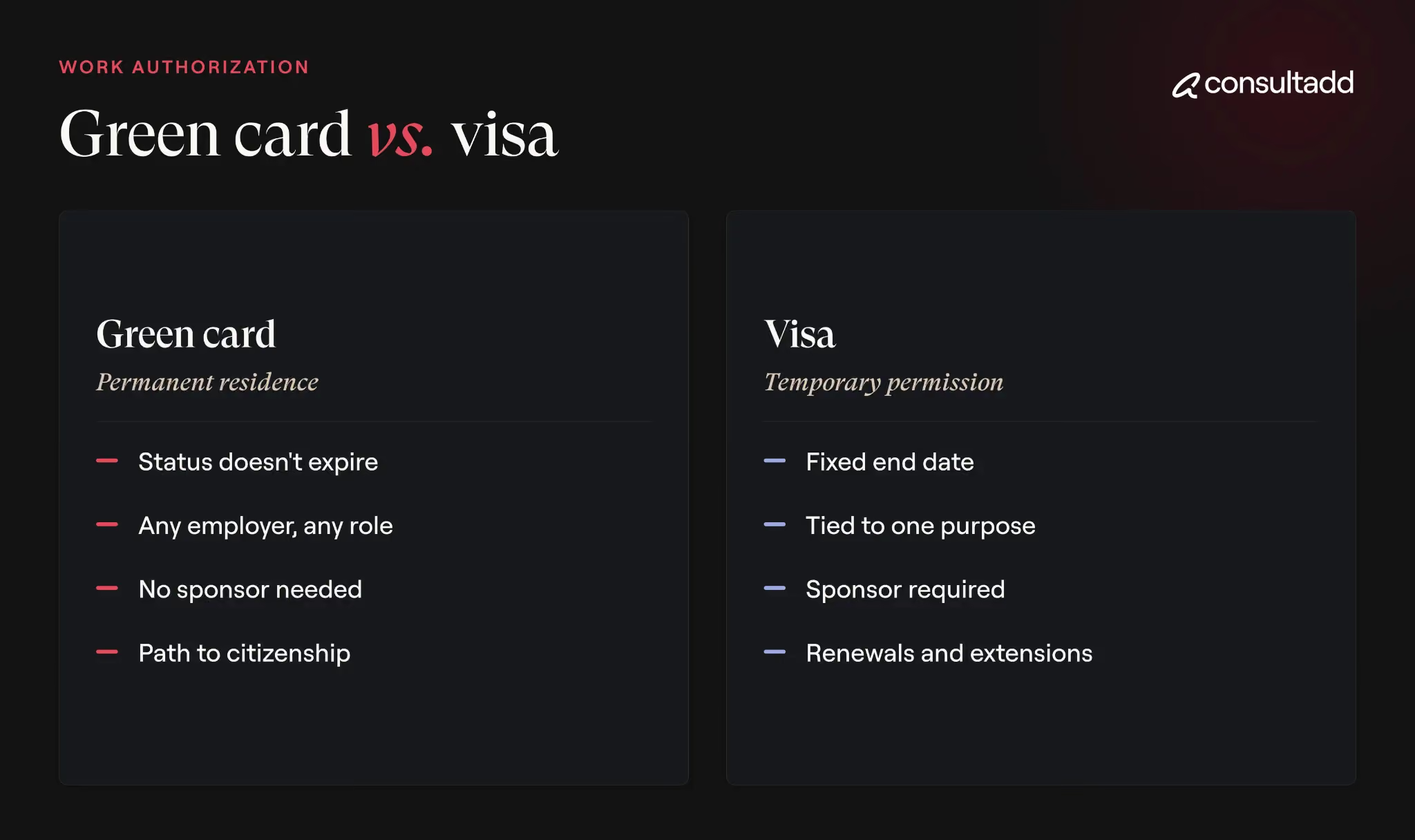
Everything below is detail on those rows:
What a visa actually is
A visa is permission to show up and ask.
- That's the part people miss. According to the U.S. Department of State, a visa allows a foreign citizen to travel to a U.S. port of entry and request permission to enter. It does not guarantee entry.
- Customs and Border Protection officers at the port of entry have the authority to permit or deny admission, and if you're admitted, the CBP official provides an admission stamp or a paper Form I-94.
- So a visa is closer to a boarding pass than a residency permit. It gets you to the door. Someone else decides whether the door opens.
Nonimmigrant visas vs. immigrant visas
There are two broad families, and mixing them up causes half the confusion around this topic.
Nonimmigrant visas are for temporary stays with a defined purpose: tourism, business, study, specialty work. B-1/B-2 visitors, F-1 students, H-1B specialty workers, L-1 intracompany transferees, O-1 extraordinary ability.
Each category has its own rules about how long you can stay, whether you can work, and who you can work for.
Immigrant visas are for people who have been approved for permanent residence but are still outside the United States.
This is the one that trips people up, because an immigrant visa is a step toward a green card, not a substitute for one. You use it to enter. Once a CBP officer endorses it at the port of entry, you become a lawful permanent resident, and the physical card arrives by mail afterward.
Two documents, one process, in sequence.
Your visa expiration date is not your deadline
This is the single most misunderstood detail in U.S. immigration, and it's worth stating plainly.
The State Department is explicit: the visa expiration date doesn't reflect how long you're authorized to stay. Entry and length of authorized stay are determined by the CBP officer at the port of entry each time you travel.
In practice that means your visa can expire while you're legally in the country, and you'd still be in status. It also means the reverse: a valid visa in your passport doesn't help if your admitted-until date has passed. The visa governs travel. The I-94 governs stay.
If you leave and want to come back, though, you'll need a valid visa again.
What a green card actually is
A green card is the physical evidence that you hold lawful permanent resident status.
- USCIS issues it, and the official name is Form I-551, Permanent Resident Card.
- Permanent residence is a status, not a document. The card proves it. That distinction sounds pedantic until the card expires, at which point it becomes the whole story.
- As a permanent resident you can live anywhere in the U.S., work for any employer or no employer, change jobs without filing anything, start a business, and travel in and out of the country using the card itself.
- You're not tied to a sponsor, a job title, or a renewal cycle tied to someone else's decisions.
Conditional cards and 10-year cards
Most green cards are valid for 10 years. Some people receive a conditional card valid for two, most commonly through a recent marriage or an EB-5 investment.
Conditional residents file a separate petition to remove the conditions before that two-year card expires, using Form I-751 for marriage-based cases or Form I-829 for investor cases.
Form I-90 is for renewing or replacing a standard card. It is not the form for removing conditions. People mix these up constantly, and filing the wrong one costs months.
The card can expire without your status ending
An expired green card does not mean expired residence. It means you're a permanent resident without current proof, which is a practical problem rather than a legal one, and it shows up fast at a job or an airport.
USCIS handles this through the renewal receipt. Per USCIS guidance on replacing a green card, the Form I-90 receipt notice presented together with your expired card serves as evidence of lawful permanent resident status for 36 months from the card's expiration date. That extension went from 24 months to 36 months in September 2024.
Long absences are a different matter. Extended trips abroad can raise questions about whether you've abandoned residence, which is why people planning long stays outside the U.S. file for a reentry permit before leaving.
Green card vs visa, in practice
The table near the top covers the mechanics. Here's what actually changes in someone's life.
How people move from a visa to a green card
There are two mechanical routes, and which one applies depends on where you are when your case is approved.
Adjustment of status happens inside the United States. You file Form I-485 while holding a valid status, and if it's approved, the green card is the first status document you receive. No consulate, no immigrant visa.
Consular processing happens abroad. You're approved, a U.S. consulate issues an immigrant visa, you travel, a CBP officer admits you, and the card follows in the mail.
Timelines vary widely by category and country of birth. Some employment-based cases move in a couple of years. Others take much longer because of per-country limits.
If you're working through the earlier stages of this, Consultadd's guides on what work authorization actually means and H-1B vs. OPT differences cover the temporary side of the journey in more detail.
What changes day to day
People tend to expect the shift from visa to green card to feel dramatic. Mostly it feels like the absence of friction.
You stop planning your career around a petition calendar. You stop asking whether a job change is worth the filing risk. You stop refreshing a case status page. A layoff becomes a career problem instead of an immigration emergency.
What doesn't change: you still file U.S. taxes, you still carry documentation, and you still have obligations. Permanent residence is durable, not unconditional. Serious criminal convictions and prolonged abandonment of residence are both routes to losing it.
What this means if you're hiring
Employers don't need to adjudicate immigration status. They need to verify work authorization correctly and avoid discriminating in the process.
Every U.S. employer completes Form I-9 for every new hire, citizen or not. The employee completes Section 1 no later than their first day of work, and the employer completes Section 2 within three business days of the hire date.
The form is retained for three years after the hire date or one year after employment ends, whichever is later.
One rule worth internalizing: employees choose which acceptable documents to present. Employers don't get to request a specific document, and asking a permanent resident for their green card specifically when they've offered other valid documents can create a discrimination problem.
For staffing firms placing visa-dependent talent, this is where engagements go sideways:
- A candidate who looks available in March may not be able to start until June.
- Verifying status before the client interview rather than after the offer saves everyone weeks.
Consultadd's guide to H-1B sponsorship for tech professionals covers the sponsorship side, and the IT staffing process walkthrough shows where compliance checks belong in a hiring sequence.
Start Strong With Consultadd
With 15 years in business and 5,000+ successful staffing engagements, we don't just fill roles, we build reliability into your process. We've supported 65 staffing companies in the past year alone and maintain MSAs with industry leaders like Robert Half and TEKsystems.
Here's what working with Consultadd looks like:
- Talent sourced in under 24 hours
- Ready-to-deploy candidates, vetted for experience and compliance
- Lower turnover risk: we match long-term goals, not just short-term needs
- Seamless compliance: visa, documentation, onboarding? Handled.
- Dedicated 1:1 account managers for responsive, personalized support
- Top 100 candidate matches delivered in the past year
- Strong partnerships with universities to tap into fresh, committed talent
- Post-placement support so your investment grows beyond day one
For candidates, your next opportunity is more than just a job title, it's a chance to build skills, gain experience, and move your career forward. At Consultadd, we connect technology professionals with projects and employers that align with their goals, whether they're looking for contract, contract-to-hire, or long-term opportunities.
The tech job market moves fast, but the right guidance can make all the difference. Ready to take the next step in your career journey? Explore Opportunities >>
Key takeaways
- A visa is a travel document from the State Department that lets you request admission. A green card is USCIS evidence that you already hold permanent resident status.
- A visa doesn't guarantee entry, and its expiration date governs travel, not how long you can stay. The I-94 does that.
- Most green cards run 10 years, conditional ones two, and an expired card doesn't end your status.
- Moving from a visa to a green card happens either through adjustment of status inside the U.S. or consular processing abroad.
- Employers verify work authorization through Form I-9 and must let employees choose which acceptable documents to present.
FAQs
Is a green card a type of visa?
No. They're issued by different agencies and do different jobs. A visa comes from the State Department and permits travel to a port of entry. A green card comes from USCIS and documents lawful permanent resident status. Some people hold an immigrant visa first and receive the green card after entering.
Can you work in the U.S. with a visa?
Only if your visa category allows it. Tourist visas don't permit employment. Work categories like H-1B and L-1 do, but usually only for the sponsoring employer. A green card removes that restriction entirely.
What happens if my green card expires?
Your permanent resident status continues. You'll need to file Form I-90 to renew the card. USCIS states that the I-90 receipt notice, presented with your expired card, serves as evidence of your status for 36 months from the card's expiration date.
How long does it take to get a green card from a work visa?
It depends heavily on category and country of birth. Some employment-based cases complete in a couple of years. Others take significantly longer because of annual per-country limits. Family-based cases vary the same way.
Can a green card be taken away?
Yes, though it's uncommon. The main routes are serious criminal convictions and abandonment of residence through extended time abroad. Permanent residents planning long absences typically apply for a reentry permit beforehand.
Do green card holders have to become citizens?
No. Permanent residence can be maintained indefinitely as long as you keep the card current and don't abandon residence. Naturalization is an option, not a requirement, and it becomes available after a qualifying period of permanent residence.
.png)

.webp)