
.avif)

Introduction
Here is the uncomfortable part. A work for hire contract with an independent contractor who builds software usually does not transfer ownership of that software. The clause is there, both parties signed it, the invoice was paid, and the contractor still owns the copyright.
This is not a drafting technicality. It is how the statute is written, and it catches companies at the worst possible moment: during due diligence, in an acquisition, or when a former contractor's counsel sends a letter about the codebase.
If you engage contract developers, designers, or consultants through any arrangement, the next fifteen minutes are worth it.
This article is general information, not legal advice. Have counsel review your actual agreements.
TL;DR
- A work for hire contract only creates work-for-hire status in two situations. Everything else is a clause without legal effect.
- For independent contractors, the work must fall into one of nine statutory categories listed in 17 U.S.C. Section 101. Software is not one of them.
- Without a separate present assignment clause, the contractor keeps the copyright regardless of payment.
- Work-for-hire status still matters because it cannot be terminated after 35 years the way an assignment can.
- Patents, trademarks, and trade secrets are outside the doctrine entirely and need their own clauses.
What a work for hire contract actually does
Copyright vests in the author the moment a work is fixed in tangible form. The author is normally the person who created it.
Work made for hire is the exception. As the U.S. Copyright Office puts it, when a work is a work made for hire, the author is not the individual who actually created it, and the party that hired the individual is considered both the author and the copyright owner.
That distinction between author and owner does real work later, and most people skip past it. An assignment moves ownership but leaves authorship with the creator. Work-for-hire status moves both.
Under Section 201(b), in the case of a work made for hire the employer or other person for whom the work was prepared is considered the author, and owns all rights in the copyright unless the parties expressly agreed otherwise in a signed writing.
One more thing the Copyright Office is clear about: whether a work is a work made for hire is determined by facts in existence at the time the work is created. You cannot decide afterward.
The two ways a work for hire contract can succeed
The statute gives exactly two pathways. There is no third.
Prong one: employees, and who counts as one
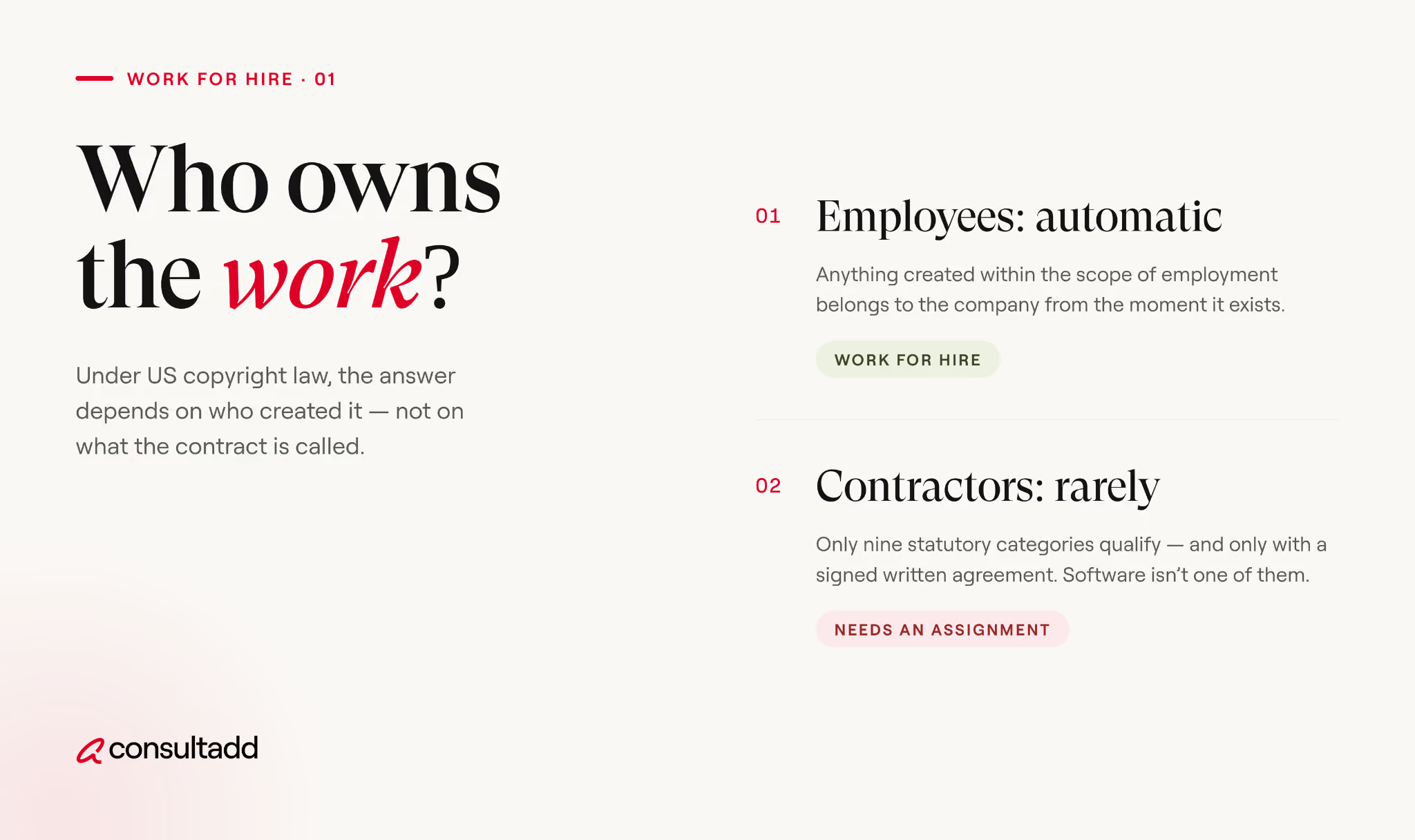
Work prepared by an employee within the scope of employment is a work made for hire automatically. No contract required.
The catch is that the Copyright Act does not define "employee." In Community for Creative Non-Violence v. Reid, 490 U.S. 730 (1989), the Supreme Court held the term carries its common-law agency meaning.
Courts then weigh a list of factors:
The hiring party's right to control how the work is done, the skill required, who supplies the tools and workspace, the duration of the relationship, whether the hiring party can assign additional projects, control over working hours, method of payment, whether the work is part of the hiring party's regular business, whether benefits are provided, and how the worker is treated for tax purposes.
Those last two carry unusual weight in practice. A worker who gets a 1099, no benefits, and sets their own hours is going to be an independent contractor no matter what your agreement calls them.
Prong two: the nine categories
For anyone who is not an employee, a commissioned work qualifies only if the parties expressly agree in a signed written instrument and the work was specially ordered for use as one of these nine things:
- A contribution to a collective work
- A part of a motion picture or other audiovisual work
- A translation
- A supplementary work
- A compilation
- An instructional text
- A test
- Answer material for a test
- An atlas
Read that list again with your actual contractor deliverables in mind.
The written agreement is necessary but not sufficient. The work must independently fit one of the nine categories, and no amount of contract language can put it there.
Why software is the biggest gap in most work for hire contracts
Software is not on the list. Neither are most of the things companies commission.
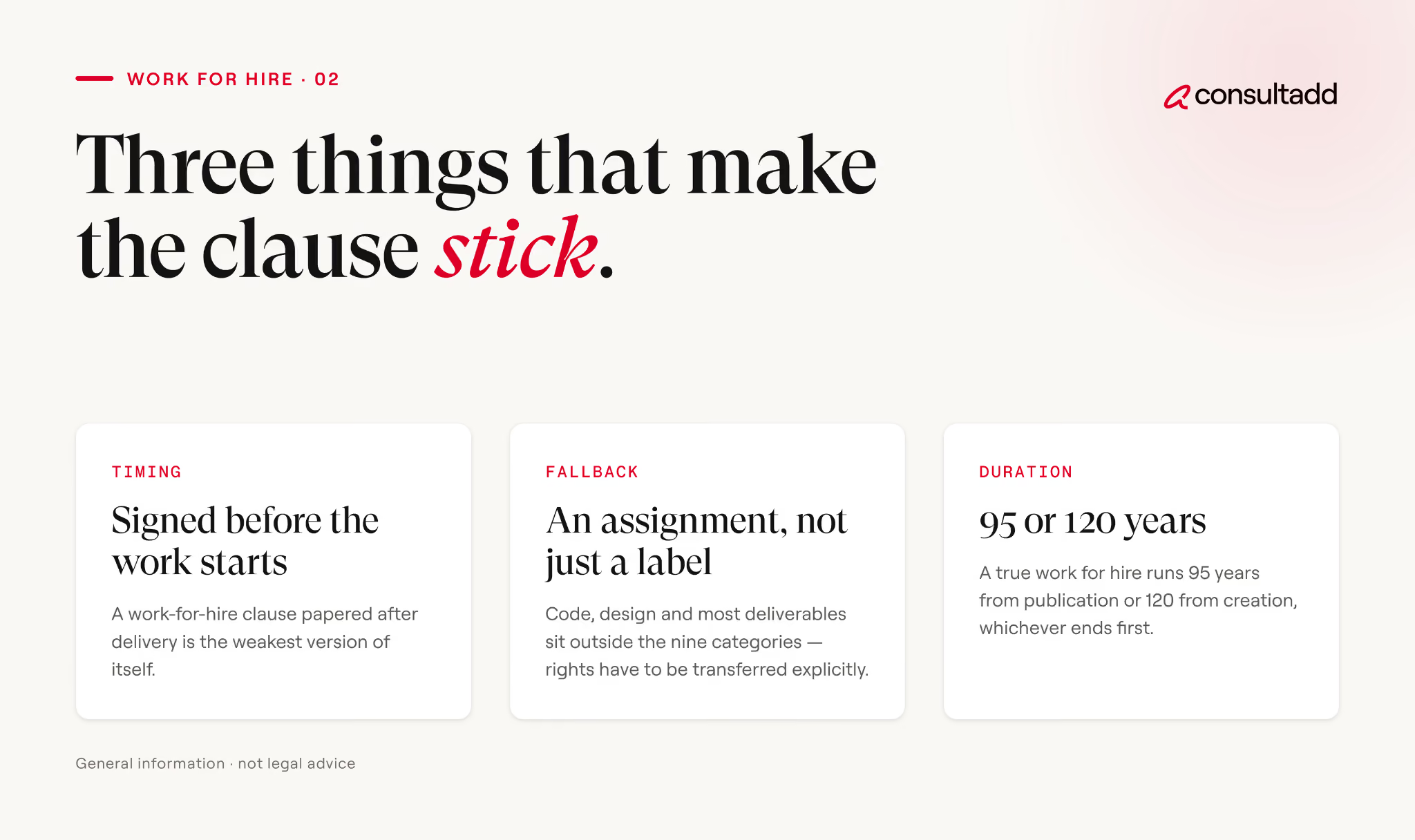
Code developed by an independent contractor under a project agreement does not fit any of the nine categories, which means the contractor retains copyright absent a separate assignment. That is a recurring source of disputes in technology.
Compare that to a salaried in-house developer writing the same code during normal working hours. That is prong one, it is automatic, and no clause is needed.
Same code. Completely different ownership outcome, decided by employment classification rather than by anything in your contract.
The assignment backstop, and why you still want the work for hire label
The fix is not complicated once you see it. You use both.
The standard construction reads something like: all deliverables are works made for hire under 17 U.S.C. Section 101, and to the extent any deliverable is not a work made for hire, Contractor hereby irrevocably assigns all right, title and interest in it to Company.
Note "hereby assigns," present tense. An agreement to assign in the future is a promise that can be breached. A present assignment transfers on execution.
So why keep the work for hire language at all if the assignment does the heavy lifting?
Because the two are not equivalent over time.
That termination right is the reason sophisticated buyers still want work-for-hire designation where it can legitimately apply.
An assignment can be terminated by the author or their heirs decades later. A genuine work made for hire cannot be clawed back.
For most contractor software, you will not get work-for-hire status. You take the assignment and you accept the 35-year exposure, because the alternative is owning nothing at all.
What a complete IP section contains
A work for hire contract that only says "work for hire" is doing about a third of the job. Here is what the full section needs.
The background IP carve-out is the one teams forget. Contractors routinely reuse their own libraries and modules rather than rebuilding from scratch.
If the agreement assigns everything with no carve-out, the contractor has technically assigned tools they use with every other client, which makes the clause commercially unrealistic and sometimes unenforceable in practice.
Handle it explicitly: they keep the library, you get a perpetual license.
Staffing chains and the ownership gap nobody checks
This is where contract IT work gets genuinely messy.
A typical engagement runs through several parties. End client hires a prime staffing firm. The prime subcontracts to a supplier. The supplier engages a consultant, sometimes on corp-to-corp terms through the consultant's own entity.
Now the code gets written. For the client to own it, ownership has to travel the entire chain, and every link needs a valid assignment.
The break usually happens at the last link. The client's MSA has a thorough IP section. The prime-to-supplier agreement has a decent one. The supplier's agreement with the consultant's LLC says "work for hire" and nothing else, which for software transfers nothing.
Worse, the consultant is often an employee of their own corp-to-corp entity. That entity may own the copyright under prong one, and the entity never assigned it to anyone.
Three checks worth running on any contract engagement:
- Does every agreement in the chain contain a present assignment, not just a work for hire label?
- If the consultant operates through an entity, does the entity assign, and is the individual bound too?
- Is the assignment effective on execution rather than conditioned on final payment?
Understanding which engagement model you are actually using matters here, since the ownership chain differs between staff augmentation, contract-to-hire, and direct placement.
Our breakdown of IT staffing models and how each one works covers where the contractual lines sit in each.
When you are evaluating a partner, IP paperwork belongs on the diligence list alongside candidate quality, which our guide to choosing an IT staffing agency touches on.
Traps that quietly void a work for hire contract
1. Signing after work started.
Whether a work is made for hire is determined at the time of creation, and courts have rejected attempts to apply the designation retroactively. Get signatures before the first line of code.
2. The California statutory employee problem.
Under California Labor Code § 3351.5(c) and related unemployment insurance provisions, designating an independent contractor's output as a work made for hire can make that contractor a statutory employee for workers' compensation and unemployment insurance purposes.
A clause meant to protect IP can create a payroll liability. This is one reason some California-facing agreements lead with assignment language rather than work for hire.
3. Assuming it travels internationally.
Work made for hire is a U.S. doctrine. India does not have it. The EU generally does not recognize it either.
A court applying foreign law may treat the designation as meaningless, which matters a great deal if your development team sits offshore. Assignment language plus a governing law clause does more work than a work-for-hire label ever will.
4. Forgetting that patents are separate.
Copyright and patent are different systems. Inventors own patent rights by default, and no work for hire clause changes that. If contractor work could produce anything patentable, you need express patent assignment and a cooperation obligation.
5. Treating the contract as the classification.
Calling someone a contractor does not make them one, and calling them an employee does not either. Courts look at the agency factors. If you control the work closely, supply the equipment, set the hours, and the person looks like staff, misclassification exposure exists independently of your IP clause.
Start Strong With Consultadd
With 15 years in business and 5,000+ successful staffing engagements, we don't just fill roles, we build reliability into your process. We've supported 65 staffing companies in the past year alone and maintain MSAs with industry leaders like Robert Half and TEKsystems.
Here's what working with Consultadd looks like:
- Talent sourced in under 24 hours
- Ready-to-deploy candidates, vetted for experience and compliance
- Lower turnover risk: we match long-term goals, not just short-term needs
- Seamless compliance: visa, documentation, onboarding? Handled.
- Dedicated 1:1 account managers for responsive, personalized support
- Top 100 candidate matches delivered in the past year
- Strong partnerships with universities to tap into fresh, committed talent
- Post-placement support so your investment grows beyond day one
For candidates, your next opportunity is more than just a job title, it's a chance to build skills, gain experience, and move your career forward. At Consultadd, we connect technology professionals with projects and employers that align with their goals, whether they're looking for contract, contract-to-hire, or long-term opportunities.
The tech job market moves fast, but the right guidance can make all the difference. Ready to take the next step in your career journey? Explore Opportunities >>
Key takeaways
- A work for hire contract creates work-for-hire status in only two situations: employee works, and nine narrow categories of commissioned works.
- Software, websites, logos, and most contractor deliverables fall outside those nine categories, so the clause alone transfers nothing.
- Pair the designation with a present assignment ("hereby assigns") signed before work begins.
- Keep the work for hire label anyway, because genuine work-for-hire status avoids the 35-year termination right that applies to assignments.
- In multi-party staffing chains, verify that every link has a valid assignment, especially the last one to a corp-to-corp consultant.
FAQs
Does a work for hire contract mean I own everything my contractor creates?
Not by itself. For independent contractors, work-for-hire status applies only when the deliverable fits one of nine categories in 17 U.S.C. § 101 and both parties signed an agreement saying so. Most commissioned work, including software, falls outside those categories, so you need a separate assignment clause.
Who owns software written by an independent contractor?
The contractor, unless they assigned the copyright to you in writing. Software is not one of the nine statutory categories, so a work for hire designation does not transfer it. Payment does not transfer copyright either.
What is the difference between work for hire and a copyright assignment?
Work for hire makes the hiring party the legal author from the moment of creation, and it cannot be terminated later. An assignment transfers ownership but leaves authorship with the creator, who can terminate the grant roughly 35 years on. Well-drafted contracts use both.
Does a work for hire contract need to be signed before the work starts?
Yes, as a practical matter. Whether a work is made for hire is determined by the facts at the time of creation, and courts have rejected retroactive designations. Get the agreement signed before any work begins.
Does work for hire cover patents and trademarks?
No. The doctrine is part of copyright law only. Inventors own patent rights by default, so patentable output requires express patent assignment plus a cooperation clause for filings. Trade secrets and trademarks need their own provisions.
Do work for hire clauses work with offshore contractors?
Often not. Work made for hire is a U.S. concept, and jurisdictions including India and most of the EU do not recognize it. For offshore engagements, a present assignment paired with a clear governing law and jurisdiction clause is the more reliable approach.
.webp)




.webp)