

Introduction
Starting an IT staffing company looks deceptively simple from the outside: find candidates, place them with clients, collect the markup. The part that trips up most first-time founders is everything underneath that simple description.
IT staffing company business plan requirements span two very different categories: the business plan itself, the document that maps your niche, market, and financial model, and the legal and operational requirements that let you actually place your first candidate without violating labor law, insurance rules, or a client's contract.
Miss the second category and the first one doesn't matter. You can have a beautifully modeled five-year revenue projection and still be unable to run payroll legally, because a staffing company takes on employer-of-record responsibility the moment it places someone, often before the client's invoice is even due.
That single fact, that you're paying your placed talent well before you're paid yourself, shapes almost every requirement in this guide.
This piece covers both halves: what a credible IT staffing business plan needs to contain, and the legal, financial, and operational requirements that have to be in place before you place your first candidate.
TL;DR
- A staffing company becomes the employer of record for placed workers, meaning payroll, tax withholding, and often workers' comp are your legal responsibility, typically before client invoices are paid.
- Core legal requirements: business entity formation, an EIN, state and sometimes county business registration, and industry-specific licenses if you place candidates in regulated fields.
- Minimum insurance stack: general liability, professional liability (errors & omissions), and workers' compensation; some states require registration even without a physical office there.
- Startup capital ranges widely: roughly $3,000-$10,000 for a lean, self-managed launch, considerably more once legal counsel, software, and payroll funding are factored in.
- Payroll funding, sometimes through invoice factoring, is often the real constraint on growth, since you must pay placed workers weekly or biweekly while client payment terms often run 30-90 days.
Why staffing is a different business than it looks like
Most service businesses collect payment before, or shortly after, delivering the service. Staffing runs the opposite direction. The moment you place a W2 candidate with a client, you typically become their employer of record: responsible for payroll, tax withholding, and often benefits and workers' compensation, regardless of when the client actually pays your invoice.
Client payment terms of 30, 60, or even 90 days are common in enterprise IT staffing, while placed employees expect to be paid weekly or biweekly.
That timing gap is the single fact that makes staffing capital-intensive in a way most first-time founders underestimate. It's also why the business plan and the legal/operational requirements can't be treated as separate projects: your financial model has to account for exactly how you'll fund payroll during that gap, and your legal setup has to be ready to handle employer obligations from day one, not after your first big contract lands.
What the business plan needs to contain
A staffing business plan serves two audiences at once: it's your own operating roadmap, and it's what a lender, investor, or factoring company will actually read before extending you credit. A credible plan for an IT staffing company includes:
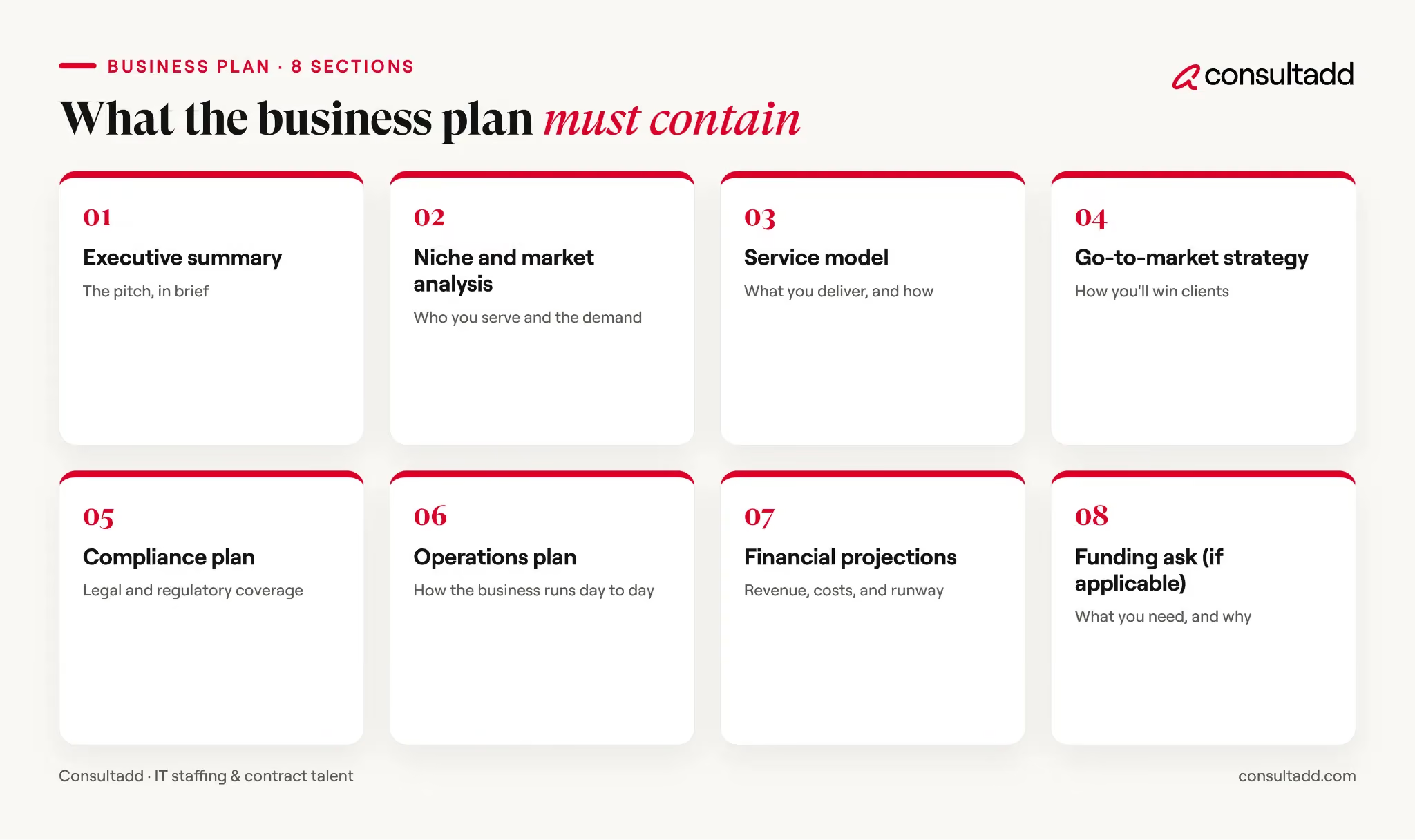
Over 20,000 staffing and recruiting companies already operate in the US, so credibility with clients comes from depth in a specific lane (cloud infrastructure, cybersecurity, ERP implementations, generative AI engineering) rather than a generalist "we place anyone in tech" pitch.
If you're still narrowing that focus, our guides to hiring generative AI engineers and hiring AWS developers illustrate how specific and technical client expectations have become in high-demand IT lanes, which is exactly the depth your plan needs to demonstrate.
Legal formation and registration requirements
Before placing a single candidate, the legal foundation needs to be in place:
Business entity formation: Most staffing founders form an LLC or corporation rather than operating as a sole proprietor, since the entity structure provides liability separation that matters enormously in a business built on employment relationships.
A business attorney is worth the cost here; entity structure affects tax treatment, liability exposure, and how cleanly you can bring on partners or investors later.
EIN and tax registration: An Employer Identification Number from the IRS is required to run payroll, and you'll need to register for state tax withholding and unemployment insurance accounts before your first placement starts.
State and local business registration: Requirements vary meaningfully by state and sometimes by county or city, so this isn't a one-time national filing. Some states have surprising reach: Massachusetts, for example, requires staffing agencies conducting business in the state to register even without a physical office there, which matters enormously if you're placing remote IT talent across state lines, an increasingly common model.
Check requirements in every state where you'll actually place workers, not just where you're headquartered.
Industry-specific licensing: IT staffing generally faces fewer specialized licensing requirements than healthcare or legal staffing, but if your clients or placements touch regulated sectors, financial services, healthcare IT, government contracting, additional registrations or clearances may apply.
Confirm this per client vertical rather than assuming a blanket IT staffing license covers every placement.
Insurance requirements
Insurance isn't optional overhead in staffing; it's frequently a contractual precondition clients require before they'll sign an MSA. At minimum, plan for:
Enterprise clients, and especially larger staffing MSAs, will often specify minimum coverage limits in the contract itself before they'll engage you, so get quotes early in your planning process rather than treating insurance as a step you'll handle right before your first placement.
Payroll, funding, and the cash flow gap
This is the requirement first-time founders most consistently underestimate, and it's the one most likely to sink an otherwise well-run agency. You must pay placed employees on a regular cycle, weekly or biweekly, while clients frequently pay invoices on 30 to 90-day terms. That gap has to be funded from somewhere.
Common approaches:
- Self-funding from working capital, viable only with substantial cash reserves and typically limited to a handful of small placements at a time.
- Invoice factoring, where a factoring company advances you a large percentage of an invoice's value immediately in exchange for a fee, letting you pay workers without waiting on client payment terms.
This is the most common funding mechanism for growing staffing agencies precisely because it scales with placement volume rather than requiring ever-larger cash reserves upfront.
- A back-office or PEO partnership, where a third party handles payroll funding, tax compliance, and sometimes benefits administration in exchange for a fee, letting a new agency start without building that infrastructure from scratch.
Whichever model your business plan assumes, the financial projections section needs to show it explicitly. A revenue projection that ignores the payroll funding gap isn't a staffing business plan; it's a wish list.
Contracts, worker classification, and IT-specific considerations
Client agreements (MSAs): Every client relationship needs a Master Service Agreement covering rate structures, payment terms, liability, indemnification, and termination conditions, before any candidate starts. This is the document that protects your agency when something goes wrong on a placement, and enterprise clients will typically insist on their own template, so budget legal review time for negotiating it.
Worker classification: Decide, and document clearly, whether placed talent works as W2 employees of your agency or through corp-to-corp arrangements with their own business entities. This decision carries real compliance weight; regulators look at the actual working relationship, not the contract label, when determining classification.
Our detailed breakdowns of contract worker vs employee and what is C2C employment cover exactly what separates a compliant arrangement from a misclassification risk, essential reading before your first placement.
Visa and work authorization compliance: IT staffing places a disproportionate share of candidates on employment visas, and getting this wrong carries real legal exposure. If your agency will sponsor H-1B workers or place candidates on OPT, understand the sponsorship obligations before you commit to a client timeline.
Our guide to H-1B sponsorship for tech professionals covers what employers are actually signing up for.
Operating systems. An applicant tracking system (ATS), CRM for client relationships, timekeeping, payroll, and invoicing all need to be in place before you scale past a handful of manual placements. Many new agencies underinvest here initially and pay for it in errors once volume increases.
Startup costs and what actually gets you to your first placement
Realistic numbers vary widely by how lean your launch is:
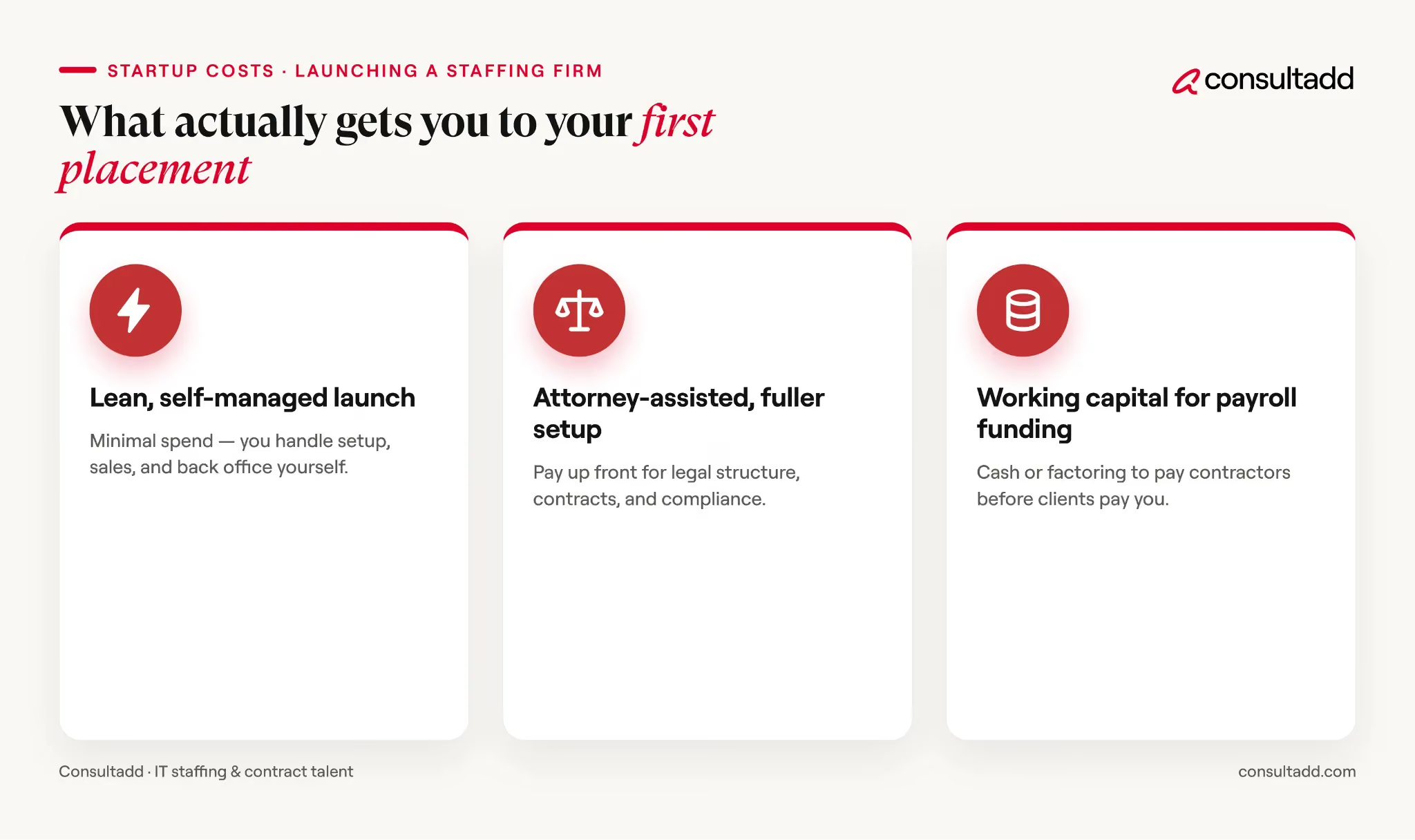
Payroll funding capacity is what actually determines how many candidates you can place at once, and it's the input most first-time business plans get wrong by omission rather than by underestimating the figure.
A plan that accounts for niche focus, full compliance requirements, and a realistic funding mechanism for the payroll gap is the difference between a document that impresses a lender and one that just impresses you.
Start Strong With Consultadd
With 15 years in business and 5,000+ successful staffing engagements, we don't just fill roles, we build reliability into your process. We've supported 65 staffing companies in the past year alone and maintain MSAs with industry leaders like Robert Half and TEKsystems.
Here's what working with Consultadd looks like:
- Talent sourced in under 24 hours
- Ready-to-deploy candidates, vetted for experience and compliance
- Lower turnover risk: we match long-term goals, not just short-term needs
- Seamless compliance: visa, documentation, onboarding? Handled.
- Dedicated 1:1 account managers for responsive, personalized support
- Top 100 candidate matches delivered in the past year
- Strong partnerships with universities to tap into fresh, committed talent
- Post-placement support so your investment grows beyond day one
For candidates, your next opportunity is more than just a job title, it's a chance to build skills, gain experience, and move your career forward. At Consultadd, we connect technology professionals with projects and employers that align with their goals, whether they're looking for contract, contract-to-hire, or long-term opportunities.
The tech job market moves fast, but the right guidance can make all the difference. Ready to take the next step in your career journey? Explore Opportunities >>
Key takeaways
- A staffing company becomes the employer of record for placed talent, so payroll, tax, and often workers' comp obligations begin the moment a candidate starts, often well before the client's invoice is paid.
- The business plan needs a defined IT niche, a compliance plan listing specific registrations and insurance, and financial projections that explicitly model the payroll funding gap, not just revenue and markup.
- Core legal requirements are entity formation, an EIN, state and sometimes county registration (state reach can extend beyond your headquarters), and industry licenses if placements touch regulated sectors.
- The minimum insurance stack is general liability, professional liability, and workers' compensation; enterprise clients often specify coverage minimums directly in the MSA.
- Payroll funding, through working capital, invoice factoring, or a back-office partner, is usually the real constraint on growth, since workers are paid weekly or biweekly while client invoices often run 30-90 days.
FAQs
What are the legal requirements to start an IT staffing company?
At minimum: form a business entity (typically an LLC or corporation), obtain an EIN, register with your state and any required local authorities, secure general liability, professional liability, and workers' compensation insurance, and set up payroll tax withholding accounts. Additional licenses may apply if your placements touch regulated industries like finance or healthcare IT.
How much does it cost to start an IT staffing company?
A lean, self-managed launch typically costs $3,000 to $10,000 for entity formation, basic insurance, and minimal software. That figure grows substantially with attorney-assisted contracts and a fuller tooling stack, and the largest cost by far is usually working capital to fund payroll while waiting on client invoices, which can run 30 to 90 days.
What should an IT staffing business plan include?
A credible plan covers your specific IT niche and target client segment, your service model (contract, contract-to-hire, or direct hire), a compliance section listing exact registrations and insurance needed, an operations plan for your ATS/CRM/payroll systems, and financial projections that explicitly account for the gap between paying placed workers and collecting client payments.
Do I need special insurance to run a staffing agency?
Yes. At minimum, staffing agencies need general liability, professional liability (errors and omissions), and workers' compensation coverage once you employ placed workers. Enterprise clients frequently specify minimum coverage limits directly in their Master Service Agreement before they'll sign, so secure quotes early in your planning process.
How do staffing agencies afford to pay workers before clients pay invoices?
Most rely on one of three approaches: sufficient working capital reserves, invoice factoring (a third party advances a percentage of invoice value immediately for a fee), or a back-office/PEO partnership that funds payroll and handles compliance for a fee. Invoice factoring is the most common growth-stage solution because it scales with placement volume.
Should my IT staffing company place W2 employees or C2C contractors?
It depends on the arrangement's actual substance, not just the label. Regulators evaluate the real working relationship, control, exclusivity, economic dependence, when determining classification, so agencies need documented, compliant structures for whichever model they use. Many IT staffing firms run both models depending on the client and candidate situation.
.png)