
.avif)

Introduction
If you search for natural language processing jobs and filter by that exact title, you will see a fraction of what is actually open. Most of the work moved under other names.
AI engineer. Applied scientist. Machine learning engineer. Search relevance engineer. Conversational AI developer.
The roles did not disappear. The label did.
That matters for anyone job hunting right now, because it changes what you search for, how you read a posting, and what you put on your resume. Here is what the market looks like underneath the titles.
TL;DR
- Most NLP work is now posted under AI, ML, or applied science titles rather than "NLP engineer."
- The field has split into applied NLP and applied LLM work, and the two screen for different skills despite similar job titles.
- Salary estimates range from roughly $107,000 to $165,000 average depending on the source, and the reason they disagree is worth understanding.
- BLS puts the median wage for computer and information research scientists at $140,300 as of May 2025, with 22% projected growth through 2035.
- The fastest path in for most people is adjacent: data engineering, backend, or search, then move sideways.
The job title problem
Start with why this is confusing.
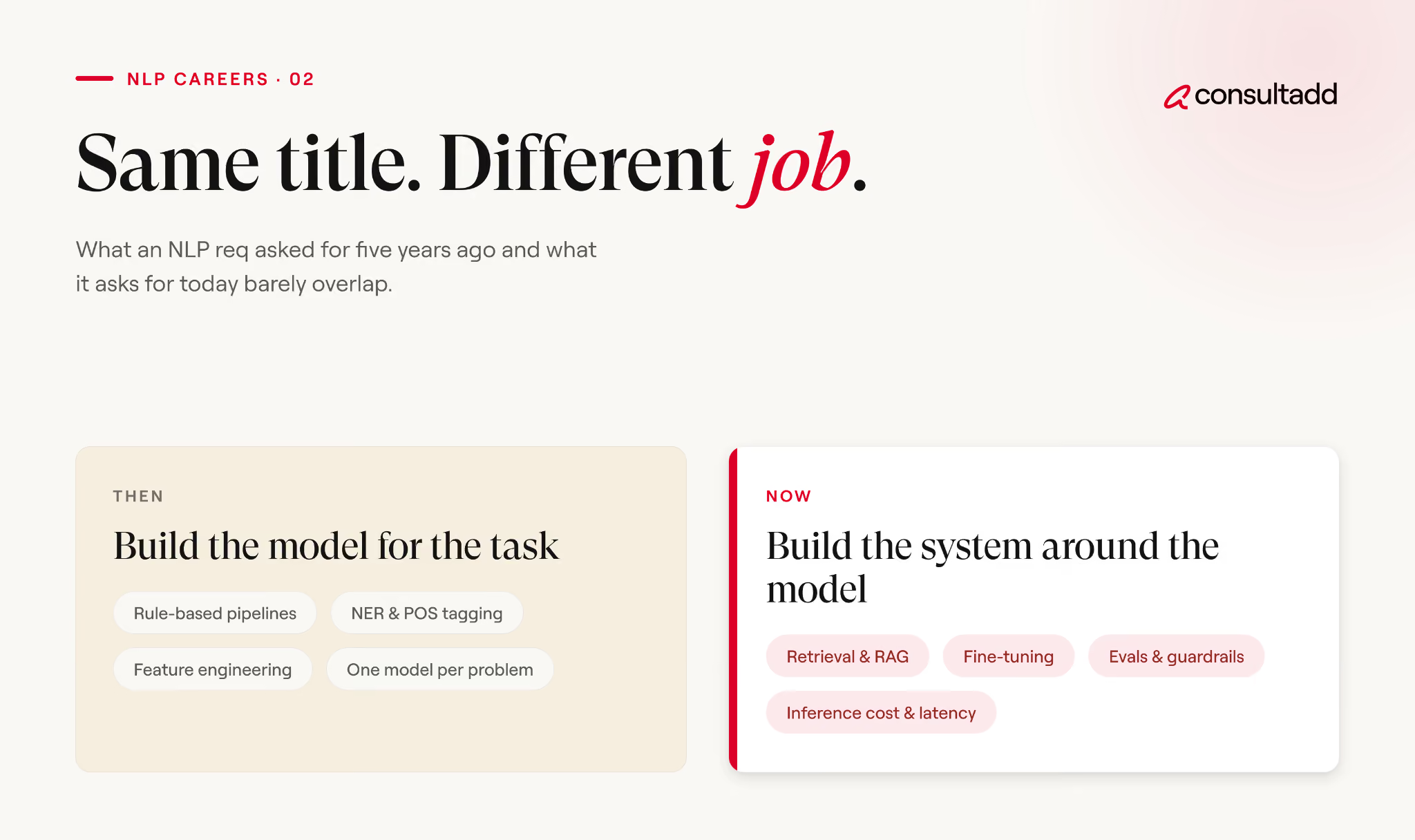
Five years ago, NLP was a distinct specialty with its own toolkit: tokenization, part-of-speech tagging, named entity recognition, custom classifiers trained on labeled data. You hired an NLP engineer because nobody else could do it.
Then foundation models made a large share of that work accessible through an API call. A backend engineer can now do sentiment analysis in an afternoon.
So the postings that used to say "NLP engineer" started saying other things, and the remaining NLP-titled roles skew toward either legacy pipeline maintenance or deep research.
The practical consequence: if you filter job boards on "NLP," you will miss most of the market.
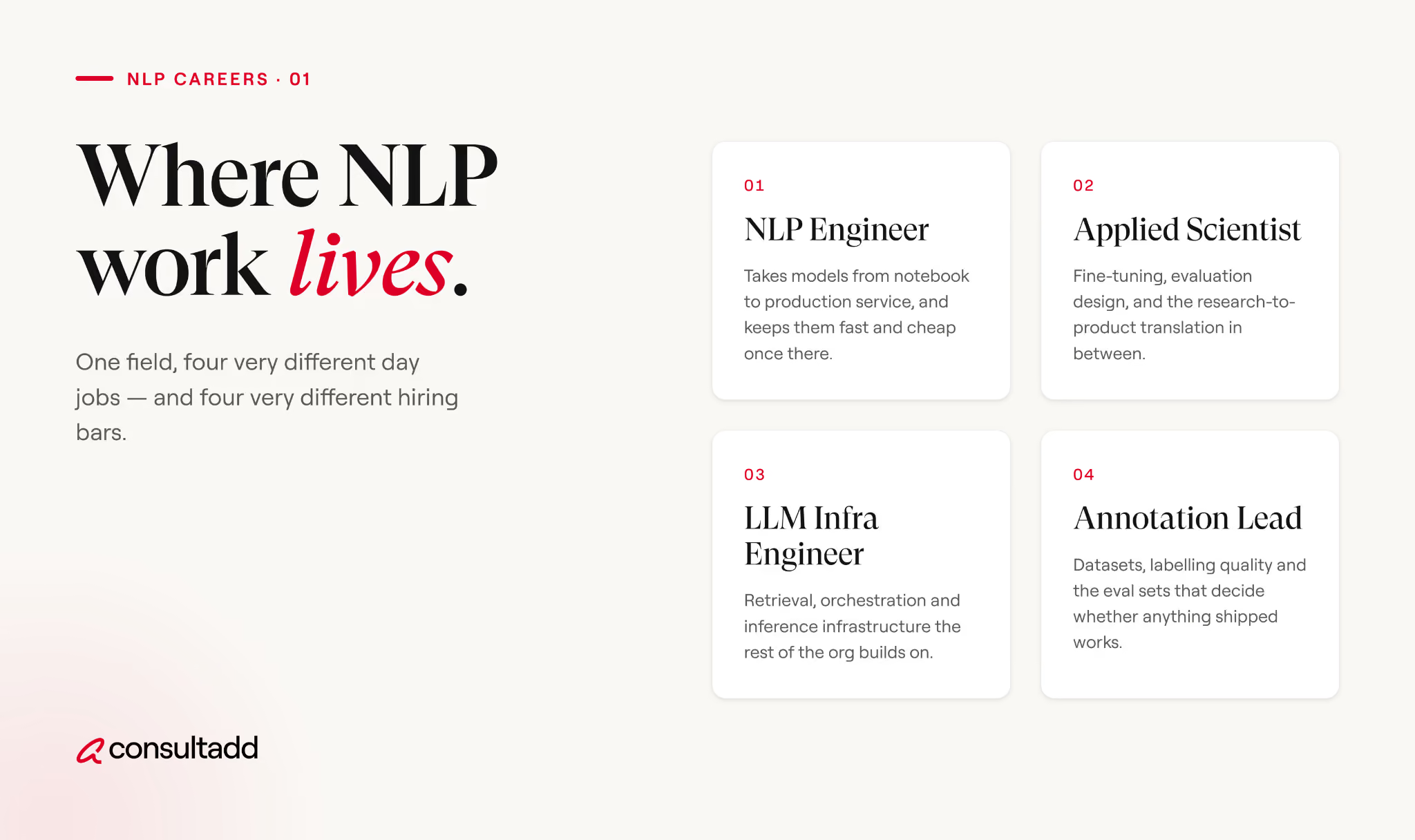
A posting that says "AI engineer" without naming a specialization usually means the company has not finished scoping the role. That is not automatically a red flag, but it is a question to ask in the first call, because it determines whether you will be fine-tuning models or writing glue code.
The applied NLP and applied LLM split
This is the distinction that trips up both candidates and hiring managers, and it costs people interviews.
Recruiters who place these roles report that swapping one for the other is the most expensive scoping mistake they see.
A company that thinks it needs a GenAI engineer sometimes actually needs someone who can rebuild a drifting classification taxonomy. A team that hires a classical NLP specialist to own a retrieval pipeline often finds nobody owns the evaluations.
For you, the takeaway is diagnostic. Read the responsibilities, not the title, and figure out which half of the split the role sits in before you tailor anything.
What natural language processing jobs actually pay
Here is where most career guides pick one number and state it confidently. The honest version is that the numbers disagree a lot.
The Bureau of Labor Statistics puts the median annual wage for computer and information research scientists at $140,300 as of May 2025, with employment projected to grow 22 percent from 2025 to 2035. The average growth rate across all occupations is 3 percent.
For broader context, the median wage across all computer and IT occupations was $109,470 in May 2025, against $50,980 for all occupations.
Why the numbers disagree
Four reasons, and understanding them helps you read any salary page.
1. Base versus total.
Glassdoor figures often fold in bonus and equity. BLS reports wages. In this field the gap can be 30% or more at senior levels.
2. Title matching versus skill matching.
Sites that scrape the "NLP engineer" title are sampling a pool that now skews toward legacy and mid-market roles, because the highest-paying language work is posted as AI or ML engineering. That alone explains much of the spread between the $107K and $165K figures.
3. Geography.
Bay Area and New York compensation pulls averages up. A remote role benchmarked to a national band will not match either.
4. Self-reporting bias.
People tend to submit salary data when the number is good.
Use these as a range, not a target. The number that matters is what comparable companies in your market pay for your specific skill set, which you find through recruiters and levels data rather than national averages.
The skills employers screen for
Sorted by how often they actually come up in interviews rather than how often they appear in job descriptions.
Foundational, assumed rather than tested:
- Python, comfortably. Not scripting level, engineering level.
- Git, testing, and the ability to ship code someone else maintains
- SQL and data manipulation at volume
Role-specific, where the interview happens:
- Transformers and how attention works, well enough to reason about tradeoffs
- PyTorch for anything involving training or fine-tuning
- Embeddings and vector search, including when similarity search fails
- Evaluation design, which is the skill most candidates underinvest in
- Retrieval, including the unglamorous parts like chunking and reranking
Differentiators that get people hired:
- You can explain how you measured whether your system worked. Most candidates cannot.
- Production experience, meaning something you built that real users hit
- Domain depth in a regulated field like healthcare, legal, or finance
- The judgment to say a problem does not need a model
That last one is underrated. Teams have spent a lot of money in the last two years on model-based solutions to problems a regex and a lookup table would have solved. An engineer who says so in an interview stands out.
If you want a sense of what technical screens look like from the other side of the table, our guide to technical recruitment covers how hiring teams structure their evaluation.
How to get in without an NLP title
The direct path, meaning a masters in computational linguistics into an NLP-titled role, is real but narrow. Most people get there sideways.
From data engineering. You already own the pipelines that feed these systems. Add embeddings and a vector store, take on the retrieval layer, and you are doing applied LLM work within a year. This is currently the shortest route.
From backend engineering. Applied LLM work is substantially systems work: latency, caching, orchestration, failure handling. Your existing skills transfer more than you think. The gap to close is evaluation methodology.
From data science. You have the statistical foundation and probably some modeling experience. The gap is production engineering, which means learning to ship and maintain rather than analyze.
From linguistics or a humanities PhD. Real but harder. Your advantage is judgment about language data quality, annotation design, and where models fail on edge cases. Pair it with demonstrable Python engineering or the interview will not go well.
Two things that help regardless of starting point.
- Build one thing end to end and write up how you evaluated it, because a project with a real eval harness signals more than five tutorial repos.
- Consider contract work as an entry route. Contract engagements often have lower credential bars than direct hire and put production experience on your resume faster.
Our breakdown of IT staffing models explains how contract and contract-to-hire arrangements typically work.
Where the demand sits
Demand is not evenly spread, and following it matters more than chasing the highest advertised salary.
Healthcare is the steadiest. Clinical documentation, coding, and record extraction are genuine unstructured-text problems with regulatory constraints that keep the work in-house. Domain knowledge compounds here.
Legal and compliance is similar. Contract analysis, discovery, and regulatory monitoring involve documents where errors are expensive, which means evaluation rigor is valued rather than tolerated.
Financial services runs both halves: classical NLP for document processing and risk, and newer LLM work for research and client-facing tools.
Enterprise search and internal knowledge tools have quietly become one of the largest employers of retrieval skills, and these roles are rarely titled NLP anything.
BLS analysis of employment projections notes that firms across industries are integrating AI-based systems into workflows, and that demand for data scientists, computer and information research scientists, and software developers is set to rise substantially. Data scientists alone are projected to grow 33.5 percent between 2024 and 2034.
What the hiring process looks like
Expect longer cycles than general software roles. Specialist searches in this space commonly run six to ten weeks for senior positions, against a much shorter average for IT roles generally. Plan your runway accordingly and keep multiple processes live.
Our breakdown of time-to-hire benchmarks covers what drives the variation.
A typical loop:
- Recruiter screen, where the specialization question gets settled
- Technical screen, usually Python plus one ML or retrieval concept
- A take-home or system design round on a realistic problem
- Depth interview on a project you led, focused on why you made specific choices
- Team and manager conversations
The depth interview is where offers are decided. Prepare one project you can discuss for forty minutes: what the problem was, what you tried first, what failed, how you measured improvement, and what you would do differently.
Vague answers about "improving accuracy" without a baseline are the most common reason strong candidates get passed over.
Start Strong With Consultadd
With 15 years in business and 5,000+ successful staffing engagements, we don't just fill roles, we build reliability into your process. We've supported 65 staffing companies in the past year alone and maintain MSAs with industry leaders like Robert Half and TEKsystems.
Here's what working with Consultadd looks like:
- Talent sourced in under 24 hours
- Ready-to-deploy candidates, vetted for experience and compliance
- Lower turnover risk: we match long-term goals, not just short-term needs
- Seamless compliance: visa, documentation, onboarding? Handled.
- Dedicated 1:1 account managers for responsive, personalized support
- Top 100 candidate matches delivered in the past year
- Strong partnerships with universities to tap into fresh, committed talent
- Post-placement support so your investment grows beyond day one
For candidates, your next opportunity is more than just a job title, it's a chance to build skills, gain experience, and move your career forward. At Consultadd, we connect technology professionals with projects and employers that align with their goals, whether they're looking for contract, contract-to-hire, or long-term opportunities.
The tech job market moves fast, but the right guidance can make all the difference. Ready to take the next step in your career journey? Explore Opportunities >>
Key takeaways
- Search beyond the NLP title. Most natural language processing jobs are posted as AI engineer, ML engineer, applied scientist, or search relevance engineer.
- Identify whether a role is applied NLP or applied LLM before you tailor your resume, because they screen for different things.
- Treat salary averages as ranges. The spread between sources reflects base versus total comp, title matching, and geography, not measurement error.
- Evaluation design is the most underweighted skill among candidates and the most discussed in interviews.
- Sideways entry from data engineering, backend, or data science is the realistic path for most people.
FAQs
What qualifications do you need for natural language processing jobs?
Most roles ask for a bachelor's in computer science or a related field plus strong Python and machine learning fundamentals. Research-oriented applied scientist positions often expect a masters or PhD. For applied LLM work, production engineering experience frequently matters more than the degree.
Is NLP still a good career in 2026?
The demand is real but the shape has changed. Work that foundation models commoditized has thinned out, while retrieval, evaluation, and domain-specific language systems are hiring steadily. BLS projects 22 percent growth for computer and information research scientists through 2035, well above the 3 percent average across occupations.
What is the difference between an NLP engineer and an LLM engineer?
An NLP engineer typically owns text processing, model training, and language-specific pipelines. An LLM engineer builds systems on top of foundation models, focused on retrieval, prompting, and evaluation. The stacks overlap, but the ownership and interview focus differ.
Can you get an NLP job without a PhD?
Yes, for most engineering roles. A PhD is commonly expected for applied scientist and research positions at large labs, but applied NLP and applied LLM engineering roles hire on demonstrated production work. A project with a real evaluation methodology carries more weight than credentials for these positions.
How much do entry level natural language processing jobs pay?
Entry-level estimates cluster around $120,000 to $125,000 in reported data, though the range is wide and geography-dependent. Contract roles sometimes offer a faster entry point at slightly lower rates. Compare against local market data rather than national averages.
Which industries hire the most for NLP skills?
Healthcare, legal and compliance, financial services, and enterprise search are the steadiest sources of demand. These fields have large volumes of unstructured text and accuracy requirements that keep the work internal. Domain knowledge in a regulated industry compounds your value over time.
.webp)



.png)