
.avif)

Introduction
A hiring manager opens a senior backend req. in February. By May it's still open, two finalists have taken counteroffers, and the roadmap has slipped a quarter. At that point the question stops being "who do we hire" and becomes "where do we look."
Nearshore staff augmentation is one answer. You add contract engineers from countries in or near your own time zone, they work inside your team and your process, and you keep control of the work. For U.S. companies that usually means Mexico, Colombia, Costa Rica, Argentina, Brazil, or Canada.
The pitch is easy to summarize and harder to execute. Most of the value comes from one variable: how many hours a day your team and theirs are both awake and working.
TL;DR
- Nearshore staff augmentation means contracting talent in a nearby country with 0 to 3 hours of time zone difference from your team, while you keep day-to-day direction of the work.
- The real benefit isn't the hourly rate. It's the six or seven overlapping work hours, which cut the review-and-rework cycle that makes far-offshore engagements drag.
- Savings against U.S. onshore contract rates are real but narrower than offshore. If cost is your only driver, nearshore is usually the wrong tool.
- Cross-border contracting brings paperwork most teams underestimate: foreign status documentation, IP assignment under the right jurisdiction, and misclassification risk.
- Nearshore fails most often on work that requires deep institutional context, not on skill.
What nearshore staff augmentation actually means
The staffing model here is nothing new. You bring in external professionals, they follow your workflows, your managers assign their work, and the vendor handles sourcing and contracts.
If you want the mechanics of that model end to end, Consultadd's breakdown of how IT staff augmentation works covers it properly.
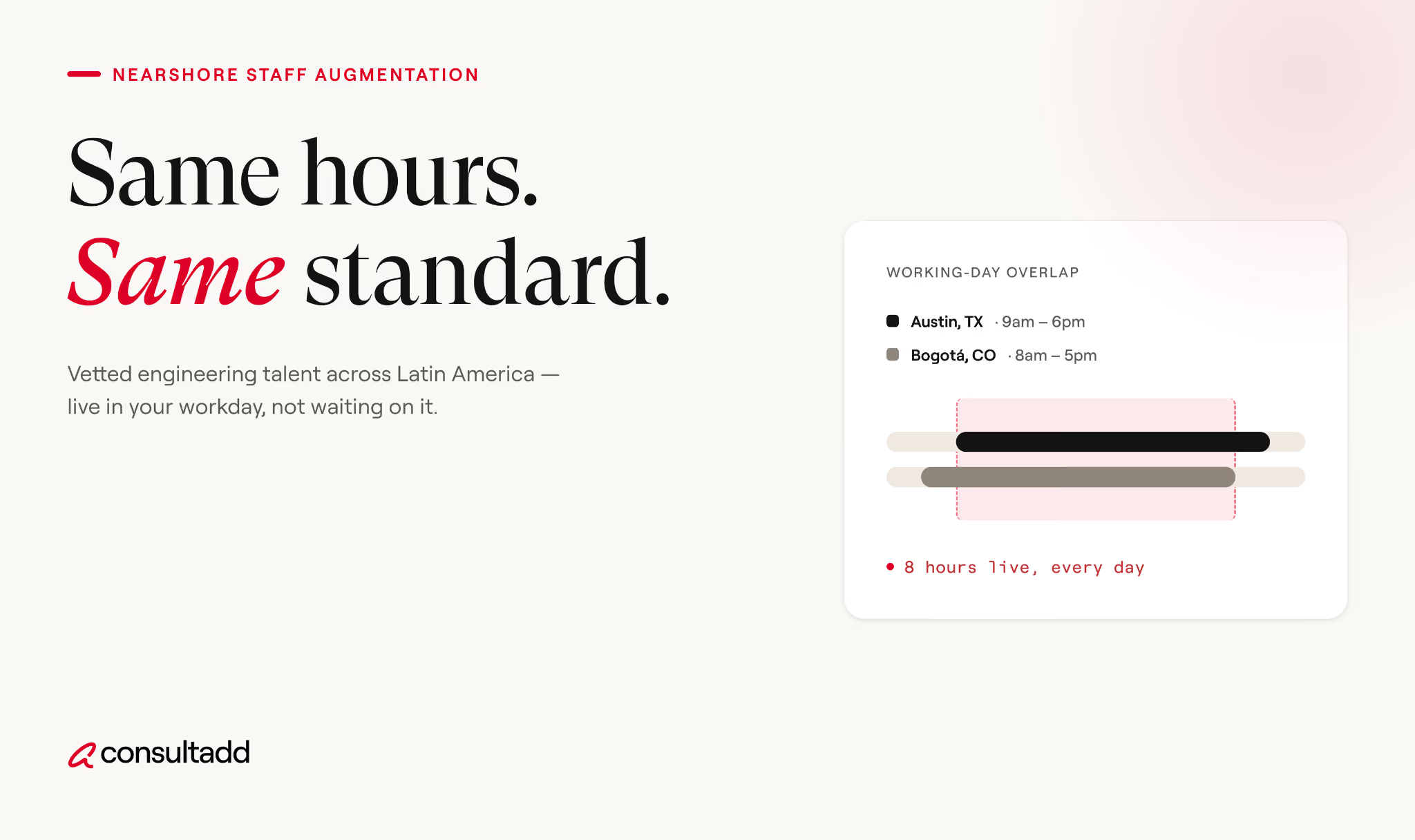
What "nearshore" changes is one input: location.
That sounds minor. It isn't, because location determines overlap, and overlap determines how many times a day a decision can get made. A question that takes four hours to answer costs you one iteration. The same question with a 12-hour gap costs you a day.
Deloitte's 2022 survey of more than 500 business and technology leaders noted companies expanding their external workforce into new regions, with Latin America specifically cited as the route to U.S. nearshore access.
That shift wasn't about finding cheaper engineers. It was about finding engineers who are online at 10 a.m. Eastern.
Nearshore vs offshore vs onshore: the overlap math
Here's what the three options look like side by side for the U.S. Eastern team working 9 to 6.
Why overlap matters more than the rate card
Offshore works well when the scope is written down clearly and doesn't change much. Migration work, test automation, maintenance on a stable system, defined data pipelines. Ambiguity is where it struggles, because every clarification costs a full cycle.
Nearshore is the opposite. Discovery work, product engineering where requirements shift mid-sprint, incident response, anything where someone needs to grab a colleague and screen-share for ten minutes. Those all depend on overlapping hours.
A recruiter we work with puts it more bluntly: “Offshore teams get judged on tickets closed, nearshore teams get judged on whether the product manager stops chasing people.”
Where the savings actually land
Nearshore rates sit between onshore and offshore, which surprises buyers who expected offshore-level pricing. Two things soften that.
The first is rework. Fewer misread requirements means fewer rebuilt features.
The second is management overhead. Someone on your side has to review, unblock, and re-explain. With a three-hour overlap, that person ends up working split days. That cost is real, it just never shows up on an invoice.
Deloitte's 2024 Global Outsourcing Survey found that 80% of executives planned to maintain or increase third-party outsourcing investment, and that skilled talent and agility had joined cost reduction as primary drivers.
When agility is the driver rather than cost, the geography that wins changes.
The markets U.S. teams hire from
"LATAM" gets used as one word. It isn't one market, and rates, English levels, and contracting norms vary considerably between them.
Two practical notes. Colombia doesn't observe daylight saving, so your overlap shifts twice a year without anyone changing schedules.
Argentina and Brazil sit east of U.S. Eastern, which means their afternoon ends before yours does. That's usually fine, but it kills the late-day sync some U.S. teams rely on.
What nearshore engagements really cost
Published hourly rates are the smallest part of this. Build your budget from components instead.
Ask any vendor for the fully loaded number, then ask what happens if you need to end the engagement in month three. Notice periods in cross-border contracts run longer than U.S. staffing norms.
Consultadd's guide to choosing a staff augmentation company has the wider vendor diligence list if you're at that stage.
Compliance across the border
This is where nearshore engagements create work that domestic contract staffing doesn't, and it's the part teams discover in month two.
1. Foreign status documentation.
- If you're paying a non-U.S. individual directly, you generally collect Form W-8BEN before the first payment rather than a W-9.
- It certifies foreign status and supports the correct withholding treatment.
- The IRS instructions for Form W-8BEN spell out when a withholding agent can rely on it and when it doesn't apply, including the case of a nonresident individual performing services inside the United States.
- Where the work is performed matters more than where the person lives.
2. Misclassification.
- Treating a full-time, exclusively assigned contractor as an independent contractor is a risk in most LATAM countries, and several have labor courts that lean toward the worker.
- Going through a staffing partner or employer of record shifts that exposure.
3. IP assignment.
- Your standard contractor agreement was probably written for U.S. law. Confirm that work-for-hire language actually transfers ownership under the contractor's local jurisdiction, because in several countries it doesn't by default without an explicit assignment clause.
4. Payment structure.
- Corp-to-corp arrangements are common in this space and change the paperwork considerably.
The key clauses in a C2C contract are worth reviewing before you sign one.
- None of this is a reason to avoid nearshore. It's a reason to decide early whether you're handling it yourself or paying a partner to handle it.
When nearshore is the wrong call
Balanced advice is more useful than a sales pitch, so here are the cases where we'd tell someone not to bother:
- The work requires a security clearance, or the contract has citizenship or onsite requirements. Federal and defense work usually rules out non-U.S. talent regardless of quality.
- The role depends heavily on institutional knowledge. A staff engineer who needs to know why a decision was made in 2019 can't be dropped in from anywhere, near or far.
- You need one person for six weeks. The setup cost isn't worth it. Local contract staffing will be faster.
- Cost reduction is the only goal and the scope is genuinely well-defined. Offshore will cost less and do the job.
- Your team has never run a distributed engagement.
Nearshore is more forgiving than offshore, but it still requires written decisions, recorded context, and managers who don't rely on hallway conversations.
If you're weighing this against other structures entirely, the full range of IT staffing models is a better starting point than picking a geography first.
Running the first 30 days
Most nearshore engagements that go badly go badly in the first month, and the reasons repeat.
Days 1 to 3. Access sorted before day one, not requested on day one. Repo, cloud console, ticketing, chat, VPN. Waiting on IT is the most common early stall.
Days 1 to 5. Name a single point of contact on your side. Not a committee. Someone who answers questions the same day.
Week 1. Agree core hours in writing. Four to six hours of guaranteed overlap, stated in both time zones, with daylight saving handled.
Week 2. Ship something small to production. A real change, not a sandbox exercise. It tests your pipeline and their access at the same time.
Week 3. First written feedback, both directions. Not a performance review, just a short correction of course.
Week 4. Review the time-to-productivity against what the vendor promised. If it's materially off, raise it now while you still have leverage in the contract.
Calendars also need a look. LATAM countries observe more public holidays than the U.S., and they don't line up. Plan capacity around them at the start of the quarter.
Start Strong With Consultadd
With 15 years in business and 5,000+ successful staffing engagements, we don't just fill roles, we build reliability into your process. We've supported 65 staffing companies in the past year alone and maintain MSAs with industry leaders like Robert Half and TEKsystems.
Here's what working with Consultadd looks like:
- Talent sourced in under 24 hours
- Ready-to-deploy candidates, vetted for experience and compliance
- Lower turnover risk: we match long-term goals, not just short-term needs
- Seamless compliance: visa, documentation, onboarding? Handled.
- Dedicated 1:1 account managers for responsive, personalized support
- Top 100 candidate matches delivered in the past year
- Strong partnerships with universities to tap into fresh, committed talent
- Post-placement support so your investment grows beyond day one
For candidates, your next opportunity is more than just a job title, it's a chance to build skills, gain experience, and move your career forward. At Consultadd, we connect technology professionals with projects and employers that align with their goals, whether they're looking for contract, contract-to-hire, or long-term opportunities.
The tech job market moves fast, but the right guidance can make all the difference. Ready to take the next step in your career journey? Explore Opportunities >>
Key takeaways
- Nearshore staff augmentation buys you overlapping work hours. That's the product, and everything else follows from it.
- Budget from fully loaded cost, including onboarding, provisioning, and the management time your leads will spend.
- Treat LATAM as several distinct markets with different rates, English levels, and contracting rules, not one region.
- Handle foreign status documentation, IP assignment, and classification before the first invoice, not after.
- Skip nearshore for clearance-restricted work, six-week gaps, or roles that live on institutional memory.
FAQs
What is nearshore staff augmentation?
It's a staffing model where you contract professionals in a nearby country, usually within three hours of your time zone, who work inside your team and take direction from your managers. For U.S. companies that generally means Latin America or Canada. You keep control of the work, and the partner handles sourcing, contracts, and compliance.
How is nearshore staff augmentation different from offshore?
The difference is overlap, not skill. Nearshore gives you six to eight shared working hours a day, so questions get answered the same morning. Offshore typically leaves one to three hours of overlap, which pushes most feedback into the next day. That makes offshore stronger on well-specified scopes and weaker on work that changes.
How much can we save with nearshore compared to hiring in the U.S.?
Nearshore rates sit between U.S. onshore and offshore, so the savings are real but smaller than offshore comparisons suggest. The more useful measure is fully loaded cost, which includes onboarding, equipment, compliance work, and the management hours your leads spend supporting the engagement.
Which countries do U.S. companies use most for nearshore staffing?
Mexico, Colombia, Costa Rica, Argentina, and Brazil are the most common, with Canada used when time zone and language alignment matter more than cost. Mexico and Colombia are popular for U.S. Eastern and Central teams because the overlap is nearly complete.
Do we need to issue a 1099 to a nearshore contractor?
Usually not, if the contractor is a non-U.S. person performing all services outside the United States. You generally collect Form W-8BEN instead of a W-9 before the first payment. If any of the work is performed inside the U.S., the reporting and withholding rules change, so confirm the specifics with a tax advisor.
How long does it take to get nearshore staff productive?
Two to four weeks is a realistic ramp for most engineering roles, assuming access is provisioned before day one. Teams that treat onboarding as an afterthought routinely double that. Ask any vendor for their average time-to-productivity by role type rather than a single company-wide number.



.webp)

.png)