.avif)

Introduction
Ask ten hiring managers to describe their recruitment and selection process and most will give you a list of stages. Post the role, screen resumes, phone screen, interviews, offer.
That's a workflow. It isn't a process, and the distinction shows up the moment someone asks why a candidate was rejected and nobody can answer with anything more specific than "not a fit."
Recruitment and selection are two separate disciplines that got merged into one phrase.
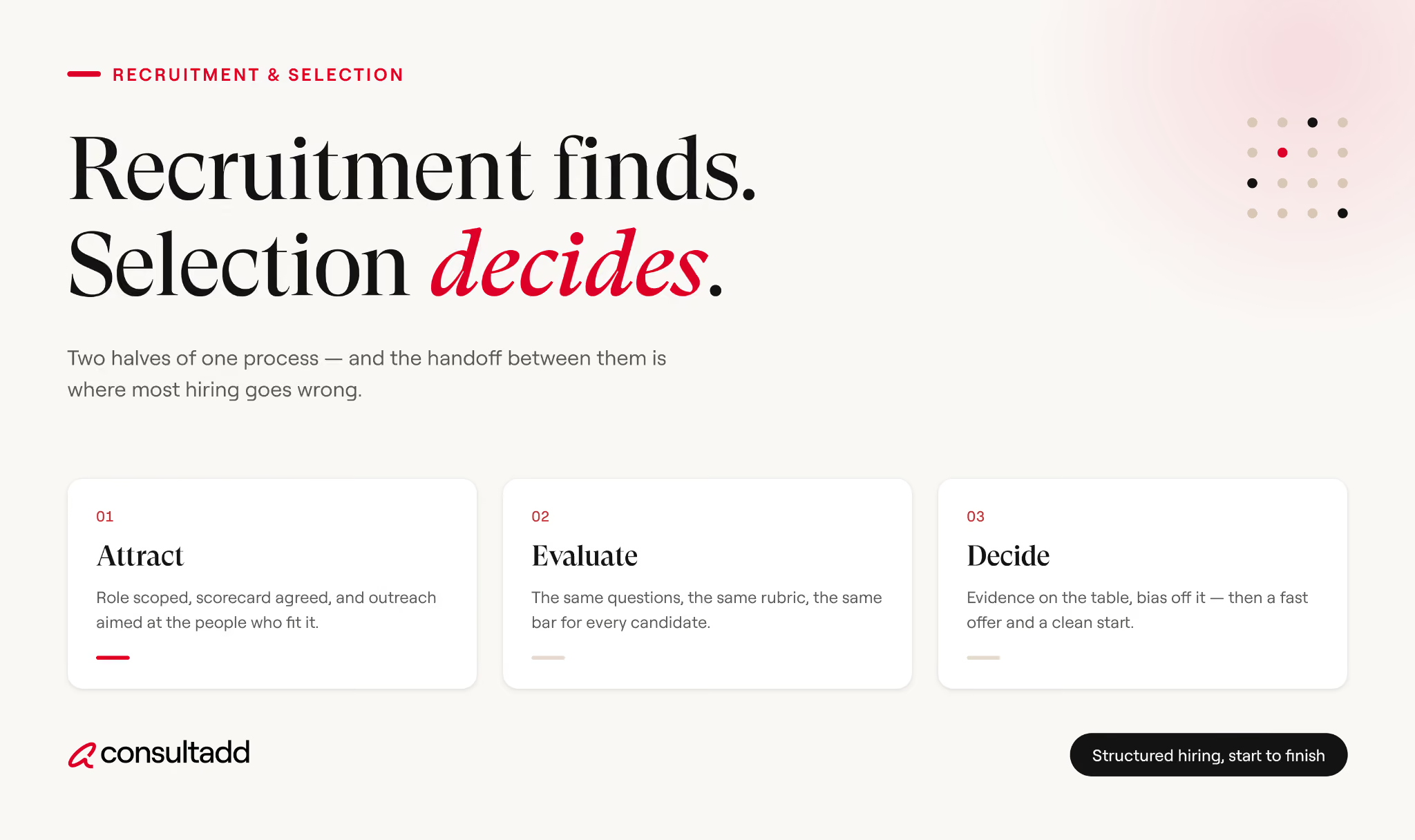
Recruitment is about attracting a pool. Selection is about choosing from it, defensibly, using methods that actually predict whether someone will do the job well. Most teams are competent at the first and improvising at the second.
This covers the second half, since that's where the money and the legal exposure both sit.
This is general information about hiring practice, not legal advice. Employment law varies by jurisdiction, so check specific obligations with counsel.
TL;DR
- Recruitment attracts candidates; selection chooses among them. Running both as one undifferentiated funnel is why hiring decisions become hard to explain.
- Under federal guidance, a selection procedure is almost anything you use to make a hiring decision, including a casual interview or an experience requirement.
- If a selection method disproportionately excludes a protected group, the employer has to show it's job-related and consistent with business necessity.
- The four-fifths rule is the standard federal starting point for spotting adverse impact, and it's simple enough to check yourself.
- Structured methods beat unstructured ones on both prediction and defensibility, which is unusual. Most tradeoffs don't point the same direction.
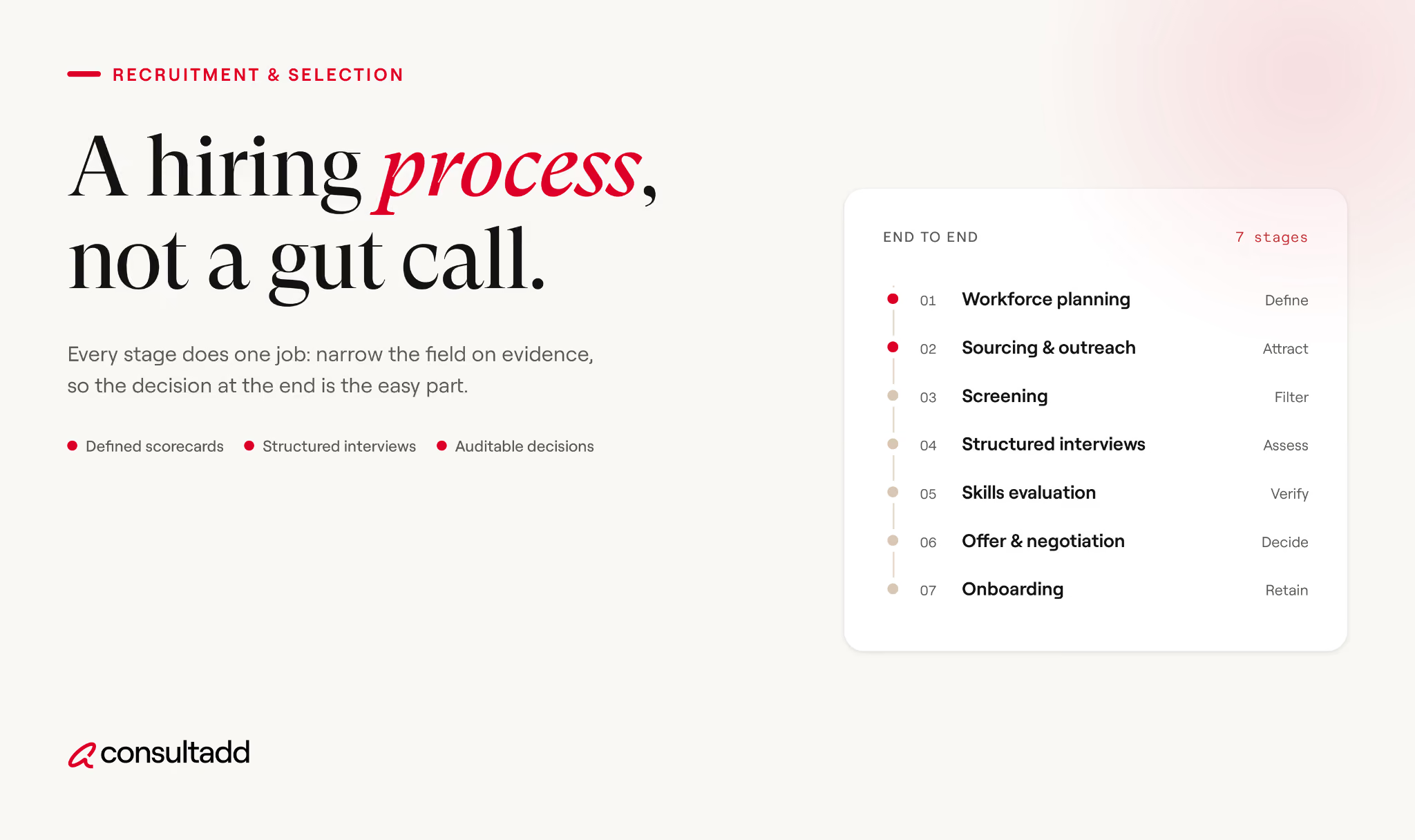
Recruitment and selection are two different jobs
They have different goals, different failure modes, and different people are usually good at them.
The practical consequence: expanding your pool won't fix a broken selection process, and it often makes it worse. More candidates through a process with no consistent criteria just means more inconsistent decisions.
If your problem is genuinely on the recruitment side, Consultadd's hiring and recruiting strategies playbook covers sourcing and pipeline building in depth.
This piece assumes you have candidates and the question is how you pick.
Why the split matters
Because the two halves are held to different standards.
Nobody audits your sourcing channels. Plenty of people can audit your selection decisions, including candidates, regulators, and your own leadership when a senior hire fails at month four.
Selection is also where most of the value is created. A recruiter who doubles your applicant pool has helped. An assessment process that reliably distinguishes the top quartile has changed your team's output for years.
And selection is the half that's usually undocumented. Teams keep detailed records of where candidates came from and almost none of why they were rejected.
What actually counts as a selection procedure
This is the part that surprises people, and it's worth reading carefully.
The Uniform Guidelines on Employee Selection Procedures, adopted in 1978 by the EEOC, the Department of Labor, the Department of Justice, and the Civil Service Commission, define a selection procedure broadly. It isn't just formal tests.
The guidelines cover job requirements like physical, educational, and experience criteria, plus evaluation through application forms, interviews, performance tests, written tests, and performance in training or probationary periods.
Read that again. An informal interview is a selection procedure. So is "must have a bachelor's degree." So is "five years minimum experience."
The EEOC's guidance on employment tests and selection procedures makes the consequence clear: employers can face liability not only for intentional discrimination, but for using apparently neutral procedures that disproportionately exclude a protected group, unless they can justify them.
So the requirement to be job-related doesn't apply only to a personality assessment you bought. It applies to the degree requirement someone copied from an old job description in 2019 and nobody has questioned since.
Choosing methods that predict performance
Different selection methods answer different questions, and using the wrong one is how teams end up with candidates who interview beautifully and can't do the work.
Two things hold consistently in the research literature.
- Structured approaches outperform unstructured ones at predicting job performance.
- Methods that sample actual work outperform methods that ask people to describe their work.
The unusual part is that structure improves defensibility at the same time. Most hiring tradeoffs force a choice between rigour and speed. This one doesn't, which is why it's the single highest-return change most teams can make.
For how these methods sequence within a technical hiring cycle specifically, Consultadd's guide to how technical recruitment works stage by stage walks through the assessment stages in order.
Keeping the process defensible
Defensibility isn't a separate compliance exercise bolted onto the end. It's mostly a byproduct of running a consistent process.
Three things do the work:
1. Start from job analysis.
- Every criterion should trace to something the job actually requires.
- If you can't explain why a requirement predicts performance in this role, it shouldn't be filtering anyone out.
- This is also the cheapest fix available, since it costs a conversation with the hiring manager.
2. Check for adverse impact.
- The Uniform Guidelines describe the four-fifths rule: a selection rate for any race, sex, or ethnic group that falls below four-fifths, or 80%, of the rate for the highest-scoring group will generally be regarded by federal enforcement agencies as evidence of adverse impact.
- Rates above that generally won't be.
- Running that check is arithmetic. Divide selected by applied for each group, find the highest rate, and compare the others against 80% of it.
- The guidelines note that smaller differences can still constitute adverse impact where they're significant in statistical and practical terms, and that larger gaps may not where the numbers are small and not statistically significant.
- So treat it as a flag to investigate, not a verdict.
- The guidelines also suggest adverse impact determinations be made at least annually for each group making up at least 2% of the relevant labor force or applicable workforce.
3. Know what happens if you find impact.
- If a procedure disproportionately excludes a protected group, the employer needs to show it's job-related and consistent with business necessity.
- Even then, a challenger can argue a less discriminatory alternative exists that would predict performance equally well.
Worth noting: the guidelines don't require validity studies where no adverse impact results. The obligation is triggered by impact, not by using a test.
The documentation most teams skip
Where the total selection process shows adverse impact, the guidelines indicate employers should keep records showing which components are producing it.
That's impossible to do retroactively if you never recorded stage-level outcomes.
None of this is heavy. It's a scorecard and a spreadsheet. The reason teams skip it isn't cost, it's that documentation feels like overhead until the first time someone asks a question you can't answer.
Where processes break
A few patterns recur, drawn from watching hiring cycles go sideways:
1. Criteria written after meeting candidates.
- The requirements quietly reshape themselves around whoever the hiring manager liked.
- This is the most common failure and the hardest to see from inside.
2. Interviewers scoring different things.
- Five interviewers, no rubric, five private definitions of a good answer.
- The debrief becomes a negotiation between confident opinions rather than a comparison of evidence.
3. Requirements nobody can justify.
- Degree minimums, arbitrary years of experience, and tool-specific demands that were copied forward.
- Each one narrows the pool and each one has to be defensible.
4. Speed collapsing rigour.
- Under pressure, teams skip the structured parts first because they feel slow.
Consultadd's breakdown of where IT recruitment strategies break down covers the speed pressure side of this in more detail.
5. Treating selection as HR's problem.
- The hiring manager owns the decision and usually owns the inconsistency too.
- Process fixes that don't involve them don't hold.
For teams hiring technical contract talent where the selection burden partly shifts to a staffing partner, the eight stages of the IT staffing process shows where vetting responsibility sits at each handoff.
Start Strong With Consultadd
With 15 years in business and 5,000+ successful staffing engagements, we don't just fill roles, we build reliability into your process. We've supported 65 staffing companies in the past year alone and maintain MSAs with industry leaders like Robert Half and TEKsystems.
Here's what working with Consultadd looks like:
- Talent sourced in under 24 hours
- Ready-to-deploy candidates, vetted for experience and compliance
- Lower turnover risk: we match long-term goals, not just short-term needs
- Seamless compliance: visa, documentation, onboarding? Handled.
- Dedicated 1:1 account managers for responsive, personalized support
- Top 100 candidate matches delivered in the past year
- Strong partnerships with universities to tap into fresh, committed talent
- Post-placement support so your investment grows beyond day one
For candidates, your next opportunity is more than just a job title, it's a chance to build skills, gain experience, and move your career forward. At Consultadd, we connect technology professionals with projects and employers that align with their goals, whether they're looking for contract, contract-to-hire, or long-term opportunities.
The tech job market moves fast, but the right guidance can make all the difference. Ready to take the next step in your career journey? Explore Opportunities >>
Key takeaways
- Treat recruitment and selection as two disciplines. Fixing your pipeline won't fix inconsistent decisions.
- Federal guidance treats interviews, experience requirements, and education minimums as selection procedures, so each one needs a job-related justification.
- Structure improves both prediction and defensibility at once, which makes rubrics and consistent questions the highest-return change available.
- The four-fifths rule is a simple arithmetic check you can run on your own data as an early warning, not a final verdict.
- Record criteria, scores, and rejection reasons as you go. Stage-level data can't be reconstructed later.
FAQs
What is the difference between recruitment and selection?
Recruitment is the work of attracting and building a pool of qualified applicants. Selection is the work of assessing that pool and choosing who to hire. Recruitment is measured by pipeline quality and volume; selection is measured by whether the people you choose succeed in the role.
What are the main stages of the recruitment and selection process?
Recruitment typically covers workforce planning, job analysis, job description, sourcing, and application. Selection covers screening, assessment, interviewing, reference and background checks, and the offer decision. The stages matter less than whether each one applies consistent, job-related criteria.
What is a selection procedure under EEOC guidance?
The Uniform Guidelines define it broadly as measures used as a basis for an employment decision. That includes formal tests but also interviews, application form reviews, work samples, and physical, educational, or experience requirements. Informal interviews are covered too.
What is the four-fifths rule?
It's the federal starting point for identifying adverse impact. If a group's selection rate is less than 80% of the rate for the highest group, federal enforcement agencies will generally regard that as evidence of adverse impact. The guidelines note smaller gaps can still matter and larger gaps may not where numbers are small.
Are structured interviews better than unstructured ones?
Yes, on both counts that matter. Structured interviews, where every candidate gets the same questions scored against a defined rubric, predict job performance more reliably and produce decisions that are far easier to explain and defend. Unstructured conversations are better used to sell the role than to score candidates.
How do we make our recruitment and selection process more defensible?
Start from a job analysis so every criterion traces to a real requirement, use the same questions and scoring across candidates, record the reason for each rejection against a specific criterion, and run periodic adverse impact checks on your stage-level data. Most of the defensibility comes free with consistency.
.webp)