.avif)

Introduction
A VP of engineering needs two Kubernetes engineers by the end of the quarter. Recruiting says the search will take ten weeks. The project can't wait ten weeks. So someone suggests tech staff augmentation, and three weeks later there are two contractors in the standup.
Sometimes that story ends well. Sometimes the contractors ship a service nobody on the permanent team understands, then leave in March.
The difference isn't the model. Tech staff augmentation is a reasonable way to add engineering capacity and also a reasonable way to create six months of technical debt.
What separates the two is how the engagement gets scoped, who owns what, and whether anyone planned for the handoff.
TL;DR
- Tech staff augmentation means adding external technology professionals to your existing team, under your management, using your tools and your process.
- The economics favor augmentation when the need is under 12 months, the skill is specialized, or the timeline is shorter than your hiring cycle.
- Control is the dividing line. If you're directing the work day to day, it's augmentation. If a vendor owns the deliverable, it's outsourcing or a managed service.
- The two biggest failure modes are vague scope and no knowledge transfer plan. Both are preventable at the start and expensive to fix later.
- Misclassification and co-employment are real legal exposures. Get the working relationship documented before anyone starts.
What tech staff augmentation actually is
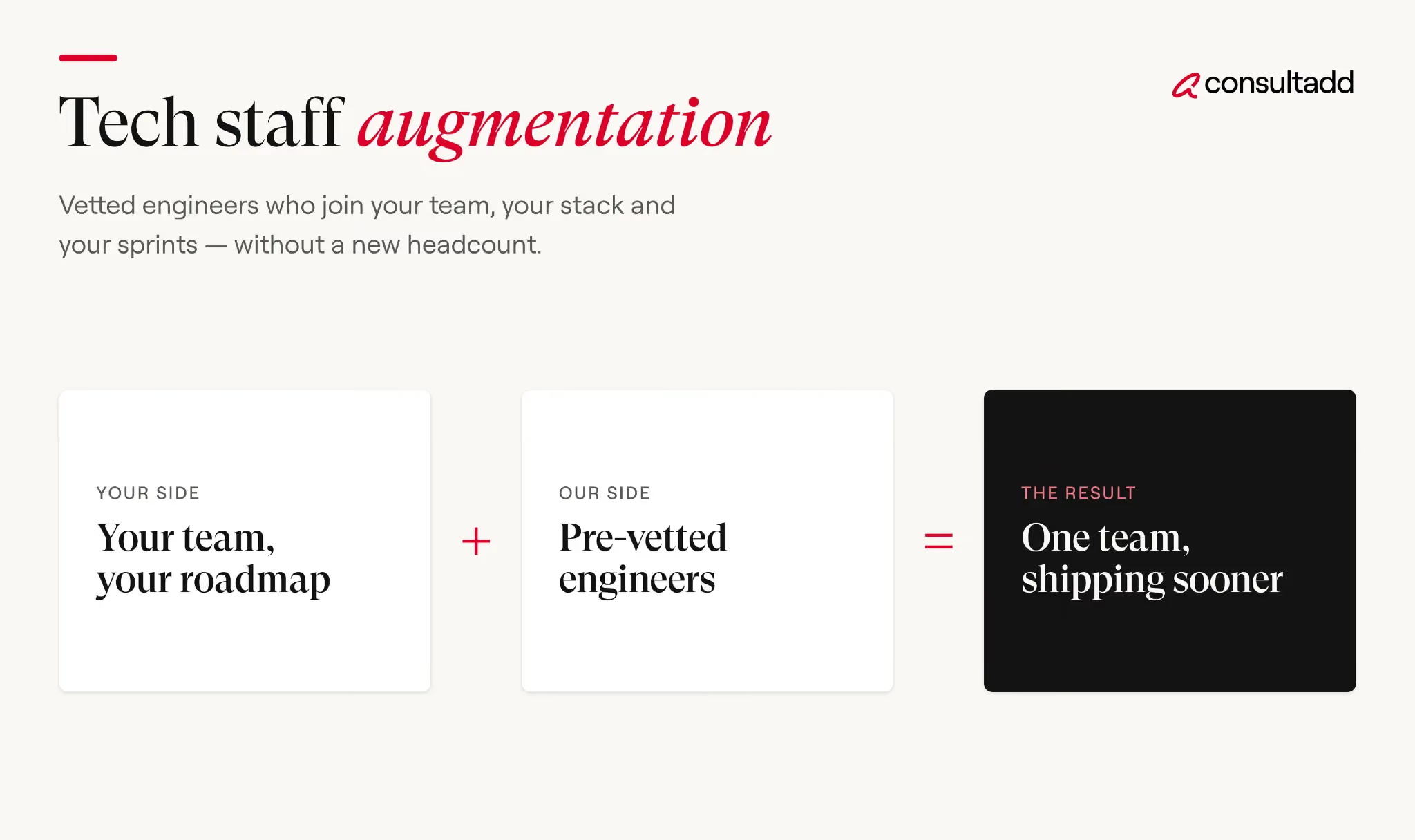
Tech staff augmentation is a staffing model where you bring in external technology professionals to work inside your team for a defined period.
They report to your managers, sit in your standups, work in your repos, and follow your process. You direct the work. A staffing partner handles sourcing, employment, payroll, and compliance.
The people are external. The work is yours.
That's the whole idea, and most confusion about the model comes from blurring it.
The control question
There's one question that sorts almost everything: who decides what gets built this sprint?
If the answer is your engineering manager, it's staff augmentation. If it's the vendor's delivery lead working from a statement of work, it's outsourcing or a managed service.
Both are legitimate. They price differently because the vendor carries different levels of risk.
Companies get into trouble buying one and expecting the other. Paying augmentation rates while expecting a vendor to own delivery outcomes is the common version.
Our breakdown of staff augmentation vs. consulting goes deeper on where that line sits and what each side is actually selling.
How it compares to the alternatives
The full comparison of IT staffing models covers the rest of the category, including RPO and high-volume hiring.
The cost math
The sticker shock is real. An augmented senior engineer might bill at $95 an hour when your equivalent full-time employee costs $160,000 a year. Hourly, that looks like a steep premium. It usually isn't once you finish the arithmetic.
A $160,000 salary carries payroll taxes, benefits, equipment, software licenses, and paid time off. Loaded cost commonly lands 25% to 40% above base. Then there's the cost of making the hire at all.
The SHRM 2025 Benchmarking Report puts average cost per hire at $5,475 for non-executive roles, with median time-to-fill around a month and a half.
And technology roles run slower than the median. The Bureau of Labor Statistics projects employment of software developers, QA analysts, and testers to grow 10 percent from 2025 to 2035, with roughly 106,100 openings a year.
Specialized subsets like ML engineering and cloud security are tighter than the headline suggests.
The last row is the one people forget. Augmentation is cheaper on a 9-month horizon and more expensive on a 3-year one. If you're augmenting the same seat for a third consecutive renewal, you don't have a capacity gap. You have an unfilled role, and you should hire for it.
A rough rule that holds up: under 12 months, augmentation usually wins on total cost. Beyond 18 months, direct hire usually does. The window between them depends on how fast your recruiting actually moves.
When tech staff augmentation is the right call
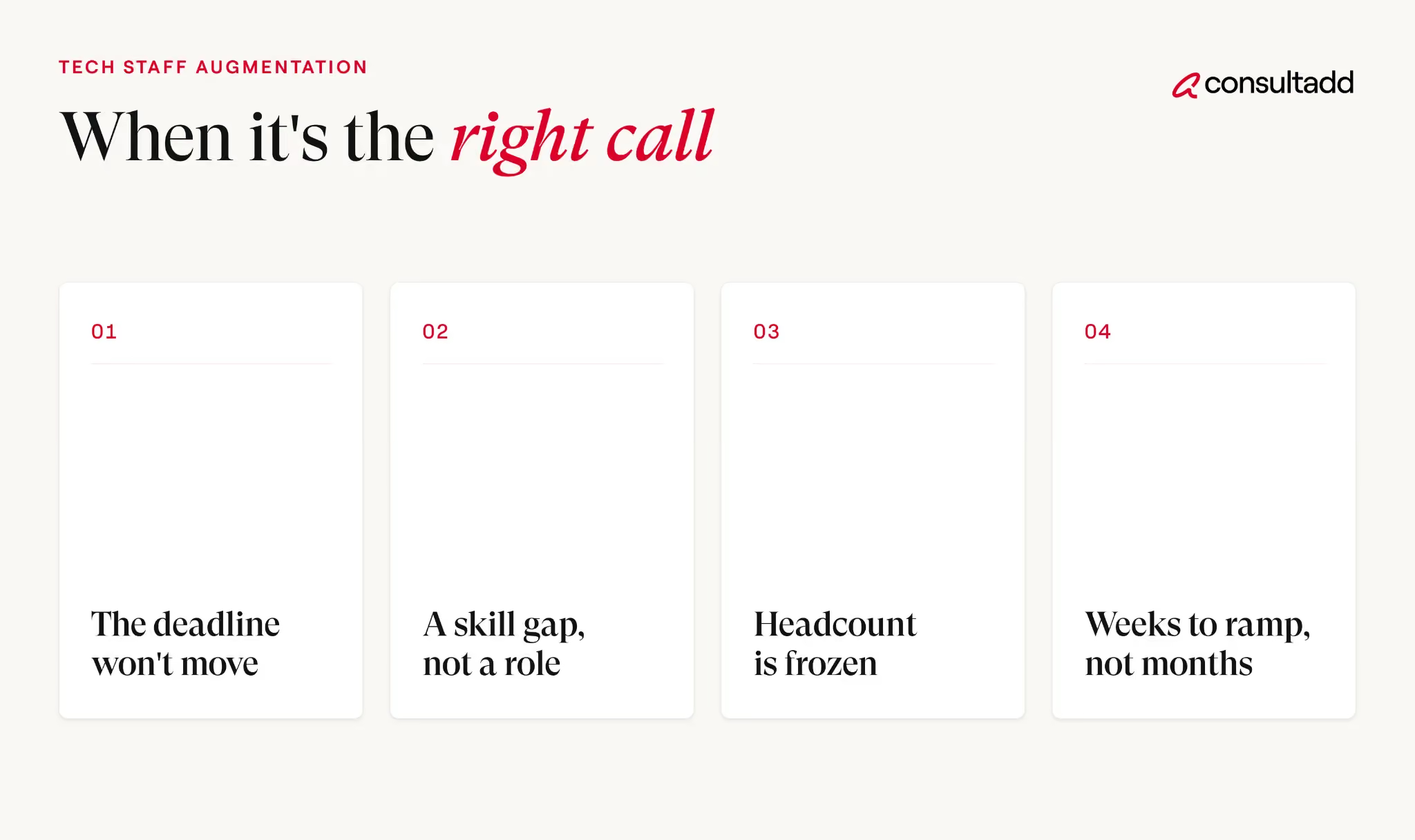
You have a dated commitment and a short runway. A migration with a contractual deadline, a compliance remediation, a product launch. The work has an end date, and missing it costs more than the rate premium.
The skill is specialized and temporary. You need someone who has actually run a Databricks migration, once, for four months. Hiring that permanently makes no sense.
Your roadmap is clear and your bottleneck is hands. This is the cleanest case. You know what to build. You have the architecture, the standards, and the review process. You just need more people writing code against it.
You're a staffing firm supplying your own clients. Different situation, same mechanics.
Our guide to IT staff augmentation and fast tech hiring covers this use case specifically.
You want to test a capability before committing headcount. Bring in a security engineer for six months, find out how much security work you actually generate, then decide.
When it's the wrong call
You don't know what you want built. Augmented engineers take direction. If the direction is unclear, you'll pay hourly rates for people waiting on decisions. Ambiguity is a consulting problem, not a capacity problem.
Nobody has time to manage them. This one kills more engagements than skill gaps do. Augmentation transfers sourcing and employment to a partner. It does not transfer management. If your engineering manager is already at capacity, adding three contractors makes things worse before it makes them better.
The role is permanent and you're avoiding a headcount conversation. Using contractors to route around a hiring freeze is common and usually ends badly. The cost shows up in a different budget line and keeps growing.
The work requires deep, undocumented institutional context. If it takes six months to understand your system, a six-month contractor will spend the whole engagement learning.
You need the knowledge to stay. More on this below, because it's fixable.
How to scope the engagement
Define the outcome, not just the seat
"We need a backend engineer" is a requisition. "We need the payments service migrated off the legacy queue by March 31, with runbooks" is a scope.
The second one tells you when you're done, tells the engineer what success looks like, and gives you something to evaluate against in week four instead of week twenty.
You still manage the work day to day. You just know what the work is for.
Plan the ramp
An augmented engineer at a well-run company is productive in one to two weeks. At a company with no documentation and a 90-minute local setup, it's six. That gap is entirely on your side.
Before anyone starts: access provisioned, environment documented, a named buddy on the team, and a first task that's real but small. The first two weeks are billed either way. Decide whether they're spent shipping or hunting for credentials.
Decide who owns what, in writing
Sourcing, employment, payroll, taxes, and work authorization sit with the staffing partner. Task assignment, code review, and technical standards sit with you.
Equipment, security access, and data handling need an explicit answer. Write it down, because ambiguity here is where compliance problems start.
Consultadd's step-by-step IT staffing process covers intake in more detail, which is where most of this gets settled.
Risks worth managing
Two of these deserve a bit more:
Misclassification is a live enforcement area.
Employers also carry documentation duties on every hire: per USCIS guidance, Form I-9 Section 1 is completed no later than the worker's first day, Section 2 within three business days of the hire date, and the form is retained for three years after hire or one year after employment ends, whichever is later.
When a staffing partner is the employer of record, these obligations sit with them, which is much of the point of using one.
Knowledge transfer is the risk people accept and then regret.
The fix is boring and it works: make documentation a contractual deliverable, pair every augmented engineer with a permanent one on anything structural, and schedule the handoff four weeks before the contract ends rather than in the final week.
Choosing a partner
Every vendor will promise fast sourcing and vetted talent. The differences show up in specifics.
That last row predicts more than people expect. A partner who disappears after placement leaves you handling every rate question, timesheet issue, and performance conversation yourself, which is a chunk of the administrative load you were paying to avoid.
Our buyer's guide to IT staff augmentation companies goes through vendor evaluation in more detail.
Start Strong With Consultadd
With 15 years in business and 5,000+ successful staffing engagements, we don't just fill roles, we build reliability into your process. We've supported 65 staffing companies in the past year alone and maintain MSAs with industry leaders like Robert Half and TEKsystems.
Here's what working with Consultadd looks like:
- Talent sourced in under 24 hours
- Ready-to-deploy candidates, vetted for experience and compliance
- Lower turnover risk: we match long-term goals, not just short-term needs
- Seamless compliance: visa, documentation, onboarding? Handled.
- Dedicated 1:1 account managers for responsive, personalized support
- Top 100 candidate matches delivered in the past year
- Strong partnerships with universities to tap into fresh, committed talent
- Post-placement support so your investment grows beyond day one
For candidates, your next opportunity is more than just a job title, it's a chance to build skills, gain experience, and move your career forward. At Consultadd, we connect technology professionals with projects and employers that align with their goals, whether they're looking for contract, contract-to-hire, or long-term opportunities.
The tech job market moves fast, but the right guidance can make all the difference. Ready to take the next step in your career journey? Explore Opportunities >>
Key takeaways
- Tech staff augmentation adds external technology professionals to your team under your direction, while a staffing partner handles employment and compliance.
- Compare loaded costs, not hourly rates. Augmentation usually wins under 12 months and loses beyond 18.
- If you're renewing the same augmented seat a third time, that's a role you should be hiring for.
- Scope to an outcome and plan the ramp. The first two weeks are billed either way.
- Misclassification, co-employment, and lost knowledge are the three failures worth designing against before anyone starts.
FAQs
What is tech staff augmentation?
It's a staffing model where external technology professionals join your existing team on a contract basis. They work under your managers, in your tools, following your process. A staffing partner handles sourcing, employment, payroll, and compliance.
How is staff augmentation different from outsourcing?
Control and ownership. With augmentation, you direct the work and own the outcome. With outsourcing, a vendor manages its own team against a statement of work and delivers a result. Augmentation prices by time; outsourcing usually prices by project or milestone.
How much does tech staff augmentation cost?
Rates depend on skill and seniority, and a contract rate will always look higher than an equivalent salary divided by hours. The useful comparison includes benefits, payroll taxes, equipment, recruiting cost, and the cost of the role sitting open. On engagements under a year, augmentation is often the cheaper total.
How quickly can augmented engineers start?
A partner with an active talent pool can present vetted candidates within 24 to 72 hours, with starts commonly falling in the two-to-five-week range once interviews, notice periods, and onboarding are accounted for. Visa-dependent candidates may need longer.
What roles are most commonly filled through staff augmentation?
Software engineers, DevOps and platform engineers, QA, data engineers, cloud architects, and security analysts. Demand for AI, ML, and cloud skills has grown fastest, and those are also the roles hardest to fill through a standard recruiting cycle.
Is staff augmentation a good fit for long-term needs?
Generally no. It's built for defined periods. Using it to staff a permanent function tends to cost more over time and concentrates knowledge in people who will eventually leave. If the need is ongoing, augmentation can bridge the gap while you hire, but it shouldn't replace hiring.



.png)