%20(1).avif)

Introduction
What is L1A visa, and why do so many multinational companies rely on it instead of other work visa categories?
In plain terms, it's the visa that lets a company move one of its managers or executives from an office abroad into a U.S. office, without going through the H-1B lottery or a labor certification process.
That makes it one of the more efficient routes into the U.S. for the right candidate, but it's also narrower than people expect. Not every transferred employee qualifies, and the paperwork burden on the employer is real.
Here's what actually determines whether an L1A petition gets approved, how long the status lasts, and what happens after.
TL;DR
- L1A is for executives and managers being transferred from a foreign office to a related U.S. company, not for general employees.
- The employee needs one continuous year of qualifying work abroad within the three years before filing.
- Initial status runs up to three years (one year for new U.S. offices), extendable to a maximum of seven years total.
- L1A doesn't require labor certification, which makes it a faster path to a green card through the EB-1C category than most other work visas.
- USCIS approval rates for L1A run high, but Requests for Evidence are common when the managerial role or corporate relationship isn't documented clearly.
What the L1A visa actually is
According to USCIS, the L-1A classification lets a U.S. employer transfer an executive or manager from an affiliated foreign office into one of its U.S. offices.
It also covers a separate situation: a foreign company that doesn't yet have a U.S. office can send an executive or manager to establish one.
The visa exists specifically for intracompany moves. It's not a general work visa a company can use to hire someone off the open market.
The employee has to already be working for a related entity abroad, and the U.S. side of the business has to have (or be actively building toward) a real qualifying relationship with that foreign company.
Who actually qualifies
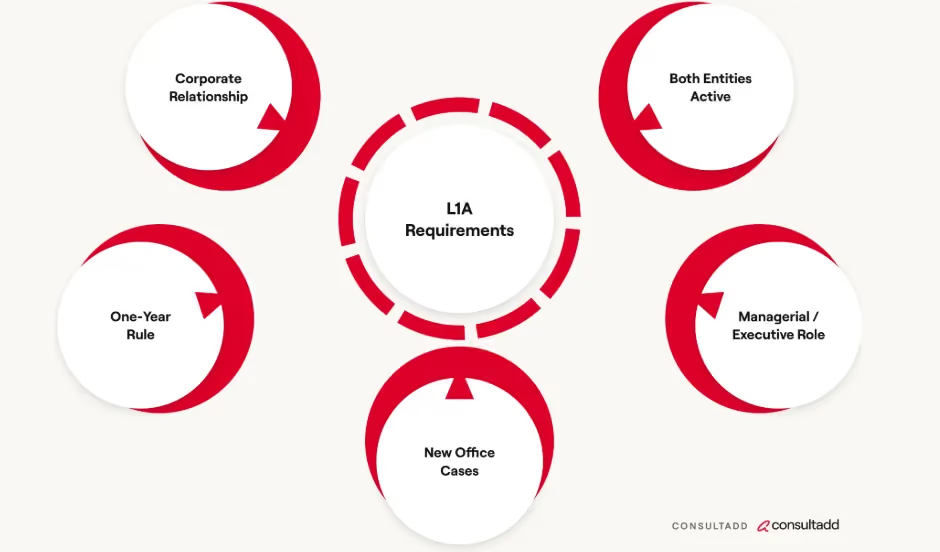
Two separate sets of requirements have to line up: one for the employer, one for the employee.
For the employer,
- USCIS requires a qualifying relationship between the U.S. company and the foreign company, structured as a parent, subsidiary, branch, or affiliate.
- Both sides need to be actually doing business, not just maintaining a name on paper.
- If the U.S. side is a brand-new office, the petition needs to show adequate physical premises and a credible plan for that office to support an executive or managerial position within its first year.
For the employee,
- The core requirement is straightforward on paper but strict in practice: at least one continuous year of employment abroad with the qualifying organization, completed within the three years immediately before filing, in a role that was genuinely managerial or executive.
- The new U.S. position also has to be genuinely managerial or executive, not a title change that doesn't reflect real authority over people, budgets, or a function.
USCIS looks at the org chart, reporting lines, and actual day-to-day duties to decide whether the role genuinely fits the legal definition of managerial or executive capacity, and gaps in that documentation are one of the more common reasons petitions get a Request for Evidence.
L1A versus L1B
The L1A and L1B categories often get confused because they cover the same basic mechanism, an intracompany transfer, but they're built for different kinds of employees.
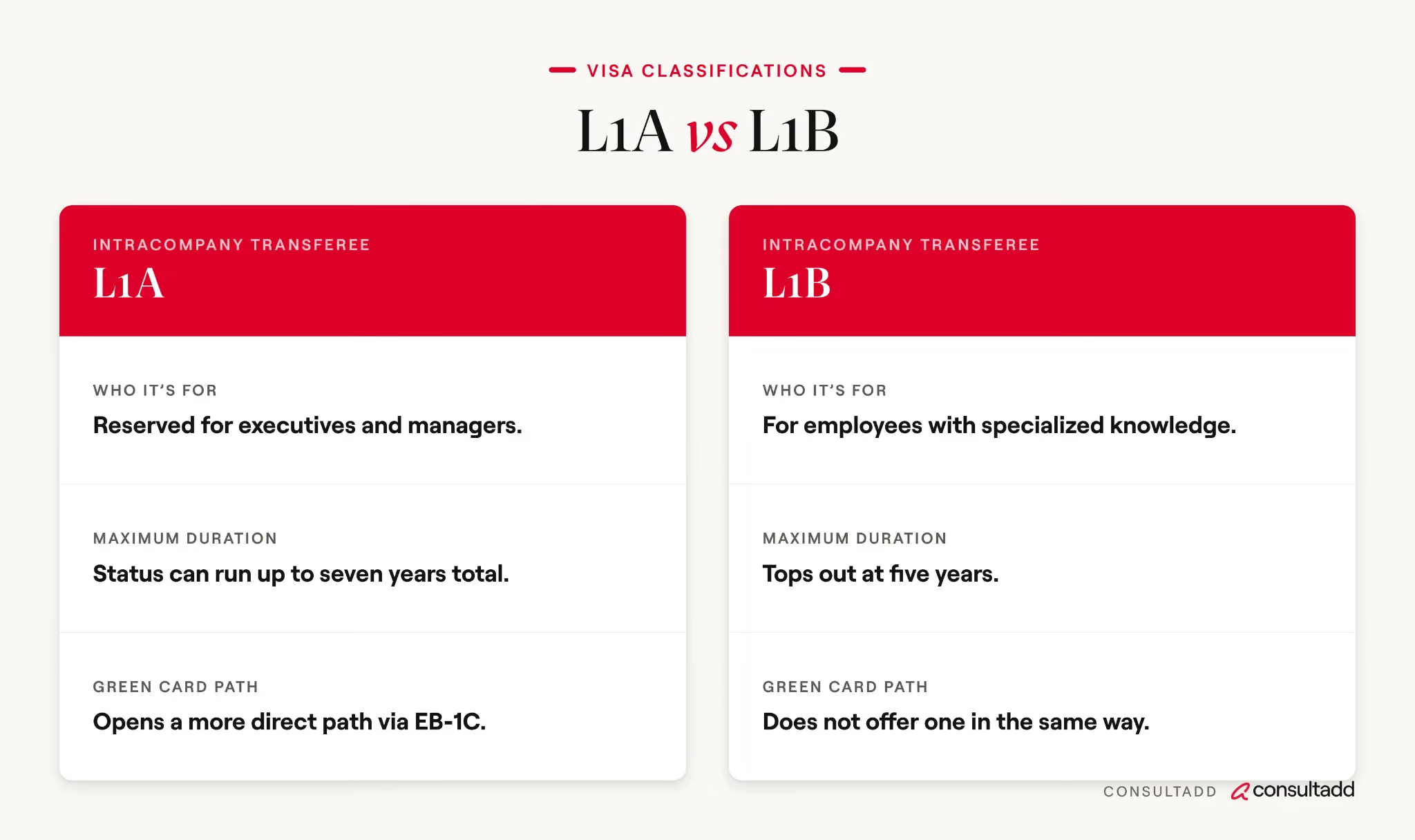
- L1A is reserved for executives and managers, people who direct an organization, a major function within it, or a team of professional staff.
- L1B is for employees with specialized knowledge, meaning deep, company-specific expertise in the business's products, processes, systems, or research that isn't easily available in the U.S. labor market.
The distinction matters beyond eligibility.
- L1A status can run up to seven years total, while L1B tops out at five.
- L1A also opens a more direct green card path, which L1B does not offer in the same way.
How long L1A status actually lasts
A standard L1A petition, for an employee joining an already-established U.S. office, grants an initial stay of up to three years.
If the petition is for a brand-new U.S. office still being set up, the initial stay is capped at one year, since USCIS wants to confirm the office is actually operating as promised before granting a longer period.
Per USCIS policy, extensions beyond that initial period are evaluated against the same managerial or executive capacity standard used at the time of filing.
From there, extensions are available in increments of up to two additional years, until the employee reaches the overall maximum of seven years in L1A status.
After that point, the employee generally needs to either change to a different visa category or, more commonly, be far enough along in a green card process to bridge the gap.
Why L1A is often a stepping stone to a green card
This is one of the biggest practical advantages of the category.
- L1A holders can pursue permanent residence through the EB-1C classification for multinational executives and managers.
- EB-1C doesn't require the PERM labor certification process that slows down most other employment-based green card routes.
- That doesn't make it automatic. The EB-1C petition still has to independently prove the same kind of qualifying relationship and managerial or executive capacity that the original L1A petition established.
- So a well-documented L1A file tends to make the green card stage smoother rather than guaranteeing it.
Employers and employees who treat the L1A paperwork as a formality often end up redoing evidentiary work later that could have been built once, properly, from the start.
For companies weighing whether to bring in transferred talent through this route versus building out a role locally, it helps to understand the broader tradeoffs first.
Our guide on IT staff augmentation covers when bringing in outside talent, transferred or contracted, makes more sense than a purely local hire.
Blanket petitions, for companies that transfer people often
Large multinational companies that regularly move executives and managers to the U.S. can apply for an L-1 blanket petition.
Once approved, it lets qualifying employees apply for L1A status more efficiently, often directly through a U.S. consulate, without the company filing a full individual petition with USCIS for each transfer.
A blanket approval doesn't lower the bar for any individual employee. Each person still has to independently demonstrate they meet the managerial or executive requirements, and a consular officer still has discretion to deny an application even under an approved blanket petition.
It speeds up the process for the employer, not the standard for the employee.
What this means if you're staffing internationally sourced talent
Agencies and companies bringing in talent through cross-border transfers need to think about L1A eligibility earlier than most people expect, ideally before a role is finalized, not after someone has already been informally offered the position.
The one-year foreign employment requirement in particular can't be worked around after the fact.
Our breakdown of how the IT staffing process works covers where visa and compliance planning fits into the broader hiring timeline, which matters just as much for L1A cases as it does for other work authorization categories.
Start Strong With Consultadd
With 15 years in business and 5,000+ successful staffing engagements, we don't just fill roles, we build reliability into your process. We've supported 65 staffing companies in the past year alone and maintain MSAs with industry leaders like Robert Half and TEKsystems.
Here's what working with Consultadd looks like:
- Talent sourced in under 24 hours
- Ready-to-deploy candidates, vetted for experience and compliance
- Lower turnover risk: we match long-term goals, not just short-term needs
- Seamless compliance: visa, documentation, onboarding? Handled.
- Dedicated 1:1 account managers for responsive, personalized support
- Top 100 candidate matches delivered in the past year
- Strong partnerships with universities to tap into fresh, committed talent
- Post-placement support so your investment grows beyond day one
For candidates, your next opportunity is more than just a job title, it's a chance to build skills, gain experience, and move your career forward. At Consultadd, we connect technology professionals with projects and employers that align with their goals, whether they're looking for contract, contract-to-hire, or long-term opportunities.
The tech job market moves fast, but the right guidance can make all the difference. Ready to take the next step in your career journey? Explore Opportunities >>
Key Takeaways
- L1A is for executives and managers transferring between related companies, not a general-purpose work visa.
- The employee needs one continuous year of qualifying foreign employment within the three years before filing.
- Status runs up to seven years total, starting at one year for new offices or three years otherwise.
- EB-1C offers a labor-certification-free green card path for L1A holders, but it still requires its own evidentiary proof.
- Blanket petitions speed up the process for frequent-transfer employers, but every employee still has to individually qualify.
FAQs
What is the difference between L1A and L1B visas?
L1A covers executives and managers who direct an organization or function. L1B covers employees with specialized, company-specific knowledge. L1A also allows a longer maximum stay and a more direct green card path than L1B.
How long does it take to get an L1A visa approved?
Standard processing typically runs around six months, though this varies by case complexity and USCIS workload. Premium processing, where available, guarantees a response within 15 business days for an added fee.
Can an L1A visa holder bring their family to the U.S.?
Yes. Spouses and unmarried children under 21 can seek L2 status, generally for the same period as the primary visa holder. Spouses can apply separately for work authorization once in L2 status.
Does the L1A visa require a labor certification?
No. That's one of its key advantages over most other employment-based visa categories, and it carries through to the EB-1C green card process, which also skips the PERM labor certification requirement.
What happens if an L1A employee's role changes after arriving in the U.S.?
The new role needs to remain genuinely managerial or executive to stay compliant with the visa's terms. A significant change in duties, especially one that moves away from managerial or executive responsibilities, can create compliance problems and should be reviewed with immigration counsel before it happens.
Can a small or newly formed company sponsor an L1A visa?
Yes, through the new office provision, but the bar is higher. The company has to show adequate physical premises and a credible plan for the U.S. office to support an executive or managerial position within its first year, and the initial approval is limited to one year instead of three.



.webp)