

Introduction
Read ten software developer job postings and you'll see ten versions of the same list: a computer science degree, three to five years of experience, a handful of languages, and "strong communication skills." Some of those lines are firm requirements. Others are wishes.
Software developer qualifications usually come down to four things: education, proven programming ability, relevant experience for the level, and sometimes a certification for cloud or platform-heavy roles.
This guide breaks down what each one means in practice, which ones employers actually hold firm on, and how candidates without a traditional background can still qualify.
It also covers how hiring teams should write qualifications so they attract the right people.
TL;DR
- Most employers list a bachelor's degree in computer science or a related field, but many accept equivalent experience or a strong portfolio.
- Experience requirements scale with level, and what you've built matters more than the number of years.
- Certifications are optional for most developer roles but carry weight for cloud, platform, and security-focused work.
- Employers test qualifications through technical interviews and code reviews, not just resumes.
- Job descriptions work best when they separate a short list of real requirements from preferred extras.
What software developer qualifications employers ask for
Here's how the common qualifications usually show up in postings, and how much weight they tend to carry in a real hiring decision.
Demand for qualified developers is still growing. The U.S. Bureau of Labor Statistics projects software developer employment to grow 10 percent from 2025 to 2035, much faster than the average for all occupations, and reports a median annual wage of $135,980 for software developers in May 2025.
Software developer education requirements
Computer science and related degrees
The traditional route is still the most common. BLS notes that software developers typically need a bachelor's degree in computer and information technology or a related field such as engineering or mathematics, and that some employers prefer a master's degree.
O*NET, the Labor Department's occupation database, places software developers in Job Zone Four, meaning most of these jobs require a four-year degree, but some do not. That "some do not" is where a lot of developers enter the field.
A degree helps in three practical ways:
- It covers fundamentals like data structures, algorithms, and operating systems that come up in technical interviews.
- It gets past automated resume filters at large employers.
- And for candidates who need an H-1B, a bachelor's degree or its equivalent in a related field is generally part of the legal requirement for the visa, not just an employer preference.
Our guide on sponsoring an H-1B visa explains how that works.
Paths without a computer science degree
Plenty of working developers studied something else or skipped college entirely. Each path proves something different and leaves a different gap to close.
From the recruiting side, the pattern is consistent.
Candidates without a CS degree who get shortlisted almost always have something concrete to point to: a deployed app, a meaningful open source contribution, or a previous job where they wrote production code under a different title.
Software developer certifications worth having
Certifications aren't required for most developer roles. They matter most when the job is tied to a specific platform.
AWS describes its Developer – Associate exam as intended for people already in a developer role, covering development, testing, deployment, and debugging of AWS applications.
That's a useful signal. A certification works best as proof of skills you're already using, not a substitute for them.
Hiring managers tend to treat certifications as a reason to ask deeper questions, not a reason to skip them.
Our post on AWS developers for hire shows how employers probe certified candidates in interviews.
Experience requirements by level
Years of experience in a posting are a rough proxy for scope. What employers really want to know is what you've owned.
These ranges vary by company. A developer with three years at a small startup may have owned more than someone with six years on a narrow slice of a large system.
If your scope fits the role but your years fall short, say so directly in your resume and cover letter with examples.
Technical and soft skill qualifications
Technical skills deserve their own deep dive, so we've covered them separately in our lists of the most in-demand software engineering skills and key IT skills employers want.
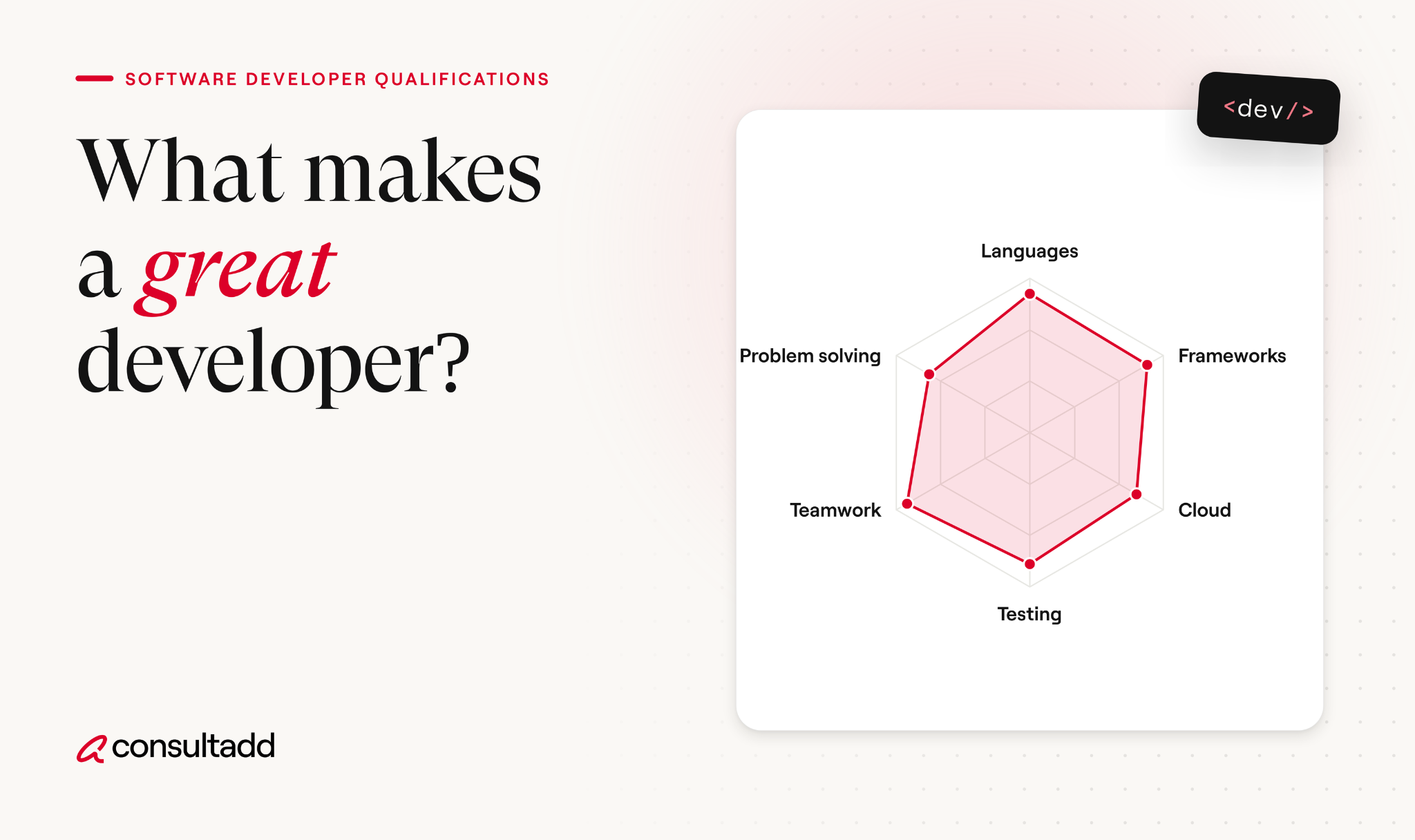
At the qualifications level, most employers expect:
- Strong command of at least one programming language used in the role
- Working knowledge of data structures and algorithms
- Version control, usually Git
- Testing practices and debugging
- Databases and APIs relevant to the stack
The soft skills are just as real. BLS lists analytical, communication, creativity, detail orientation, interpersonal, and problem-solving skills among the important qualities for the occupation. In interviews, these show up as how clearly you explain a design decision and how you handle a question you can't immediately answer.
How candidates can show their qualifications
A qualification only counts if the hiring team can see it. Recruiters review a lot of resumes quickly, so make the evidence easy to find.
- Lead with outcomes. "Built a payment retry service in Java that cut failed transactions" says more than "Responsible for backend development."
- Link to real work. A GitHub profile with two well-documented projects beats twenty abandoned repositories.
- Match the stack. If the posting lists Spring Boot and PostgreSQL, make sure those words appear where you actually used them.
- Explain gaps in formal qualifications. If you don't have a CS degree, put your strongest project or work experience near the top.
- Prepare to prove it live. Expect a coding exercise or a walkthrough of code you've written.
For role-specific examples, see our breakdown of Java full stack developer skills, which includes expectations by experience level.
Writing software developer qualifications in a job description
For hiring teams, the qualifications section of a job description does more filtering than any interview. Long lists of requirements push away qualified people who don't check every box.
Keep required qualifications to what the person truly needs on day one. Everything else goes under preferred. Then test those requirements directly with a practical assessment.
Our guide on how to hire the best software engineers walks through skills-based assessments that do this well.
Meeting software developer qualifications without every box checked
Most software developer qualifications are more flexible than job postings make them look. Education and years of experience open doors, but demonstrated ability is what gets the offer.
For candidates, that means building proof: projects, contributions, and work you can explain in detail. For hiring teams, it means writing requirements that describe the work and testing for it directly.
Both sides end up in the same place, a developer who can do the job, judged on evidence rather than a checklist.
Start Strong With Consultadd
With 15 years in business and 5,000+ successful staffing engagements, we don't just fill roles, we build reliability into your process. We've supported 65 staffing companies in the past year alone and maintain MSAs with industry leaders like Robert Half and TEKsystems.
Here's what working with Consultadd looks like:
- Talent sourced in under 24 hours
- Ready-to-deploy candidates, vetted for experience and compliance
- Lower turnover risk: we match long-term goals, not just short-term needs
- Seamless compliance: visa, documentation, onboarding? Handled.
- Dedicated 1:1 account managers for responsive, personalized support
- Top 100 candidate matches delivered in the past year
- Strong partnerships with universities to tap into fresh, committed talent
- Post-placement support so your investment grows beyond day one
For candidates, your next opportunity is more than just a job title, it's a chance to build skills, gain experience, and move your career forward. At Consultadd, we connect technology professionals with projects and employers that align with their goals, whether they're looking for contract, contract-to-hire, or long-term opportunities.
The tech job market moves fast, but the right guidance can make all the difference. Ready to take the next step in your career journey? Explore Opportunities >>
Key takeaways
- Most software developer roles list a bachelor's degree in computer science or a related field, but many accept equivalent experience.
- Programming ability is the one qualification employers almost never bend on, and they test it directly.
- Certifications add the most value for cloud, platform, and security-focused roles.
- Experience is judged by scope and ownership more than by the number of years.
- Hiring teams attract better candidates by separating a short list of true requirements from preferred extras.
FAQs
What qualifications do you need to be a software developer?
Most employers look for a bachelor's degree in computer science or a related field, strong programming skills in at least one language, and experience building working software. Many accept equivalent experience or a solid portfolio in place of a degree. Communication and problem-solving skills are also expected.
Can you become a software developer without a degree?
Yes. Many developers come from bootcamps, self-study, or unrelated degrees. The key is proving your ability through real projects, open source work, or previous jobs where you wrote production code. Some employers and visa categories do still require a degree or its equivalent.
Which certifications are best for software developers?
It depends on the role. Cloud developer certifications from AWS, Microsoft, or Google are the most widely recognized for cloud-focused work. Language and platform certifications, such as Oracle Java or Salesforce, help for enterprise roles. For most general developer jobs, certifications are a plus rather than a requirement.
How many years of experience do software developers need?
Entry-level roles often ask for zero to two years, mid-level roles two to five, and senior roles five or more. These ranges vary by company. Employers care more about what you've built and owned than the exact number of years.
What is the difference between software developer and software engineer qualifications?
The titles are often used interchangeably, and the qualifications overlap heavily. Some companies expect engineers to have more focus on system design and the broader architecture. Read the responsibilities in each posting rather than relying on the title.
What qualifications do entry-level software developers need?
Entry-level candidates usually need a degree or equivalent training, a working knowledge of one programming language, and familiarity with Git, testing, and basic data structures. A few well-documented projects make a big difference. Internships or freelance work help show you can work on a real codebase.