
Contracts

Corp to Corp Staffing Explained: The Complete Guide
Introduction
"C2C only" shows up on so many IT job postings that most people scroll right past it without a second thought. But corp to corp is a specific business arrangement with its own tax rules, contracts, and risks, and getting it wrong can cost real money on both sides.
This guide breaks down what corp to corp actually means, how the paperwork and payments move through the chain, and when this staffing model makes sense for your hiring plans.
TL;DR
- Corp to corp (C2C) means a company pays another business entity, not an individual, for a contractor's work.
- The contractor needs a real registered business, such as an LLC or S-corp. A sole proprietorship doesn't count.
- C2C differs from W2 and 1099 arrangements in who handles taxes, benefits, and legal liability.
- Misclassifying a worker under a C2C label can trigger IRS penalties, back pay, and audits.
- Consultadd handles the vetting, compliance, and paperwork so staffing firms and clients can move fast without taking on the risk themselves.
What Is Corp to Corp (C2C)?
Corp to corp is a contracting arrangement where a business pays another business for a worker's services, instead of paying that worker directly. The contractor sets up a registered entity, usually an LLC or S-corp, and that entity signs the contract, sends the invoice, and collects the payment.
The person still shows up and does the job. What changes is the paper trail. Money moves from company to company instead of company to individual, which is exactly where the name comes from.
This setup is common in IT staffing, where specialized skills are needed for a defined stretch of time and neither side wants the overhead of a permanent hire.
For a closer look at how these agreements typically read, our breakdown of what C2C employment actually involves walks through a sample arrangement piece by piece.
Who's Involved in a Corp to Corp Chain
A typical C2C placement usually has three parties in it:
- The end client, who needs the work done
- A staffing agency or prime vendor, who holds the contract with the client
- The contractor's business entity, which signs the corp-to-corp agreement with the agency
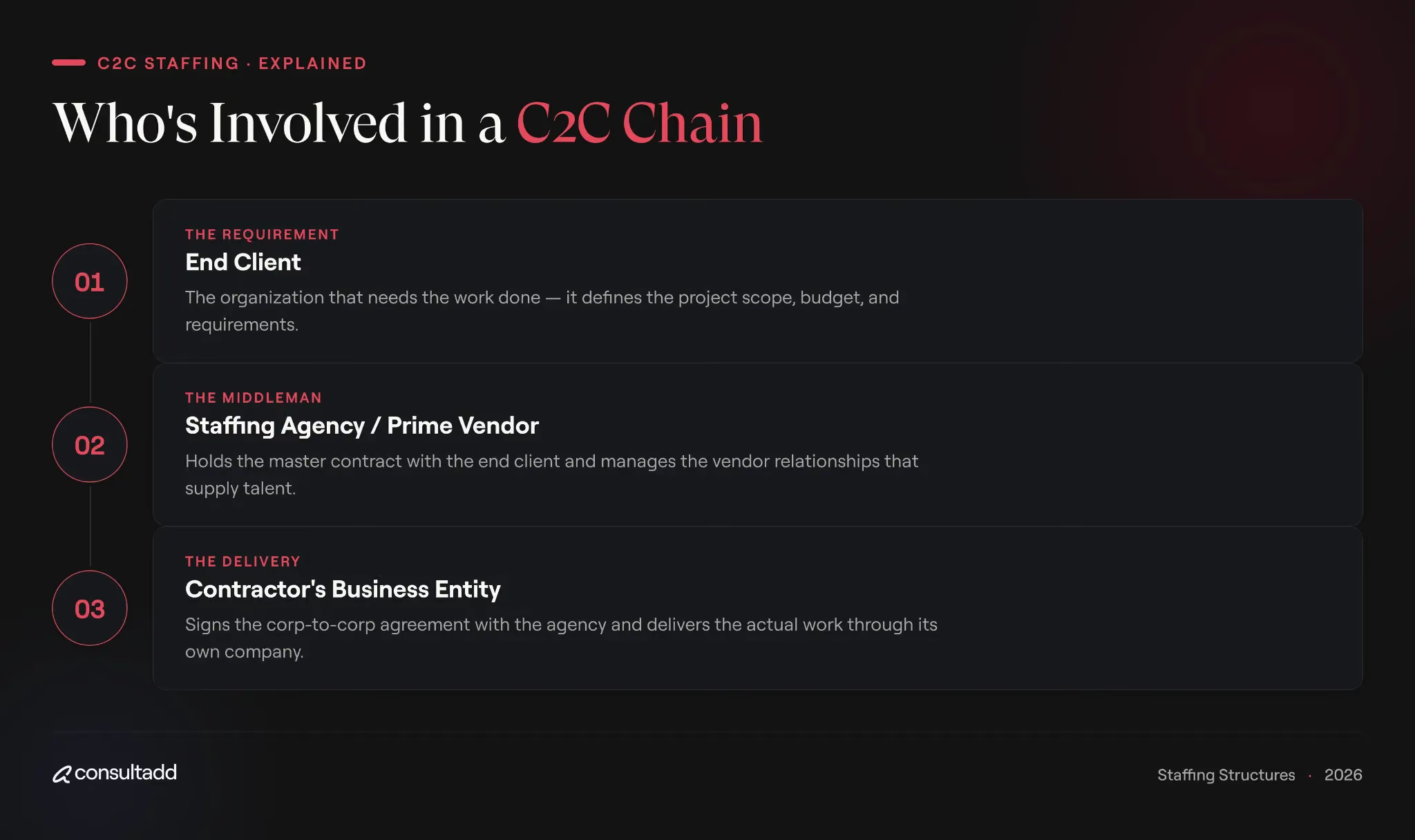
Money and paperwork flow down this chain, and so does risk. If one link in the chain isn't set up correctly, everyone above it can inherit the problem.
How a Corp to Corp Agreement Actually Works
Picture a nine-month software engineering project. The client doesn't want to hire full time for it. A staffing agency finds a contractor who already runs an LLC. The agency signs a C2C agreement with that LLC, not with the person behind it.
The contractor does the work. Their LLC invoices the agency. The agency bills the client. Everyone gets paid, but no one in the chain is technically the "employer" of the person writing the code, at least not in the traditional sense.
For a plain-language comparison of how this stacks up against other contract types, our guide on what contract work actually means covers 1099 and W2 setups side by side.
Corp to Corp vs W2 vs 1099
People mix these three up constantly, and honestly, the confusion isn't surprising. All three describe someone working on a project without a permanent job title, but the tax picture and the liability picture change with each one.
Why Companies and Contractors Choose Corp to Corp
For companies, C2C usually means no payroll taxes, no benefit obligations, and no long-term commitment. The relationship ends when the contract ends. There's no severance conversation to have.
For contractors, running a business entity brings more control over rates, the freedom to work with multiple clients at once, and tax deductions that W2 employees simply don't get.
None of that makes C2C the automatic right answer. It fits short, well-defined projects with niche skills far better than it fits an open-ended role where the company wants ownership over how the day-to-day work gets done.
Our piece on why C2C contract hiring solutions matter for recruitment goes into the scenarios where this model earns its keep.
Compliance Risks in Corp to Corp Staffing
This is where things go wrong for companies that treat C2C as a shortcut around hiring rules.
The IRS doesn't care what label sits on the contract. It looks at who controls the work, who carries the financial risk, and how the relationship actually functions from day to day.
The IRS's own guidance on employee versus independent contractor status lays out the same three factors examiners use in every classification review: behavioral control, financial control, and the type of relationship between the parties.
Get the classification wrong, and the Department of Labor's rules on misclassification can require back pay, overtime, and penalties, even when both sides agreed to the C2C label going in.
Corp to Corp and Visa Sponsorship
C2C gets more complicated once visa sponsorship enters the picture, especially for H-1B roles placed at a client's site instead of the sponsoring employer's own office.
USCIS pays close attention to these placements. Its guidance on third-party worksite requirements requires the petitioning employer to prove the work qualifies as a specialty occupation and that a genuine employer-employee relationship exists for the entire length of the petition.
That means real paperwork: signed contracts, detailed job duties, and a clear chain showing who actually directs the work. Skip this step and an H-1B extension can get denied or flagged for further review.
Our guide to corp to corp visa sponsorship for H1B jobs walks through the documentation USCIS typically asks for.
Is Corp to Corp Right for Your Hiring Needs?
C2C tends to make sense when:
- The project has a defined scope and a clear end date
- You need a specialized skill set you won't need on a permanent basis
- The contractor already runs a registered business with insurance in place
- Speed matters more than long-term retention
It tends to make less sense when:
- The role is genuinely full time and open-ended
- You want direct control over schedules, tools, and daily supervision
- The worker doesn't have, or want, their own business entity
If you land somewhere in the middle, that's usually a sign to bring in a staffing partner rather than guess your way through it.
Start Strong With Consultadd
With 15 years in business and 5,000+ successful staffing engagements, we don't just fill roles, we build reliability into your process. We've supported 65 staffing companies in the past year alone and maintain MSAs with industry leaders like Robert Half and TEKsystems.
Here's what working with Consultadd looks like:
- Talent sourced in under 24 hours
- Ready-to-deploy candidates, vetted for experience and compliance
- Lower turnover risk: we match long-term goals, not just short-term needs
- Seamless compliance: visa, documentation, onboarding? Handled.
- Dedicated 1:1 account managers for responsive, personalized support
- Top 100 candidate matches delivered in the past year
- Strong partnerships with universities to tap into fresh, committed talent
- Post-placement support so your investment grows beyond day one
For candidates, your next opportunity is more than just a job title, it's a chance to build skills, gain experience, and move your career forward. At Consultadd, we connect technology professionals with projects and employers that align with their goals, whether they're looking for contract, contract-to-hire, or long-term opportunities.
The tech job market moves fast, but the right guidance can make all the difference. Ready to take the next step in your career journey? Explore Opportunities >>
Key Takeaways
- Corp to corp means the hiring company pays a contractor's business entity, not the contractor as an individual.
- A real LLC, S-corp, or C-corp is required on the contractor's side. A sole proprietorship won't qualify.
- C2C shifts tax and benefit responsibility to the contractor's business, unlike W2 arrangements.
- Misclassification is the biggest compliance risk, and both the IRS and Department of Labor enforce it.
- H-1B placements under C2C need solid documentation to satisfy USCIS third-party worksite rules.
FAQs
What does corp to corp (C2C) mean in staffing?
Corp to corp means the hiring company or staffing agency pays a contractor's registered business, like an LLC or S-corp, instead of paying the contractor directly. The contractor's business invoices for the work and handles its own taxes.
What's the difference between C2C and 1099?
A 1099 contractor works as an individual and reports income on their own tax return. A C2C contractor works through a registered business entity, and that entity, not the person, is the party named in the contract.
Can a corp to corp contractor be on an H1B visa?
It's possible, but it requires careful documentation. USCIS scrutinizes third-party placements closely and needs proof that a genuine employer-employee relationship exists for the full length of the petition.
Do I need an LLC to work corp to corp?
Yes. A C2C arrangement requires a real registered business entity, typically an LLC, S-corp, or C-corp. Working as a sole proprietor doesn't satisfy the structure.
Who pays taxes in a corp to corp arrangement?
The contractor's business entity handles its own tax obligations. The hiring company doesn't withhold payroll taxes the way it would for a W2 employee.
Is corp to corp the same as being self-employed?
Not quite. Both involve working outside traditional employment, but C2C specifically requires a registered business entity as the contracting party, while general self-employment (like 1099 work) doesn't.

What Is a 1099 Business Opportunity? A Simple Guide
Introduction
You have probably seen it on a job listing or in a recruiter's email: a 1099 role, a 1099 gig, a 1099 opportunity. It sounds official, maybe a little intimidating. So what is a 1099 business opportunity, really?
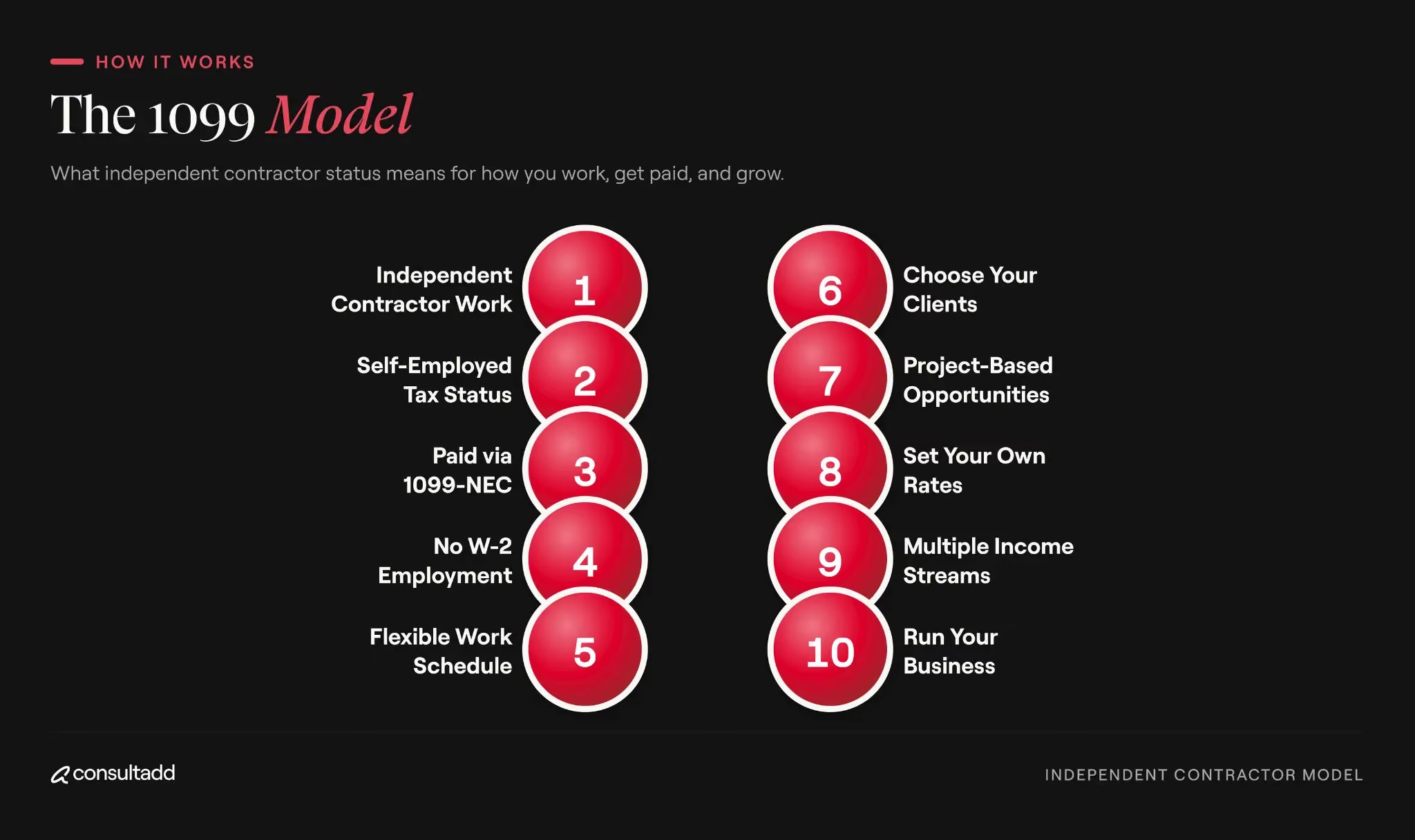
Here is the short version. It is not a product you buy off a shelf or a franchise you sign up for. It is a chance to earn money as an independent contractor instead of a regular employee. You offer your skills or services to a client, they pay you, and at tax time you get a Form 1099-NEC rather than a W-2. That one difference changes how you get paid, how you file taxes, and how much freedom you have over your work.
For a lot of people, that trade is worth it. For others, it is a headache they did not sign up for. Let me walk through how it works so you can decide which camp you fall into.
TL;DR
- A 1099 business opportunity is a chance to earn income as a self-employed independent contractor, not a job you buy or a franchise.
- You get paid without tax withholding, so you handle your own taxes and set aside 25% to 30% of income.
- The 2026 self-employment tax rate is 15.3%, and on $100,000 a 1099 worker pays roughly $7,065 more in employment taxes than a W-2 employee.
- The upside is control, flexibility, higher earning potential, and broad tax deductions.
- Watch for red flags like upfront fees or "recruit others to earn" pitches, which are not real 1099 opportunities.
What is a 1099 business opportunity?
A business opportunity, in plain terms, is a favorable situation you can use to start or grow something of your own. Add "1099" to it and you are talking about doing that as an independent contractor.
The name comes from the IRS form. When a client pays you as a contractor, they report it on a 1099-NEC (short for nonemployee compensation). When an employer pays you as staff, they use a W-2.
The IRS treats anyone who receives a 1099-NEC as self-employed, which is a tax status, not a business structure.
So a 1099 business opportunity usually means one thing: there is a demand for a skill you have, and you can meet it as your own boss.
Maybe a company needs a software developer for a six-month project. Maybe a growing business needs marketing help but does not want a full-time hire. You step in, do the work, and run it like a one-person business.
The best of these opportunities share a few traits. They solve a clear need, they pay well enough to be worth your time, and they can grow as you add clients.
How a 1099 opportunity actually works
The mechanics are simpler than the paperwork makes them look. You agree on a scope and a rate, you do the work, and you invoice for it. No taxes come out of your pay.
That money is yours to manage, which is both the appeal and the catch.
The 1099-NEC form and reporting thresholds
- If a single client pays you enough in a year, they send you a 1099-NEC and file a copy with the IRS.
- For 2026, that reporting threshold rose to $2,000, up from the long-standing $600 figure, under a recent tax law change.
- One thing trips people up here. You owe tax on all your self-employment income whether or not a form shows up in your mailbox.
- The 1099 is a reporting tool, not the thing that creates the tax. Keep your own records and report everything.
1099 versus W-2: who handles what
This is the comparison that matters most. A W-2 employer withholds your income tax, takes out your share of Social Security and Medicare, and pays the employer half on top.
As a 1099 contractor, none of that happens for you. You carry it all.
Neither column is "better" in the abstract. It depends on what you value. If predictability keeps you sane, W-2 has real appeal.
If you want control and can handle the admin, the 1099 side opens up.
The tax side you need to understand
This is where a 1099 opportunity earns its reputation. Not because the taxes are unfair, but because nobody is doing them for you. Go in prepared and it is manageable. Ignore it and April gets ugly.
Self-employment tax and what to set aside
Since no employer is splitting the bill, you pay both halves of Social Security and Medicare.
For 2026 that self-employment tax is 15.3%, made up of 12.4% for Social Security and 2.9% for Medicare, calculated on about 92.35% of your net earnings.
The Social Security portion applies up to a wage base of $184,500.
To put a number on it, a 1099 worker earning $100,000 pays roughly $7,065 more in employment taxes than a W-2 employee at the same income. That gap surprises people who jump to contracting for the higher rate without adjusting for it.
The fix is boring but works: set aside 25% to 30% of every payment for taxes. Pay quarterly estimated taxes if you expect to owe $1,000 or more for the year. Here are the 2026 numbers worth memorizing.
Deductions that lower your bill
Here is the part people forget when they only look at the tax rate. As a 1099 worker, the IRS treats you as a business, so ordinary business expenses reduce what you owe. You can also deduct half of your self-employment tax right off your income.
The qualified business income deduction lets many contractors write off up to 20% of their business income, and it is now permanent.
Add a home office, software, equipment, mileage, and a retirement plan like a SEP-IRA or Solo 401(k), and your effective tax rate can land lower than that 15.3% headline suggests.
For the full mechanics, the IRS self-employment tax page lays out the forms, mainly Schedule C and Schedule SE.
Pros and cons of a 1099 business opportunity
No sugarcoating here. A 1099 business opportunity gives you real freedom and real responsibility in equal measure. Weigh both before you commit.
The honest read: contracting rewards people who are disciplined about money and comfortable with uneven income. If a slow month would put you in a panic, build a cushion first. If you like variety and hate being told when to log on, this setup can fit you well.
How to spot a legitimate 1099 opportunity
Not everything labeled a "1099 business opportunity" is a real one. The term gets borrowed by pitches that are closer to a sales scheme than actual contract work. A little skepticism protects you.
Real contract work has a clear scope, a rate you agree to, and a client who pays you for services. If someone asks you to pay to join, or the money comes mainly from recruiting other people, that is not a 1099 opportunity. That is a warning sign.
There is also a legal angle. Some companies label workers as 1099 contractors when they treat them like employees, which is called misclassification. The IRS uses a test built on behavioral control, financial control, and the type of relationship.
If you think you have been misclassified, the U.S. Department of Labor and IRS Form SS-8 give you a path to a formal determination.
Common types of 1099 opportunities
The label covers a wide range of work. What ties it together is that you serve clients as an independent business rather than clocking in as staff.
Technology leads the list. Software developers, cloud engineers, data specialists, and IT consultants take contract roles constantly, often through a staffing partner that handles the client relationship and paperwork.
If that is your field, our overview of contract-to-hire roles explains how these engagements often convert into permanent offers, and IT staff augmentation covers how companies bring contractors onto their teams.
Beyond tech, you will find consultants advising on business or finance, creative freelancers like writers and designers, tradespeople, and gig platform workers. The tax rules are the same across all of them.
Start Strong With Consultadd
With 15 years in business and 5,000+ successful staffing engagements, we don't just fill roles, we build reliability into your process. We've supported 65 staffing companies in the past year alone and maintain MSAs with industry leaders like Robert Half and TEKsystems.
Here's what working with Consultadd looks like:
- Talent sourced in under 24 hours
- Ready-to-deploy candidates, vetted for experience and compliance
- Lower turnover risk: we match long-term goals, not just short-term needs
- Seamless compliance: visa, documentation, onboarding? Handled.
- Dedicated 1:1 account managers for responsive, personalized support
- Top 100 candidate matches delivered in the past year
- Strong partnerships with universities to tap into fresh, committed talent
- Post-placement support so your investment grows beyond day one
For candidates, your next opportunity is more than just a job title, it's a chance to build skills, gain experience, and move your career forward. At Consultadd, we connect technology professionals with projects and employers that align with their goals, whether they're looking for contract, contract-to-hire, or long-term opportunities.
The tech job market moves fast, but the right guidance can make all the difference. Ready to take the next step in your career journey? Explore Opportunities >>
Key takeaways
- A 1099 business opportunity is simply a chance to earn income as a self-employed independent contractor, reported on Form 1099-NEC instead of a W-2.
- You keep more control and gain wide tax deductions, but you handle your own taxes and give up employer benefits.
- Plan for the 2026 self-employment tax of 15.3% and set aside 25% to 30% of your income.
- Deductions like the 20% qualified business income write-off can pull your effective tax rate below the headline number.
- Vet every offer: real contract work pays you for services, while upfront fees or recruit-to-earn pitches are red flags.
FAQs
Is a 1099 business opportunity the same as a job?
Not exactly. A job usually means W-2 employment with taxes withheld and benefits provided. A 1099 opportunity means you work as an independent contractor, run your own taxes, and serve clients as a business. You gain freedom but take on more responsibility.
Do I need an LLC to take a 1099 opportunity?
No. You can operate as a sole proprietor and still receive 1099-NEC income. Forming an LLC or S Corp can offer liability protection and possible tax savings as your income grows, but it is optional, not a requirement to start.
How much should I set aside for taxes as a 1099 contractor?
A good rule is 25% to 30% of each payment. Since no taxes are withheld, you are responsible for self-employment tax plus income tax. If you expect to owe $1,000 or more for the year, the IRS wants you to pay quarterly estimated taxes.
What is the difference between a 1099-NEC and a 1099-K?
A 1099-NEC reports payments a client made to you directly for services. A 1099-K reports payments processed through platforms like PayPal or Stripe. For 2026, the 1099-K threshold returns to $20,000 and 200 transactions, but you still report all income regardless of which form arrives.
Are 1099 business opportunities legit or a scam?
Most are legitimate contract work. The term gets misused, though. Real opportunities pay you for a service under a clear agreement. If an offer asks for an upfront fee or the income depends on recruiting others, treat it as a warning sign and walk away.
Can a 1099 opportunity turn into a full-time job?
Yes, often. Contract-to-hire arrangements are built for exactly this. Both sides use the contract period to test fit, and many convert into permanent W-2 roles. Working through a staffing partner can make that transition smoother.

What's Work Authorization?
Introduction
You found the perfect candidate. Skills, culture fit, everything lines up. Then someone asks whether they can legally work here, and the hire grinds to a halt. If you have been there, you already know why this matters.
So what's work authorization? In plain terms, it is the legal permission a person needs to work in a country where they are not a citizen.
For employers, it is also a compliance line you cannot cross. Hire someone who is not authorized, and the fines land on you, not them. This guide breaks down what work authorization means, who needs it, the main types, and how you verify it without stepping into legal trouble.
TL;DR
- Work authorization is the legal permission to work in a country you are not a citizen of.
- U.S. citizens and green card holders are already authorized and need no extra document.
- Many non-citizens prove authorization with an Employment Authorization Document (EAD), also called a work permit.
- Every U.S. employer must confirm work authorization using Form I-9 for every new hire, citizens included.
- Getting classification or verification wrong can trigger fines, so process and paperwork matter.
What work authorization actually means
Work authorization is the legal right to hold a job in a country where you are not a citizen or permanent resident. In the United States, that right comes from your immigration status, your circumstances, or a document that proves both.
Some people carry their authorization automatically. A U.S. citizen does not think twice about it. A lawful permanent resident, or green card holder, is authorized to work without applying for anything extra, since the green card itself is the proof.
Everyone else usually needs to show something. That something is often a work permit, which brings us to the different types below.
If you want a staffing-focused primer on the topic, Consultadd has a clear rundown of what a work authorization is and why it matters in hiring.
Who needs work authorization
Citizens do not need to prove work authorization the way non-citizens do, though they still complete the paperwork every employer requires.
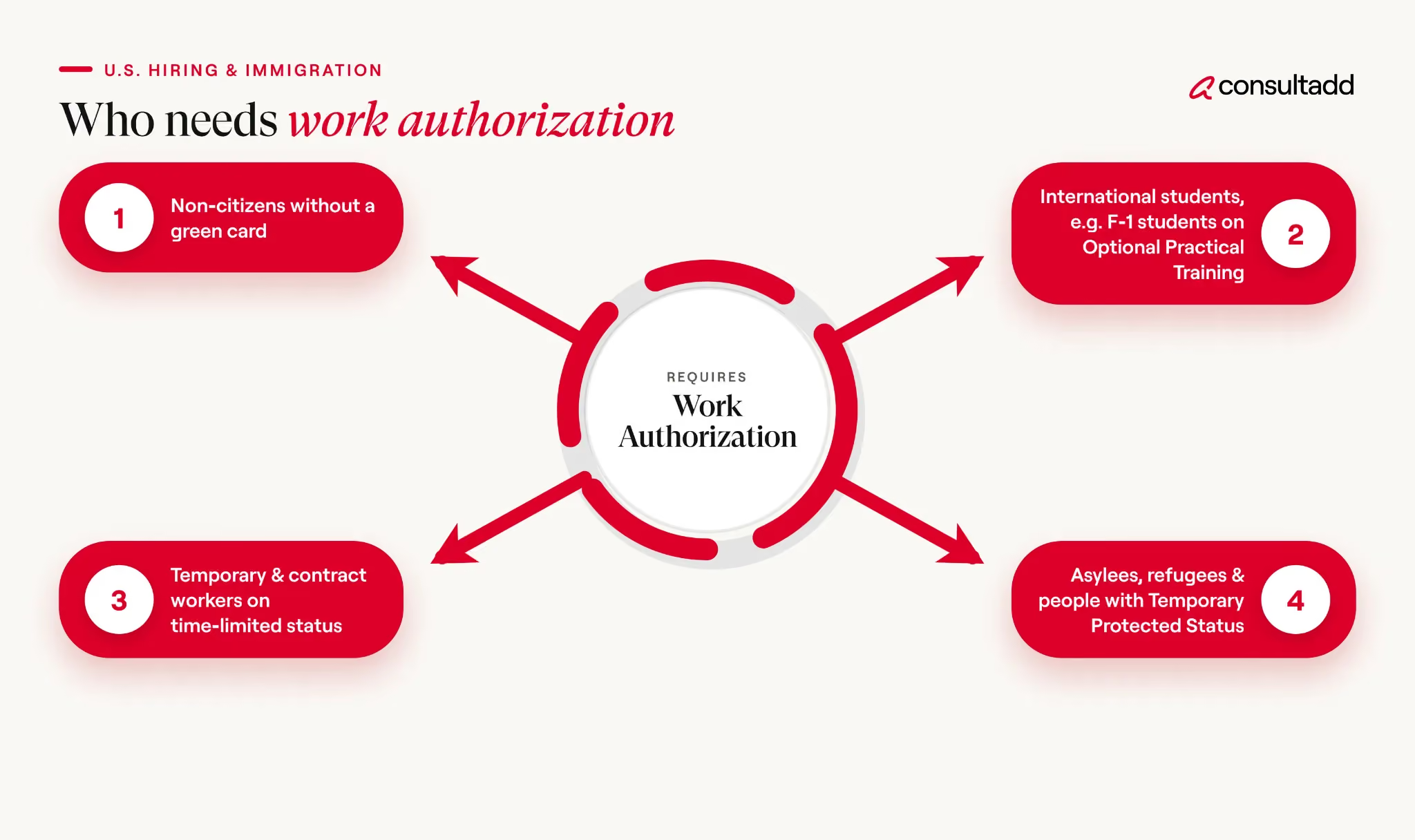
The people who actually need to establish work authorization tend to fall into a few groups:
- Non-citizens without a green card
- International students, such as F-1 students on Optional Practical Training
- Temporary and contract workers on time-limited status
- Asylees, refugees, and people with Temporary Protected Status
If a worker is not a citizen or a permanent resident, assume they need to show valid authorization before their first day. No card in hand usually means no legal start date, even for unpaid roles in some categories.
The main types of work authorization
Here is where people get lost, because "work authorization" is really an umbrella over several very different situations. Some workers are authorized because of who they are. Others are authorized only for a specific employer. And a large group has to apply for a card first.
Citizens and permanent residents
This group is the simplest. Citizens and green card holders can work for any employer, in any role, with no time limit tied to a permit. Their proof is built into documents they already hold.
Employment Authorization Document (EAD)
The EAD, officially Form I-766 and often called a work permit, is a card issued by U.S. Citizenship and Immigration Services. It proves a non-citizen can work legally for a set period. To get one, most applicants file Form I-765, and an approved EAD is usually valid for one or two years before it needs renewing.
The USAGov work permit guide is a good starting point for eligibility and how the card works. One planning note: rules on automatically extending an expiring EAD changed in late 2025, so always check current USCIS guidance before assuming a lapsed card still counts.
Employer-specific work visas
Some nonimmigrants are authorized to work "incident to status," meaning the status itself grants the right, but only for a specific sponsoring employer. H-1B and L-1B workers are common examples. They generally do not carry an EAD, since their approval notice and I-94 do the job. This is also where visa categories overlap and confuse people.
Consultadd's breakdown of the differences between H-1B and OPT visas untangle two of the most common ones.
How employers verify work authorization
Here is the part every employer has to get right. Federal law requires that every employer complete Form I-9 for each new hire, a rule in place since November 6, 1986. It applies to citizens and non-citizens alike.
Form I-9 does two jobs at once: it confirms identity and confirms work authorization. The employee attests to their status and presents documents, and the employer examines them to see that they reasonably appear genuine.
The catch that trips up new hiring managers: the employee picks which acceptable documents to show. You cannot demand a specific one. Doing so can count as discrimination. Workers choose either one document from List A, or one from List B paired with one from List C.
A List B document has to be paired with a List C document to cover both requirements. Keep the completed I-9 on file and make it available if federal officials ask to inspect it.
Work authorization vs a work visa
People use these terms as if they mean the same thing. They do not. A work visa is one route to work authorization, but authorization is the broader idea.
So a work visa can give you work authorization, but you can also have work authorization without a traditional work visa, for example through an EAD tied to asylum or a pending green card.
Common work authorization mistakes to avoid
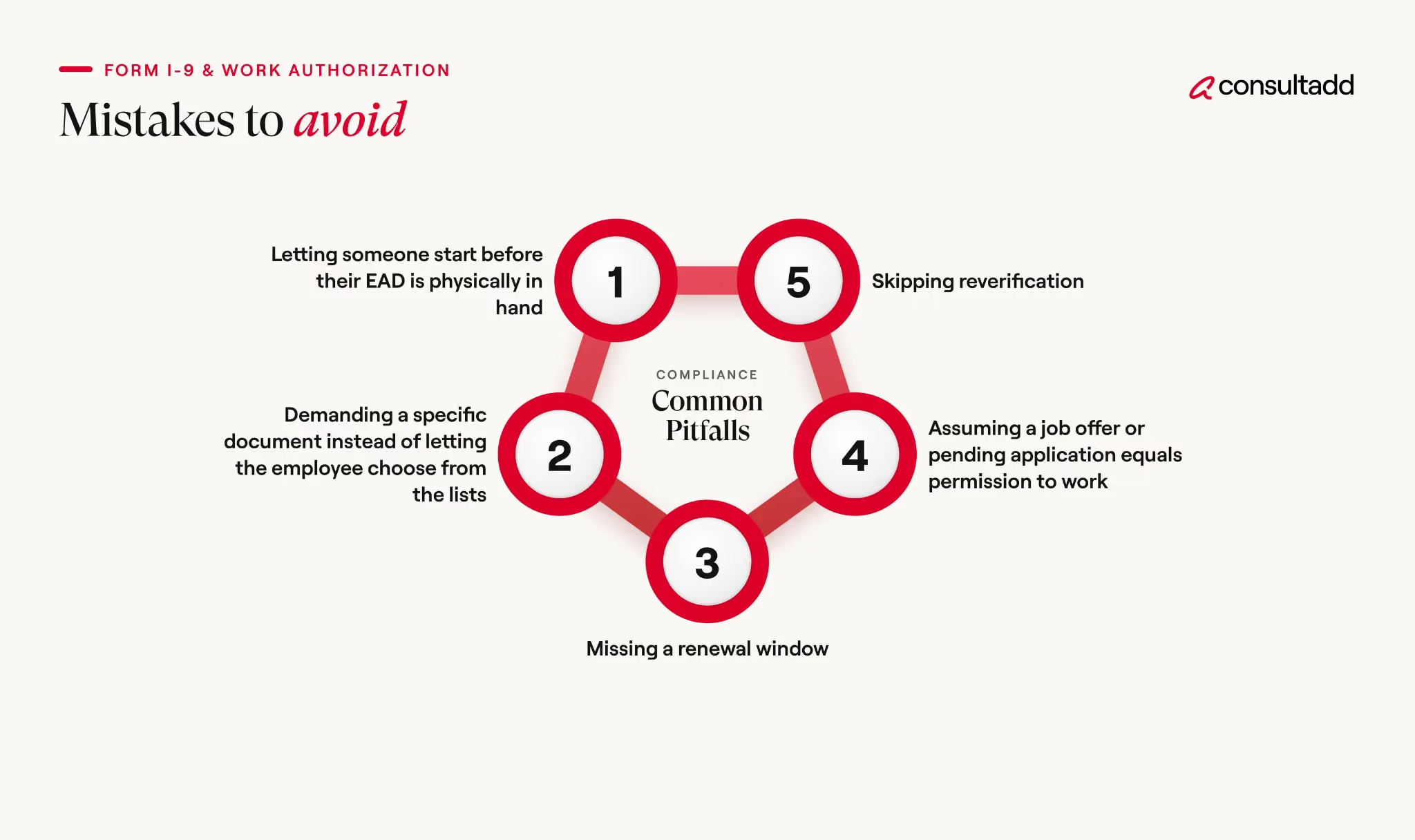
A few errors show up again and again, and each one carries real cost:
- Letting someone start before their EAD is physically in hand.
- Demanding a specific document instead of letting the employee choose from the lists.
- Missing a renewal window and letting authorization lapse mid-employment.
- Assuming a job offer or pending application equals permission to work.
- Skipping reverification when a time-limited authorization expires.
For staffing teams juggling many placements at once, this is where a partner earns its keep. Handling compliance across contract and project roles is a core part of project-based recruiting and staffing, and getting it wrong slows every hire behind it.
The bottom line
So, what's work authorization? It is the legal green light that says a person can work, and the paperwork that proves it.
- For workers, it decides whether they can accept a role.
- For employers, it decides whether a hire is safe or a liability.
Get the status right, verify it properly, and track the expiration dates, and most of the risk takes care of itself.
Start strong with Consultadd
With 15 years in business and 5,000+ successful staffing engagements, we don't just fill roles, we build reliability into your process. We've supported 65 staffing companies in the past year alone and maintain MSAs with industry leaders like Robert Half and TEKsystems.
Here's what working with Consultadd looks like:
- Talent sourced in under 24 hours
- Ready-to-deploy candidates, vetted for experience and compliance
- Lower turnover risk: we match long-term goals, not just short-term needs
- Seamless compliance: visa, documentation, onboarding? Handled.
- Dedicated 1:1 account managers for responsive, personalized support
- Top 100 candidate matches delivered in the past year
- Strong partnerships with universities to tap into fresh, committed talent
- Post-placement support so your investment grows beyond day one
For candidates, your next opportunity is more than just a job title, it's a chance to build skills, gain experience, and move your career forward. At Consultadd, we connect technology professionals with projects and employers that align with their goals, whether they're looking for contract, contract-to-hire, or long-term opportunities.
The tech job market moves fast, but the right guidance can make all the difference. Ready to take the next step in your career journey? Explore Opportunities >>
Key takeaways
- Work authorization is the legal permission to work in a country where you are not a citizen.
- Citizens and green card holders are already authorized, while many non-citizens need an EAD.
- The EAD (Form I-766) is issued by USCIS and usually valid for one to two years.
- Every employer must verify work authorization with Form I-9 and let the employee choose which documents to show.
- Most compliance risk comes from timing and paperwork, so track statuses and renewal dates closely.
FAQs
What's work authorization in simple terms?
It is the legal right to work in a country where you are not a citizen or permanent resident. In the U.S., that right comes from your immigration status, your circumstances, or a document like an EAD that proves it. Employers must confirm it before you start.
What is the difference between work authorization and a work visa?
Work authorization is the broad legal right to work. A work visa is one specific way to get that right, usually tied to a sponsoring employer. You can have work authorization without a traditional work visa, for example through an EAD.
Who needs an Employment Authorization Document (EAD)?
Non-citizens who are not green card holders often need an EAD, including many students on OPT, asylees, TPS holders, and people with a pending green card. Citizens and permanent residents do not need one, since their existing documents already prove authorization.
How do employers verify work authorization?
Employers use Form I-9 for every new hire. The employee presents documents that prove identity and work authorization, and the employer reviews them. The employee chooses which acceptable documents to show, and the employer cannot demand a specific one.
Can someone start working before their EAD arrives?
Generally no. In most categories, a worker cannot legally begin until the EAD card is in hand and any required start date has passed. Starting early can violate their status, so it is worth waiting for the physical card.
How long is work authorization valid?
It depends on the basis for it. An EAD is usually valid for one or two years, then needs renewal. Status-based authorization lasts as long as the underlying status. Citizens and permanent residents have no expiration tied to a permit.

What Are 3 Different Types Of Employment?
Introduction
If you have ever stared at a job post and wondered whether "full-time," "part-time," or "contract" changes anything beyond your hours, you are asking the right question.
It changes a lot!
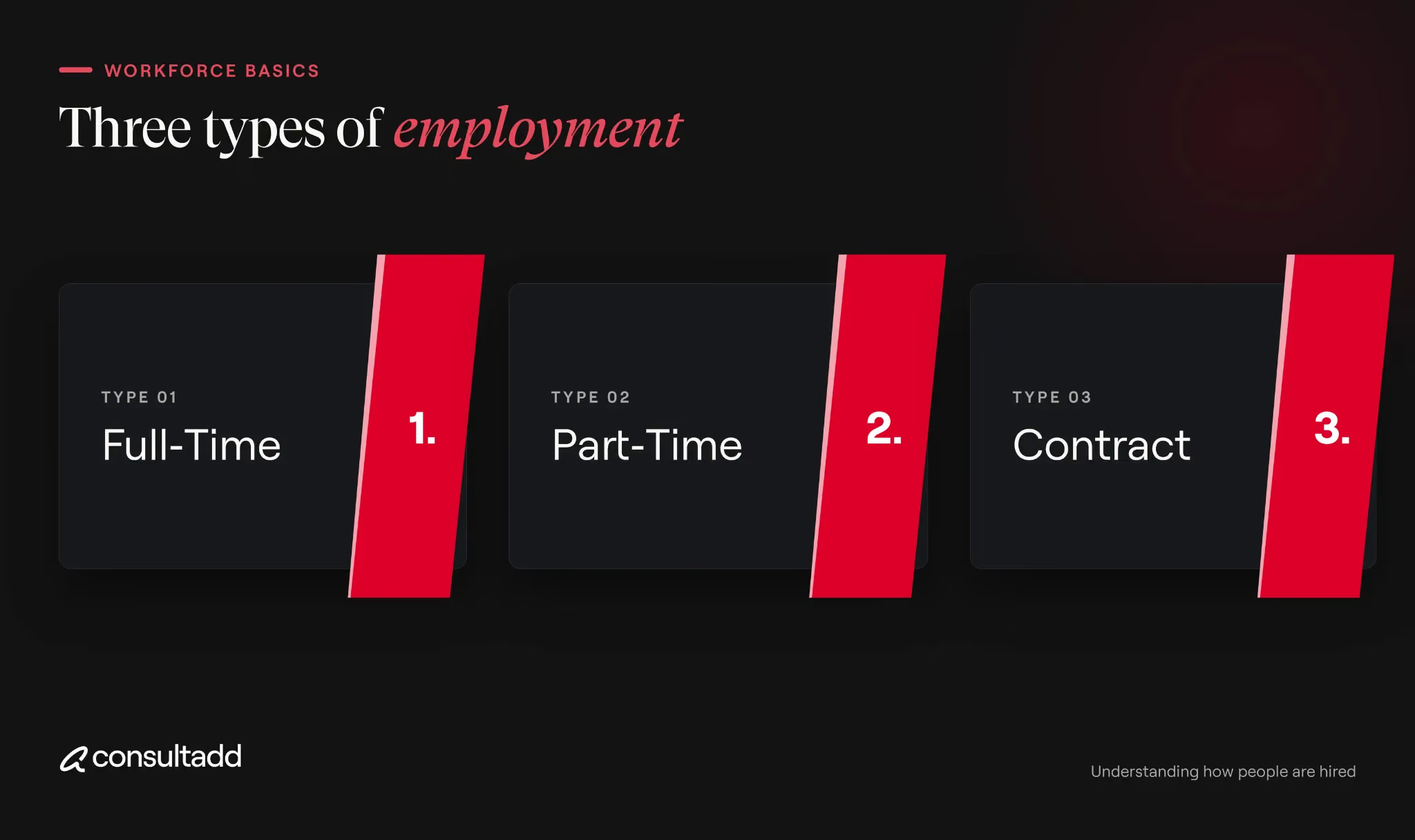
So when people ask what are 3 different types of employment, the short answer is full-time, part-time, and contract work. The longer answer, which is the part that actually affects your paycheck, your benefits, and your taxes, is what this guide is about.
Whether you run a staffing team trying to fill a role fast or you are a professional deciding which offer to take, the label on the arrangement tells you almost everything about how the job will really work. Let's break down each one.
TL;DR
- The three main types of employment are full-time, part-time, and contract (independent contractor) work.
- Full-time usually means a set weekly schedule with benefits, though no federal law actually defines the hour count.
- Part-time means fewer hours, often fewer or prorated benefits, and more schedule flexibility.
- Contract workers run their own show. They handle their own taxes, set their own methods, and rarely get company benefits.
- The classification you pick decides taxes, benefits, and legal protections, so getting it wrong can cost real money.
What a "type of employment" actually means
A type of employment is just the nature of the working relationship between a person and the business paying them. It sets who controls the work, who pays which taxes, and what benefits and protections apply.
Here is the part that trips people up. There is no single government list that says "these are the official categories." The U.S. Department of Labor notes that the Fair Labor Standards Act does not even define full-time or part-time employment. That call is left to each employer.
What the law does care about is a bigger question: are you an employee or an independent contractor?
That single distinction drives most of the tax and benefit differences you will read about below.
For a plainer walk-through of the contractor side, Consultadd has a helpful breakdown of what contract work actually means.
The 3 different types of employment at a glance
Before we get into each one, here is a side-by-side view of the 3 different types of employment so you can see where they split.
Notice the real dividing line is not hours. It is employee versus self-employed. Full-time and part-time workers are both employees. Contractors are not.
Type 1: Full-time employment
Full-time employment is the arrangement most people picture when they think of a "real job." You work a regular weekly schedule for one employer on an ongoing basis, and you are on the payroll as an employee.
What counts as full-time
Most employers treat 35 to 40 hours a week as full-time, but that number is a company policy, not a legal rule. Many organizations set the line at 30 hours a week, partly because of health coverage requirements. The point is that your employer decides, so it pays to read the offer.
Full-time employees get a W-2, have taxes withheld from every paycheck, and usually receive a benefits package. That often includes health insurance, paid time off, and retirement contributions.
Pros and cons of full-time roles
For businesses, full-time hires make sense when the work never really ends. Product development, account management, and anything that needs institutional memory usually belongs here.
If you are weighing a permanent hire against a shorter arrangement, this comparison of contract-to-hire versus full-time hiring for developers lays out the trade-offs well.
Type 2: Part-time employment
Part-time employment is the same employee relationship as full-time, just with fewer hours. The Department of Labor treats part-time and full-time workers the same way under the FLSA when it comes to core protections like minimum wage and overtime.
What counts as part-time
Part-time usually means working fewer hours than the company's full-time threshold, often somewhere under 30 hours a week. Schedules vary. Some part-timers work a few hours daily, others work full days a couple of times a week.
Benefits are where part-time and full-time really diverge. Part-time employees may get some benefits on a prorated basis, but many receive fewer than their full-time peers.
Even so, they still earn at least the federal minimum wage of $7.25 an hour and qualify for overtime the same way full-time staff do.
Where part-time works best
Part-time roles shine when demand rises and falls.
- Retail stores staff up for busy shopping hours.
- Restaurants and hotels lean on part-timers for weekends and holidays.
- Clinics and schools use them to cover specific shifts or seasons.
Type 3: Contract employment
Contract employment is the odd one out, and the most misunderstood. A contract worker, or independent contractor, is not an employee at all.
They are self-employed and brought in for a specific project, gap, or skill. When the work wraps, so does the arrangement.
Contractors control how they do the job, set much of their own schedule, and receive a 1099-NEC instead of a W-2. They pay their own self-employment tax and cover their own benefits.
Employee or contractor? The three-factor test
This is the classification that gets businesses in trouble, so it is worth getting right. The IRS says that whether someone is a contractor or an employee comes down to the relationship, and it weighs three categories of evidence:
Here is the catch: Calling someone a contractor does not make them one. If the working relationship looks like employment, the IRS can reclassify the worker no matter what the paperwork says. Misclassify on purpose and you can end up owing back taxes and penalties.
Pros and cons of contract work
If that is your situation, Consultadd's guide to project-based recruiting and staffing covers how to bring in consultants for a defined scope without the long-term overhead.
How to choose the right employment type
There is no single best option. The right pick depends on the work in front of you. A quick way to decide:
- Choose full-time when the role is ongoing and central to the business.
- Choose part-time when the workload is real but does not need 40 hours, or when demand swings.
- Choose a contract when you need a specific skill for a set window and want flexibility.
For workers, the same logic flips. Want stability and benefits? Full-time. Want flexibility and are fine handling your own taxes? Contract. Somewhere in between? Part-time might be the fit.
Start Strong With Consultadd
With 15 years in business and 5,000+ successful staffing engagements, we don't just fill roles, we build reliability into your process. We've supported 65 staffing companies in the past year alone and maintain MSAs with industry leaders like Robert Half and TEKsystems.
Here's what working with Consultadd looks like:
- Talent sourced in under 24 hours
- Ready-to-deploy candidates, vetted for experience and compliance
- Lower turnover risk: we match long-term goals, not just short-term needs
- Seamless compliance: visa, documentation, onboarding? Handled.
- Dedicated 1:1 account managers for responsive, personalized support
- Top 100 candidate matches delivered in the past year
- Strong partnerships with universities to tap into fresh, committed talent
- Post-placement support so your investment grows beyond day one
For candidates, your next opportunity is more than just a job title, it's a chance to build skills, gain experience, and move your career forward. At Consultadd, we connect technology professionals with projects and employers that align with their goals, whether they're looking for contract, contract-to-hire, or long-term opportunities.
The tech job market moves fast, but the right guidance can make all the difference. Ready to take the next step in your career journey? Explore Opportunities >>
Key takeaways
- The 3 different types of employment are full-time, part-time, and contract work.
- The real split is not hours, it is employee (full-time and part-time) versus self-employed (contract).
- Full-time offers stability and benefits, part-time offers flexible coverage, and contract offers speed and specialized skills.
- The IRS decides contractor status using behavioral control, financial control, and the relationship, not the job title.
- Match the arrangement to the work, and treat classification carefully to avoid tax and legal trouble.
FAQs
What are the 3 main types of employment?
The three main types are full-time, part-time, and contract (independent contractor) work. Full-time and part-time workers are employees on a company payroll. Contractors are self-employed and hired for specific projects.
How many hours is considered full-time?
Most employers treat 35 to 40 hours a week as full-time, but that is a company decision. The Fair Labor Standards Act does not define full-time or part-time, so the threshold can vary from one employer to the next.
What is the difference between an employee and an independent contractor?
An employee works under the company's direction and receives a W-2, with taxes withheld and usually benefits included. An independent contractor controls how the work gets done, receives a 1099-NEC, and pays their own self-employment tax.
Do part-time employees get benefits?
Sometimes. Part-time employees may receive prorated benefits, but many get fewer than full-time staff. They still earn at least minimum wage and qualify for overtime, since the FLSA protects part-time and full-time workers equally.
Is full-time or part-time better?
Neither is universally better. Full-time suits people who want steady income, benefits, and career growth. Part-time suits people who need flexibility or fewer hours. The right choice depends on your financial needs and your schedule.
Can an employer classify a worker as a contractor to avoid taxes?
No. If the working relationship functions like employment, the IRS can reclassify the worker regardless of the contract. Misclassifying an employee as a contractor can lead to back taxes, penalties, and audits, so businesses should classify carefully.

F-1 Visa Duration Of Status Change
Introduction
The F-1 visa duration of status change is now final. DHS published the rule in the Federal Register on July 17, 2026, and it takes effect on September 15, 2026. If you study in the U.S. on an F-1 visa, the biggest thing to understand is this: your permission to stay will no longer last as long as you keep studying.
It will end on a fixed date printed on your Form I-94, capped at four years, and staying past that date without an approved extension starts a clock you really don't want running.
That's the whole story in one paragraph. The rest of this article breaks down the rule, who it affects most, what overstaying now costs, and the specific steps to take before the effective date.
TL;DR
- Duration of status (D/S) is going away for F-1, J-1, and I visa holders. Admission will now end on a fixed date on your Form I-94, capped at four years for F and J.
- The rule was published July 17, 2026, and becomes effective September 15, 2026, after which new arrivals get a fixed end date instead of "D/S."
- Need more time to finish your program? You must file a formal Form I-539 extension with USCIS. A DSO can no longer just update SEVIS to give you more time.
- The post-completion grace period for F-1 drops from 60 days to 30 days, and overstaying your I-94 date now triggers automatic unlawful presence plus possible 3-year or 10-year reentry bars.
- Current students keep their status through their I-20 end date, capped at four years from the effective date, so PhD candidates, medical trainees, and OPT/STEM OPT workers should map their dates immediately.
What the F-1 visa duration of status change actually does
For about three decades, F-1 students were admitted for "duration of status." Your I-94 said D/S, not a calendar date. You could stay as long as you kept enrolled, followed the rules, and kept your I-20 current. A four-year bachelor's, a six-year PhD, a long medical program, all of it ran on continued enrollment rather than a countdown.
The new rule ends that. Every F-1 student admitted under it gets a specific "admit until" date on Form I-94. That date matches your program end date on the I-20, and it can't exceed four years. J-1 exchange visitors work the same way. English language training tops out at 24 months. Foreign media on I visas get up to 240 days.
DHS says the point is oversight. The agency framed the change around ending what it called "forever students," and lists goals like cutting overstays, improving compliance, and tightening national security. Whatever you think of the reasoning, the practical result is simple: your stay is now tied to a date, not to your enrollment.
The old rule vs the new rule
Here's the side-by-side so you can see exactly what shifts.
The two columns describe two different mental models. The old one was "stay enrolled, stay legal." The new one is "watch your I-94 date, file on time, or lose status."
Who gets hit hardest by the duration of status change
Almost every new F-1 and J-1 arrival is affected. But some groups carry far more risk because their programs or work periods routinely run past four years.
Doctoral and research students
PhD programs regularly run five, six, or seven years. Medical residencies and fellowships often stretch well beyond four. Long research appointments and dual-degree tracks do too. If your program crosses the four-year cap, you'll need at least one Form I-539 extension mid-program, with the cost, paperwork, and processing wait that comes with it.
OPT and STEM OPT workers
This is the one that surprises people. Filing for OPT or STEM OPT no longer extends your period of admission. If your I-94 date is approaching, you may need two filings on two clocks: Form I-765 for the work card and Form I-539 for the stay. There's one transition cushion here, discussed below, but plan for both. Staffing, consulting, and other employers with large OPT populations face real workforce-continuity risk, so this matters for hiring decisions too.
Our overview of OPT and STEM OPT work authorization for employers walks through how that plays out on a team.
Students relying on Day-1 CPT or same-level pivots
The rule closes a common bridge. F-1 students can no longer switch to a program at the same or lower academic level, which was the mechanic behind the "Day-1 CPT" move people used after missing the H-1B lottery. Graduate students also can't change majors or transfer schools mid-program without narrow SEVP authorization.
If your plan B depended on that pivot, it's time for a new plan B. If your goal is a work visa, compare paths in our guide to H-1B cap-gap timing and alternatives.
What happens if you overstay: unlawful presence and reentry bars
This is the part worth reading twice, because the consequence changed in a way that's easy to miss.
Under D/S, you generally started building "unlawful presence" only after a formal finding by USCIS or an immigration judge. Under the new rule, unlawful presence starts on its own, the day after your fixed admission date passes, if you haven't filed for an extension. No notice. No hearing. Just the calendar.
Why that's a big deal: accruing more than 180 days of unlawful presence triggers a 3-year bar on reentering the U.S. Accruing more than one year triggers a 10-year bar. A timely-filed extension pauses the clock while it's pending, which is exactly why filing early is the whole game now.
If an extension is denied, there's no grace period. You and any F-2 dependents are expected to leave.
Transition rules if you're already in the US
Good news for current students: you don't get kicked onto a four-year clock overnight, and you don't have to rush to file the day the rule takes effect.
If you're already here on D/S, you keep your status through your I-20 or DS-2019 program end date, capped at four years from the effective date. So a student with two years left generally has those two years, subject to the rule's specifics.
There's also a transition cushion for work authorization. From the effective date through roughly mid-March 2027, a timely-filed Form I-765 on its own protects your period of stay. After that window, the I-765 and I-539 split into two separate filings again. Because these provisions are fact-specific, confirm how they apply to your exact record with your DSO or an immigration attorney before you rely on them.
What to do right now: your action checklist
You asked for direct steps, so here they are.
Before September 15, 2026
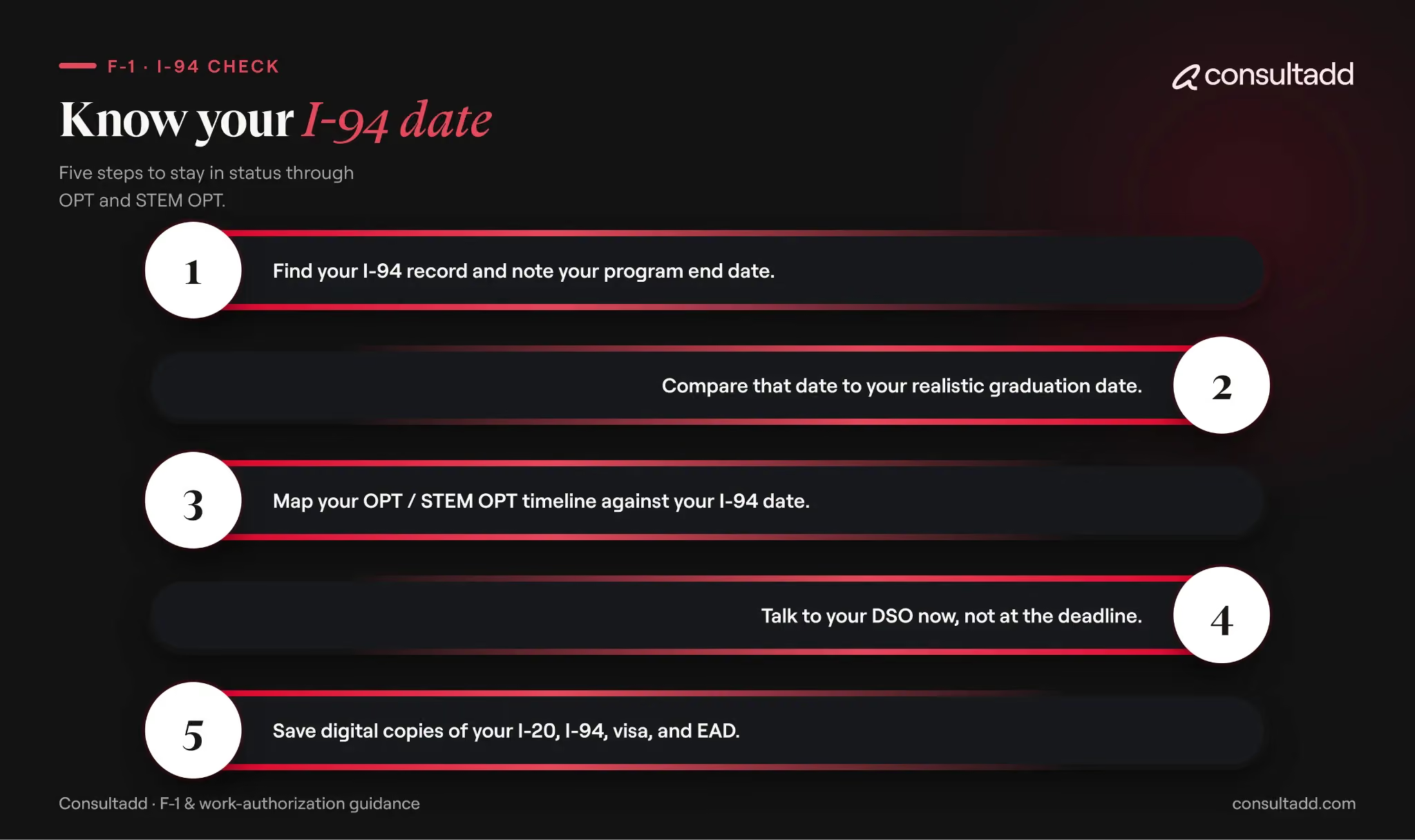
If your program runs past four years
Start the extension conversation early. Form I-539 needs a real justification, like a documented academic delay or a medical reason. Academic probation does not count.
Build in months, not days, for processing, and avoid international travel near your admission expiry date since it complicates reentry. If you're weighing longer-term options, it's reasonable to look at categories that stand on their own, such as O-1A or an employment green card, well before your student status runs short.
One honest caveat: the rule is classified as a major rule subject to congressional review, so some details could still shift. That's not a reason to wait. The smart move is to prepare as if the September 15 date holds, because it very likely will.
For the official text and forms, go straight to the source: the DHS final rule in the Federal Register, the DHS announcement, and the USCIS Form I-539 page for extension filings.
Start Strong With Consultadd
With 15 years in business and 5,000+ successful staffing engagements, we don't just fill roles, we build reliability into your process. We've supported 65 staffing companies in the past year alone and maintain MSAs with industry leaders like Robert Half and TEKsystems.
Here's what working with Consultadd looks like:
- Talent sourced in under 24 hours
- Ready-to-deploy candidates, vetted for experience and compliance
- Lower turnover risk: we match long-term goals, not just short-term needs
- Seamless compliance: visa, documentation, onboarding? Handled.
- Dedicated 1:1 account managers for responsive, personalized support
- Top 100 candidate matches delivered in the past year
- Strong partnerships with universities to tap into fresh, committed talent
- Post-placement support so your investment grows beyond day one
For candidates, your next opportunity is more than just a job title, it's a chance to build skills, gain experience, and move your career forward. At Consultadd, we connect technology professionals with projects and employers that align with their goals, whether they're looking for contract, contract-to-hire, or long-term opportunities.
The tech job market moves fast, but the right guidance can make all the difference. Ready to take the next step in your career journey? Explore Opportunities >>
Key takeaways
- The F-1 visa duration of status change replaces open-ended stays with a fixed I-94 end date, capped at four years, effective September 15, 2026.
- More time now means a formal Form I-539 filing with USCIS, not a quiet SEVIS update from your DSO.
- Overstaying your fixed date starts unlawful presence automatically, and crossing 180 days or one year triggers 3-year or 10-year reentry bars.
- Doctoral students, medical trainees, and OPT/STEM OPT workers face the most exposure because their timelines often exceed four years.
- Current students keep status through their I-20 end date, capped at four years from the effective date, so check your dates and talk to your DSO now.
FAQs
When does the F-1 duration of status change take effect?
The final rule was published in the Federal Register on July 17, 2026, and takes effect 60 days later, on September 15, 2026. Students entering the U.S. on or after that date should expect a fixed admission date on their I-94 rather than the old "D/S" notation.
Does the new rule apply to students already in the U.S.?
Yes, but with a transition path. Current D/S holders keep their status through their I-20 or DS-2019 program end date, capped at four years from the effective date. You won't be forced to file an extension the moment the rule starts, but you should confirm your own dates with your DSO.
How do I extend my stay if my program runs long?
You file Form I-539, Application to Extend/Change Nonimmigrant Status, with USCIS, along with a documented reason such as an academic delay or medical issue. This is a real adjudication with a processing wait, so file well before your I-94 date, not at the last minute.
What happened to the F-1 grace period?
The post-completion grace period for F-1 students dropped from 60 days to 30 days. The J-1 grace period stays at 30 days. If an extension is denied, no grace period applies and you're expected to depart.
Do OPT and STEM OPT filings still protect my stay?
Not automatically anymore. Filing Form I-765 for work authorization no longer extends your admission period, so you may need a separate Form I-539 to keep lawful status. During a transition window running from the effective date through about mid-March 2027, a timely I-765 does independently protect your stay, after which the two filings separate again.
What are the penalties for staying past my I-94 date?
Unlawful presence now begins automatically the day after your fixed admission date if you haven't filed to extend. More than 180 days of unlawful presence brings a 3-year reentry bar, and more than one year brings a 10-year bar, which is why timely filing matters so much.

What Is C2C Employment? Explained Simply
Introduction
If you've spent any time in US contract staffing, especially in IT, you've seen the phrase "C2C only" on job postings.
So what is C2C employment? C2C stands for corp-to-corp, an arrangement where a company pays another business entity for a worker's services instead of paying the worker directly. Your corporation bills their corporation. Hence the name.
That single structural change ripples into everything: how you're taxed, what benefits you get, who carries the liability, and even whether the arrangement is legal for your visa status.
Recruiters throw around C2C, W2, and 1099 like everyone was born knowing the difference, and honestly, the confusion costs people money on both sides of the table.
This guide breaks down how C2C works, how it compares to W2 and 1099, the compliance traps, and who it actually makes sense for.
TL;DR
- C2C (corp-to-corp) means the hiring company contracts with the worker's registered business entity, such as an LLC or S-corp, not with the worker as an individual.
- The contractor's corporation handles all taxes, including the full 15.3% for Social Security and Medicare, plus its own insurance and benefits.
- C2C rates run higher than W2 rates because no benefits, payroll taxes, or protections come from the client. The gross number isn't the take-home number.
- A registered entity alone doesn't guarantee compliance. The IRS and Department of Labor look at the actual working relationship, not the paperwork.
- Most H-1B professionals work "C2C" through an employer, like a consulting firm, that holds their visa. Independent solo C2C generally isn't an option on H-1B.
What is C2C employment and how does it work?
In a standard job, a company hires you, withholds your taxes, and sends you a W-2 each January.
In a C2C arrangement, the company never hires you at all. It signs a services contract with your business entity, and your entity is the one that employs you, invoices the client, and gets paid.
For that to work, the contractor side needs a real registered business: an LLC, an S-corporation, or a C-corporation. A sole proprietorship doesn't count. Many clients also require the entity to carry general liability insurance, and some ask for professional liability coverage on top.
The parties involved
A typical C2C chain in IT staffing looks like this:
- An end client needs a software engineer for a nine-month project.
- A prime vendor or staffing agency holds the contract with that client.
- The contractor's corporation (or a consulting firm that employs the contractor) signs a corp-to-corp agreement with the staffing agency.
- The contractor does the work. Their corporation invoices the agency, the agency bills the client, and money flows back down the chain.
Sometimes there are more layers than that, which is where the phrase "C2C" gets its slightly complicated reputation in tech staffing.
We covered how these layered contract models actually function in our piece on IT contract staffing as a business strategy.
What the contractor's corporation is responsible for
Once the money lands in the corporation's account, everything else is the corporation's job:
- All payroll and self-employment taxes, including both the employer and employee halves of Social Security and Medicare (15.3% combined)
- Health insurance, retirement contributions, and paid time off, if any
- Business liability insurance
- Invoicing, bookkeeping, quarterly estimated tax payments, and state filings
None of it comes from the client. That's the trade: a higher rate in exchange for carrying the full administrative and financial load yourself.
C2C vs W2 vs 1099: the real differences
These three terms describe who gets paid and who handles the obligations. Here's the side-by-side:
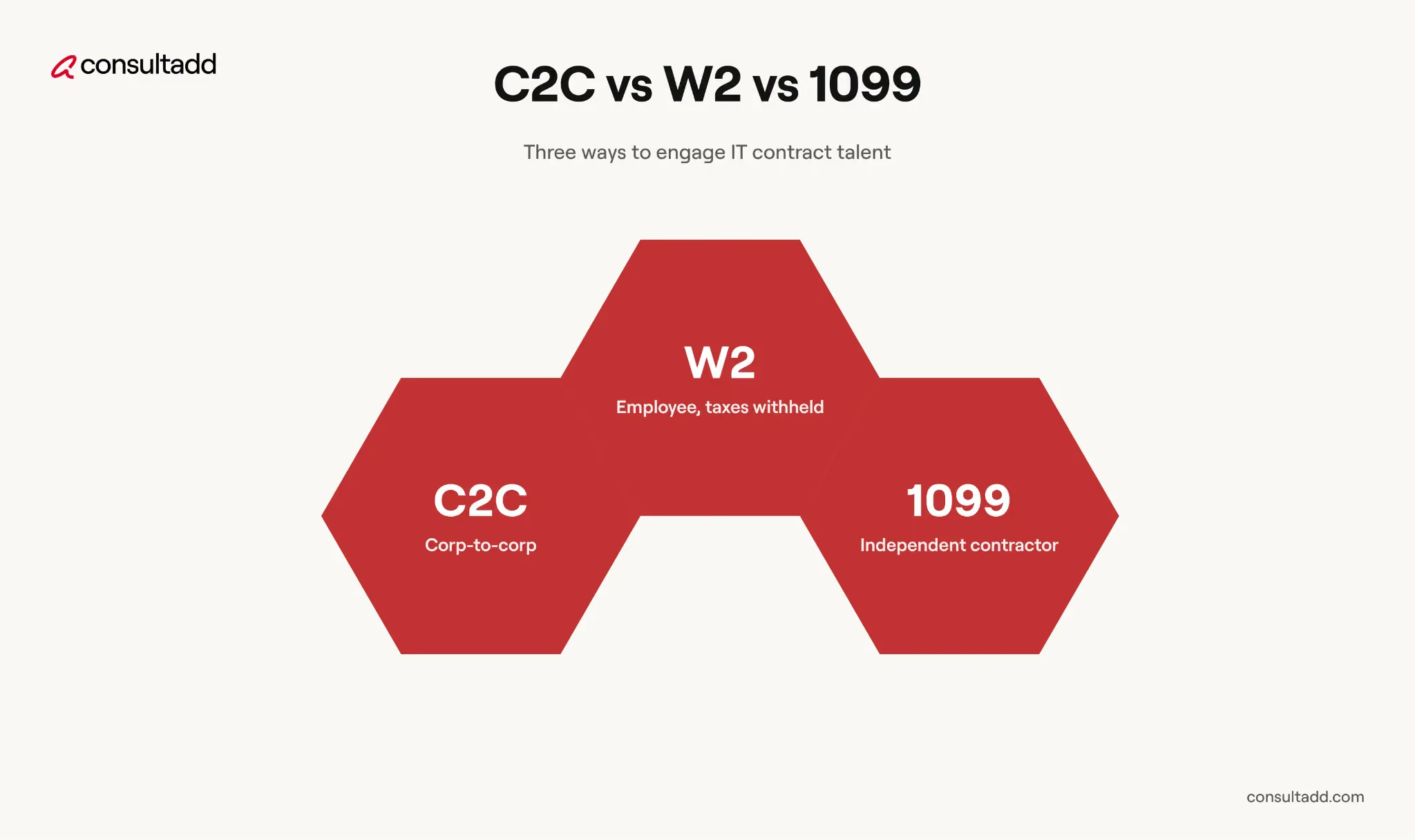
A pattern worth noticing: C2C and 1099 are cousins. Both are independent contractor arrangements. The difference is purely structural.
A 1099 contractor is paid as a person; a C2C contractor is paid as a company. That structural layer matters more to the client than to the worker, because contracting with a vetted corporation reduces (but doesn't eliminate) the client's misclassification exposure.
Under US law, the default assumption is that a worker is a W-2 employee unless the hiring party can show the relationship genuinely meets independent contractor criteria.
That's why W2 remains the dominant model in professional staffing, something we see reflected across the market in our review of the best IT staffing firms in 2026.
Pros and cons of C2C employment
C2C tends to attract experienced contractors who treat their work as a business. Here's the honest ledger, for both sides:
C2C and Work Visas: What H-1B and OPT holders should know
This is where a lot of misinformation circulates, so let's be precise.
H-1B status requires an employer to sponsor and employ you.
That means you can't simply form an LLC and contract yourself out solo the way a citizen or green card holder can. When an H-1B professional works "on C2C," what's really happening is that a consulting or staffing company employs them on W2 and holds their visa, and that company has a corp-to-corp agreement with the vendor or client upstream.
The C2C layer exists between companies, not between the worker and the client.
For F-1 students on OPT, the picture is different but has its own constraints.
Standard OPT allows properly documented self-employment related to your field, but STEM OPT requires an E-Verify enrolled employer and a formal training plan, which effectively rules out working through your own single-member entity for most students.
So when a recruiter asks a visa-holding candidate "are you open to C2C?", the practical question is usually "does your employer allow you to work through their corp-to-corp agreements?"
If you're navigating this, our guide on H-1B visa sponsorship for tech professionals explains the employer-side mechanics in detail.
Misclassification: the risk nobody prices in
Here's the uncomfortable truth about C2C: the entity is evidence, not a shield.
The IRS looks at behavioral control, financial control, and the nature of the relationship. The Department of Labor applies its own economic reality test under the FLSA, and it runs independently of the IRS analysis. Some states, notably California and Massachusetts, layer an ABC test on top that's stricter than both.
A worker who formed an LLC last month, has one client, works set hours under that client's daily direction, and uses the client's equipment is not running a business-to-business relationship. It's an employment relationship with extra paperwork, and regulators treat it that way.
Penalties can reach 100% of the taxes owed, plus fines per unfiled form, plus exposure to wage-and-hour claims.
What a legitimate C2C engagement looks like:
For staffing agencies, vetting the entity on the other side of a C2C agreement isn't optional paperwork. It's the difference between a clean audit and a very expensive year.
It's also one of the compliance gaps we flagged in our look at what's broken in IT recruitment in 2026.
Is C2C right for you?
Now that you know what C2C employment is, the decision comes down to your situation, not the label.
C2C fits well if you're an experienced independent contractor with multiple clients, you're comfortable running a business (or paying someone to), you have your own benefits sorted, and the higher gross rate genuinely outpaces the added costs.
It also fits consulting firms that deploy their own W2 employees to clients through corp-to-corp agreements, which is the standard model across US tech staffing.
W2 fits better if you value stability, employer-paid benefits, unemployment protection, and zero tax administration. And if you're on a work visa, W2 employment through a sponsoring company isn't just the better option, it's usually the only compliant one at the individual level.
Whichever side of the contract you're on, the fundamentals are the same: read the agreement, verify the entity, and make sure the substance of the relationship matches the label on it.
Start Strong With Consultadd
With 15 years in business and 5,000+ successful staffing engagements, we don't just fill roles, we build reliability into your process. We've supported 65 staffing companies in the past year alone and maintain MSAs with industry leaders like Robert Half and TEKsystems.
Here's what working with Consultadd looks like:
- Talent sourced in under 24 hours
- Ready-to-deploy candidates, vetted for experience and compliance
- Lower turnover risk: we match long-term goals, not just short-term needs
- Seamless compliance: visa, documentation, onboarding? Handled.
- Dedicated 1:1 account managers for responsive, personalized support
- Top 100 candidate matches delivered in the past year
- Strong partnerships with universities to tap into fresh, committed talent
- Post-placement support so your investment grows beyond day one
For candidates, your next opportunity is more than just a job title, it's a chance to build skills, gain experience, and move your career forward. At Consultadd, we connect technology professionals with projects and employers that align with their goals, whether they're looking for contract, contract-to-hire, or long-term opportunities.
The tech job market moves fast, but the right guidance can make all the difference. Ready to take the next step in your career journey? Explore Opportunities >>
Key takeaways
- C2C employment means a company contracts with the worker's registered business entity (LLC, S-corp, or corporation) rather than hiring the individual, and the entity handles all taxes, benefits, and insurance.
- Compared with W2, C2C offers higher gross pay and business deductions but no benefits, no unemployment coverage, and the full 15.3% Social Security and Medicare burden.
- Compared with 1099, C2C is structurally similar; the difference is that payment flows to a corporation, which lowers (but never eliminates) the client's misclassification risk.
- Regulators judge the substance of the working relationship, not the entity paperwork. A single-client LLC under daily client direction is an employee in everything but name.
- H-1B professionals participate in C2C through a sponsoring employer's corp-to-corp agreements, not through a personal entity, and STEM OPT students need an E-Verify employer.
FAQs
What does C2C mean in employment?
C2C stands for corp-to-corp. It's a contract arrangement where the hiring company pays the worker's business entity, such as an LLC or S-corporation, instead of paying the worker directly. The worker's corporation then handles payroll, taxes, insurance, and benefits.
What is the difference between C2C and W2?
A W2 worker is an employee: the employer withholds taxes, pays half of Social Security and Medicare, and usually provides benefits. A C2C contractor works through their own corporation, receives no benefits from the client, and their entity covers the full 15.3% in payroll taxes. C2C gross rates are higher precisely because all of that responsibility shifts to the contractor.
What is the difference between C2C and 1099?
Both are independent contractor arrangements without benefits or withholding. The difference is who receives payment: a 1099 contractor is paid as an individual and gets a 1099-NEC, while a C2C contractor is paid through a registered business entity. Clients often prefer C2C because contracting with a corporation reduces their misclassification exposure.
Do I need an LLC for C2C employment?
Yes, C2C requires a registered business entity, typically an LLC, S-corporation, or C-corporation. A sole proprietorship doesn't qualify. Many clients and staffing agencies also require the entity to carry general liability insurance before signing a corp-to-corp agreement.
Can H-1B visa holders work on C2C?
Not independently. H-1B status requires a sponsoring employer, so an H-1B professional can't contract through their own personal entity. In practice, H-1B workers on "C2C" projects are W2 employees of a consulting or staffing firm, and the corp-to-corp agreement exists between that firm and the client or vendor.
Is C2C better than W2?
Neither is universally better. C2C usually pays a higher gross rate and unlocks business tax deductions, but you give up benefits, unemployment coverage, and simplicity, and you take on the full self-employment tax load. Compare the full-year net of each option, including insurance costs and unpaid gaps between contracts, before deciding.