If you want one number to work with, here it is. The average time to hire in 2026 runs from the mid-20s to around 39 calendar days for most non-executive roles, and closer to 45 days once you get into senior and executive hiring. SHRM's 2026 benchmarking data puts the median time to fill for non-executive positions at 39 calendar days, down from 44 last year. Time to hire, which starts later in the process, lands shorter than that.
That's the headline. The useful part is what sits underneath it, because a single average tells you almost nothing about whether your own hiring is healthy. A 39-day cycle for a warehouse supervisor is slow. The same 39 days for a cleared cloud security engineer is quick work.
TL;DR
SHRM's 2026 median time to fill is 39 days for non-executive roles and 45 days for executive roles, both improved from prior years.
Time to hire and time to fill measure different windows, and mixing them up makes every benchmark comparison useless.
Company size moves the number more than most people expect, largely because of requisition approvals and interview scheduling.
Screening and interviewing each eat roughly 8 to 9 days on average, which is where most of the recoverable time sits.
Faster hiring comes from fewer decision-makers, pre-built pipelines, and interview loops that are booked as a block instead of one round at a time.
What the average time to hire actually measures
Time to hire counts the calendar days between a candidate entering your pipeline and that candidate accepting your offer. It's a measure of how well your team evaluates and closes people once they're in front of you.
Time to fill is the wider window. It starts when the requisition is approved or posted and ends at the same place, offer acceptance. So time to fill always equals or exceeds time to hire, and the gap between them is your sourcing lag.
The distinction matters because the two numbers point at different problems.
We've covered this at length in our breakdown of time to hire vs time to fill, but the short version is this: a healthy time to hire paired with a bloated time to fill means your sourcing is the bottleneck.
Both numbers high means your evaluation process is where to look.
The three timing metrics side by side
Metric
Clock Starts
Clock Stops
What It Diagnoses
Time to Fill
Requisition approved or job posted
Offer accepted
Overall recruiting efficiency, including sourcing effectiveness.
Time to Hire
Candidate applies or is sourced
Offer accepted
Speed of screening, interviewing, and closing candidates.
Time to Start
Offer accepted
First day on the job
Notice periods, background checks, and onboarding readiness.
How to calculate it
Add up the days each hire spent in your pipeline, then divide by the number of hires.
Three hires that took 18, 26, and 40 days give you an average of 28 days.
Use calendar days, not business days, since candidates experience weekends too.
And segment the average by role family before you draw any conclusion from it, because blending an intern hire with a principal architect hire produces a number that describes neither.
Average time to hire benchmarks for 2026
SHRM surveyed 4,657 members between November 2025 and January 2026 for its recruiting benchmarking data. Here's what that data shows on hiring speed and cost.
Benchmark
2022
2025
2026
Median time to fill (non-executive)
Not reported
44 days
39 days
Median time to fill (executive)
60 days
45 days
45 days
Median cost per hire (non-executive)
Not reported
$1,200
$1,300
Median cost per hire (executive)
$8,800
$10,600
$15,000
Median requisitions per recruiter
Not reported
20
25
Two things jump out :
First, non-executive hiring got five days faster in a single year, which is a real shift and not a rounding error. SHRM ties it partly to AI tooling in recruiting, noting that organizations with the most effective recruitment practices fill roles about five days faster than everyone else.
Second, recruiter workload went up 25% at the median while cycle times came down. In extra-large organizations the median jumped from 60 requisitions per recruiter to 100. That combination is not sustainable forever, and it's worth watching whether the speed gains hold once recruiter burnout catches up.
Why company size changes the number
Bigger companies hire slower, and the reason is boring. More approval layers before a job goes live, more calendars to coordinate for panels, more compliance steps before an offer clears.
The fix is structural rather than motivational. Pre-approve headcount by quarter instead of by requisition, cap the interview panel at four people, and give hiring managers a standing block on their calendar for interviews so scheduling doesn't become a two-week email thread.
Why role type changes it more
Role scarcity beats company size as a driver. A support role with 200 qualified applicants closes fast. A niche skill set with a shallow candidate pool does not, no matter how tight your process is.
For context on the demand side, BLS reported 7.6 million job openings and 5.2 million hires in May 2026. Roughly 2.4 million more openings than hires each month, and specialized technical roles are heavily represented in that gap.
If you're hiring for one of them, benchmark against similar roles at similar companies, not against a national median.
Our guide on technical recruitment goes deeper on what makes engineering searches behave differently.
Where your hiring process loses days
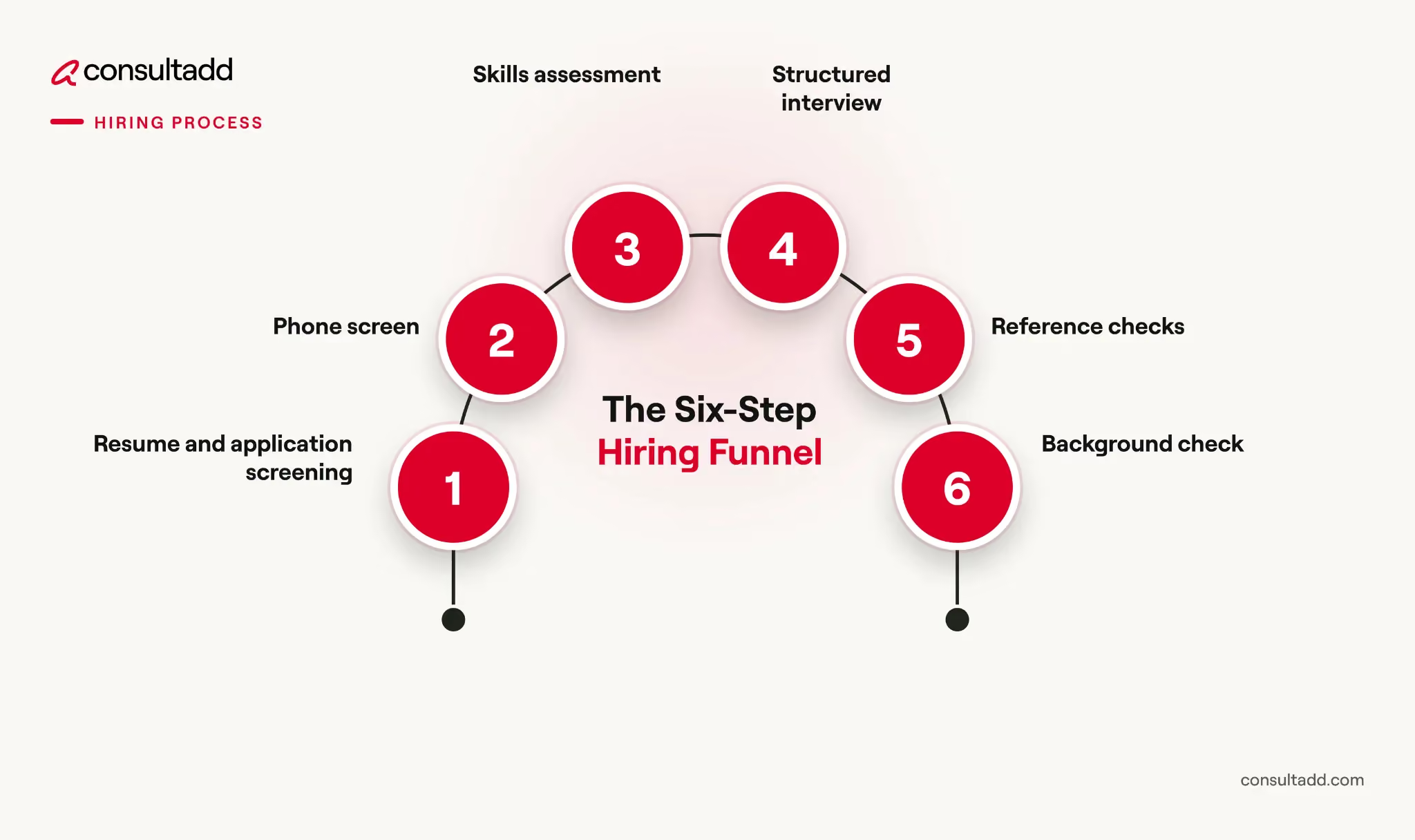
SHRM's benchmarking found that screening and interviewing each average 8 to 9 days. That's over two weeks of a roughly five-week cycle sitting in two stages, and both are stages you control completely.
Stage
Target Window
Common Failure
What Actually Fixes It
Requisition Approval
1–3 days
Approval sits in a VP's inbox.
Use pre-approved headcount plans by quarter.
Intake with Hiring Manager
1 day
Screening criteria drift because the intake is skipped.
Hold a 30-minute scorecard session before sourcing begins.
Sourcing & First Submittals
3–7 days
Waiting for inbound applicants.
Build a warm talent pipeline before the role opens.
Screening
3–5 days
Resume reviews are batched weekly.
Conduct daily reviews with a two-day feedback SLA.
Interview Loop
5–10 days
Interview rounds are booked sequentially.
Schedule all interview rounds together upfront.
Debrief & Decision
1–2 days
Waiting for consensus by email.
Run a same-day asynchronous debrief with a single decision-maker.
Offer to Acceptance
2–5 days
The pattern in that table is consistent. Almost none of the delay comes from the work itself. It comes from waiting, and waiting is a scheduling problem you can solve on a Tuesday afternoon.
One more thing worth naming: every extra interview round adds days on both ends, the scheduling before it and the debrief after. Cutting a six-round loop to four typically buys back a week or more with no measurable loss in hiring signal.
How to reduce your average time to hire
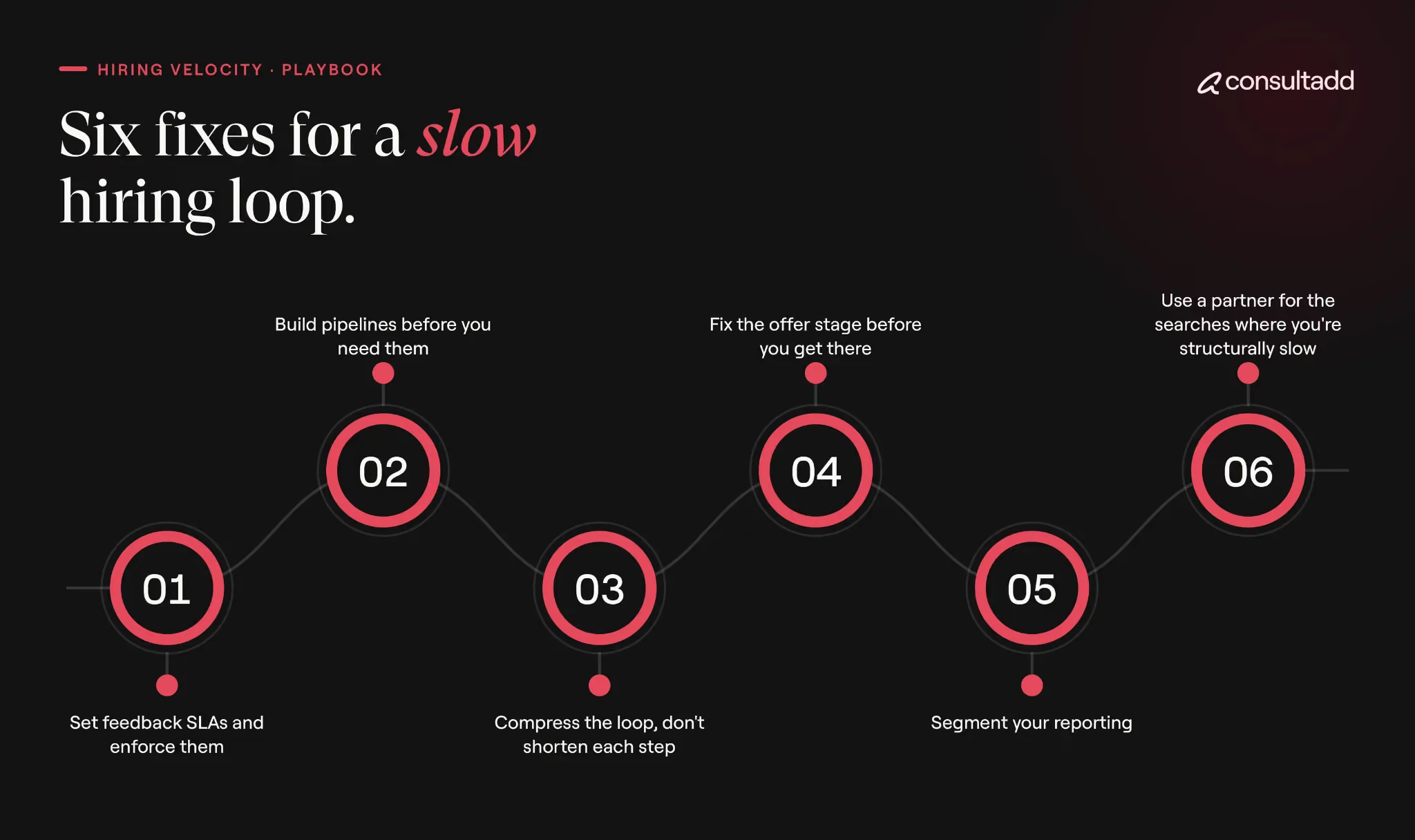
Set feedback SLAs and enforce them. Shortlists reviewed within two working days, interview feedback within 24 hours. Most hiring managers will hit this if someone actually tracks it.
Build pipelines before you need them. For roles you hire repeatedly, entering a search with three warm candidates already partially assessed removes the entire sourcing phase.
Compress the loop, don't shorten each step. Same-day or same-week interview blocks beat trimming a 45-minute interview to 30.
Fix the offer stage before you get there. Comp bands approved, references started in parallel, offer letter templated. This stage should never take a week.
Segment your reporting. Track time to hire by role family and by stage, quarterly. An aggregate number hides the one role type dragging your average up.
Use a partner for the searches where you're structurally slow. If a role type consistently takes you 60 days and you only hire two a year, building internal capability for it rarely pays off.
That last point is worth being honest about. Speed advantages in staffing usually come from a pipeline that already exists, not from working harder on the search.
Our step-by-step walkthrough of the IT staffing process breaks down where a specialized partner compresses timelines and where it doesn't help much. If you're weighing that decision, our buyer's guide to IT staffing firms covers what to ask before you sign anything.
When a longer hiring cycle is the right call
Only 20% of organizations measure quality of hire at all, according to SHRM's 2026 data. That's a problem, because a team optimizing purely for speed without a quality counterweight will eventually hire the wrong person quickly and call it a win.
Some situations justify a longer cycle. A first engineering leader who'll set technical direction for years. A role with security clearance requirements. A hire replacing someone who failed, where you need to understand what went wrong before you repeat it.
The test I'd apply is simple. Is the extra time buying you better information, or is it just waiting? Extra weeks spent on a structured work sample buy information. Extra weeks spent waiting for a fourth stakeholder's calendar buy nothing. Most teams with a bad average time to hire have plenty of the second kind and very little of the first.
Start strong with Consultadd
With 15 years in business and 5,000+ successful staffing engagements, we don't just fill roles, we build reliability into your process. We've supported 65 staffing companies in the past year alone and maintain MSAs with industry leaders like Robert Half and TEKsystems.
Here's what working with Consultadd looks like:
Talent sourced in under 24 hours
Ready-to-deploy candidates, vetted for experience and compliance
Lower turnover risk: we match long-term goals, not just short-term needs
Dedicated 1:1 account managers for responsive, personalized support
Top 100 candidate matches delivered in the past year
Strong partnerships with universities to tap into fresh, committed talent
Post-placement support so your investment grows beyond day one
For candidates, your next opportunity is more than just a job title, it's a chance to build skills, gain experience, and move your career forward. At Consultadd, we connect technology professionals with projects and employers that align with their goals, whether they're looking for contract, contract-to-hire, or long-term opportunities.
The tech job market moves fast, but the right guidance can make all the difference. Ready to take the next step in your career journey? Explore Opportunities >>
Key takeaways
The average time to hire in 2026 sits below the widely quoted 44-day figure, with SHRM reporting a 39-day median time to fill for non-executive roles.
Executive searches hold steady at a 45-day median, well below the 60 days recorded in 2022.
Screening and interviewing consume 8 to 9 days each, making them the highest-value stages to tighten.
Benchmark by role family and company size. A national median is context, not a target.
Track quality of hire alongside speed, or you'll optimize your way into faster bad decisions.
FAQs
What is a good average time to hire?
For most non-executive roles, anything at or under about 30 days from candidate entry to offer acceptance is solid. Compare against similar roles in your industry rather than a cross-industry median, since scarce technical skills routinely take twice as long as high-volume roles.
What's the difference between time to hire and time to fill?
Time to hire starts when a candidate enters your pipeline. Time to fill starts earlier, when the requisition is approved or posted. Both end at offer acceptance, so time to fill is always the equal or larger number, and the difference between them is your sourcing lag.
Why is my time to hire increasing?
The usual culprits are added interview rounds, more stakeholders in the decision, and slower feedback loops. Rising recruiter workload contributes too. SHRM's 2026 data shows the median recruiter now handles 25 open requisitions, up from 20 the year before.
How do you calculate the average time to hire?
Add the total days each candidate spent in the pipeline before accepting, then divide by the number of hires. Use calendar days rather than business days, and calculate separately for each role family so the average stays meaningful.
Does a faster hiring process lower quality of hire?
Not by itself. Speed gained by removing scheduling delays and redundant approvals has no effect on quality. Speed gained by skipping assessment steps does. The distinction is whether you're cutting waiting time or cutting evidence.
How much does a slow hiring process cost?
Beyond direct recruiting spend, an open role carries lost productivity and added workload on the remaining team. SHRM puts the 2026 median cost per hire at $1,300 for non-executive roles and $15,000 for executive roles, and vacancy costs typically exceed those figures for revenue-generating positions.
Here's the paradox defining recruitment right now: applications per job opening have roughly doubled since 2022, and employers still can't fill their roles.
More resumes, worse outcomes. Which is exactly why hiring and recruiting strategies matter more than hiring and recruiting effort. Teams drowning in applicants don't need to work harder; they need a system that attracts the right people, filters accurately, and closes fast.
The pressure is structural, not seasonal. Recruiters today handle 93% more applications and 40% more open roles than in 2021, with teams 14% smaller. Meanwhile 75% of recruiters tell LinkedIn they struggle to find candidates with the right skills. Volume went up, signal went down, and headcount went sideways.
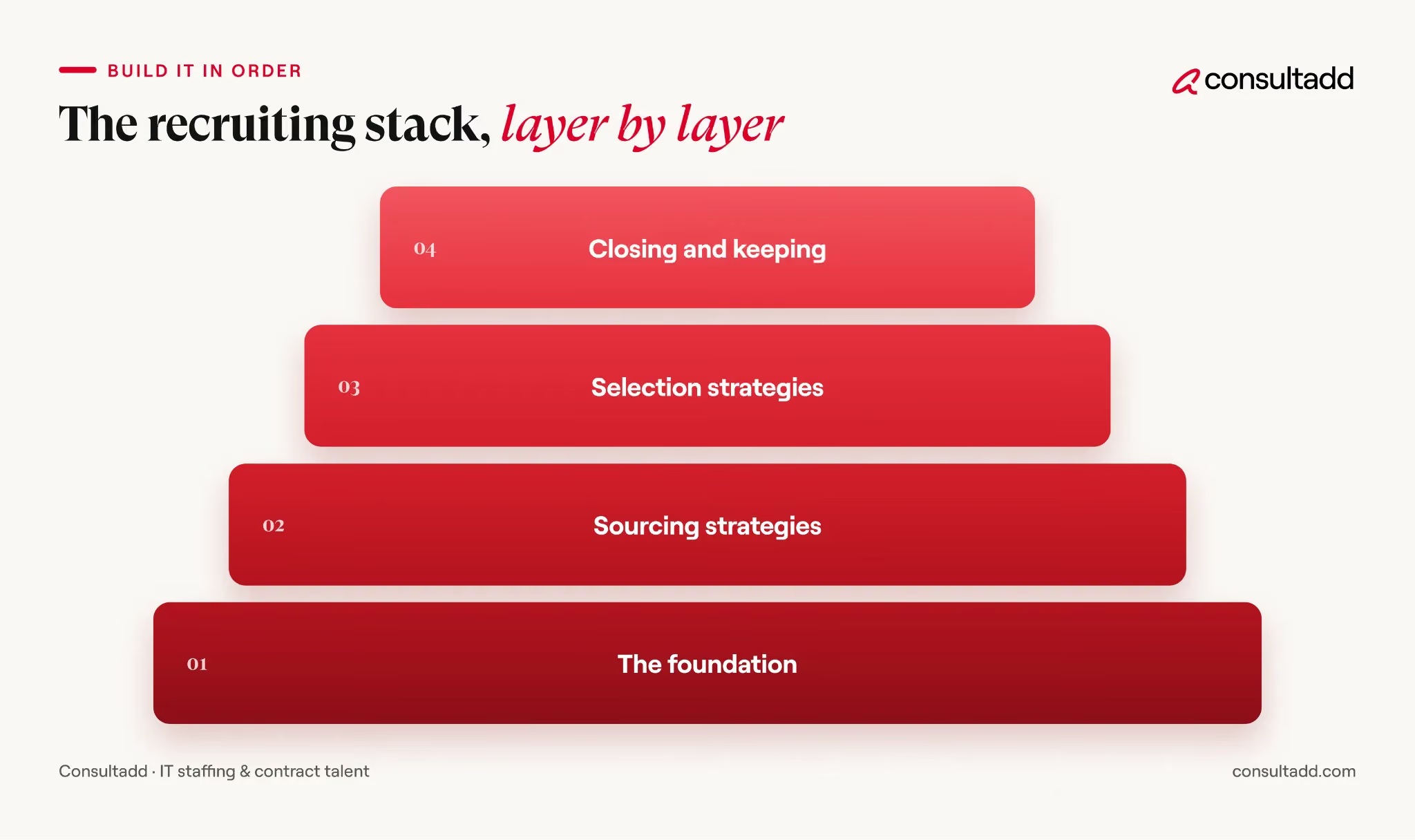
This playbook lays out a complete strategy across four layers: the foundation, sourcing, selection, and closing, plus the metrics that tell you whether any of it is working.
TL;DR
A hiring strategy is a connected system across four layers: workforce planning and employer brand, sourcing channels, structured selection, and offer-to-onboarding, measured end to end.
Skills-based hiring is now the default: roughly 70% of employers prioritize demonstrated skills over degrees, and doing so can expand talent pools dramatically.
The highest-ROI sourcing channels are usually the least glamorous: internal mobility, employee referrals, and warm pipelines for repeat roles.
Structured interviews with scorecards beat improvised conversations on both speed and accuracy, and they're the guardrail that makes AI screening safe to use.
Track quality of hire and 90-day retention alongside speed metrics; a fast process that produces mis-hires is just failing quickly.
Strategy vs a pile of tactics
Most companies don't have a hiring strategy. They have a job board subscription, an ATS nobody configured properly, and a set of interview habits inherited from whoever hired the current managers. Tactics without architecture.
A real strategy answers four questions in order: What talent will the business need, and when? Where will we find it? How will we decide accurately?
And how do we close candidates and keep them past year one? Each layer feeds the next; a brilliant interview process can't rescue an empty pipeline, and a full pipeline is wasted on coin-flip interviews.
One framing note before the layers. This guide is the architecture; if you want a ground-level look at specific tactics companies are running right now, our companion piece on the hiring strategies companies are actually using pairs well with it.
Layer 1: The Foundation
Workforce planning before requisitions:
Reactive hiring, opening a req the day someone resigns, guarantees you're always paying rush prices in time and salary.
Quarterly planning with department heads (growth roles, likely attrition, skills the roadmap will demand) converts emergencies into scheduled work. Even a rough forecast beats none: if engineering will need four hires by Q3, sourcing starts now, not in Q3.
Job design and honest requirements:
Every requirement on a job post is a filter, and most posts are over-filtered. Separating true must-haves from nice-to-haves, and cutting degree requirements where skills can be tested instead, widens the pool without lowering the bar.
This is the entry point to skills-based hiring, now practiced in some form by roughly 70% of employers, up from 65% in 2024.
Employer brand as pipeline infrastructure:
Candidates research you before applying: reviews, salaries, your careers page, how your engineers talk online. Brand work isn't vanity; it's conversion rate.
The practical version is unglamorous: honest job descriptions, posted salary ranges where feasible, visible employee stories, and responding to reviews like a company that listens.
Layer 2: Sourcing Strategies
No single channel wins. The strategy is a portfolio, weighted by role type and urgency:
Internal mobility is the most underpriced channel:
Leading organizations now target filling around 30% of mid-to-senior roles internally, and companies with mature skills data manage even more.
Internal fills cost less, ramp faster, and signal to everyone else that careers grow here, which quietly improves retention across the board.
Pipelines beat searches.
If you hire the same role more than twice a year, a warm pipeline (past silver-medal candidates, engaged passive prospects, alumni) changes the economics entirely.
Starting a search from zero every time is the single most expensive habit in recruiting.
Contract and contract-to-hire deserve a seat in the strategy, not the emergency drawer:
Flexible capacity decouples "work is getting done" from "permanent hire decided," which is precisely what volatile 2026 headcount planning needs.
Layer 3: Selection Strategies
Sourcing gets people to the door. Selection decides whether the next two years go well, and it's where most processes quietly leak accuracy.
Structured interviews are the highest-leverage fix:
Same questions per role, criteria-based scorecards, independent scoring before group debriefs.
Decades of selection research back this, and SHRM's guidance links structured screening to better 90-day performance and lower early attrition. It's also faster: rubrics kill the endless "let's add one more round to be sure" cycle.
Test skills, don't infer them:
Work samples, job simulations, and role-relevant assessments predict performance better than resume pedigree.
The skills-based approach can expand US talent pools by an order of magnitude for many roles, and it's fairer at the same time, a rare free lunch.
Use AI as a screen, never a judge:
With around 87% of companies now using AI somewhere in recruitment, the question isn't whether but how.
The pattern that works: AI for scheduling, sourcing suggestions, first-pass matching, and note-taking; humans for every consequential judgment. Two cautions earn their place here.
Candidates use AI too (79% of job seekers, by recent counts), so resume polish signals less than it used to, another argument for testing skills directly. And unaudited screening models carry real bias and compliance risk, so keep humans reviewing rejections and vendors answerable for their models.
Candidate experience is a selection strategy:
Slow feedback and ghosting don't just annoy people; they select for candidates with no other options.
Set SLAs (feedback within 24 hours, decisions within days of the final round) and tell candidates the timeline upfront.
The teams that fixed this are the same ones that fixed the broader dysfunctions we cataloged in what's broken in IT recruitment.
Layer 4: Closing And Keeping
Offers fall apart in the last mile more than anywhere else, usually for preventable reasons.
Close with speed and transparency:
Top candidates hold multiple offers and short windows. Pre-approve compensation bands so offers go out in days, not weeks of committee review.
Lead with the full picture: salary, equity, benefits, growth path. Exploding offers and lowball-then-negotiate games win short-term and poison your brand long-term, in an era where every candidate can read about it afterward.
Onboarding is part of recruiting:
The hire isn't successful when the offer is signed; it's successful when the person is productive and still there at month twelve. Structured onboarding, a real 30-60-90 plan, an assigned buddy, and early wins measurably lift 90-day retention.
Given that replacing a professional employee costs somewhere between half and twice their annual salary once productivity loss is counted, onboarding is the cheapest retention program you'll ever run.
Retention data feeds the top of the funnel:
Exit and stay interviews tell you which sources, managers, and role designs produce people who thrive versus churn.
That loop, hire, measure, adjust sourcing and selection, is what makes the whole thing a strategy rather than a conveyor belt.
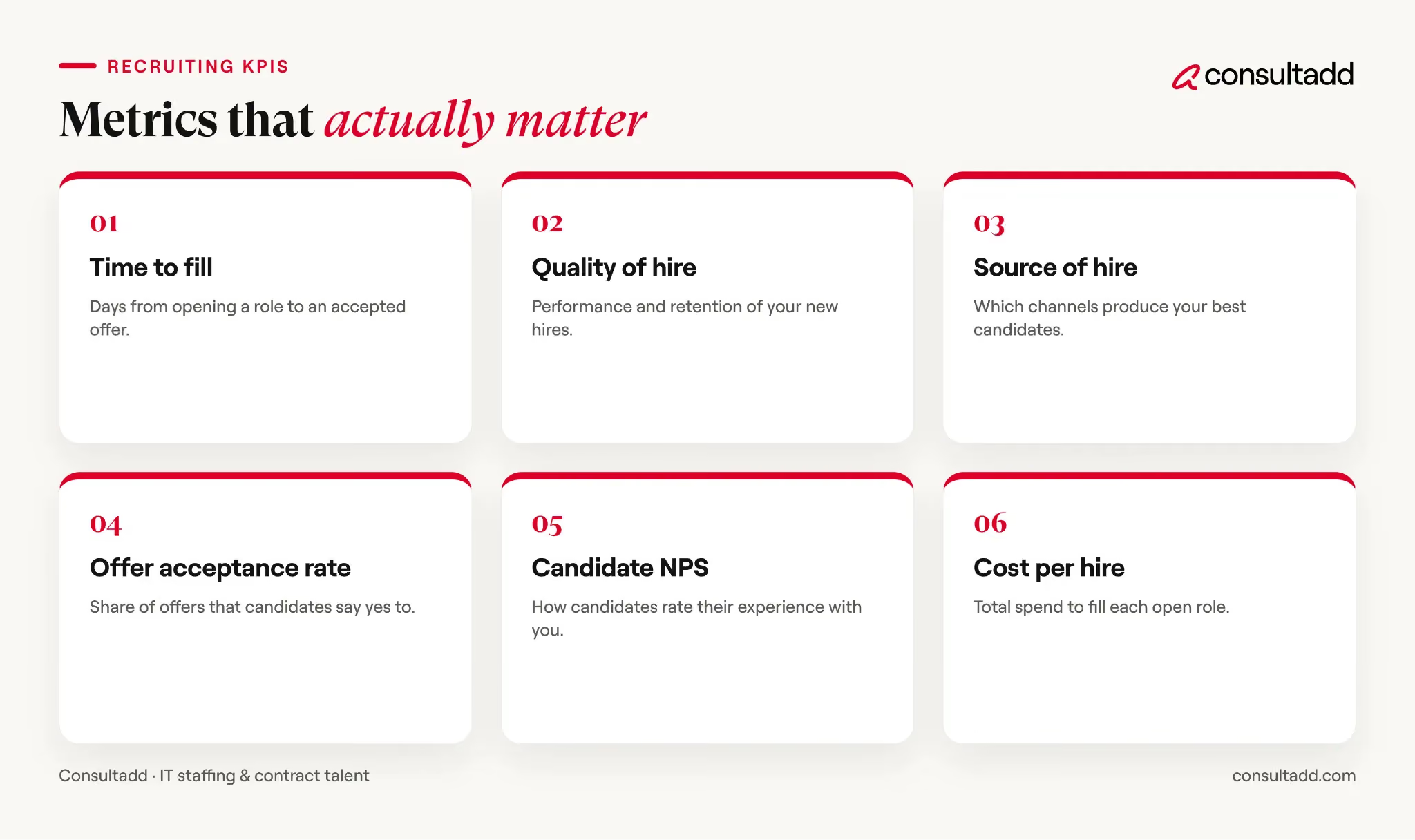
Measuring what matters
You can't steer what you don't measure, and you'll mis-steer if you measure only speed:
Metric
What it tells you
Healthy signal
Time to fill
Total days a seat stays open
Trending down by segment, not just on average
Quality of hire
90-day/1-year performance and retention of hires
Rising; the metric that justifies all others
Source of hire
Which channels produce keepers, not just applicants
Budget follows quality, not volume
Offer acceptance rate
Competitiveness of offers and closing process
85%+ for most professional roles
Candidate NPS
How your process treats people
Positive and improving; leaders target 70+
Cost per hire
Total recruiting spend per hire
Benchmarked; SHRM puts recent averages near $4,700–$5,500
The meta-lesson across all four layers: nothing here is exotic. Skills over pedigree, warm pipelines over cold searches, structure over improvisation, speed with respect, and measurement that includes quality. The companies winning talent in 2026 aren't running secret plays. They're running boring ones, consistently.
Start Strong With Consultadd
With 15 years in business and 5,000+ successful staffing engagements, we don't just fill roles, we build reliability into your process. We've supported 65 staffing companies in the past year alone and maintain MSAs with industry leaders like Robert Half and TEKsystems.
Here's what working with Consultadd looks like:
Talent sourced in under 24 hours
Ready-to-deploy candidates, vetted for experience and compliance
Lower turnover risk: we match long-term goals, not just short-term needs
Dedicated 1:1 account managers for responsive, personalized support
Top 100 candidate matches delivered in the past year
Strong partnerships with universities to tap into fresh, committed talent
Post-placement support so your investment grows beyond day one
For candidates, your next opportunity is more than just a job title, it's a chance to build skills, gain experience, and move your career forward. At Consultadd, we connect technology professionals with projects and employers that align with their goals, whether they're looking for contract, contract-to-hire, or long-term opportunities.
The tech job market moves fast, but the right guidance can make all the difference. Ready to take the next step in your career journey? Explore Opportunities >>
Key takeaways
Effective hiring and recruiting strategies form a system across four layers: foundation (planning, job design, brand), sourcing, selection, and closing/onboarding, with metrics tying them together.
Skills-based hiring is the 2026 default: ~70% of employers now prioritize demonstrated ability over degrees, expanding pools and improving fairness simultaneously.
Weight your sourcing portfolio toward internal mobility, referrals, and warm pipelines; they consistently beat job-board volume on quality per dollar.
Structured interviews with scorecards, direct skills testing, and AI-with-human-oversight are the selection combination that raises both speed and accuracy.
Measure quality of hire and 90-day retention alongside time to fill and cost per hire, then reallocate budget toward the channels producing people who stay.
FAQs
What are the most effective hiring and recruiting strategies in 2026?
The consistent winners: skills-based hiring with direct assessments, internal mobility programs, employee referral systems, warm talent pipelines for repeat roles, structured interviews with scorecards, and AI-assisted screening kept under human oversight. The effectiveness comes from running them as a connected system rather than isolated tactics.
What is the difference between hiring and recruiting?
Recruiting is the attraction side: sourcing, engaging, and building a pipeline of candidates. Hiring is the decision side: assessing, selecting, and making the offer. A complete strategy covers both, plus onboarding, because a great pipeline feeding a broken selection process (or vice versa) still produces bad outcomes.
What is skills-based hiring and why does it matter?
It means evaluating candidates on demonstrated abilities, through work samples, assessments, and structured competency interviews, instead of degrees or brand-name employers. Around 70% of employers now practice it because it expands the talent pool substantially, reduces mis-hires, and improves diversity without lowering standards.
How is AI changing recruiting strategy?
AI now handles scheduling, sourcing suggestions, first-pass screening, and candidate communication at most companies, cutting administrative load significantly. The strategic rule that separates good implementations: AI accelerates, humans decide. Unaudited screening models carry bias and compliance risk, and with most candidates using AI to polish applications, direct skills testing matters more than ever.
Which recruiting channel gives the best return?
For most organizations, employee referrals and internal mobility deliver the highest quality per dollar, followed by warm pipelines for frequently hired roles. Job boards produce volume but heavy screening costs. The honest answer requires your own source-of-hire data: track which channels produce people who perform and stay, then shift budget accordingly.
How do you measure whether a hiring strategy is working?
Pair speed metrics (time to fill, offer acceptance rate) with quality metrics (quality of hire, 90-day and first-year retention) and efficiency metrics (cost per hire, source of hire). Segment by role family and review quarterly. Improvement in speed at the expense of quality means the strategy is failing faster, not working better.
You can tell within the first two weeks if a new hire is going to work out. The trouble is, by then you've already spent weeks sourcing them, days interviewing them, and a good chunk of your recruiting budget getting them through the door.
The vetting of candidates is what happens before that two-week mark, the part of hiring that decides whether you're building a team or setting up your next resignation letter.
Most hiring mistakes trace back to the same root cause: something got skipped. A reference call that never happened. A credential nobody confirmed. A visa status nobody double-checked until payroll flagged it.
This guide walks through what candidate vetting actually involves, where companies cut corners without meaning to, and how to build a process that holds up under pressure.
TL;DR
Candidate vetting covers identity checks, background screening, reference calls, work authorization, and skills validation, not just a resume scan.
The U.S. Department of Labor estimates a bad hire can cost around 30% of that employee's first-year earnings, and that's before you count team disruption.
Reference checks catch things interviews miss, but only when someone asks specific, structured questions instead of "would you rehire them?"
Work authorization is a legal requirement, not a nice-to-have. Every U.S. employer must complete Form I-9 for new hires, and many also use E-Verify.
Staffing partners that already vet candidates before submission cut weeks off your hiring timeline and reduce your exposure to compliance gaps.
What candidate vetting actually covers
Vetting a candidate means confirming that what's on the resume, and what came up in the interview, holds up once you look closer. It's not one check. It's a sequence of them, and each one answers a different question.
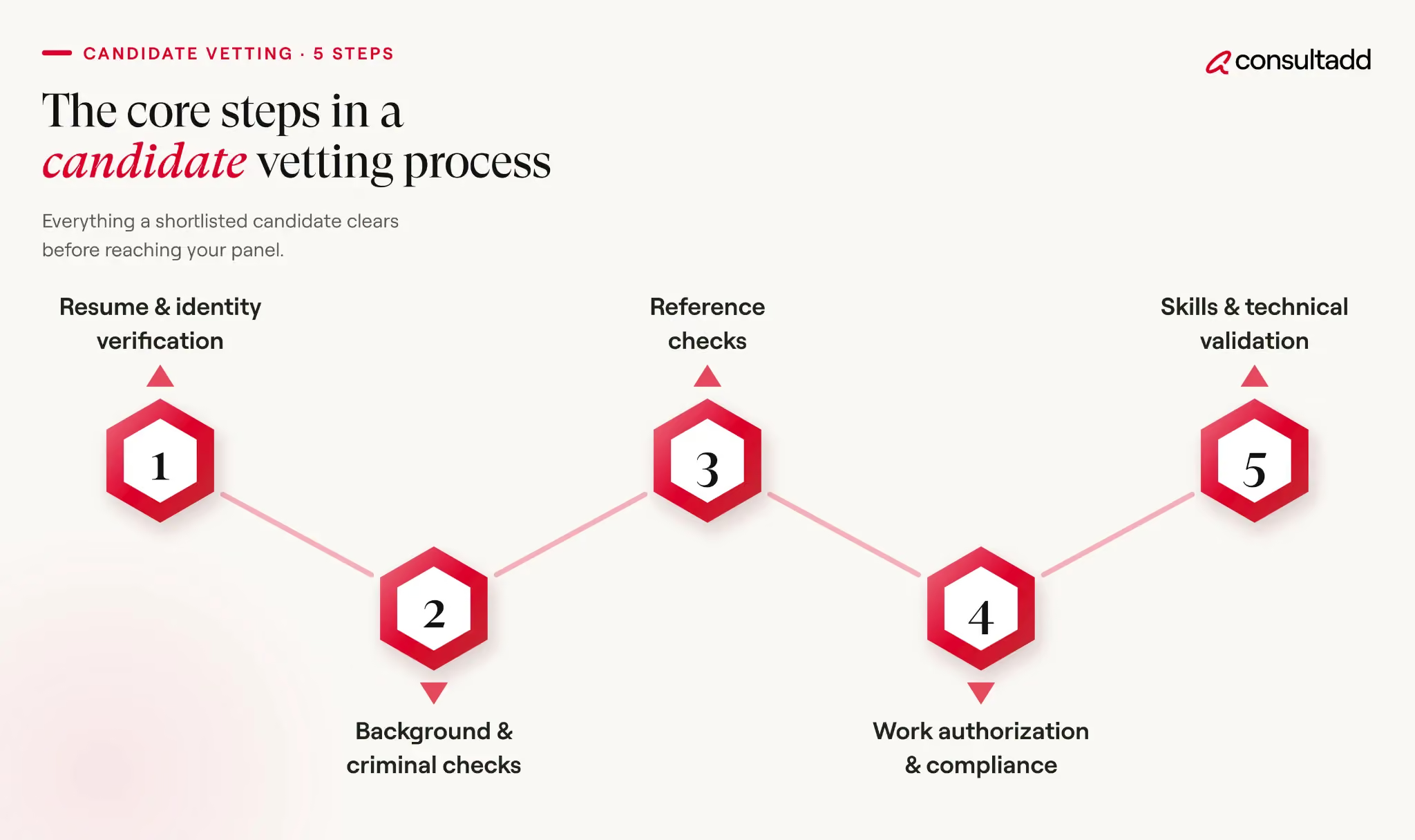
Identity verification confirms the person is who they say they are. Background screening looks at criminal history, employment history, and sometimes credit, depending on the role. Reference checks bring in a third party's perspective on how the candidate actually performs day to day. Work authorization checks confirm the candidate can legally work for you. Skills validation confirms they can do the job they're being hired for.
Skip any one of these, and you're hiring on trust alone. Sometimes that works out. Often it doesn't, and you don't find out until the cost of fixing it is much higher than the cost of checking it upfront.
Why skipping steps costs more than it saves
Vetting takes time, and time feels expensive when a hiring manager needs a seat filled yesterday. But rushing the process tends to cost more than it saves, just later and less visibly.
The U.S. Department of Labor has long estimated that a bad hire costs roughly 30% of that person's first-year salary once you factor in recruiting, training, and lost productivity.
Cost type
What it includes
When it shows up
Direct replacement cost
Recruiting fees, advertising, interview time
Weeks 1-8 after termination
Training and onboarding loss
Time spent training someone who doesn't stay
Month 1-3
Productivity gap
Reduced output while the role sits vacant or underperforms
Ongoing until backfilled
Team disruption
Extra work absorbed by other staff, morale impact
Often the longest-lasting cost
The financial hit is one thing. The harder cost to measure is what a bad hire does to the people around them, extra work absorbed, deadlines slipping, good employees quietly job-hunting because they're tired of covering gaps.
The core steps in a candidate vetting process
A solid vetting process doesn't need to be complicated. It needs to be consistent, and it needs to happen in a logical order.
1. Resume and identity verification
Start with the basics.
Confirm the candidate's identity, confirm the dates and titles on their resume match what previous employers report, and flag any gaps that don't add up.
This step alone catches a surprising number of discrepancies before you invest more time in the process.
2. Background and criminal checks
Most U.S. employers run some form of background check. SHRM's research on employer screening practices found that 92% of organizations conduct background checks, with the majority happening at the pre-employment stage rather than after someone's already on payroll.
What gets checked depends on the role. A finance position might warrant a credit check.
A role working with vulnerable populations might require a more thorough criminal history review.
3. Reference checks
This is the step people rush through, and it's often the most revealing one. A generic "would you hire them again?" gets you a generic answer.
Structured questions about specific projects, how the candidate handled conflict, and what a manager would coach them on tend to surface real patterns.
Reference checks also work best when they happen before an offer, not after. For more on the timing and why some companies push this step too late in the process.
Every U.S. employer is legally required to complete Form I-9 for each new hire, confirming both identity and the right to work in the United States, according to USCIS.
Many employers also enroll in E-Verify, a program run by the Department of Homeland Security that cross-checks I-9 information against Social Security Administration and DHS records to confirm employment eligibility, as explained on the DHS E-Verify page.
Getting this wrong isn't just a compliance headache. It can mean fines, and in worse cases, having to remove someone from a role after they've already started.
If your team handles a mix of citizens, visa holders, and contractors, our guide on work authorization requirements for new hires breaks down the different categories and what documentation each one needs.
5. Skills and technical validation
For technical roles especially, a resume and a good interview aren't proof of ability.
Coding assessments, portfolio reviews, or a structured technical interview round confirm the candidate can actually do the work, not just talk about it convincingly.
Common mistakes companies make
A few patterns show up again and again when vetting processes fail.
Rushing reference checks to the point where they become a formality instead of a real conversation. Skipping work authorization checks for contractors or short-term hires, assuming the risk is lower because the engagement is temporary. Treating background checks as a box to check rather than tailoring them to the actual risk level of the role. And relying on a single interviewer's gut feeling instead of cross-checking that impression against references and screening results.
Mistake
Why it happens
What to do instead
Skipping reference checks under time pressure
Hiring manager wants a fast fill
Build reference checks into the timeline from day one, not as a final step
Treating all roles the same
No role-based screening policy
Match the depth of screening to the risk and responsibility of the role
Ignoring contractor compliance
Assuming short-term hires carry less risk
Apply the same work authorization checks to contractors as full-time hires
No documentation of the process
Vetting happens informally, notes aren't kept
Use a consistent checklist and keep records for every hire
How a staffing partner changes the equation
Running a thorough vetting process for every hire takes time your internal team may not have, especially if you're filling several roles at once. This is where a staffing partner earns its keep.
Instead of vetting a candidate after you've already found them, a good partner has already done that work before the candidate lands on your desk.
That means the resumes you see have already been checked for experience, references have already been pulled, and compliance documentation is already handled. You still make the final call, but you're making it with a much shorter list of unknowns.
With 15 years in business and 5,000+ successful staffing engagements, we don't just fill roles, we build reliability into your process. We've supported 65 staffing companies in the past year alone and maintain MSAs with industry leaders like Robert Half and TEKsystems.
Here's what working with Consultadd looks like:
Talent sourced in under 24 hours
Ready-to-deploy candidates, vetted for experience and compliance
Lower turnover risk: we match long-term goals, not just short-term needs
Dedicated 1:1 account managers for responsive, personalized support
Top 100 candidate matches delivered in the past year
Strong partnerships with universities to tap into fresh, committed talent
Post-placement support so your investment grows beyond day one
For candidates, your next opportunity is more than just a job title, it's a chance to build skills, gain experience, and move your career forward. At Consultadd, we connect technology professionals with projects and employers that align with their goals, whether they're looking for contract, contract-to-hire, or long-term opportunities.
The tech job market moves fast, but the right guidance can make all the difference. Ready to take the next step in your career journey? Explore Opportunities >>
Key Takeaways
The vetting of candidates is a sequence of checks, identity, background, references, work authorization, and skills, not a single resume review.
A bad hire costs roughly 30% of first-year salary by DOL estimates, and that figure doesn't count the disruption to your existing team.
Reference checks work best when they're structured and happen before an offer, not squeezed in as an afterthought.
Work authorization compliance, including Form I-9 and E-Verify where applicable, is a legal requirement for every U.S. employer, not an optional step.
Partnering with a staffing firm that pre-vets candidates shortens your timeline and reduces the number of unknowns you're hiring against.
FAQs
What does "vetting a candidate" actually mean?
It means confirming that a candidate's claims, identity, work history, credentials, and legal right to work all hold up before you extend an offer. It typically involves background checks, reference calls, and in technical roles, some form of skills validation.
How long does a proper candidate vetting process take?
It depends on the role and how many checks are needed, but most background and reference checks can be completed within three to five business days when they're built into the hiring timeline instead of added at the last minute.
Do I need to run a background check for every hire?
Not necessarily to the same depth. Higher-risk roles, those handling money, vulnerable populations, or sensitive data, usually warrant more thorough screening than a standard office role. A role-based policy helps you apply the right level of scrutiny consistently.
What's the difference between a reference check and a background check?
A background check verifies factual records: criminal history, employment dates, sometimes credit. A reference check gathers a subjective but informed perspective from someone who worked with the candidate directly, covering things like work style and reliability that records can't show.
Is E-Verify required for all employers?
No. E-Verify is voluntary for most private employers, though some states mandate it and federal contractors are often required to use it. Every employer, regardless of E-Verify enrollment, must still complete Form I-9 for new hires.
Can a staffing agency handle candidate vetting for us?
Yes. Staffing partners that pre-screen candidates for experience, references, and compliance before submitting them can significantly cut down the vetting work your internal team needs to do, while still leaving the final hiring decision with you.
Open twenty requisitions in a month and your usual hiring process will show its cracks fast. Interviews stack up, good candidates go cold waiting for a callback, and your recruiters end up doing data entry instead of actual recruiting.
That's the problem a high volume hiring strategy is meant to solve: filling a large number of roles quickly, without letting quality slide just because the volume went up.
This isn't just a staffing-agency problem anymore. Retailers gearing up for a holiday season, warehouses scaling for a new contract, and tech firms building out a product team all run into the same wall.
The fix isn't hiring more recruiters and hoping. It's rebuilding the process itself so it holds up under pressure.
TL;DR
High volume hiring means filling many roles fast, and it needs its own process, not a scaled-up version of your regular one.
Most high volume hiring strategies break down at screening and scheduling, not at sourcing.
A working strategy leans on structured requisitions, automation for repetitive tasks, and clear metrics like time-to-fill and cost-per-hire.
SHRM's 2026 benchmarking data shows nonexecutive time-to-fill dropped to a median of 39 days, largely because more teams automated the routine parts of hiring.
Partnering with a staffing firm like Consultadd can absorb sourcing, compliance, and vetting so your internal team focuses on interviews and final decisions.
What high volume hiring actually means
High volume hiring is the practice of filling a large number of open positions within a compressed window, usually driven by seasonal demand, rapid growth, a new client contract, or high turnover in frontline roles. It shows up most in retail, logistics, healthcare, hospitality, and IT staffing, where dozens or even thousands of roles need to be filled on a rolling basis.
The job openings data backs up how real this pressure is. The Bureau of Labor Statistics reported job openings held around 7.6 million in May 2026, with hires holding steady near 5.2 million for the month. That's a lot of roles moving through pipelines at once, across every industry, at the same time.
The mistake most companies make is treating high volume hiring like their normal hiring process, just faster. It doesn't work that way.
Regular hiring can afford a slow, thoughtful funnel because there are only a handful of roles open.
High volume hiring needs a funnel built for throughput from day one: standardized screening criteria, faster scheduling, and enough automation that your recruiters aren't buried before lunch.
Why high volume hiring strategies break down
1. The volume trap
Most teams assume the bottleneck is sourcing, so they throw more job boards and more ad spend at the problem. But candidates usually aren't the issue.
The real bottleneck is almost always screening and scheduling. A recruiter manually reviewing 400 resumes for a single requisition will always fall behind, no matter how good the sourcing was.
Gartner's research on 2026 talent acquisition trends points to the same thing: high-volume, low-complexity roles are the roles best suited for an AI-first approach, precisely because the work is repetitive and the risk of getting it slightly wrong is lower than it is for a senior hire.
2. The compliance blind spot
Speed without structure creates legal exposure. When you're moving fast on visa documentation, background checks, and onboarding paperwork, corners get cut, and that's where fines and bad hires come from.
Anyone who has handled work authorization at scale knows this is where a rushed process turns into a six-month cleanup job.
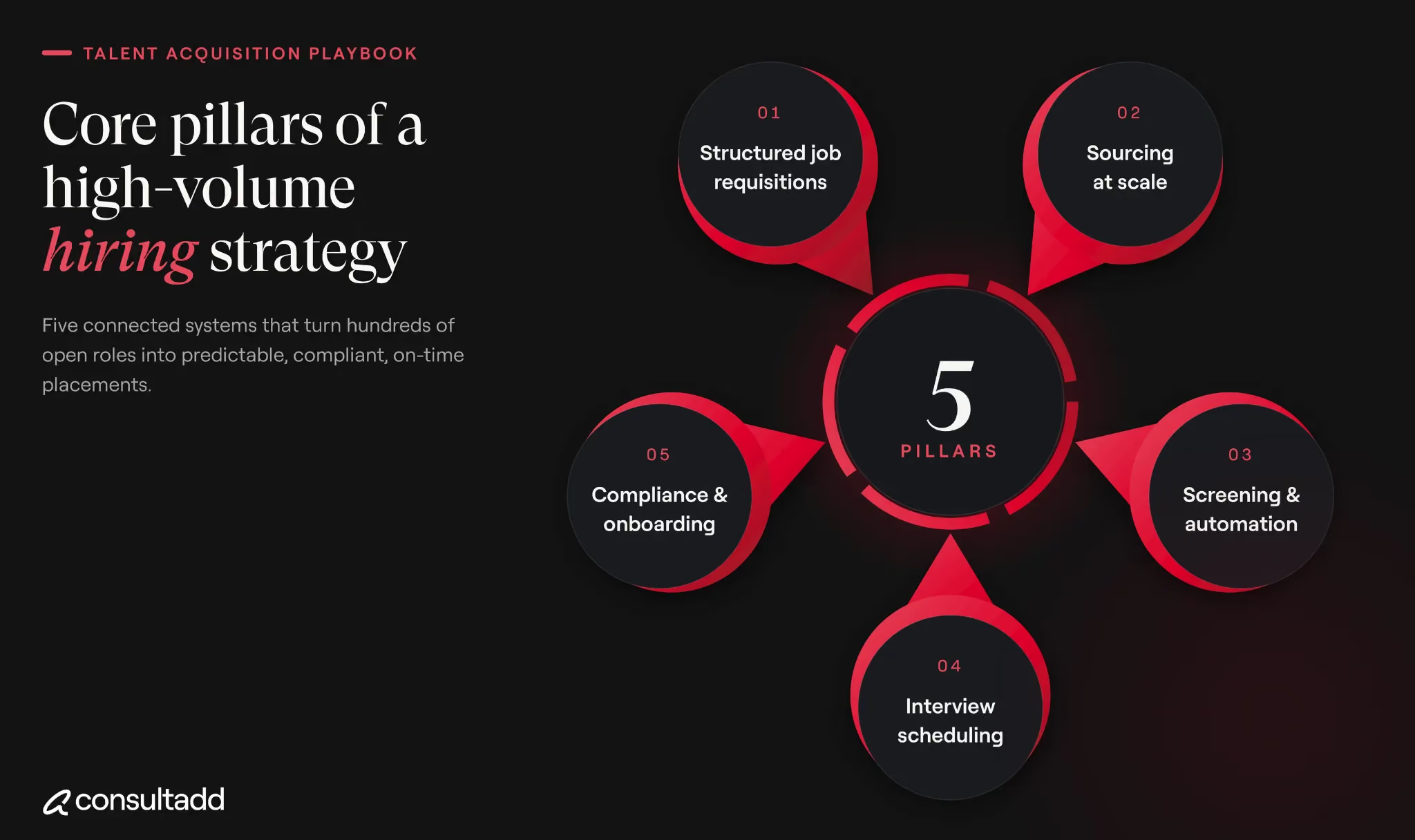
Core pillars of a high volume hiring strategy
1. Structured job requisitions
Every role in a high volume batch should map to a template: same core screening questions, same must-have qualifications, same approval chain.
Without this, every requisition becomes its own one-off project, and that's how timelines slip.
2. Sourcing at scale
Job boards, referral programs, and university partnerships each play a different role.
University partnerships in particular give you a steady stream of candidates for entry-level and technical roles instead of scrambling every time a contract lands.
3. Screening and automation
This is where most of the time savings live.
Resume parsing, skills-based filtering, and automated pre-screening questions cut the pile down to a manageable shortlist before a human ever looks at it.
For a deeper look at how work authorization fits into a fast hiring process, our blog on C2C contract hiring solutions walks through how staffing structures affect compliance and speed together.
4. Interview scheduling
Coordinating interviews for high volume roles by email is a losing game.
Self-scheduling tools and structured interview slots keep candidates moving instead of going cold waiting for a reply.
5. Compliance and onboarding
Visa sponsorship, background checks, and documentation need a standard checklist, not case-by-case handling.
Building your high volume recruitment process step by step
Step 1: Forecast demand before you post a single role.
Look at historical turnover, seasonal patterns, and upcoming contracts. Guessing at volume is how teams end up under-resourced in week three of a hiring push.
Step 2: Standardize the funnel.
Same stages, same scorecards, same decision criteria across every requisition in the batch. This is what makes the process scalable instead of chaotic.
Step 3: Automate repetitive work.
Resume screening, scheduling, and status updates to candidates should run without a human touching every single one. Save your recruiters' time for interviews and final calls.
Step 4: Track the right metrics.
Time-to-fill, cost-per-hire, and offer-acceptance rate tell you if the process is actually working, not just moving.
Ask hiring managers what's working after each batch. A high volume hiring strategy that doesn't improve batch over batch isn't really a strategy, it's just a rush.
High volume hiring vs. traditional hiring
Factor
High Volume Hiring
Traditional Hiring
Roles per cycle
Dozens to thousands
One to a handful
Screening approach
Automated, criteria-based
Manual, case-by-case
Timeline pressure
Days to a few weeks
Weeks to months
Interview process
Structured, often batched
Individually scheduled
Compliance handling
Standardized checklists
Handled per candidate
Typical roles
Retail, warehouse, seasonal, entry-level IT
Specialized, senior, executive
Metrics worth tracking in a high volume hiring strategy
Metric
What it tells you
Target signal
Time-to-fill
How long a requisition stays open
Trending down batch over batch
Cost-per-hire
Total spend divided by hires
Stable or falling as volume rises
Offer-acceptance rate
How many offers get accepted
80%+ is a healthy range
Screen-to-interview ratio
How efficient your screening is
Fewer wasted interviews over time
Early turnover
Hires who leave within 90 days
Low and steady, not rising with volume
Common mistakes in high volume recruiting
The biggest one is skipping reference checks to save time. It feels reasonable when you're filling forty roles in two weeks, but a bad hire at volume costs just as much as a bad hire anywhere else, sometimes more, because it repeats across every location using the same flawed process.
Our guide on reference check questions hiring managers should ask covers how to keep this step fast without cutting it out entirely.
The second mistake is treating every role the same. A warehouse associate role and a help desk technician role don't need the same screening depth, and forcing them through one identical funnel slows down the simple roles and under-vets the complex ones.
Mistakes and fixes at a glance
Mistake
Why it happens
Fix
Skipping reference checks
Time pressure at volume
Use short, structured reference questions instead of skipping
One funnel for every role
Trying to keep things simple
Tier roles by complexity and adjust screening depth
No feedback loop
Moving to the next batch too fast
Debrief with hiring managers after each cycle
Manual scheduling
Underestimating the time cost
Use self-scheduling tools for candidates
Ignoring early turnover data
Focus only on time-to-fill
Track 90-day retention alongside speed metrics
Start Strong With Consultadd
With 15 years in business and 5,000+ successful staffing engagements, we don't just fill roles, we build reliability into your process. We've supported 65 staffing companies in the past year alone and maintain MSAs with industry leaders like Robert Half and TEKsystems.
Here's what working with Consultadd looks like:
Talent sourced in under 24 hours
Ready-to-deploy candidates, vetted for experience and compliance
Lower turnover risk: we match long-term goals, not just short-term needs
Dedicated 1:1 account managers for responsive, personalized support
Top 100 candidate matches delivered in the past year
Strong partnerships with universities to tap into fresh, committed talent
Post-placement support so your investment grows beyond day one
For candidates, your next opportunity is more than just a job title, it's a chance to build skills, gain experience, and move your career forward. At Consultadd, we connect technology professionals with projects and employers that align with their goals, whether they're looking for contract, contract-to-hire, or long-term opportunities.
The tech job market moves fast, but the right guidance can make all the difference. Ready to take the next step in your career journey? Explore Opportunities >>
Key Takeaways
A high volume hiring strategy needs its own process, built for throughput, not a faster version of a normal hiring funnel.
Screening and scheduling are usually the real bottleneck, not sourcing.
Standardized requisitions and automation free up recruiters for the parts of the job that actually need a human.
Tracking time-to-fill, cost-per-hire, and early turnover together shows whether speed is coming at the cost of quality.
Working with an experienced staffing partner like Consultadd takes the sourcing, vetting, and compliance load off your internal team.
FAQs
What is a high volume hiring strategy?
It's a recruiting approach built specifically for filling many roles in a short window, usually through standardized screening, automation, and structured interview scheduling. It differs from regular hiring because it's designed for throughput rather than depth on any single candidate.
How is high volume hiring different from regular recruiting?
Regular recruiting can afford a slower, more individualized process because there are only a few open roles at a time. High volume hiring needs consistent templates and automated screening because dozens or hundreds of requisitions are moving at once.
What tools help most with high volume hiring?
Applicant tracking systems with automated resume screening, self-scheduling interview tools, and bulk candidate communication features make the biggest difference. The goal is removing repetitive manual work so recruiters can focus on interviews and decisions.
How do you measure success in high volume hiring?
Time-to-fill and cost-per-hire are the starting point, but they should always be paired with quality signals like offer-acceptance rate and 90-day retention. Speed without those checks just hides quality problems until later.
Which industries rely most on high volume hiring?
Retail, logistics, healthcare, hospitality, and IT staffing see the most high volume hiring activity, usually tied to seasonal demand, new contracts, or high turnover in frontline roles.
How can a staffing agency help with high volume hiring?
An experienced staffing partner brings pre-vetted candidate pipelines, handles visa and compliance documentation, and can flex capacity up or down as demand shifts. That takes the operational load off an internal team that's already stretched thin.
AWS still runs roughly 30% of the world's cloud infrastructure, more than Azure and Google Cloud combined at some measurements, which means the demand to hire AWS developers hasn't cooled even as the broader tech hiring market has.
What's changed is the bar. In 2026, "knows EC2 and S3" doesn't clear it anymore. Companies now need engineers who can architect for cost and scale, secure what they build, and increasingly, work fluently with AWS's AI services like Bedrock and SageMaker.
That raised bar is exactly why hiring AWS developers has gotten harder to do well, even though the talent pool is objectively large. Titles are inconsistent, certifications get treated as proof of competence when they're really proof of studying, and the best candidates rarely stay on the market long enough for a slow process to catch them.
This guide covers what to actually look for, what the role costs in 2026, how to structure the hiring process, and which engagement model fits your situation.
TL;DR
Look past the title. Evaluate compute, storage, networking, IaC (Terraform or CloudFormation), and security fundamentals, not just years of "AWS experience."
AWS certifications correlate with roughly a 26% salary premium and reliably indicate structured knowledge, but they're a signal to verify, not a substitute for a technical assessment.
US salaries for AWS developers commonly run $110,000 to $195,000+ depending on seniority and location; contract and freelance rates in North America typically fall between $90 and $180+ per hour.
AI-service fluency (Bedrock, SageMaker, Amazon Q) is now a real differentiator, not a nice-to-have, especially for roles touching product development.
Match the engagement model to the need: full-time for core infrastructure ownership, contract or contract-to-hire for defined projects, migrations, and fluctuating capacity.
What an AWS developer actually does
"AWS developer" covers a wider range of work than the title suggests, and the range is exactly why hiring for it goes wrong when the job description is vague. In practice, the role usually blends three things: building application code that runs on AWS services, provisioning and managing the infrastructure that supports it, and making ongoing decisions about cost, scale, and security as the system grows.
That's different from a pure cloud engineer or DevOps hire, who typically owns infrastructure and pipelines without writing much application code, and different from a solutions architect, who designs systems at a higher level without necessarily implementing them day to day.
Job posts often blur these, which is the single biggest reason companies interview five "AWS developers" and get five wildly different skill profiles. Decide which of the three you actually need before writing the req.
The skills that separate strong candidates from average ones
Years of "AWS experience" on a resume tells you almost nothing; plenty of engineers have spent three years clicking around the console without developing real judgment. Here's what actually predicts performance:
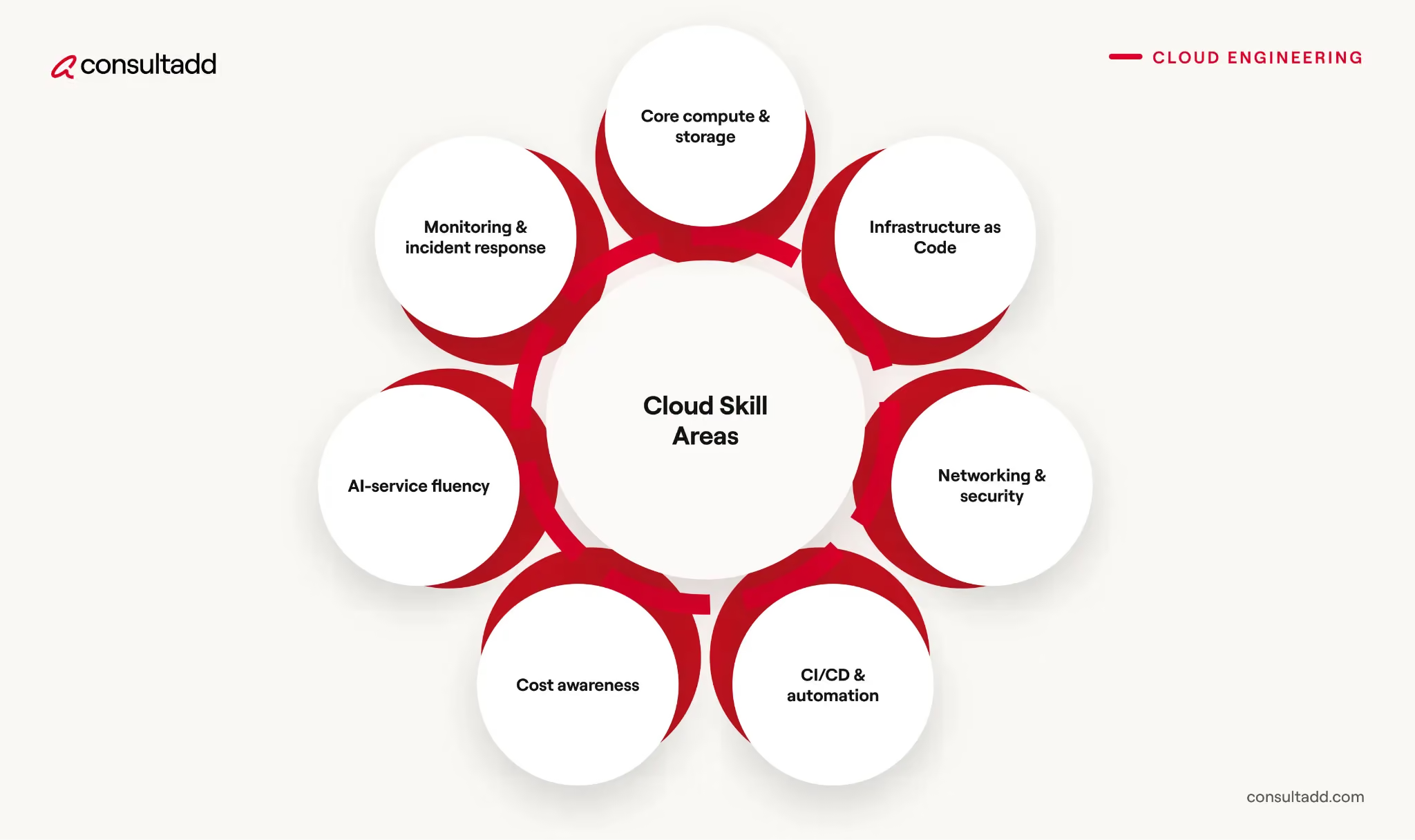
AWS Skills Checklist
Skill area
What to look for
Why it matters
Core compute & storage
Real fluency with EC2, Lambda, S3, RDS/DynamoDB, and when to use each.
The foundation; weak here means everything built on top is fragile.
Infrastructure as Code
Working proficiency in Terraform or CloudFormation, not just console clicking.
Reproducible, reviewable infrastructure instead of tribal knowledge.
Networking & security
VPC design, IAM least-privilege thinking, security groups, encryption basics.
The most common source of costly production incidents and breaches.
CI/CD & automation
Experience with CodePipeline, GitHub Actions, or similar deployment to AWS.
Ships reliably instead of manually, and scales with the team.
Cost awareness
Can explain how a design choice affects the AWS bill, and has optimized one.
Distinguishes engineers who build systems from those who build surprises.
AI-service fluency
Working knowledge of Bedrock, SageMaker, or Amazon Q where relevant.
Increasingly expected for roles touching modern product development.
Monitoring & incident response
CloudWatch, X-Ray, and a real story about diagnosing a production issue.
Tells you how they behave when something breaks at 2 a.m.
The single best interview signal across all of these: ask a candidate to walk through a system they actually built, end to end, including a decision they'd make differently now. Depth and honesty here separate real builders from resume padding faster than any trivia question.
For teams building out a broader technical interview loop around this role, our guide to interview questions for a full stack developer covers the adjacent frontend/backend rigor that pairs well with AWS-specific technical rounds.
Do certifications matter?
Yes, with a caveat. AWS certifications correlate with a real salary premium, industry salary reports put the average uplift around 26%, and the Solutions Architect Associate remains the most commonly required credential, appearing in a large majority of cloud job postings.
Certifications also give recruiters a fast, standardized signal: a certified candidate has demonstrably studied AWS's own best practices rather than picked up habits from whatever their last employer happened to do.
The caveat is real too. A certification proves someone can pass a structured exam, not that they can debug a production incident under pressure or make a sound cost trade-off on a live system. Treat certifications the way you'd treat a degree: a credible signal worth weighting, never a substitute for a hands-on technical assessment.
The strongest candidates typically pair a relevant certification (Developer Associate for coding-heavy roles, Solutions Architect for design-heavy ones, Security or Machine Learning specialties for those niches) with a portfolio or work history that shows the certification in action.
What it costs to hire AWS developers in 2026
Budget conversations go smoother with real numbers on the table. Here's the 2026 landscape across engagement models:
AWS Salary Ranges
Level / model
Typical range
Notes
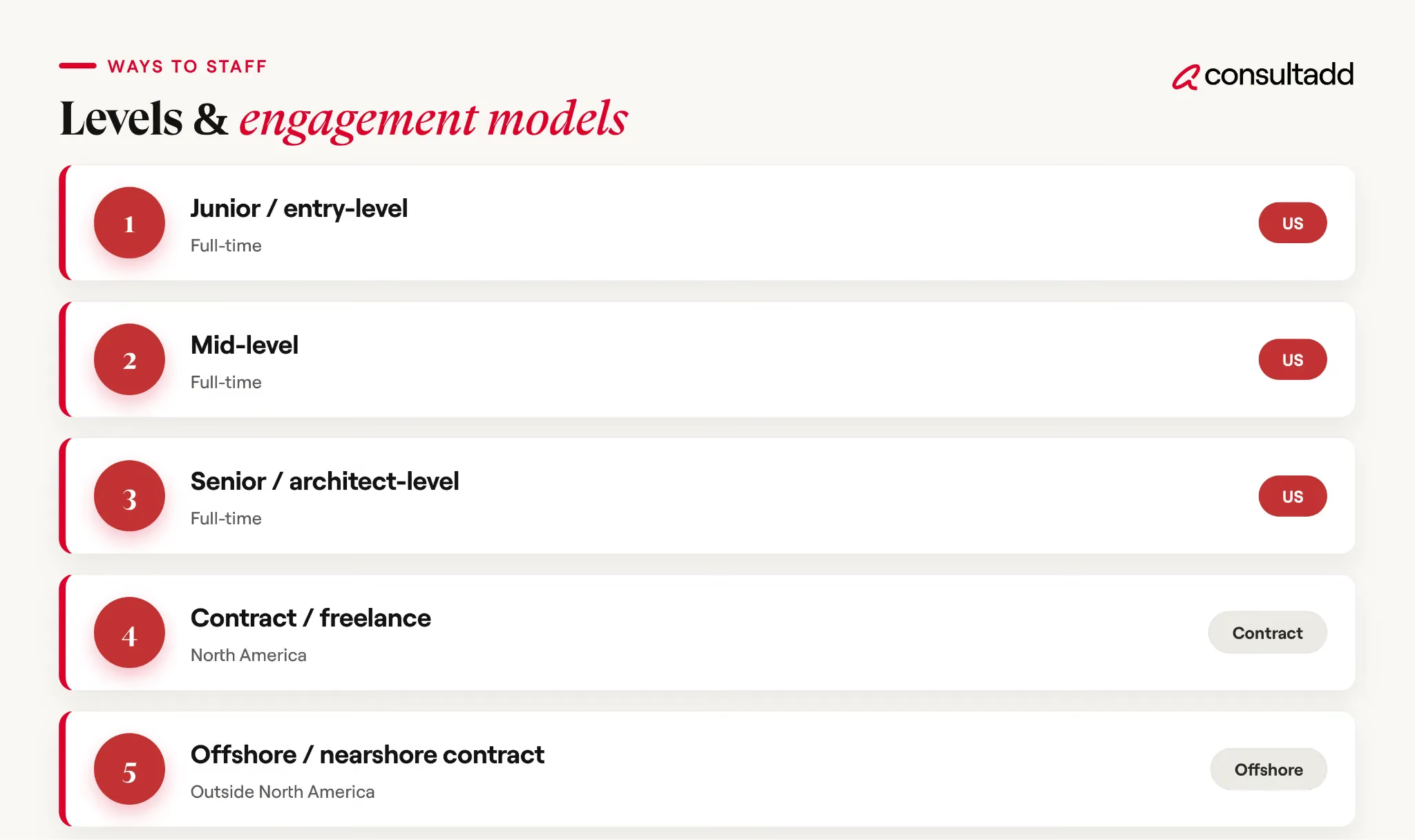
Junior / entry-level (full-time, US)
$85,000–$110,000 base
Cloud Practitioner or Developer Associate certified candidates commonly start here.
Mid-level (full-time, US)
$110,000–$165,000 base
The largest hiring segment; most roles fall here.
Senior / architect-level (full-time, US)
$165,000–$200,000+ base
Premium for Professional or Specialty certifications and AI-service experience.
Contract / freelance, North America
$90–$180+ per hour
Scales with seniority and specialty (security, ML, cost optimization command the top end).
Offshore / nearshore contract
Meaningfully lower hourly rates
Trade-offs in time zone overlap, communication, and compliance overhead need real planning.
Two budgeting notes worth internalizing.
First, the sticker salary isn't the full cost: recruiting fees, onboarding time, and tooling commonly add another 20-30% on top, and companies that budget only the base salary consistently get surprised.
Second, speed has a price tag of its own. Top AWS talent doesn't sit on the market long, and a slow offer process is one of the most common, most avoidable reasons companies lose candidates they'd already won over.
Our breakdown of time to hire vs time to fill covers how to diagnose exactly where that speed leaks out of your process.
Full-time, contract, or contract-to-hire?
The right engagement model depends on the shape of the need, not just the budget:
Hiring Models Comparison
Model
Best fit
Trade-off
Full-time hire
Core infrastructure ownership, long-term architecture decisions, and on-call responsibility.
Slower to hire and harder to scale down if business needs shrink.
Contract
Migrations, defined projects, temporary capacity spikes.
Faster start and no long-term commitment, but less institutional continuity.
Contract-to-hire
Uncertain long-term need, or wanting a working trial before commitment.
Lower risk on both sides, though top contractors may have competing offers before conversion.
Staffing partner
Any of the above when speed and pre-vetting matter most.
Partner quality varies significantly; vetting the vendor matters as much as vetting the candidate.
How to vet candidates: questions and process
A structured loop beats an improvised one, both for accuracy and for speed. A solid AWS developer process runs three stages:
1. Technical screen (30-45 minutes):
Verify fundamentals conversationally before investing in a longer assessment:
"Walk me through the architecture of a system you built on AWS, end to end."
"How would you design for a service that needs to handle a 10x traffic spike?"
"Explain the difference between an IAM role and an IAM user, and when you'd use each."
"Tell me about a time your AWS bill surprised you. What did you do?"
2. Hands-on assessment (60-90 minutes):
A live or take-home exercise scoped to the actual role: provisioning infrastructure with Terraform or CloudFormation, debugging a broken deployment, or designing a solution to a realistic scenario (a service outgrowing its current architecture, a security misconfiguration to find and fix). Watch for how they reason, not just whether they land the exact right answer.
3. Architecture and judgment discussion (45-60 minutes):
For anything above junior level, this is where separation actually happens. Present a system with real constraints (cost ceiling, compliance requirement, legacy dependency) and have the candidate reason through trade-offs out loud.
The candidates worth hiring will ask clarifying questions before proposing a design, the same discipline that matters in any serious system design interview.
The bottom line: hiring AWS developers well in 2026 comes down to clarity on what you actually need, a real technical bar instead of a certification checklist, honest budgeting for the full cost of a hire, and a process fast enough to close candidates before someone else does.
Start Strong With Consultadd
With 15 years in business and 5,000+ successful staffing engagements, we don't just fill roles, we build reliability into your process. We've supported 65 staffing companies in the past year alone and maintain MSAs with industry leaders like Robert Half and TEKsystems.
Here's what working with Consultadd looks like:
Talent sourced in under 24 hours
Ready-to-deploy candidates, vetted for experience and compliance
Lower turnover risk: we match long-term goals, not just short-term needs
Dedicated 1:1 account managers for responsive, personalized support
Top 100 candidate matches delivered in the past year
Strong partnerships with universities to tap into fresh, committed talent
Post-placement support so your investment grows beyond day one
For candidates, your next opportunity is more than just a job title, it's a chance to build skills, gain experience, and move your career forward. At Consultadd, we connect technology professionals with projects and employers that align with their goals, whether they're looking for contract, contract-to-hire, or long-term opportunities.
The tech job market moves fast, but the right guidance can make all the difference. Ready to take the next step in your career journey? Explore Opportunities >>
Key Takeaways
Define which role you actually need, developer, cloud engineer, or architect, before writing the job post; the titles get used interchangeably but the skill profiles differ.
Evaluate compute, IaC, networking/security, cost awareness, and increasingly AI-service fluency, not just years of AWS exposure.
Certifications carry a real ~26% salary premium and are a credible signal, but pair them with a hands-on technical assessment rather than treating them as sufficient proof.
US salaries commonly run $110K-$195K+ by seniority, with contract rates in North America typically $90-$180+ per hour; budget an extra 20-30% for recruiting, onboarding, and tooling costs.
Match the engagement model to the need: full-time for core ownership, contract or contract-to-hire for migrations and defined projects, and a vetted staffing partner when speed matters most.
FAQs
What skills should I look for when I hire AWS developers?
Prioritize core compute and storage fluency (EC2, Lambda, S3, RDS/DynamoDB), Infrastructure as Code experience with Terraform or CloudFormation, networking and IAM security judgment, CI/CD experience, and demonstrated cost awareness. In 2026, working familiarity with AWS's AI services like Bedrock and SageMaker is an increasingly important differentiator for roles touching product development.
How much does it cost to hire an AWS developer in 2026?
Full-time US salaries typically run $85,000-$110,000 for junior roles, $110,000-$165,000 for mid-level, and $165,000-$200,000+ for senior and architect-level positions. Contract and freelance rates in North America generally fall between $90 and $180+ per hour depending on seniority and specialty. Budget an additional 20-30% beyond salary for recruiting, onboarding, and tooling.
Are AWS certifications worth requiring for candidates?
They're a credible, worth-weighting signal: certified professionals earn roughly a 26% premium on average, and certifications like Solutions Architect Associate appear in most cloud job postings. But a certification proves exam knowledge, not production judgment, so pair it with a hands-on technical assessment rather than treating it as sufficient on its own.
Should I hire a full-time AWS developer or use a contractor?
Choose full-time for core infrastructure ownership and long-term architectural responsibility. Choose contract or contract-to-hire for defined projects like cloud migrations, modernization efforts, or temporary capacity spikes where a permanent headcount line isn't justified once the work completes. A vetted staffing partner can support either model with faster, pre-screened access to talent.
What interview questions best reveal a strong AWS developer?
The single highest-signal question: have the candidate walk through a real system they built end to end, including a decision they'd revisit today. Follow with a scaling scenario ("design for a 10x traffic spike"), an IAM/security question, and a story about an unexpected AWS bill. For senior roles, an open-ended architecture discussion with real constraints reveals judgment better than any trivia round.
What's the difference between an AWS developer, cloud engineer, and solutions architect?
An AWS developer typically builds application code that runs on AWS services and manages the supporting infrastructure. A cloud engineer or DevOps hire usually owns infrastructure and deployment pipelines with less application-code responsibility. A solutions architect designs systems at a higher level, often across teams, without necessarily implementing them directly. Job posts frequently blur these, so clarify which one you need before hiring.
Post a generative AI engineer role today and you'll get resumes fast. That's the trap. Everyone lists "LLM" and "RAG" now, because job postings reward it, but the gap between someone who's shipped a production RAG pipeline to real users and someone who finished a weekend tutorial has never been wider.
To hire generative AI engineers well in 2026, the job isn't finding candidates. It's telling those two apart before an offer goes out, not two quarters later when a hallucinated response lands in a customer's inbox.
The numbers explain why this role gets mis-hired so often. Demand for LLM-specific freelance work grew roughly 304% year over year, while the supply of engineers with real production LLM experience grew only around 85%.
That mismatch inflates resumes and rates in equal measure. And the title itself has splintered: "generative AI engineer" now covers at least five genuinely different jobs, and hiring for the wrong one is the single most common reason these searches stall past ninety days.
This guide breaks down what the role actually involves, the five working profiles you're choosing between, 2026 compensation, and how to run a loop that filters signal from resume-padding.
TL;DR
"Generative AI engineer" isn't one job. Pick one of five lanes before writing the req: LLM application, RAG/retrieval, fine-tuning, eval/safety, or production GenAI/MLOps.
Nearly all of this work is integration, not model training. Almost nobody trains foundation models from scratch; the job is building on top of OpenAI, Claude, or open-weight models.
2026 US compensation runs roughly $145,000 - $215,000 mid-level and $230,000-$340,000+ senior for full-time roles, with freelance/contract rates from $75 to $200+ per hour.
RAG architecture now appears in a majority of applied LLM job listings, making retrieval-pipeline competence close to a baseline requirement, not a specialty.
Run a real technical loop: RAG system design, failure-mode analysis, and eval discipline predict production performance far better than a "tell me about transformers" conversation.
What a generative AI engineer actually does
Set expectations correctly from the start: a generative AI engineer builds applications on top of pre-trained foundation models. They are not training GPT-class models from scratch, virtually nobody outside a handful of labs does that, the computer cost alone runs into the millions.
The job is integration and orchestration: taking a raw model behind an API and turning it into a working product feature that's reliable, fast enough, and affordable to run at scale.
That distinguishes it clearly from a traditional machine learning engineer, who more often builds models from structured data for classification or prediction tasks. It also distinguishes it from a research scientist, whose work sits closer to advancing model capability than shipping product.
The generative AI engineer sits between those roles and product engineering: fluent enough in the models to reason about their failure modes, and fluent enough in software engineering to ship something dependable around them.
The five profiles hiding under one job title
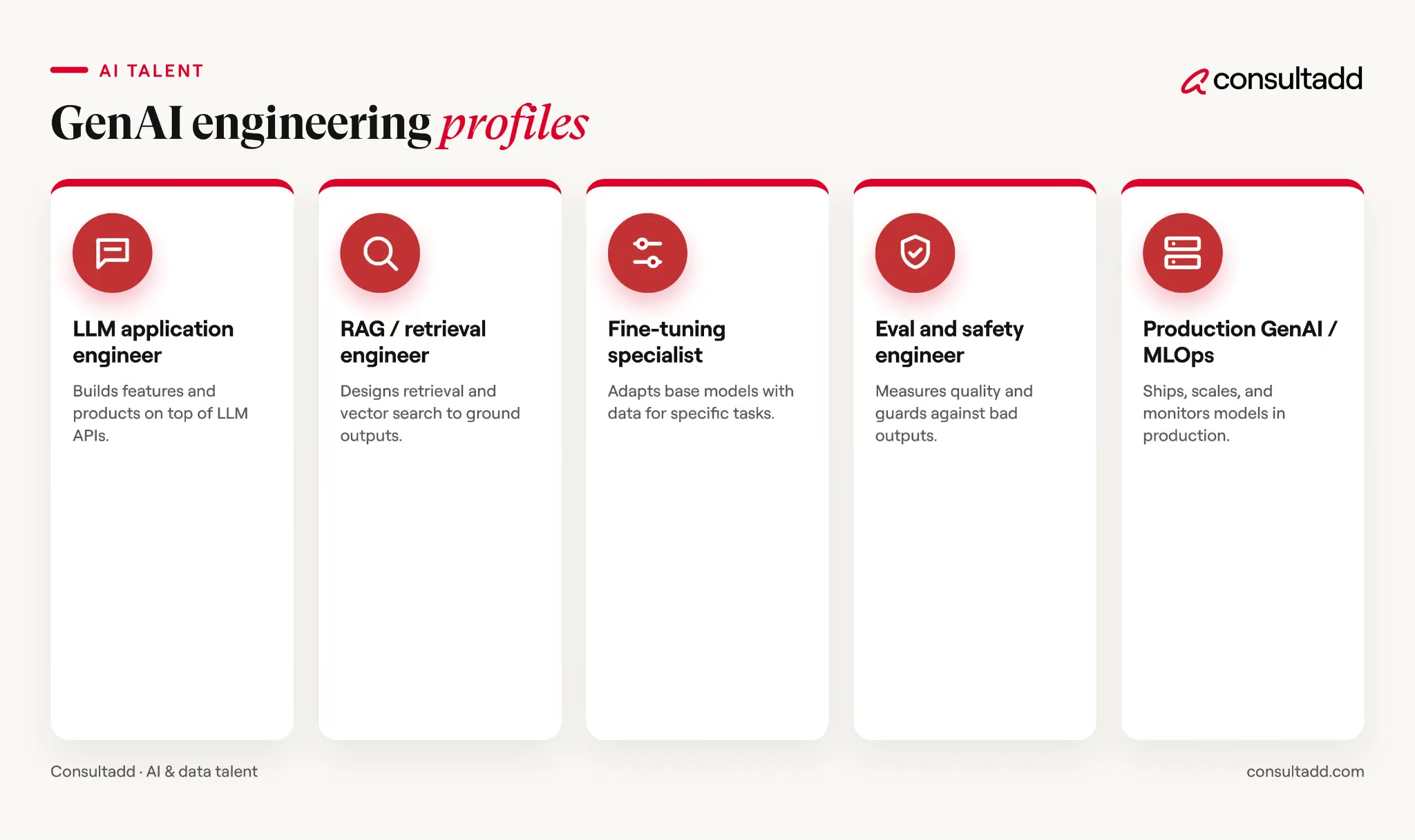
This is the section that saves the most wasted interview cycles. "Generative AI engineer" as a title covers at least five distinct working profiles, and searches that try to hire for two or three of them in one person routinely stall for months:
Profile
What they actually do
Best fit for
LLM application engineer
Builds product features on top of LLM APIs: prompting, chaining, tool use, agent workflows
Most product teams shipping a chat, assistant, or copilot feature
RAG / retrieval engineer
Builds retrieval-augmented generation pipelines connecting an LLM to your company's own data
Any product where the model needs to "know" your data, docs, or customer records
Fine-tuning specialist
Adapts foundation models to a specific domain using LoRA, QLoRA, or instruction tuning
Specialized domains (legal, healthcare, finance) where off-the-shelf prompting underperforms
Eval and safety engineer
Builds evaluation frameworks measuring hallucination rate, coherence, latency, and cost
Regulated industries, or any company that's been burned by an unmonitored model in production
Production GenAI / MLOps
Manages GPU workloads, inference costs, and model-serving infrastructure at scale
Companies running LLM features at real volume, where cost and reliability become engineering problems
At most early-stage companies, one person covers two or three of these out of necessity. LLM application work paired with a credible RAG lean is the most common combination that actually gets hired successfully; fine-tuning paired with eval skews toward a more research-leaning hire. Asking for all five in one req is asking for a unicorn, and searches built that way are the ones still open ninety days later.
Decide your primary lane before the job post goes live, the same discipline that matters across technical hiring generally, and something we cover in more general terms in our guide to hiring and recruiting strategies.
Skills that separate real builders from resume padding
Within whichever lane you're hiring for, these are the concrete signals that correlate with real, shipped experience rather than tutorial-level familiarity:
Skill area
What to verify
Red flag if missing
LLM API fluency
Real experience with OpenAI, Anthropic, or comparable APIs in a shipped feature
Only describes capabilities in the abstract, no specifics about limits or failure handling
Orchestration
LangChain, LlamaIndex, or a custom orchestration approach, and reasons for choosing it
Can name the tools but can't explain a design decision they made with one
Describes RAG only conceptually, no story about tuning retrieval quality
Evaluation discipline
Has built or used evals for hallucination rate, coherence, latency, or cost, not just "it felt right"
No answer when asked how they know a prompt change was actually an improvement
Prompt engineering
Structured, testable prompting practice, not one-off trial and error
Treats prompting as guesswork rather than an iterative, measurable process
Fine-tuning (where relevant)
Hands-on LoRA/QLoRA or instruction-tuning experience for a real use case
Only theoretical knowledge of the techniques
Cost and latency awareness
Can explain how an architecture choice affects per-request cost and response time
Has never had to justify an AI feature's unit economics to anyone
This mirrors the same "explain a real system you built" test that works well in broader technical interviews, something we cover for adjacent roles in our guide to interview questions for a full stack developer.
2026 compensation: salary and contract rates
Compensation for this role moves fast and varies more by specialization than almost any other engineering hire. Here's where the market sits:
Level / model
Typical range
Notes
Mid-level (full-time, US)
$145,000 – $215,000
LLM application and RAG-focused roles cluster here
Senior (full-time, US)
$230,000 – $340,000+
Fine-tuning, eval/safety, and production infrastructure specialists command the top end
Series A-C startup offers
Around $170,000 – $230,000 base, plus 0.04% – 0.35% equity
Equity percentage shrinks sharply from Series A to Series B and beyond
Freelance / contract, US
$75 – $200+ per hour
Rate scales heavily with proven production experience, not certifications
Embedded offshore contract
Substantially lower hourly cost
Real trade-offs in time zone overlap and communication; vet rigorously rather than choosing on price alone
First, generalists are losing ground: engineers without a clear specialization increasingly compete against domain experts commanding 30-50% more for equivalent experience, so a vague "AI engineer" req attracts a weaker slate than a lane-specific one.
Second, this is consistently one of the hardest categories to close: median time from role-open to accepted offer at competitive companies runs into the tens of days, meaningfully longer than most engineering hires, and the most common reason a strong candidate walks is a competing offer from a company with deeper AI-team budgets.
Building slack into your process, and moving fast once you find the right person, matters more here than in almost any other technical search.
Our breakdown of time to hire vs time to fill covers how to diagnose where a slow-moving process is bleeding candidates.
How to run a hiring loop that actually filters
A four-round structure, scoped to your chosen lane, consistently outperforms an improvised conversation-heavy process:
1. Recruiter screen (30 min)
Confirm the lane match and get one concrete example of shipped GenAI work before investing further time. "Walk me through a generative AI feature you built, from idea to production" is the single best filter question at this stage.
2. Technical deep dive (60-90 min)
Review a take-home or portfolio piece in detail, then move into live problem-solving: RAG system design for a realistic scenario, plus failure-mode analysis. Ask what happens when retrieval returns irrelevant context, or when the model confidently states something false, and how they'd catch it before a user sees it.
3. Architecture and judgment discussion (45-60 min)
Present a system with real constraints, a cost ceiling, a latency requirement, a compliance concern, and have the candidate reason through trade-offs aloud. This is where the difference between someone who's read about RAG and someone who's debugged one in production becomes obvious.
4. Team and mission fit (30-45 min)
How does generative AI solve your company's specific problem, and what would they build in the first ninety days. Vague enthusiasm here is a weaker signal than a candidate who's already thought concretely about your use case.
Close fast once you've found the right person. Strong generative AI candidates evaporate off the market within days, not weeks, and moving to offer within 48 hours of the final round is standard practice among teams that close successfully without a compensation arms race.
If your search is bigger than one hire, or the timeline is tight, pairing internal recruiting with a specialist staffing partner can meaningfully compress the search.
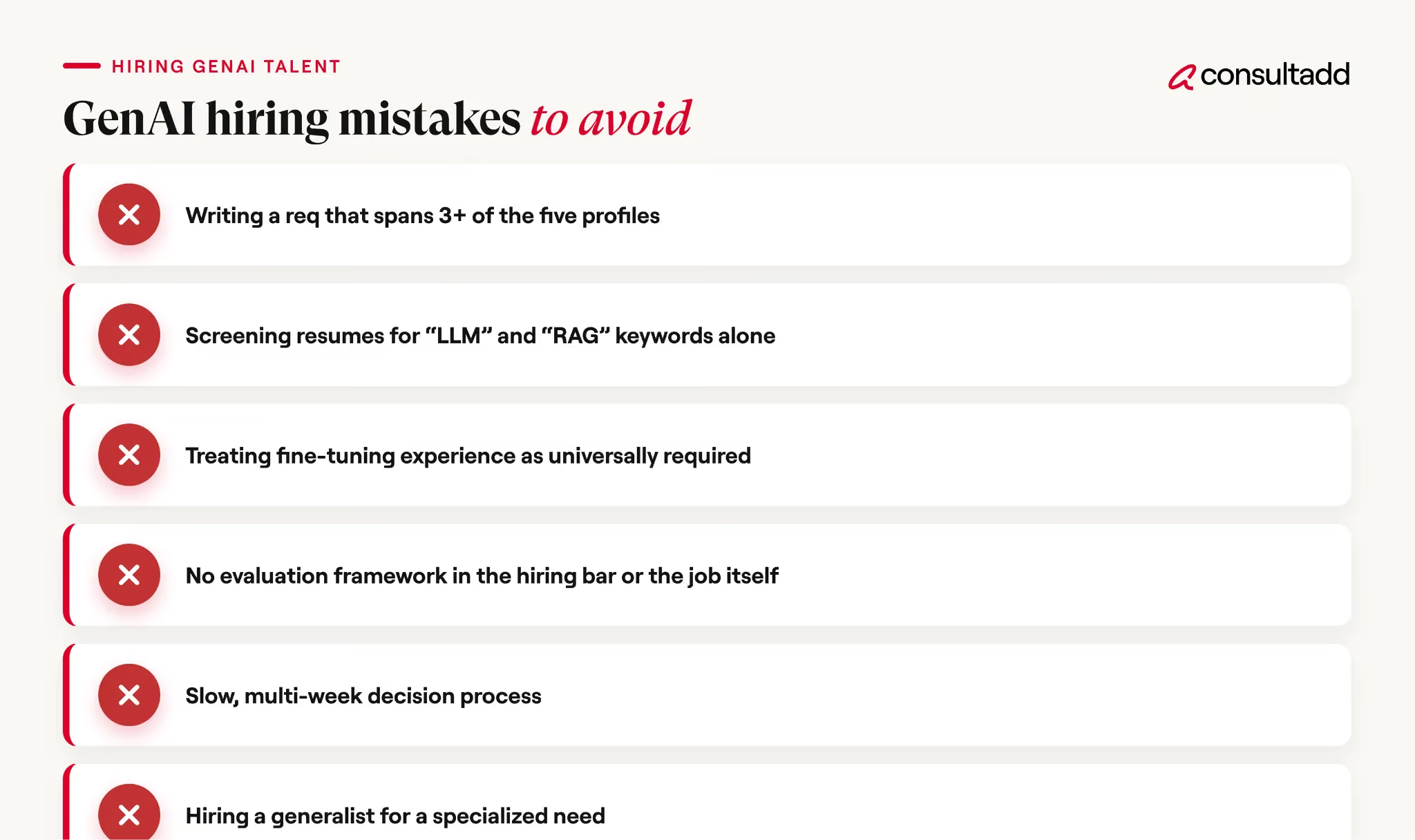
The same failure patterns show up across most stalled or regretted generative AI hires:
Mistake
Why it fails
The fix
Writing a req that spans 3+ of the five profiles
Searches for a unicorn who doesn't exist at any reasonable price
Pick one primary lane; add a secondary only if the pool genuinely supports it
Screening resumes for "LLM" and "RAG" keywords alone
Nearly every applicant now lists both terms regardless of real experience
Require a concrete, shipped example in the screening call before advancing anyone
Treating fine-tuning experience as universally required
Most product use cases need application and RAG skill, not fine-tuning
Fine-tuning matters most for specialized domains; don't over-require it by default
No evaluation framework in the hiring bar or the job itself
Teams discover the gap only after a hallucination reaches a customer
Ask directly how candidates measure whether a change actually improved output quality
Slow, multi-week decision process
Top candidates hold competing offers and short windows
Compress to an offer within 48 hours of the final round once you've decided
Hiring a generalist for a specialized need
Generalists increasingly underperform domain specialists at the same experience level
Match the hire's specialization to your actual production problem, not the trendiest title
The pattern underneath all of these: this role rewards precision in how you hire, not just speed or budget. Scope the lane, test for shipped experience and evaluation discipline, and move fast once the right person is in front of you.
Start Strong With Consultadd
With 15 years in business and 5,000+ successful staffing engagements, we don't just fill roles, we build reliability into your process. We've supported 65 staffing companies in the past year alone and maintain MSAs with industry leaders like Robert Half and TEKsystems.
Here's what working with Consultadd looks like:
Talent sourced in under 24 hours
Ready-to-deploy candidates, vetted for experience and compliance
Lower turnover risk: we match long-term goals, not just short-term needs
Dedicated 1:1 account managers for responsive, personalized support
Top 100 candidate matches delivered in the past year
Strong partnerships with universities to tap into fresh, committed talent
Post-placement support so your investment grows beyond day one
For candidates, your next opportunity is more than just a job title, it's a chance to build skills, gain experience, and move your career forward. At Consultadd, we connect technology professionals with projects and employers that align with their goals, whether they're looking for contract, contract-to-hire, or long-term opportunities.
The tech job market moves fast, but the right guidance can make all the difference. Ready to take the next step in your career journey? Explore Opportunities >>
Key takeaways
"Generative AI engineer" splits into five distinct profiles, LLM application, RAG/retrieval, fine-tuning, eval/safety, and production GenAI/MLOps, and scoping one lane before hiring is the single biggest predictor of a clean search.
The role is overwhelmingly about integration on top of foundation models, not training them; screen for shipped product experience, not theoretical model knowledge.
2026 US compensation runs roughly $145K-$215K mid-level and $230K-$340K+ senior full-time, with freelance rates from $75 to $200+ per hour depending on proven experience.
RAG competence has become close to a baseline expectation, appearing in most applied LLM job listings, while fine-tuning matters most for specialized domains rather than every hire.
Run a scoped, four-round loop testing RAG design, failure-mode reasoning, and evaluation discipline, and move to offer within 48 hours of the final round once you've decided, since strong candidates don't stay available long.
FAQs
What does a generative AI engineer actually do?
They build applications on top of pre-trained foundation models like GPT or Claude rather than training models from scratch. The work centers on integration and orchestration: prompting, chaining tools, building retrieval pipelines, and sometimes fine-tuning a model, all aimed at turning a raw API into a reliable product feature.
What's the difference between hiring a generative AI engineer and a machine learning engineer?
A traditional machine learning engineer typically builds models from structured data for tasks like classification or prediction. A generative AI engineer works on top of existing large language models, focused on integration, retrieval, prompting, and evaluation rather than building models from the ground up. The skill sets overlap but the day-to-day work differs substantially.
How much does it cost to hire generative AI engineers in 2026?
Full-time US compensation typically runs $145,000-$215,000 for mid-level roles and $230,000-$340,000+ for senior specialists, with the top end driven by fine-tuning, evaluation, and infrastructure expertise. Freelance and contract rates range from about $75 to $200+ per hour depending on demonstrated production experience.
What questions should I ask to interview a generative AI engineer?
Start with "walk me through a generative AI feature you shipped, including a failure it produced and what you changed." Follow with RAG system design for a realistic scenario, how they'd handle irrelevant retrieval results or confident-but-false model output, and how they measure whether a prompt or architecture change actually improved quality.
Do I need to hire someone who can fine-tune models?
Only if your use case genuinely requires it. Most product applications, chat features, internal copilots, customer-facing assistants, are served well by LLM application and RAG skills without any fine-tuning. Fine-tuning matters most in specialized domains like legal, healthcare, or finance where off-the-shelf prompting underperforms.
Why is it hard to hire generative AI engineers right now?
Demand for LLM-specific work has grown far faster than the supply of engineers with real production experience, which inflates both resumes and rates. The title also covers at least five distinct working profiles, so companies that don't scope a specific lane end up interviewing mismatched candidates and stalling well past a normal hiring timeline.