
Hiring & Recruitment

Hire Data Engineers: A Practical 2026 Hiring Guide
Introduction
To hire data engineers who can actually do the job, look past the resume keywords and evaluate whether someone can design a pipeline that stays reliable once real data volume and edge cases hit it. That's the gap most hiring processes miss.
Plenty of candidates can name Spark, Airflow, and Snowflake in an interview. Fewer can explain what happens when a pipeline fails at 2 a.m. or how they'd redesign a schema that's outgrown its original use case.
This guide covers what to actually screen for, where to find qualified candidates, and the mistakes that slow down data engineering hires more than any other technical role.
TL;DR
- Screen for pipeline design and failure handling, not just tool familiarity.
- Python, SQL, and a distributed processing framework like Spark are close to table stakes now.
- Sourcing through niche communities and staffing partners beats generic job boards for this role.
- Take-home projects using realistic data problems predict performance better than whiteboard questions.
- Data engineering demand keeps climbing, which means slow hiring processes lose candidates to faster competitors.
Why hiring data engineers is harder than it looks
Data engineer job postings often read like a wish list: Python, SQL, Spark, Airflow, dbt, cloud platforms, and increasingly, some exposure to ML pipelines. That breadth is real.
Python and SQL sit at the core of the role, and having an additional language or framework like Java, Scala, or Kafka on top of that tends to signal stronger versatility.
Few candidates are strong across all of it, which pushes hiring teams toward one of two mistakes: hiring for the tool list and missing weak fundamentals, or hiring for fundamentals and ending up with a slow ramp-up on the specific stack.
Demand isn't slowing down either. Government labor data has tracked steady growth for data-related engineering occupations over the past decade, and the market has gotten more competitive for companies trying to move fast. Teams that take six weeks to make a decision routinely lose strong candidates to companies that move in two.
What to actually screen for
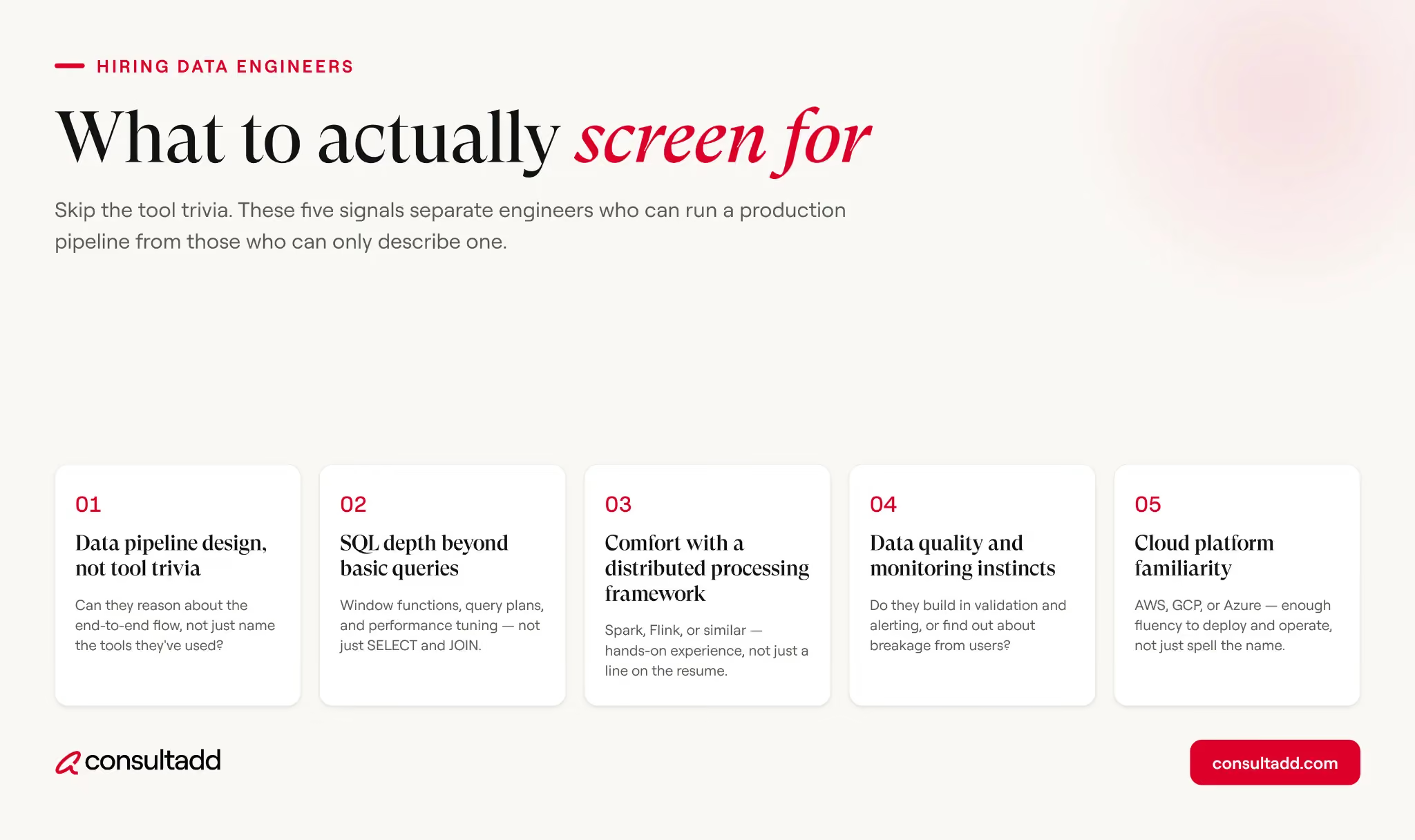
A strong data engineer needs to be evaluated on more than the tool list on their resume.
1. Data pipeline design, not tool trivia
- Ask a candidate to walk through how they'd design a pipeline for a specific, realistic scenario: ingesting data from three sources with different formats, handling schema drift, and keeping the pipeline running if one source goes down.
- Their answer reveals whether they think in terms of resilience and maintainability, or just know which tool does what.
2. SQL depth beyond basic queries
- Almost every data engineer claims strong SQL.
- Fewer can explain query performance, indexing trade-offs, or how they'd debug a query that suddenly got slow after a data volume increase.
- This is one of the highest-signal areas to test directly rather than take on faith.
3. Comfort with a distributed processing framework
- Apache Spark remains the dominant framework in the field, though platforms like Snowflake and Databricks have carved out real market share.
- A candidate doesn't need mastery of every option, but should be able to speak concretely about how one of these tools handles large-scale processing and where it breaks down.
4. Data quality and monitoring instincts
- The best data engineers think about how they'll know a pipeline is producing bad data before anyone downstream notices.
- Ask what monitoring or validation they've built into past pipelines. Vague answers here are a common warning sign.
5. Cloud platform familiarity
- Most data engineering work now runs on AWS, Google Cloud, or Azure.
- Certifications aren't required, but a candidate should be able to speak specifically about services they've used for storage, compute, and orchestration, not just name-drop the platform.
Interview structure that actually predicts performance
Traditional whiteboard algorithm questions tend to test the wrong thing for this role. A structure closer to the candidate's actual day-to-day work produces better signals.
Skip generic algorithm puzzles unless the role genuinely requires heavy computer science depth. Most data engineering work rewards someone who can reason about data flow and failure modes, not someone who's memorized sorting algorithms.
Where to find qualified data engineers
Generic job boards surface a flood of applicants, but the strongest data engineers are often not actively browsing listings. A few channels tend to produce better results.
- Niche data engineering and data platform communities, where practitioners already discuss real problems
- Referrals from current engineers, who tend to know who's actually strong versus who just interviews well
- Specialized staffing partners with an existing pipeline of vetted candidates, similar to the approach covered in how to hire Scala developers, since data engineering and Scala expertise often overlap in fintech and streaming-heavy environments
- Conferences and meetups focused on specific tools like Spark, Kafka, or dbt
Working with a staffing partner also helps when the internal team doesn't have a structured process yet.
A clear framework matters here, and following a defined staffing process instead of an ad hoc one tends to shorten time to hire without lowering the bar.
Common mistakes that slow this hire down
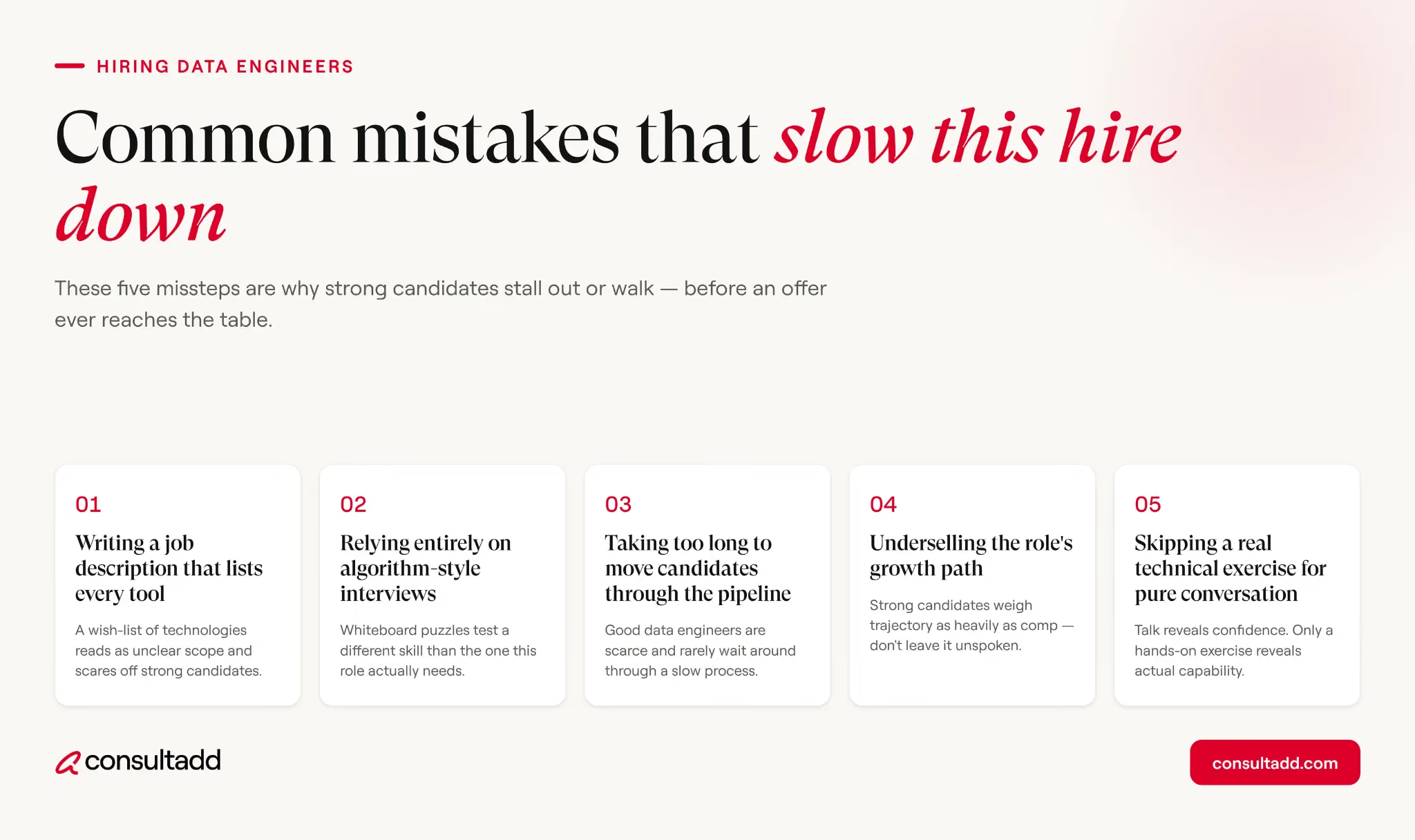
- Writing a job description that lists every tool in the ecosystem instead of the three or four that actually matter for this team
- Relying entirely on algorithm-style interviews that don't reflect real data engineering work
- Taking too long to move candidates through the pipeline, which matters more here given how tight the talent shortage has become for specialized technical roles
- Underselling the role's growth path, since strong data engineers are frequently comparing multiple offers at once
- Skipping a real technical exercise in favor of pure conversation, which makes it harder to catch candidates who interview well but can't execute
Start Strong With Consultadd
With 15 years in business and 5,000+ successful staffing engagements, we don't just fill roles, we build reliability into your process. We've supported 65 staffing companies in the past year alone and maintain MSAs with industry leaders like Robert Half and TEKsystems.
Here's what working with Consultadd looks like:
- Talent sourced in under 24 hours
- Ready-to-deploy candidates, vetted for experience and compliance
- Lower turnover risk: we match long-term goals, not just short-term needs
- Seamless compliance: visa, documentation, onboarding? Handled.
- Dedicated 1:1 account managers for responsive, personalized support
- Top 100 candidate matches delivered in the past year
- Strong partnerships with universities to tap into fresh, committed talent
- Post-placement support so your investment grows beyond day one
For candidates, your next opportunity is more than just a job title, it's a chance to build skills, gain experience, and move your career forward. At Consultadd, we connect technology professionals with projects and employers that align with their goals, whether they're looking for contract, contract-to-hire, or long-term opportunities.
The tech job market moves fast, but the right guidance can make all the difference. Ready to take the next step in your career journey? Explore Opportunities >>
Key takeaways
- Evaluate data engineers on pipeline design and failure handling, not just a list of familiar tools.
- SQL depth, distributed processing frameworks, and data quality instincts are the highest-signal areas to screen.
- Realistic take-home exercises predict performance better than algorithm-heavy interviews.
- Niche communities, referrals, and specialized staffing partners outperform generic job boards for this role.
- Slow hiring processes lose strong candidates in a market where demand keeps climbing.
FAQs
What's the most important skill to screen for when hiring a data engineer?
Pipeline design and reasoning about failure scenarios tend to separate strong candidates from ones who only know tool syntax. SQL depth is a close second, since it comes up in nearly every part of the job.
Should I require a specific cloud certification?
Not necessarily. Certifications from AWS or Google Cloud can indicate structured learning, but hands-on experience with real pipelines matters more than the credential itself.
How long should a data engineering hiring process take?
Aim to move a strong candidate from the first interview to offer within two to three weeks. Longer processes risk losing candidates to competing offers, especially given current demand for the role.
Is a take-home project necessary, or can interviews alone assess skill?
A short, realistic exercise catches gaps that conversation alone often misses, particularly around actual coding ability and data handling. Keep it scoped to a few hours so it doesn't become a burden that discourages strong candidates from finishing.
What's the difference between a data engineer and a data scientist for hiring purposes?
Data engineers build and maintain the infrastructure that moves and stores data. Data scientists analyze that data to produce insights or models. The two roles need different interview processes, since strong data science skills don't guarantee strong pipeline engineering skills.
Are data engineers hard to find right now?
Demand has stayed strong, and the required skill set keeps shifting toward AI-adjacent work, which narrows the pool of candidates who are current on the latest tools. Working with a staffing partner that already maintains a pipeline of vetted candidates typically shortens the search.

What Is A Direct Hire? Meaning, Process, And Benefits
Introduction
What is a direct hire? It's when a company hires someone directly onto its own payroll as a permanent employee, with no staffing agency or third party sitting between the worker and the employer once the placement is made.
The person becomes a full employee from day one, eligible for the company's benefits, subject to its policies, and expected to stay on indefinitely rather than for a fixed contract term.
That's different from contract work, where a staffing agency employs the worker and places them at a client site, or contract-to-hire, where the arrangement starts temporary and converts later. Direct hire skips the trial period entirely.
Below is what the process actually looks like, how it compares to the alternatives, and when it's the right call.
TL;DR
- A direct hire is a permanent employee hired straight onto the employer's payroll, no agency in between.
- It differs from contract and contract-to-hire roles mainly in who employs the worker and how long the role is expected to last.
- Direct hire recruiters usually charge a one-time placement fee instead of an ongoing markup.
- It works best for core, long-term roles where retention and institutional knowledge matter.
- It's a slower process than contract staffing, since employers vet for long-term fit, not just immediate availability.
How direct hire actually works
The mechanics are simpler than the terminology suggests. A company has an open permanent role. It either recruits directly or works with a recruitment agency to source candidates.
Once someone accepts the offer, they go straight onto the employer's own payroll, receive the employer's benefits package, and are treated the same as any other full-time employee at the company.
If a staffing agency was involved in sourcing the candidate, its role ends once the placement is made. The agency typically earns a one-time fee, often a percentage of the new hire's first-year salary, and then steps out of the relationship.
This is different from contract staffing, where the agency stays involved as the employer of record for the length of the assignment.
Direct hire versus other staffing models
The confusion around this term usually comes from mixing it up with contract or contract-to-hire arrangements. The table below lays out the practical differences.
A contract-to-hire arrangement exists precisely because some employers want the trial period direct hire skips.
If neither party is confident about long-term fit, starting on contract and converting later reduces the risk on both sides.
Some companies also work through Corp-to-Corp arrangements for specialized project work, which is a different structure again from direct hire.
The C2C model puts a business entity, not an individual, between the worker and the client, which changes how payroll, taxes, and compliance are handled.
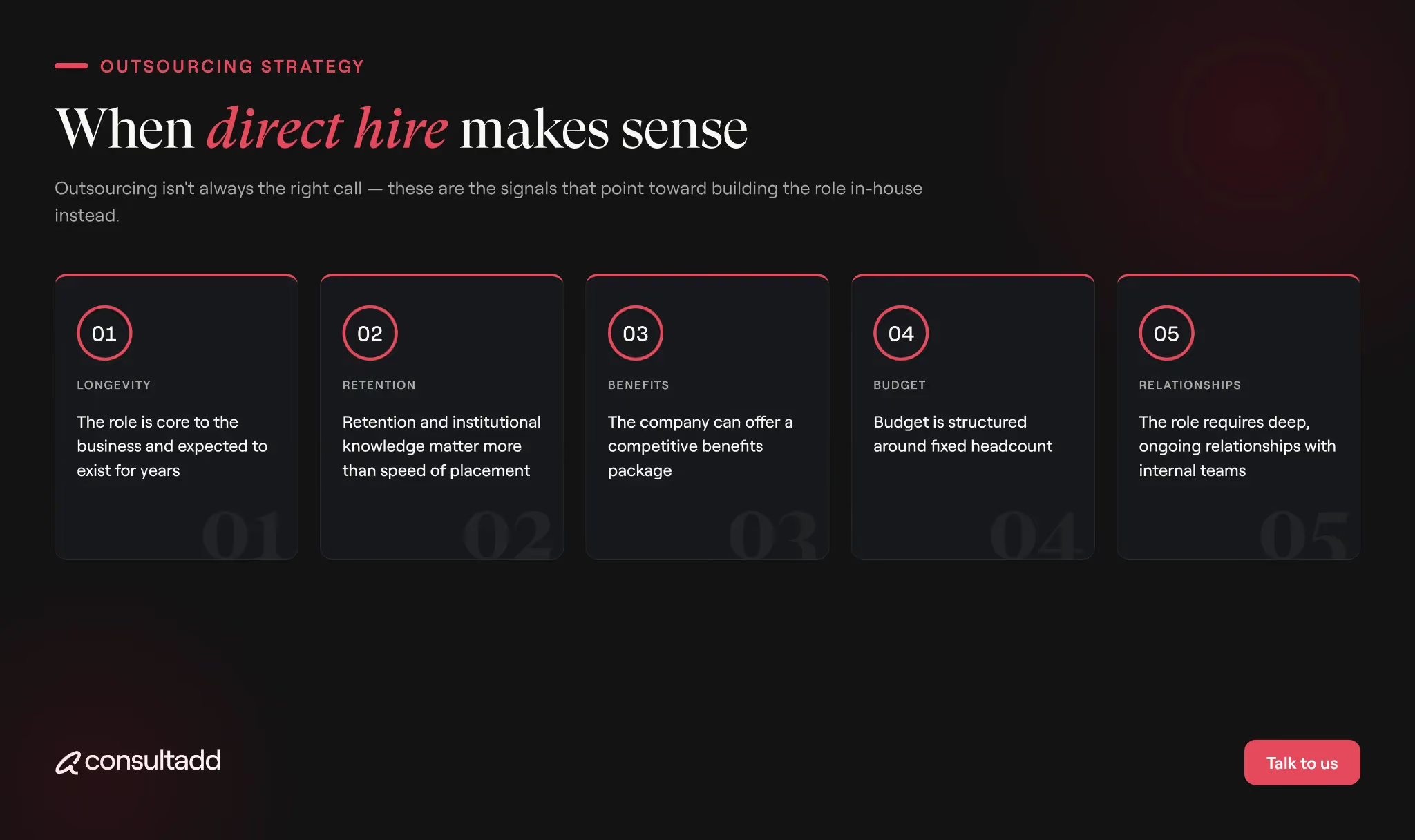
When direct hire makes sense
Direct hire isn't automatically the "better" option. It fits certain situations more than others.
- The role is core to the business and expected to exist for years, not months
- Retention and institutional knowledge matter more than speed of placement
- The company can offer a competitive benefits package and wants to attract candidates who value that
- Budget is structured around fixed headcount rather than a flexible project spend
- The role requires deep, ongoing relationships with internal teams or clients
Roles like engineering leadership, core product management, or long-term finance positions almost always go through direct hire, because the cost of turnover and lost institutional knowledge outweighs the appeal of contract flexibility.
This is also why understanding worker classification differences like W-2 versus 1099 matters early, since misclassifying a direct hire as a contractor creates real compliance risk under U.S. Department of Labor rules.
What the direct hire process looks like
A direct hire search generally moves through the same stages, whether it's run internally or through a recruiter.
This process tends to take longer than contract staffing, because employers are evaluating for long-term fit, not just immediate availability. A candidate who can start Monday but isn't a strong long-term match usually loses out to someone who takes a bit longer to onboard but fits the role for years.
Direct hire from the candidate's side
For job seekers:
- A direct hire offer usually means full benefits, job security that isn't tied to a contract end date, and a clearer path to internal growth.
- It also tends to come with a more thorough interview process, since employers are screening for fit beyond just technical skill.
- Candidates weighing a direct hire offer against a contract role should think about which trade-off matters more right now: the stability and benefits of direct hire, or the flexibility and often higher hourly pay of contract work.
Start Strong With Consultadd
With 15 years in business and 5,000+ successful staffing engagements, we don't just fill roles, we build reliability into your process. We've supported 65 staffing companies in the past year alone and maintain MSAs with industry leaders like Robert Half and TEKsystems.
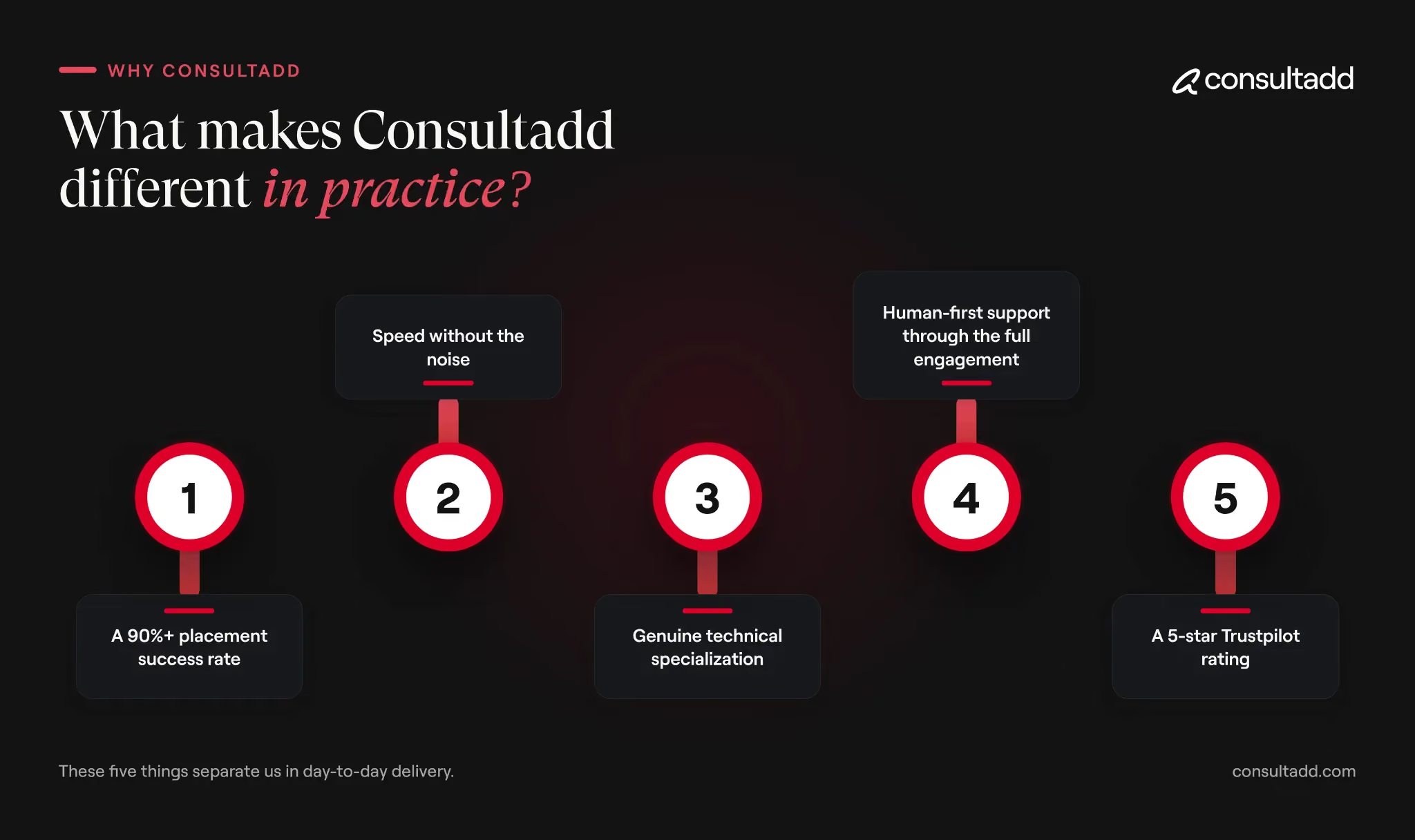
Here's what working with Consultadd looks like:
- Talent sourced in under 24 hours
- Ready-to-deploy candidates, vetted for experience and compliance
- Lower turnover risk: we match long-term goals, not just short-term needs
- Seamless compliance: visa, documentation, onboarding? Handled.
- Dedicated 1:1 account managers for responsive, personalized support
- Top 100 candidate matches delivered in the past year
- Strong partnerships with universities to tap into fresh, committed talent
- Post-placement support so your investment grows beyond day one
For candidates, your next opportunity is more than just a job title, it's a chance to build skills, gain experience, and move your career forward. At Consultadd, we connect technology professionals with projects and employers that align with their goals, whether they're looking for contract, contract-to-hire, or long-term opportunities.
The tech job market moves fast, but the right guidance can make all the difference. Ready to take the next step in your career journey? Explore Opportunities >>
Key takeaways
- A direct hire goes straight onto the employer's payroll as a permanent employee, with no agency staying involved after placement.
- It's distinct from contract and contract-to-hire arrangements, mainly in who employs the worker and for how long.
- Direct hire recruiters typically charge a one-time fee, not an ongoing markup.
- It suits core, long-term roles better than short-term or highly specialized project work.
- The process usually takes longer than contract staffing because employers screen for long-term fit.
FAQs
Is a direct hire the same as a full-time employee?
Usually, yes. Direct hire almost always means full-time, permanent employment, though the term specifically refers to how the person was hired, directly onto the employer's payroll, rather than the hours they work.
How much does a direct hire recruiter typically charge?
Placement fees commonly range from 15 to 30 percent of the new hire's first-year salary, paid once, when the hire is made. This differs from contract staffing, which charges an ongoing markup for the life of the assignment.
Can a direct hire be let go like any other employee?
Yes. Once hired, a direct hire employee is subject to the same employment laws and company policies as anyone else on the payroll, including the U.S. Department of Labor's guidance on employee rights and classification.
Why would a company choose contract-to-hire instead of direct hire?
Contract-to-hire lets both sides evaluate fit before committing to permanent employment, which reduces the risk of a bad long-term match. Direct hire skips that trial period, which works well when the employer is confident in the role and candidate.
Do direct hire roles usually pay more than contract roles?
Not necessarily in take-home terms. Contract roles often have a higher hourly rate to offset the lack of benefits, while direct hire compensation includes the value of benefits, retirement contributions, and job security that contract work doesn't.
Is direct hire more common in certain industries?
It's especially common for core, ongoing roles across most industries, including tech, healthcare, and finance, where retention and institutional knowledge carry real weight, according to SHRM's talent acquisition resources.

Why Do Companies Choose To Outsource Work? 5 Key Reasons
Introduction
Why do companies choose to outsource work? Mostly because building every function in-house is slower and more expensive than most leadership teams want to admit.
Outsourcing lets a company get specialized work done without carrying the full-time salary, training time, and management overhead that comes with hiring for it directly. That's the short answer. The longer answer depends on what's being outsourced, how urgent the need is, and whether the company can find that skill set internally at all.
This article walks through the real reasons behind outsourcing decisions, where it tends to work well, where it doesn't, and how to tell which one applies to your situation.
TL;DR
- Cost savings matter, but they're rarely the only reason or even the main one.
- Speed to hire is often the bigger driver, especially for specialized or short-term roles.
- Outsourcing gives access to skills a company doesn't have time to build internally.
- It works best for defined, scoped work, and worst for roles needing deep institutional knowledge.
- The decision usually comes down to a build versus buy trade-off, not a blanket policy.
The core reasons companies outsource
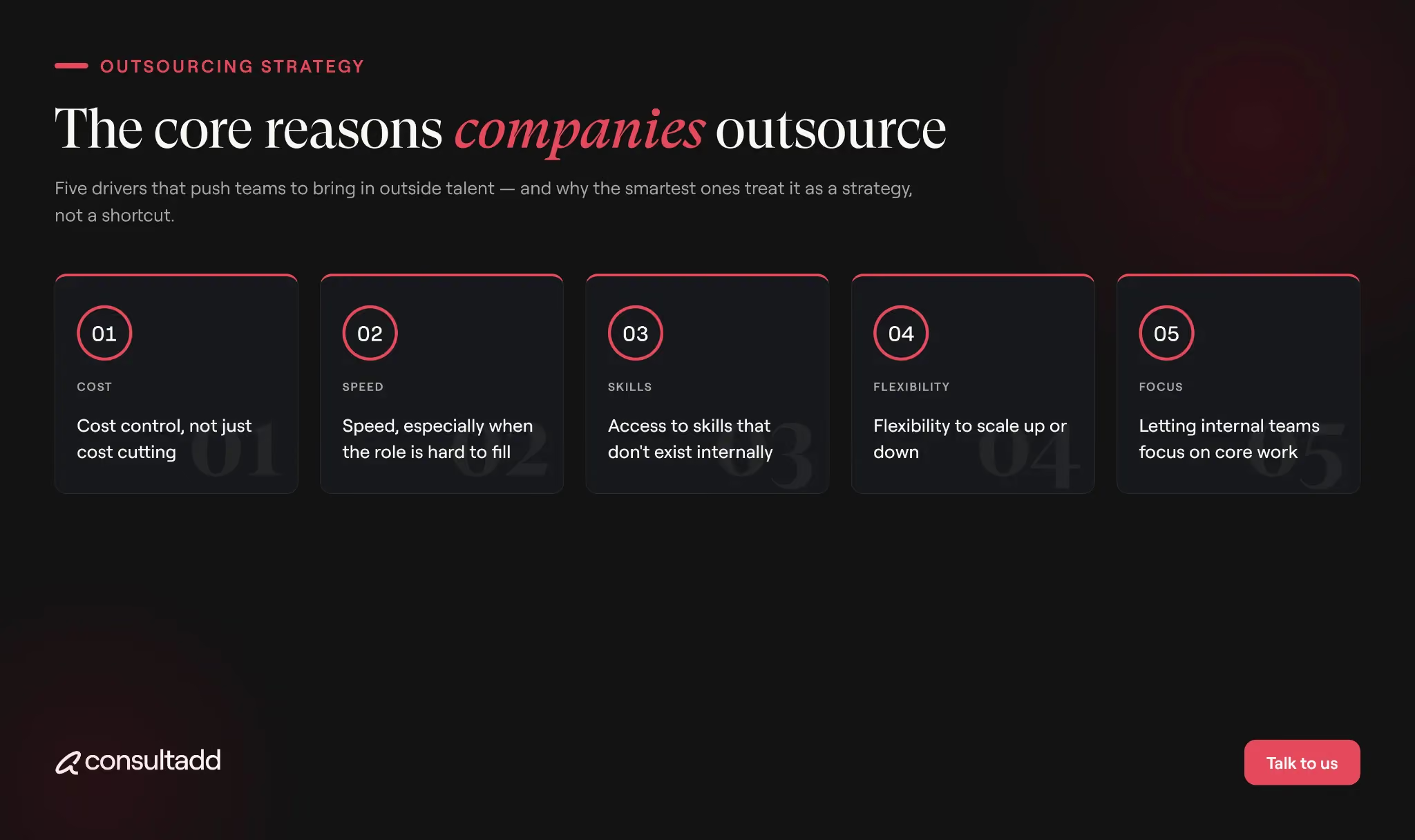
Ask five different companies why they outsource and you'll get five slightly different answers, but they tend to cluster around the same handful of drivers.
1. Cost control, not just cost cutting
- Outsourcing can lower costs, but the smarter framing is cost control.
- A full-time hire comes with salary, benefits, payroll tax, equipment, and management time, whether that person is fully utilized or not.
- Outsourced work is often scoped and priced to the task, which makes budgeting more predictable for project-based needs.
- This matters most for roles that don't need to exist year-round.
- A six-month system migration doesn't justify a permanent headcount line, but it does need real expertise while it's happening.
2. Speed, especially when the role is hard to fill
- Recruiting, screening, and onboarding a full-time employee takes weeks, sometimes months, for specialized technical roles.
- Outsourcing to a staffing partner or contractor can compress that timeline significantly because the vetting and sourcing work is already done.
- This is one of the more underrated reasons companies outsource: it's not that they can't hire, it's that they can't hire fast enough for the problem in front of them.
Companies dealing with a sudden spike in project work, similar to the situations covered in IT staff augmentation, often use outsourcing as a way to add capacity without waiting out a full hiring cycle.
3. Access to skills that don't exist internally
- Not every company needs a full-time cloud security architect or a niche compliance specialist.
- Outsourcing gives access to that expertise for the specific window it's needed, without the company trying to build a permanent team around a skill set it will only use occasionally.
- This is different from cost savings. Sometimes the internal skill genuinely doesn't exist yet, and building it from scratch would take longer than the project timeline allows.
4. Flexibility to scale up or down
- Workloads aren't flat. A retail company staffs differently in November than in February. A software company might need ten extra engineers for a six-month push and none of them afterward.
- Outsourcing lets headcount flex with the work instead of locking in a fixed team that's either overstaffed in slow periods or scrambling in busy ones.
5. Letting internal teams focus on core work
- Every hour a product team spends managing a side project, like a website redesign or a data migration, is an hour not spent on the product itself.
- Outsourcing peripheral work frees internal staff to stay focused on what actually differentiates the business.
This is a common reason for outsourcing functions like IT support, payroll, or recruiting itself, which is why staffing agency partnerships exist as a category in the first place.
Outsourcing versus hiring in-house
Neither approach is universally better. The right choice depends on the shape of the work.
A company migrating a legacy system to the cloud, for example, usually leans toward outsourcing because the work is bounded and specialized.
A company hiring its next VP of Engineering almost never outsources that role, because it requires deep, ongoing familiarity with the business.
Where outsourcing tends to go wrong
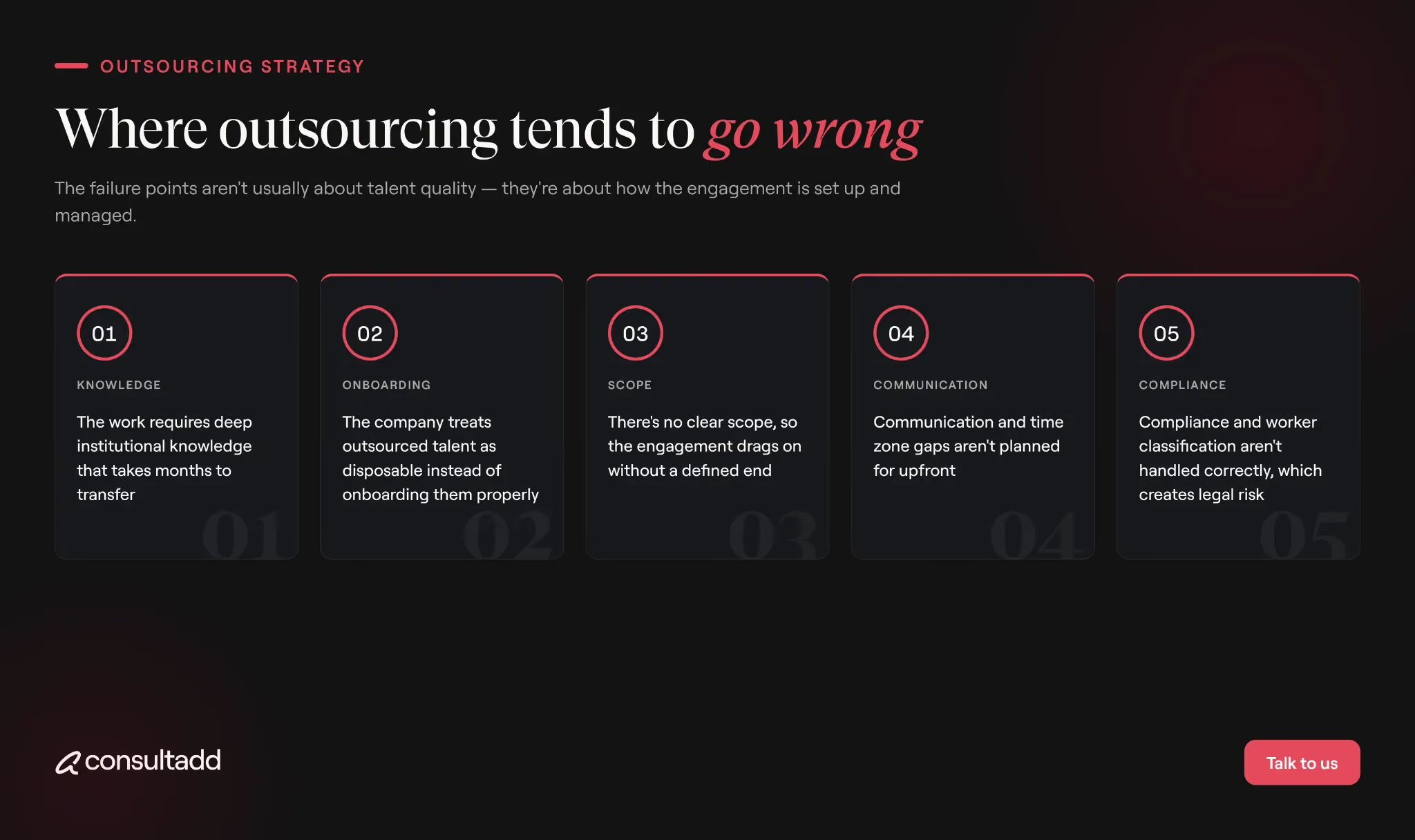
Outsourcing isn't automatically the right call, and it fails for predictable reasons.
- The work requires deep institutional knowledge that takes months to transfer
- The company treats outsourced talent as disposable instead of onboarding them properly
- There's no clear scope, so the engagement drags on without a defined end
- Communication and time zone gaps aren't planned for upfront
- Compliance and worker classification aren't handled correctly, which creates legal risk
That last point matters more than most companies expect.
Misclassifying a contractor as an employee, or vice versa, can trigger real penalties, which is part of why understanding the difference between contract-to-hire and full-time arrangements matters before signing anything.
How to decide if outsourcing makes sense
A simple gut check helps before committing either way.
They outsource the roles that match this pattern and hire directly for the ones that don't, which is why average time to hire varies so much by role type, as covered in average time to hire benchmarks.
Start Strong With Consultadd
With 15 years in business and 5,000+ successful staffing engagements, we don't just fill roles, we build reliability into your process. We've supported 65 staffing companies in the past year alone and maintain MSAs with industry leaders like Robert Half and TEKsystems.
Here's what working with Consultadd looks like:
- Talent sourced in under 24 hours
- Ready-to-deploy candidates, vetted for experience and compliance
- Lower turnover risk: we match long-term goals, not just short-term needs
- Seamless compliance: visa, documentation, onboarding? Handled.
- Dedicated 1:1 account managers for responsive, personalized support
- Top 100 candidate matches delivered in the past year
- Strong partnerships with universities to tap into fresh, committed talent
- Post-placement support so your investment grows beyond day one
For candidates, your next opportunity is more than just a job title, it's a chance to build skills, gain experience, and move your career forward. At Consultadd, we connect technology professionals with projects and employers that align with their goals, whether they're looking for contract, contract-to-hire, or long-term opportunities.
The tech job market moves fast, but the right guidance can make all the difference. Ready to take the next step in your career journey? Explore Opportunities >>
Key takeaways
- Outsourcing is usually a build versus buy decision, not a cost-cutting reflex.
- Speed to hire is often a bigger driver than the headline cost savings.
- Specialized, short-term, or hard-to-find skills are the strongest fit for outsourcing.
- Roles needing deep institutional knowledge are usually better hired in-house.
- Worker classification and compliance need attention before signing any outsourcing agreement.
FAQs
Is outsourcing always cheaper than hiring in-house?
Not always. It removes the fixed costs of a full-time hire, but specialized outsourced talent can carry a premium, especially for short engagements. The savings usually come from avoided overhead and faster time to productivity, not a lower hourly rate.
What kinds of work do companies outsource most often?
IT support, software development, payroll and HR administration, customer service, and recruiting are among the most commonly outsourced functions, based on guidance from the U.S. Small Business Administration.
Does outsourcing hurt company culture?
It can, if outsourced workers are treated as disconnected from the team. Companies that onboard contractors properly and include them in relevant communication tend to avoid this problem.
How is outsourcing different from staff augmentation?
Outsourcing typically hands off an entire function or project to an external provider. Staff augmentation adds individual contractors to an existing internal team, who work under your company's own processes and management.
What should a company check before signing an outsourcing contract?
Scope of work, data security terms, worker classification rules, and an exit plan if the engagement ends early.
Can outsourcing work for a small business, or is it mainly for large enterprises?
It works for both, though the use case differs. Small businesses often outsource to access skills they can't afford to hire full-time, while larger companies outsource to manage volume and scale flexibly.

What Does a Background Check Show? Full Breakdown
Introduction
A background check typically shows criminal records, employment history, education verification, and sometimes credit history or driving records, depending on the role. What it shows changes based on the type of check an employer orders and the state the candidate lives in. A warehouse job and a finance role don't get the same screening, and they shouldn't.
If you're a candidate waiting on a report, or a hiring manager trying to figure out which checks actually matter for your open role, the confusion usually comes down to one thing: nobody explains what's in the box until it's already been opened. This breaks down each type of check, what shows up, what doesn't, and where the legal lines sit.
TL;DR
- A standard background check usually covers criminal history, employment verification, and education verification.
- Credit checks, driving records, and drug screens only apply to specific roles, not every hire.
- Federal law requires written consent before an employer can pull a background report.
- Most checks look back 7 years for criminal and credit history, though state law can shorten or extend that.
- Candidates have the right to see the report and dispute anything inaccurate before a final decision is made.
What shows up on a standard employment background check
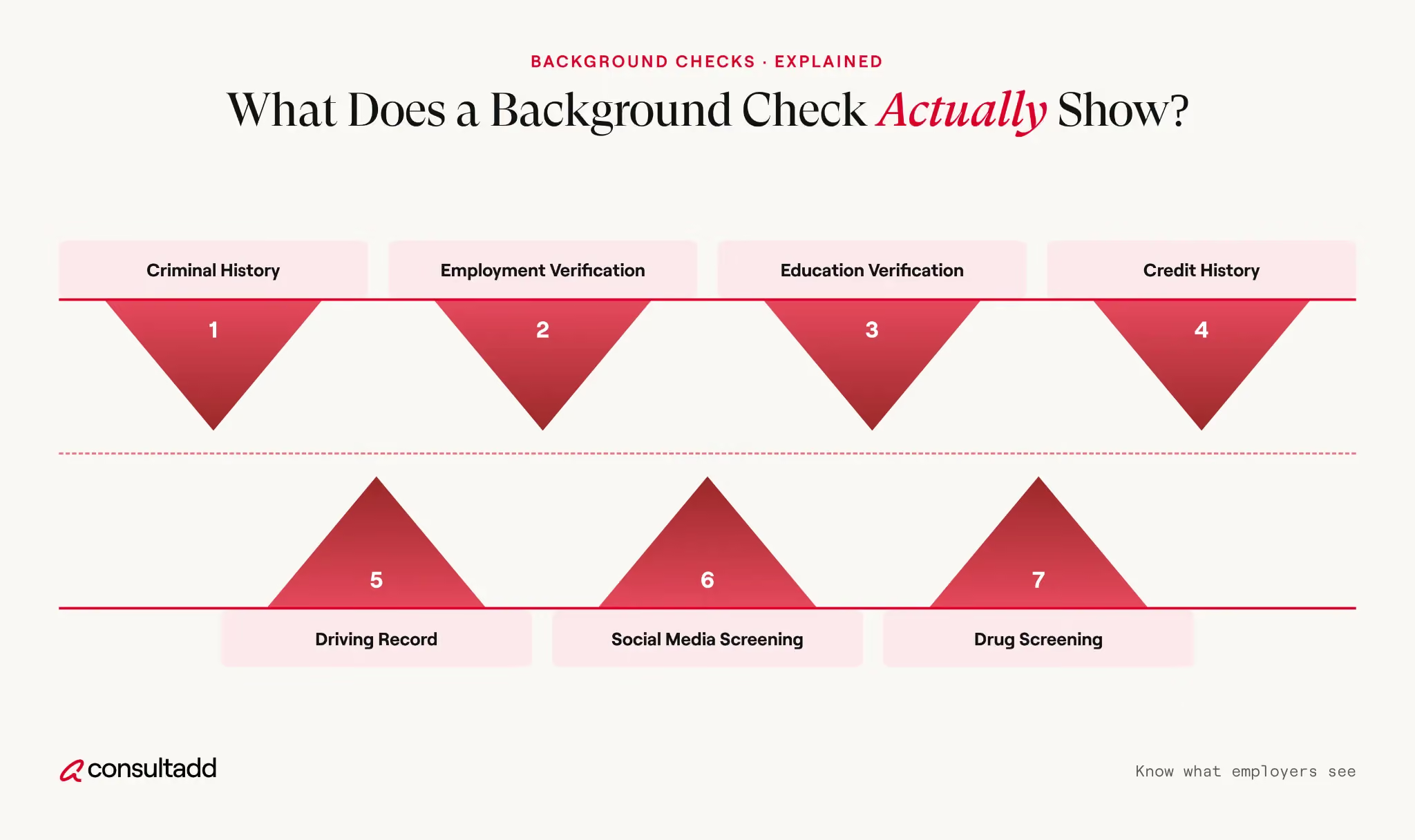
Most pre-employment screens are built from a handful of core searches. Here's what each one actually pulls.
Not every employer runs every check on this list. A retail hire rarely needs a credit pull. A delivery driver almost always needs a driving record check. The role should decide the scope, not habit.
Criminal history is the one candidates worry about most, and for good reason. It's also the one with the most legal nuance. Under EEOC guidance on employment background checks, a policy that excludes anyone with a criminal record can be illegal if it disproportionately affects a protected group and isn't actually tied to the job.
That's a mouthful, but it means blanket "no felons" policies are legally shaky, especially for roles where the conviction has nothing to do with the job.
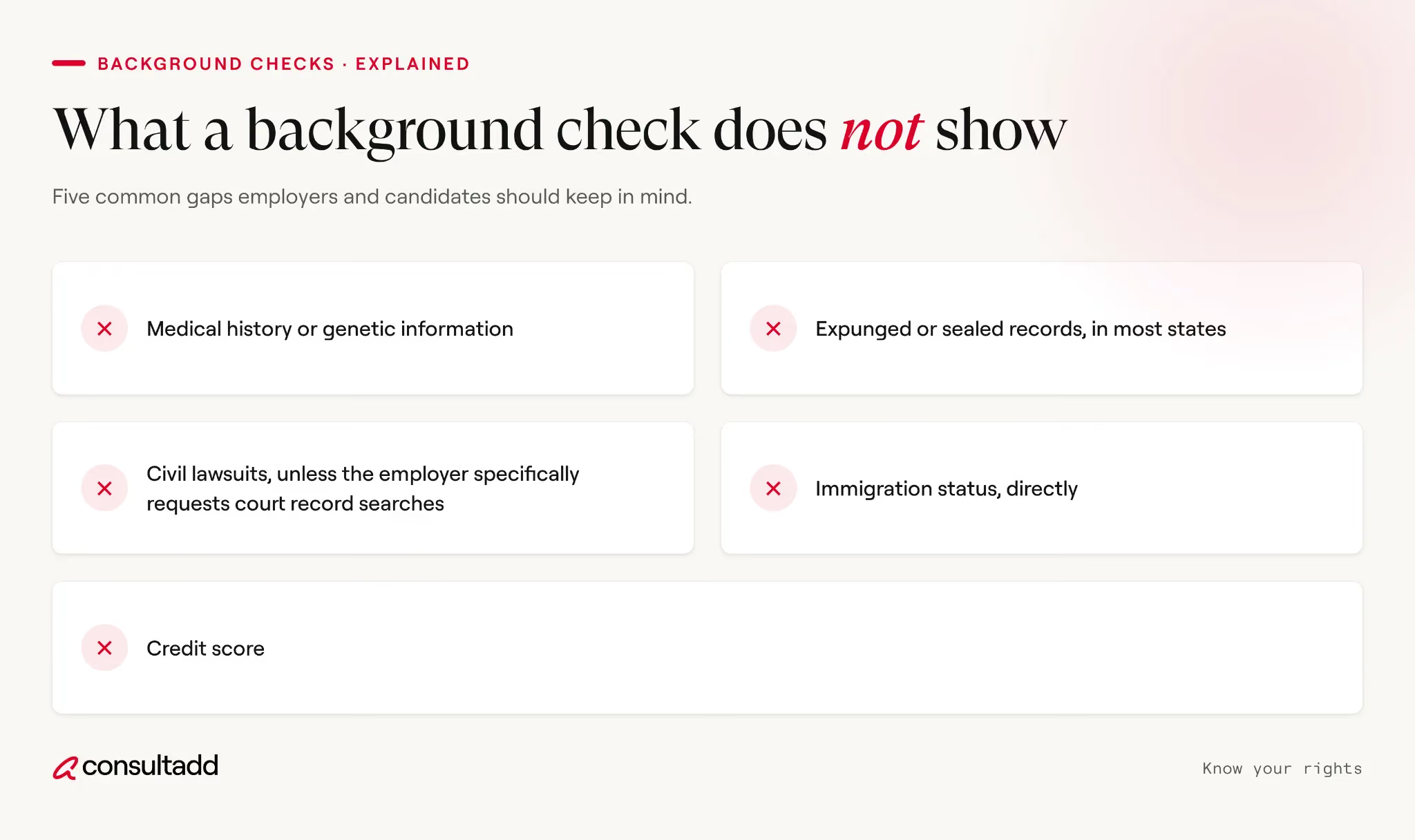
What a background check does not show
This part gets left out of most guides, and it's just as important as the list above.
- It does not show medical history or genetic information. Employers cannot ask for genetic information, including family medical history, and cannot ask medical questions before a conditional job offer is made, according to FTC guidance for employers.
- It does not include expunged or sealed records in most states.
- It does not automatically include civil lawsuits unless the employer specifically requests court record searches.
- It does not show immigration status directly, though separate work authorization verification (like Form I-9 or E-Verify) happens alongside hiring.
- It does not include a credit score. Credit reports for employment purposes show account history, not the three-digit score lenders use.
If a candidate is worried something private will surface in a routine check, most of that worry is misplaced. Background checks are narrower than people assume.
How far back does a background check go
Lookback periods depend on the type of check and the state.
California, New York, and a handful of other states have their own rules layered on top of federal law, so the same job req can require different screening depending on where the candidate is based.
This is one of the reasons a staffing partner who already understands the full staffing process saves time. Someone has to track this state by state, and most internal HR teams aren't set up to do it for every location they hire in.
Who can see the report, and what has to happen first
Before any of this data reaches a hiring manager's inbox, a few legal steps have to happen in order.
- The employer notifies the candidate, in writing, that a background check will be run.
- The candidate signs a consent form, separate from the general job application.
- The employer orders the report from a company that specializes in compiling background information, not from a random online search.
- If something in the report leads to a rejection, the employer sends a pre-adverse action notice with a copy of the report.
- The candidate gets a chance to respond before the employer finalizes the decision.
- If the employer proceeds with rejection, a final adverse action notice goes out.
Federal guidance from the FTC and EEOC is clear on this: employers need written permission from job applicants before getting background reports from a company in the business of compiling background information.
Skip that step, and the employer isn't just risking a bad hire. They're risking a Fair Credit Reporting Act violation, which comes with its own penalties separate from any discrimination claim.
Job applicants also have the right to review their background reports for accuracy when they're turned down for a job or denied a promotion based on that information. That review step catches more errors than people expect. Court records get mismatched to the wrong person more often than most candidates realize, especially with common names.
Why so many employers run these checks anyway
A SHRM survey found that 92 percent of organizations conduct background checks, mostly at the pre-employment stage, and nearly all of those screens include a search for criminal records. That number has held steady for years because the cost of a bad hire rarely shows up on day one. It shows up three months in, after training time, client exposure, and a resignation letter nobody saw coming.
We've seen staffing teams skip a verification step because a candidate looked strong on paper and the client wanted someone placed fast. Sometimes that works out fine. Sometimes the employment dates on the resume don't match what the last employer confirms, and now there's a harder conversation to have with the client than there ever would have been with the candidate.
The check isn't there to slow things down for no reason. It's there because paper and reality don't always match, and vetting a candidate properly catches that gap before it becomes the client's problem.
Background checks and reference checks aren't the same thing
It's worth separating these because people mix them up constantly.
- A background check pulls third-party records.
- A reference check calls people who actually worked with the candidate and asks what they were like day to day.
One tells you what happened on paper. The other tells you how someone performs under pressure, whether they show up on time, and whether a past manager would rehire them. Both matter. Neither replaces the other.
If you're building out your process, it's worth reading through how to run a reference check before making an offer, since the two steps usually happen back to back and catch different problems.
Building a background check process that doesn't create legal risk
A rushed process causes more problems than a slow one. Here's a simple framework that keeps things compliant without dragging out the timeline.
- Decide which checks actually apply to the role before you post the job, not after an offer is drafted.
- Use a standalone consent form. Don't bury it in the general application.
- Apply the same screening standard to every candidate for the same role. Inconsistent screening is where discrimination claims come from.
- Give candidates a real chance to explain flagged items before making a final call.
- Keep a written policy so every recruiter on the team is running the same process the same way.
Teams that document their screening steps consistently spend less time defending decisions later and more time actually hiring.
Start Strong With Consultadd
With 15 years in business and 5,000+ successful staffing engagements, we don't just fill roles, we build reliability into your process. We've supported 65 staffing companies in the past year alone and maintain MSAs with industry leaders like Robert Half and TEKsystems.
Here's what working with Consultadd looks like:
- Talent sourced in under 24 hours
- Ready-to-deploy candidates, vetted for experience and compliance
- Lower turnover risk: we match long-term goals, not just short-term needs
- Seamless compliance: visa, documentation, onboarding? Handled.
- Dedicated 1:1 account managers for responsive, personalized support
- Top 100 candidate matches delivered in the past year
- Strong partnerships with universities to tap into fresh, committed talent
- Post-placement support so your investment grows beyond day one
For candidates, your next opportunity is more than just a job title, it's a chance to build skills, gain experience, and move your career forward. At Consultadd, we connect technology professionals with projects and employers that align with their goals, whether they're looking for contract, contract-to-hire, or long-term opportunities.
The tech job market moves fast, but the right guidance can make all the difference. Ready to take the next step in your career journey? Explore Opportunities >>
Key takeaways
- A background check usually shows criminal history, employment verification, and education verification, with credit and driving checks added only for relevant roles.
- Medical history, genetic information, and expunged records are off-limits or excluded by law.
- Written consent has to come before the report is pulled, and candidates have the right to dispute inaccuracies.
- Lookback periods run around 7 years for most checks, though state law can change that window.
- Background checks and reference checks solve different problems and work best done together.
FAQs
Does a background check show past jobs I didn't list on my resume?
Usually not. Employment verification confirms the jobs you disclosed and gave permission to check. It doesn't go digging for jobs you left off, though gaps in your history may prompt a recruiter to ask about them directly.
Can an employer see my arrest record if I was never convicted?
It depends on the state. Some states only allow reporting of convictions, not arrests that didn't lead to one. Others allow pending charges to appear. This is one of the bigger state-by-state variations in background screening law.
Will a background check show my credit score?
No. Employment credit reports show account history, payment patterns, and public records like bankruptcies. They don't include the numeric score used for loans or credit cards.
How long does a background check take?
Most turn around in 1 to 5 business days. Checks that require county court searches in multiple jurisdictions, or international education verification, can take longer.
Can I dispute something wrong on my background report?
Yes. The FTC enforces the federal law that regulates background reports for employment, and if there's a mistake, you have the right to contact the company that issued the report to correct it. Start with the reporting agency, not just the employer.
Do background checks show social media activity?
Only if the employer specifically runs a social media screen, which is a separate service from a standard background check. It's not automatically bundled in.
Does every job require a background check?
No. Regulated industries like healthcare, finance, and transportation often require it by law. Other employers choose to run checks based on internal policy, and the scope should match the actual risk of the role.

How To Recruit For Hard-To-Fill Roles In 2026
Introduction
If you're wondering how to recruit for hard-to-fill roles, you're probably staring at a job req that's been open for two months with barely any qualified applicants in the pipeline. You're not doing anything wrong. The market itself has shifted.
Nearly seven in ten HR professionals now say they struggle to recruit for these exact positions, and the usual playbook of posting a job and waiting isn't cutting it anymore.
The good news is that hard-to-fill roles aren't unfillable. They just need a different approach than the roles that draw 200 applicants in a week.
This guide covers what actually moves the needle: fixing the job post, sourcing instead of waiting, widening who counts as qualified, and knowing when contract talent solves the problem faster than another round of interviews.
TL;DR
- Hard-to-fill roles need active sourcing, not another job board posting.
- Most job descriptions overstate requirements and scare off qualified candidates before they apply.
- Passive candidates, the people not actively job hunting, are often your best bet for niche skills.
- Speeding up your interview process matters as much as finding candidates in the first place.
- Contract or contract-to-hire talent can fill the gap while your search for a permanent hire keeps running.
Why Hard-to-Fill Roles Stall
Before fixing anything, it helps to know why these roles get stuck in the first place. It's rarely one single cause.
Robert Half's 2026 data found 47% of employers report difficulty finding skilled professionals, and the shortage is heaviest in specialized technical and cybersecurity roles. The ISC2 Cybersecurity Workforce Study puts a number on just one corner of that gap: 4.8 million unfilled cybersecurity positions worldwide, with the workforce needing to grow by 87% to catch up with demand.
A few patterns show up again and again in stalled searches:
- The job description asks for a unicorn: five years of experience in a tool that's been around for three
- The role only gets posted on job boards, so it only reaches people already looking
- The interview process takes six weeks, and the best candidates get poached before you make an offer
- Compensation wasn't benchmarked against what specialists in that skill actually earn right now
None of these are hard to fix once you see them clearly. The fix just takes more effort than clicking "post" and waiting.
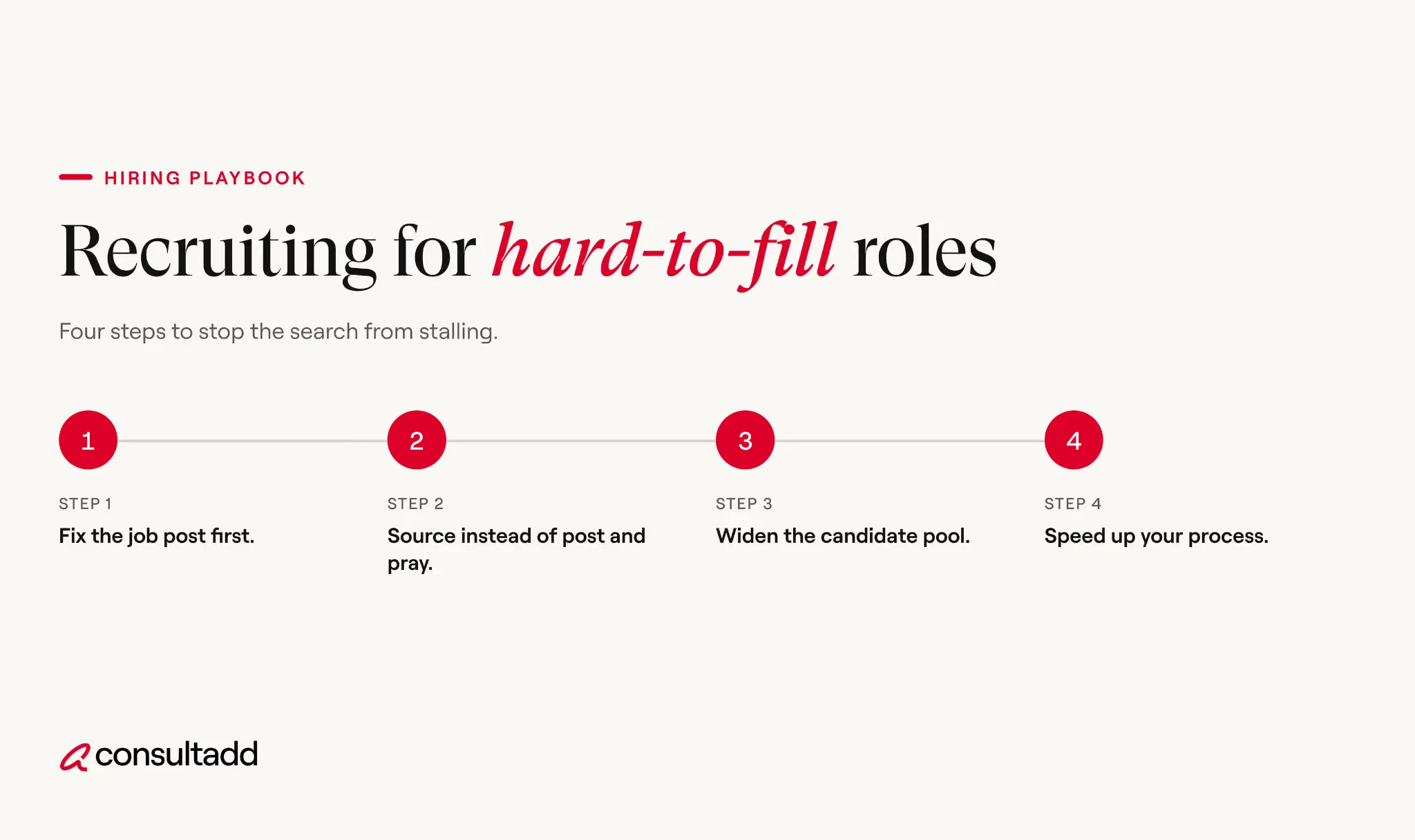
Step 1: Fix the Job Post First
Most hard-to-fill roles start with a job description that's working against you. Hiring managers tend to write a wish list instead of a requirements list, and candidates who'd otherwise apply talk themselves out of it.
Go through the posting and separate "must have" from "nice to have." A candidate who meets 70% of the real requirements is usually worth an interview, especially for roles where the skill itself is scarce.
Cut the requirement count down to what the person actually needs on day one, not what would be nice to have eventually.
Pay transparency helps too. Jobs that list a salary range draw more qualified applicants than ones that don't, since serious candidates skip listings where compensation is a mystery.
Step 2: Source Instead of Post and Pray
Here's the part most teams skip: the best candidates for hard-to-fill roles usually aren't applying to anything. They're employed, not actively looking, and only open to a conversation if someone reaches out directly.
Sourced candidates convert into hires at a far higher rate than inbound applicants for specialized roles, which is exactly why niche recruiting firms build their entire model around outreach instead of postings. A few sourcing channels worth building into your process:
- LinkedIn outreach targeted at people in adjacent roles, not just the exact title you're hiring for
- Referrals from your current team, since referred candidates tend to be a stronger fit and move faster through the process
- Alumni networks from companies known for training people in the skill you need
- Niche community forums and Slack groups specific to the discipline, from data engineering to instrumentation
Building this kind of pipeline takes real time.
If your internal team is stretched thin, this is often where working with a specialized IT staffing partner makes sense, since sourcing for scarce skills is most of what that kind of partner does all day.
Step 3: Widen the Candidate Pool
A big reason roles sit open is that the search stays too narrow. Widening the pool doesn't mean lowering the bar. It means looking in more places for people who can do the job.
Internal mobility is worth a hard look too. A growing share of organizations now train existing employees for hard-to-fill roles instead of only recruiting externally, since someone who already understands your systems and culture can often ramp up on a new skill faster than an outside hire can ramp up on your company.
Step 4: Speed Up Your Process
Finding the right candidate doesn't matter if your process loses them before an offer goes out. Slow hiring is one of the most fixable problems on this list, and it costs teams candidates they'd otherwise land.
A few changes that consistently shorten time-to-fill:
- Combine interview rounds instead of scheduling five separate one-hour calls across three weeks
- Give hiring managers a same-week deadline for feedback after each interview
- Tell candidates where they stand after every stage, even if the answer is "still deciding"
- Set a target number of days for each stage and track when a req blows past it
Teams with structured, faster processes report noticeably lower first-year turnover alongside quicker fills, which suggests speed and quality aren't actually in tension the way people assume.
When to Bring in Contract Talent
Sometimes the honest answer is that a permanent search will keep running for months while the work still needs to get done today. This is where contract or contract-to-hire talent earns its place in the plan.
Bringing in a contractor for the scarce skill lets your team keep shipping while the permanent search continues in the background. It also gives you a real trial period.
If the contractor is a strong fit, converting them to a full-time offer is often smoother than starting a brand-new search from zero.
Robert Half's research found 45% of employers plan to increase contract hiring specifically to close gaps faster, which tells you this isn't a fallback option anymore. It's a standard part of how hard-to-fill roles get covered.
If you're weighing this route, our guide on are staffing agencies worth it walks through how to decide between a contract hire, a full outsourced team, or continuing the permanent search alone.
Start Strong With Consultadd
With 15 years in business and 5,000+ successful staffing engagements, we don't just fill roles, we build reliability into your process. We've supported 65 staffing companies in the past year alone and maintain MSAs with industry leaders like Robert Half and TEKsystems.
Here's what working with Consultadd looks like:
- Talent sourced in under 24 hours
- Ready-to-deploy candidates, vetted for experience and compliance
- Lower turnover risk: we match long-term goals, not just short-term needs
- Seamless compliance: visa, documentation, onboarding? Handled.
- Dedicated 1:1 account managers for responsive, personalized support
- Top 100 candidate matches delivered in the past year
- Strong partnerships with universities to tap into fresh, committed talent
- Post-placement support so your investment grows beyond day one
For candidates, your next opportunity is more than just a job title, it's a chance to build skills, gain experience, and move your career forward. At Consultadd, we connect technology professionals with projects and employers that align with their goals, whether they're looking for contract, contract-to-hire, or long-term opportunities.
The tech job market moves fast, but the right guidance can make all the difference. Ready to take the next step in your career journey? Explore Opportunities >>
Key Takeaways
- Hard-to-fill roles usually stall because of an inflated job description, a narrow candidate pool, or a slow process, not a total absence of qualified people.
- Active sourcing beats posting and waiting, especially for specialized or passive candidates.
- Widening where and how you look for candidates opens up talent you'd otherwise miss.
- A faster interview process keeps strong candidates from disappearing to a competing offer.
- Contract or contract-to-hire talent can cover the gap while your permanent search keeps running.
FAQs
What makes a role "hard to fill"?
A role is generally considered hard to fill when it stays open well beyond your typical time-to-fill, usually because it needs a scarce skill, a specific certification, or experience that few candidates in the market actually have.
How long should a hard-to-fill role stay open before changing strategy?
If a role has been open twice as long as your average time-to-fill with few qualified applicants, that's a signal to shift from posting to active sourcing rather than waiting longer for the same approach to work.
Should I lower the requirements to fill the role faster?
Not exactly. The better move is separating true requirements from nice-to-haves, so you're not screening out candidates who could do the job well but don't match every line on a wish-list description.
Is contract hiring a good fit for hard-to-fill technical roles?
Yes, especially when the skill is scarce and the work can't wait for a permanent search to finish. Many contract placements convert to full-time offers once both sides confirm the fit.
How much does a slow interview process actually cost recruiting?
Strong candidates for scarce skills often have competing offers, so every extra week in your process raises the odds they accept somewhere else before you extend an offer.
What's the difference between sourcing and posting a job?
Posting waits for candidates to find and apply to your listing. Sourcing means your team or recruiting partner reaches out directly to qualified people, including those not actively job hunting, which matters most for specialized roles.

Executive Hiring Process Optimization: Strategies to Hire Faster in 2026
Introduction
The executive hiring process optimization strategies that work are unglamorous: define the success profile before you source, shrink the number of people with veto power, keep a warm bench between searches, and score candidates against a rubric instead of a room's gut feeling. Everything else is variation on those four.
Optimization here does not mean speed for its own sake. A senior hire who fails costs months of severance, a stalled function, and a second search with a demoralized team watching. The goal is a shorter cycle with better evidence behind it.
The data on where executive searches lose time is fairly clear, and most of the loss is recoverable.
TL;DR
- SHRM puts median executive time to fill at 45 days in 2026, unchanged from 2025 but well below the 60 days recorded in 2022.
- Executive cost per hire jumped to a $15,000 median in 2026 from $10,600 the year before, while non-executive cost per hire barely moved.
- Boards are going outside more often. External CEO appointments in the S&P 500 nearly doubled between 2024 and 2025.
- Only 1 in 5 organizations measures quality of hire, which means most companies cannot tell whether their executive hiring is working.
- The highest-return fixes are structural: fewer decision-makers, a defined success profile, and a scoring rubric agreed on before the first interview.
What the executive hiring data shows right now
SHRM surveyed 4,657 members between November 2025 and January 2026. The executive numbers tell a different story from the non-executive ones.
The cost gap is widening, not closing
Executive cost per hire rose 42% in one year while non-executive cost stayed flat. SHRM's earlier benchmarking found executive hires running nearly seven times more expensive than non-executive hires, and the 2026 figures widen that ratio further.
Part of this is deliberate. Leadership development has been the top CHRO priority for two consecutive years. Part of it is that senior roles are harder to fill, and difficulty shows up as spend.
Either way, process waste at this level is expensive in a way non-executive waste isn't. A redundant interview round on a $1,300 hire is a rounding error. The same round on a $15,000 search is not.
Boards are going outside more often
The Conference Board, working with Egon Zehnder and Semler Brossy, found that external CEO appointments in the S&P 500 nearly doubled from 18% in 2024 to 33% in 2025, the highest level in eight years. The overall succession rate climbed to 12.5% from 9.8%.
That same research found turnover among top-performing companies rose from 7% to 12%, nearly matching the 14% rate at bottom-quartile performers. Boards are treating succession as a strategic tool rather than a response to bad results.
The implication for anyone designing an executive hiring process is direct. External searches are becoming the norm at the top, and the process has to work without a ready internal successor waiting.
Executive hiring process optimization strategies, ranked by impact
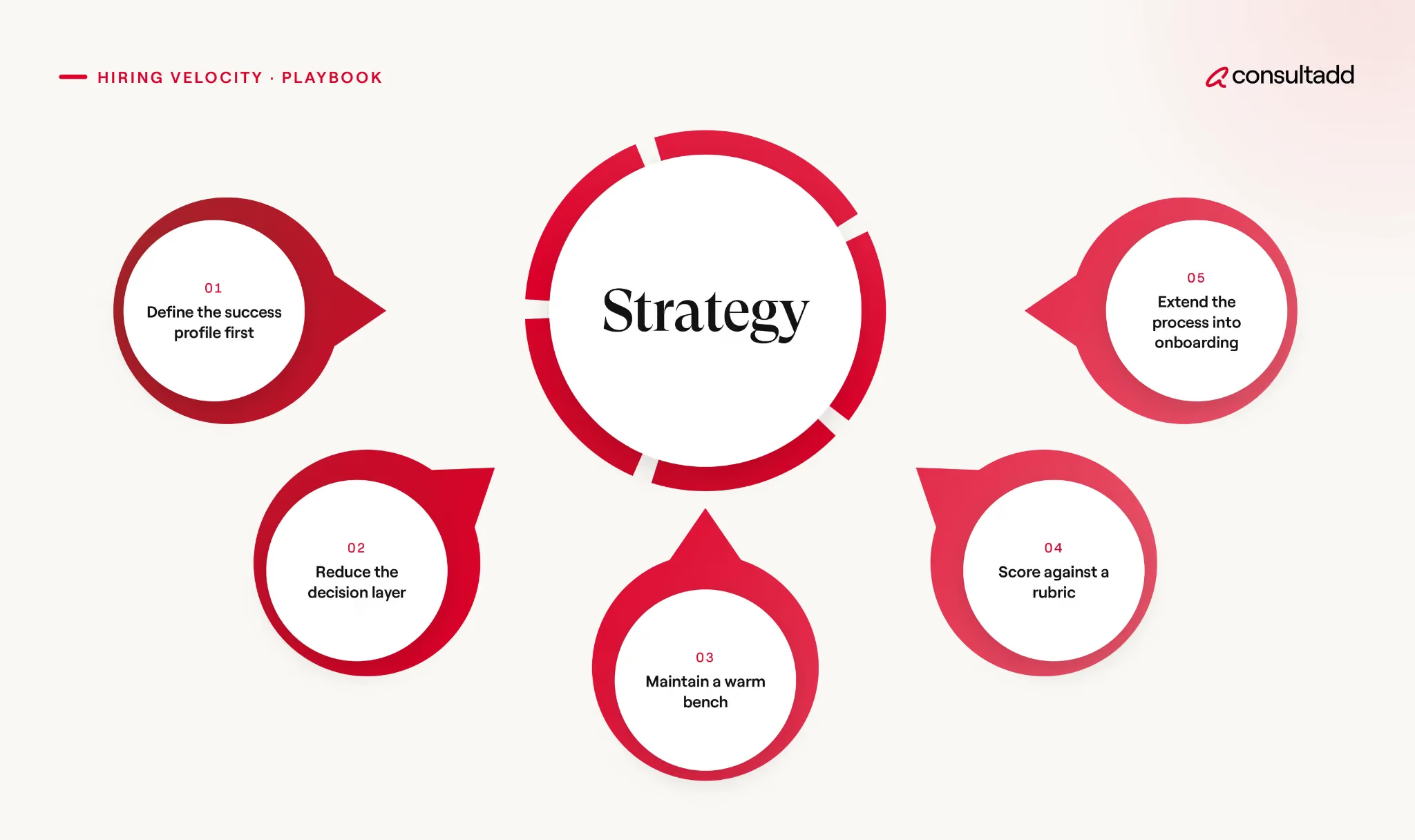
The first two cost nothing and return the most.
Strategy 1 - Define the success profile before you source
Most executive searches begin with a job description, which is a list of responsibilities. What you need is a success profile: what the person must accomplish and how it will be judged.
Write down three or four outcomes the hire owns in year one, the constraints they'll inherit, and what evidence would convince you a candidate can deliver them. Get the sponsor to sign off before a single name is sourced.
Skipping this is why searches restart. Six weeks in, someone says "I'm not sure this is really the profile we need," and it turns out nobody wrote the profile down.
Strategy 2 - Reduce the decision layer
Executive searches accumulate stakeholders. Every extra opinion adds scheduling friction on the front end and consensus-building on the back end.
Name one decision-maker and a small set of advisers whose input is heard but not binding. Cap the panel. Run the debrief as one scheduled session rather than an email thread, with written scores submitted beforehand so the loudest voice doesn't set the anchor.
I've watched this single change take two weeks off a search. It's also the change organizations resist most, because reducing the decision layer means telling someone their vote no longer counts.
Strategy 3 - Maintain a warm bench between searches
Recruiting cold at this level is slow because the people you want are not applying. They're employed, performing, and not reading job postings.
Relationship-building has to happen before the requisition exists. That means a named list of 20 to 30 credible senior people per function, refreshed quarterly, with occasional real contact rather than a mail merge. Teams that keep this list open a search with a slate instead of a blank page.
The same logic applies to interim coverage. If a fractional or project-based leader can run the function while the permanent search proceeds properly, the pressure to rush disappears.
Our overview of project-based recruiting covers how that bridge is structured.
Strategy 4 - Score against a rubric, not a room
Structured interviewing, where every candidate faces the same questions scored against defined criteria, predicts job performance considerably better than open conversation. It's the basis of SHRM's guidance to work from standardized questions and rating criteria.
At the executive level this gets skipped constantly, usually with some version of "you can't put a rubric on judgment." You can. Define the four or five competencies the success profile demands, write one question each, and anchor a 1-to-5 scale with what weak, adequate, and strong answers sound like.
Have interviewers submit scores within 30 minutes. Memory of a conversation degrades faster than most people believe.
Strategy 5 - Treat onboarding as part of the hire
The search isn't over at offer acceptance. Senior hires arrive without the informal context that makes decisions possible, and a leader who spends five months learning who actually influences what has been onboarding for five months.
Build a 90-day plan before day one: which relationships matter, which decisions they own immediately, which they should hold. Assign a peer sponsor and schedule a real 60-day check-in.
Where executive searches actually stall
Screening and interviewing each averaging 8 to 9 days across all roles. At the executive level both stretch further, since calendars are harder and panels larger.
Notice how little of that list is about evaluating candidates. Almost all of it is coordination, and coordination problems are solvable without judgment calls about people.
Metrics worth tracking for senior roles
Only 20% of organizations measure quality of hire, per SHRM's 2026 data, and that hasn't moved since 2025. It's the most consequential gap in executive hiring, because without it you're optimizing a process whose output you never check.
Four measures worth keeping for senior searches:
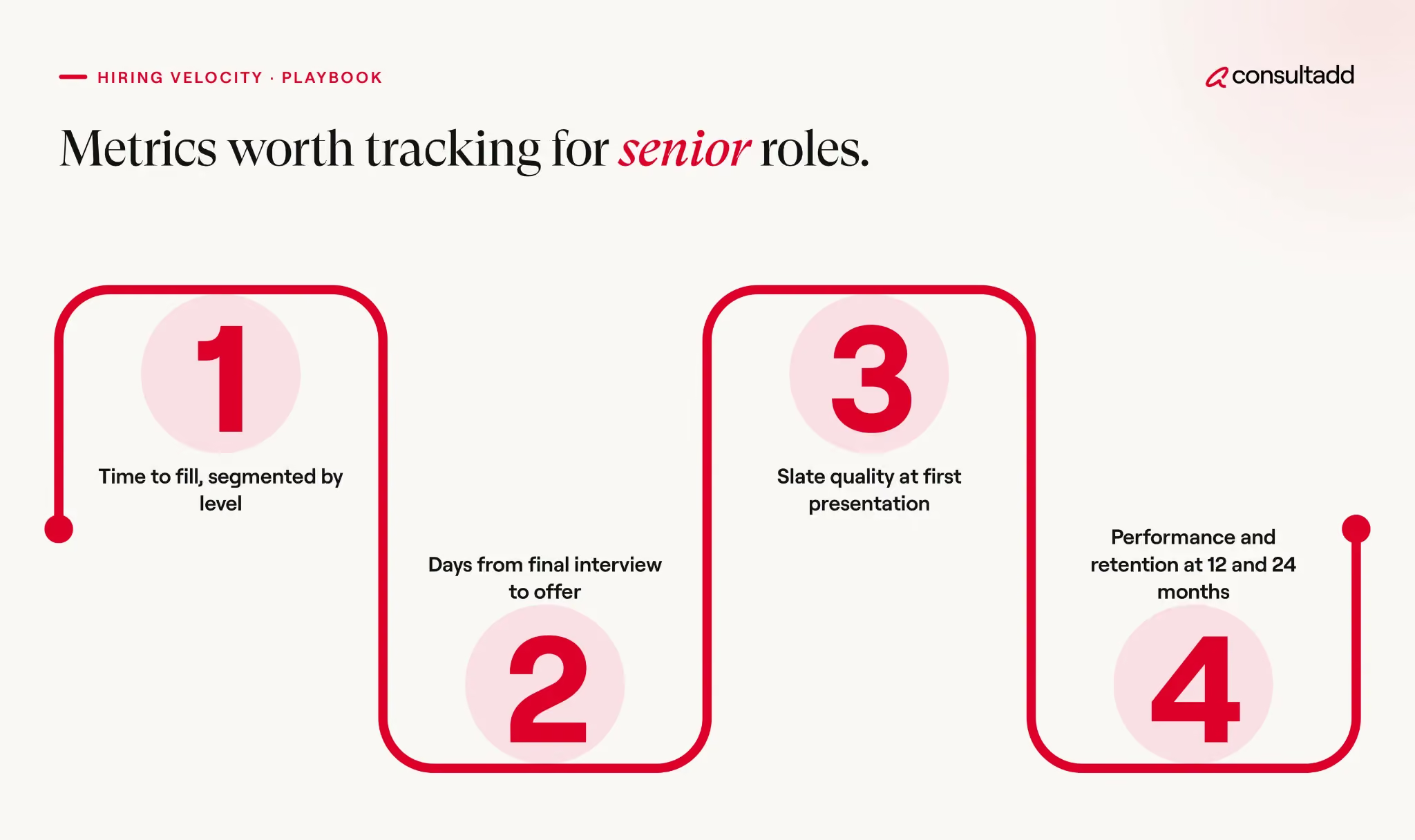
- Time to fill, segmented by level. Blending executive and non-executive searches produces a number that describes neither. Track your own trend rather than a national median.
Our breakdown of time to hire versus time to fill explains why the two diagnose different problems.
- Days from final interview to offer. This isolates your decision layer. If it's over five days on an executive search, the problem is governance, not candidates.
- Slate quality at first presentation. How many of the first candidates presented reached final rounds? A low rate means the success profile was never clear.
- Performance and retention at 12 and 24 months. Imperfect, lagging, and still the only measure that tells you whether the process produced good decisions.
Track the first three monthly, the fourth annually.
Running the search internally versus bringing in a partner
There's no universal answer, but there's a reasonable test.
Handle it internally:
- When you hire that profile regularly, your network in the function is real, and you have recruiter capacity for a proper search.
- That last condition fails more often than people admit. SHRM's 2026 data puts the median recruiter at 25 open requisitions, rising to 100 in the largest organizations.
- Nobody running 100 requisitions is also running a careful executive search.
Bring in a partner:
- When the profile is rare, the search is confidential, you're entering an unfamiliar market, or the seat has been open long enough that internal urgency is distorting judgment.
- If you go this route, ask about placement retention rates and average days to first qualified slate for comparable roles.
Our buyer's guide to staffing and search firms covers what to press on before signing.
One thing worth being honest about: a partner does not fix an undefined success profile or a committee that cannot decide. Those are internal problems, and outsourcing sourcing just relocates them. Fix the process first, then decide who runs it.
Our step-by-step staffing process guide is a reasonable frame for rebuilding.
Start strong with Consultadd
With 15 years in business and 5,000+ successful staffing engagements, we don't just fill roles, we build reliability into your process. We've supported 65 staffing companies in the past year alone and maintain MSAs with industry leaders like Robert Half and TEKsystems.
Here's what working with Consultadd looks like:
- Talent sourced in under 24 hours
- Ready-to-deploy candidates, vetted for experience and compliance
- Lower turnover risk: we match long-term goals, not just short-term needs
- Seamless compliance: visa, documentation, onboarding? Handled.
- Dedicated 1:1 account managers for responsive, personalized support
- Top 100 candidate matches delivered in the past year
- Strong partnerships with universities to tap into fresh, committed talent
- Post-placement support so your investment grows beyond day one
For candidates, your next opportunity is more than just a job title, it's a chance to build skills, gain experience, and move your career forward. At Consultadd, we connect technology professionals with projects and employers that align with their goals, whether they're looking for contract, contract-to-hire, or long-term opportunities.
The tech job market moves fast, but the right guidance can make all the difference. Ready to take the next step in your career journey? Explore Opportunities >>
Key takeaways
- The executive hiring process optimization strategies with the best return are structural: a written success profile, fewer decision-makers, a warm bench, and a scoring rubric.
- Executive median time to fill sits at 45 days, while cost per hire climbed to $15,000 in 2026, so process waste at this level is expensive.
- External hiring at the top is rising, which means the process has to work without a ready internal successor.
- Most delay in executive searches comes from coordination, not from evaluating people.
- Measure quality of hire alongside speed, or you have no way to know whether the process is producing good leaders.
FAQs
How long should an executive hiring process take?
SHRM's 2026 benchmarking puts the median executive time to fill at 45 days, down from 60 days in 2022. Treat that as a reference point rather than a target, since a confidential C-suite search in a thin market will reasonably take longer than a director-level hire in a deep one.
Why is executive cost per hire rising so fast?
Executive cost per hire reached a $15,000 median in 2026, up from $10,600 in 2025. Two forces: organizations are deliberately investing more in leadership, and more executive roles are filled externally, which brings search fees and relocation costs internal promotions avoid.
What's the single biggest fix for a slow executive search?
Reducing the number of people who can block a decision. It costs nothing and compresses both the scheduling phase and the debrief. It's also the change organizations resist hardest, because it means telling a stakeholder their vote is advisory.
Should executive candidates go through structured interviews?
Yes. Structured interviews predict job performance substantially better than unstructured conversation, and that holds at senior levels. Define four or five competencies from the success profile, write one question per competency, and have interviewers submit scores before any group discussion begins.
How do you measure whether executive hiring is working?
Track time to fill segmented by level, days from final interview to offer, the share of first-slate candidates who reach final rounds, and performance and retention at 12 and 24 months. Only about 20% of organizations measure quality of hire at all, which is the gap most worth closing.
When should we use an external search partner instead of hiring internally?
Use a partner when the profile is rare, the search needs to stay confidential, you're entering a market you don't know, or internal recruiter capacity is already stretched. Handle it internally when you hire that profile often and have genuine reach in the function.