
Hiring & Recruitment

SAP MM Hiring Guide: What Employers Need to Know in 2026
Introduction
SAP MM hiring has gotten harder in the last two years, not easier. Companies are still running procurement and inventory through SAP, S/4HANA migrations are picking up speed, and the pool of consultants who actually know the module cold hasn't grown at the same rate.
If you're a hiring manager or recruiter trying to fill an SAP MM seat right now, you've probably already noticed candidates asking for more money, more flexibility, or both.
This guide walks through what SAP MM hiring looks like today: the skills worth screening for, what the role actually pays, which hiring model fits your timeline, and where the process tends to go wrong.
TL;DR
- SAP MM pay has held steady through 2026, with average hourly rates near $73 in the US and senior consultants clearing $130,000 a year.
- The S/4HANA migration deadline is pulling more companies into hiring mode, which is tightening supply for experienced MM consultants.
- Screening should focus on procurement, inventory, and master data experience, not just a certification badge.
- Contract-to-hire has become the default model for MM roles because it lets both sides test fit before committing.
- Compliance work, including visa sponsorship, is often the slowest part of an SAP MM hire and worth planning for early.
SAP MM is a narrower hire than most job descriptions suggest
SAP Materials Management covers procurement, inventory management, material requirements planning, and vendor management inside the broader SAP ERP or S/4HANA system.
It's one of the modules most companies stood up first, because procurement and inventory touch nearly every part of a manufacturing, retail, or logistics business.
That history is part of the hiring problem. A lot of job postings for "SAP MM consultant" actually want someone who also understands SD (sales and distribution), FI (finance), or PP (production planning), because those modules integrate so closely with MM in a live system.
If your job description reads like three roles stitched together, you'll get fewer qualified applicants, not more.
The SAP MM talent market in 2026
Demand for SAP MM hasn't slowed down, and the reason has less to do with new implementations than with old ones.
- A large share of SAP's installed base is still running the legacy ECC system, and support for it ends in 2027.
- Gartner data cited by CIO reported that only about 39% of the roughly 35,000 ECC customers worldwide had migrated to S/4HANA by the end of 2024, which leaves a sizable chunk of companies racing to convert before the deadline.
- That migration wave is a direct driver of MM hiring, since inventory and procurement configuration has to be rebuilt or validated in the new system.
Pay reflects that pressure.
- ZipRecruiter salary data pegged the average US hourly rate for SAP MM work at $72.65 as of mid-August 2026, with senior consultants and specialized roles running well above that.
- Annual salaries for experienced SAP MM consultants commonly land between $60,000 and $120,000, with senior architects and niche specialists clearing $130,000.
The broader labor picture backs this up too.
- The Bureau of Labor Statistics projects that computer and information technology occupations will grow much faster than the average for all jobs through 2034, with roughly 317,700 openings a year across the field.
- SAP MM sits inside that broader IT demand curve, which means it's competing for the same limited talent pool as cybersecurity, cloud, and data roles.
Core skills and certifications to screen for
A certification tells you someone studied the material. It doesn't tell you they can configure a pricing procedure under a live deadline or untangle a messy vendor master data set.
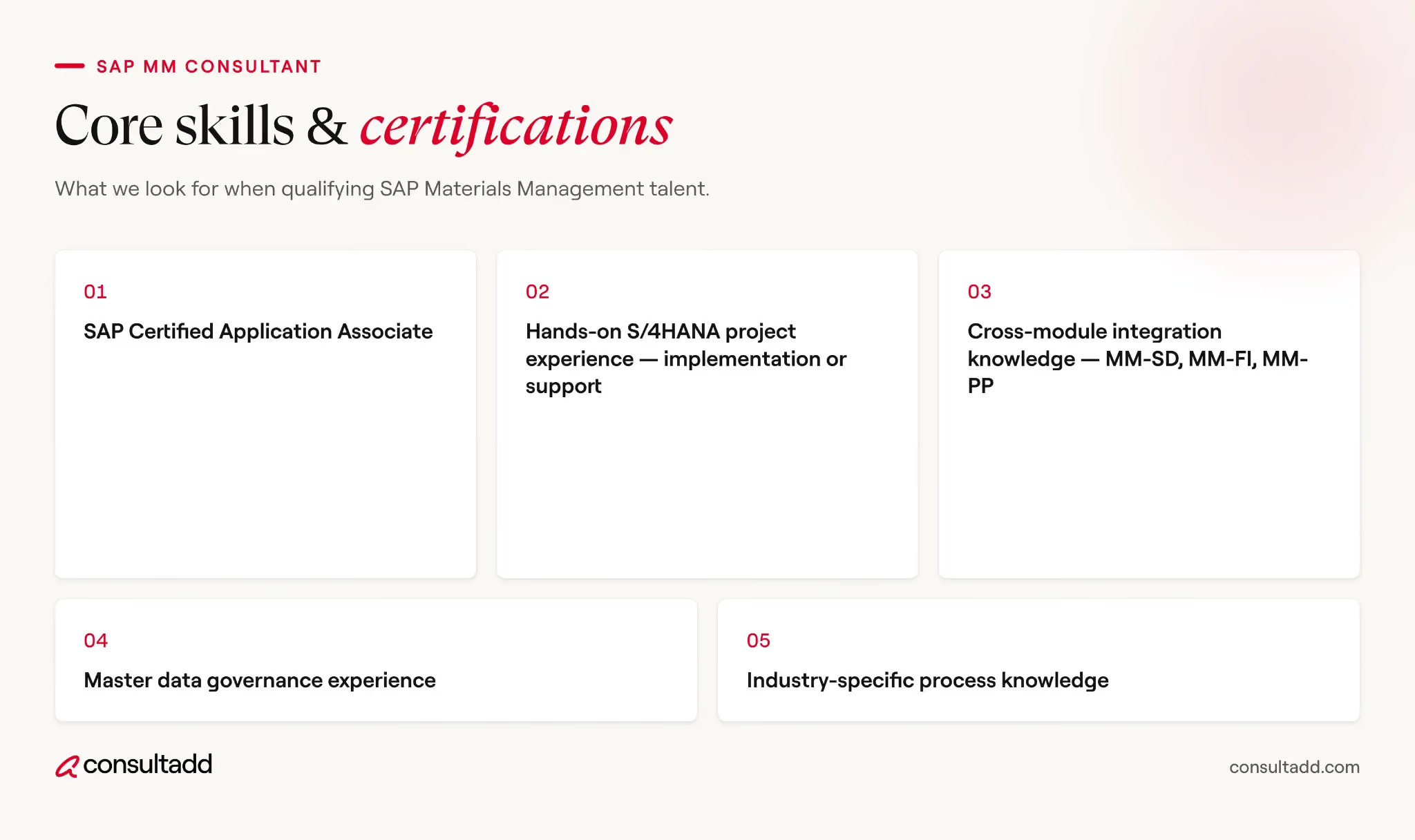
Use certifications as a baseline filter, then screen for hands-on experience underneath it.
Here's how skill expectations generally break down by seniority level:
If a candidate's resume is heavy on certifications but light on named projects, ask them to walk through a specific configuration decision they made and why.
It's a fast way to separate people who studied SAP MM from people who've actually run it.
Contract, contract-to-hire, or full-time: choosing the right model
The hiring model matters as much as the candidate. SAP MM work often comes in project waves (a migration, a rollout, a go-live) rather than steady-state need, which is part of why contract and contract-to-hire arrangements are so common in this space.
If you're not sure which model fits your situation, this breakdown of what contract-to-hire actually means and how it works is worth reading before you write the job posting.
Where to find SAP MM candidates
Sourcing SAP MM talent directly is possible, but it competes with every other company running the same migration timeline.
Most hiring teams end up mixing three channels:
- Internal referrals
- Direct sourcing through job boards
- Staffing partners who already maintain a bench of vetted SAP consultants
Staff augmentation tends to be the fastest option when you need someone live on a project within weeks rather than months.
If that's the situation you're in, this guide on how to hire tech talent faster through staff augmentation covers how the model works and what it costs relative to a direct hire.
Whatever channel you use, the process itself matters. A slow, disorganized hiring process loses good SAP MM candidates to competing offers, especially in a market where contract rates are attractive.
If you want a broader look at what's slowing hiring down and how to fix it, see this rundown of hiring and recruiting strategies that actually work in 2026.
Compliance and visa considerations
A meaningful share of SAP MM consultants in the US work under H-1B or similar visa classifications, since the role often qualifies as a specialty occupation requiring a bachelor's degree in a related field.
According to USCIS, employers filing H-1B petitions must obtain a certified Labor Condition Application from the Department of Labor and attest to paying the prevailing wage for the role and location.
That process, plus the annual H-1B cap, means visa-dependent hires need longer lead times than most hiring managers plan for.
If your SAP MM candidate pool includes visa holders, build the sponsorship timeline into your hiring plan from the start rather than discovering it after you've already made a verbal offer.
Common hiring mistakes to avoid
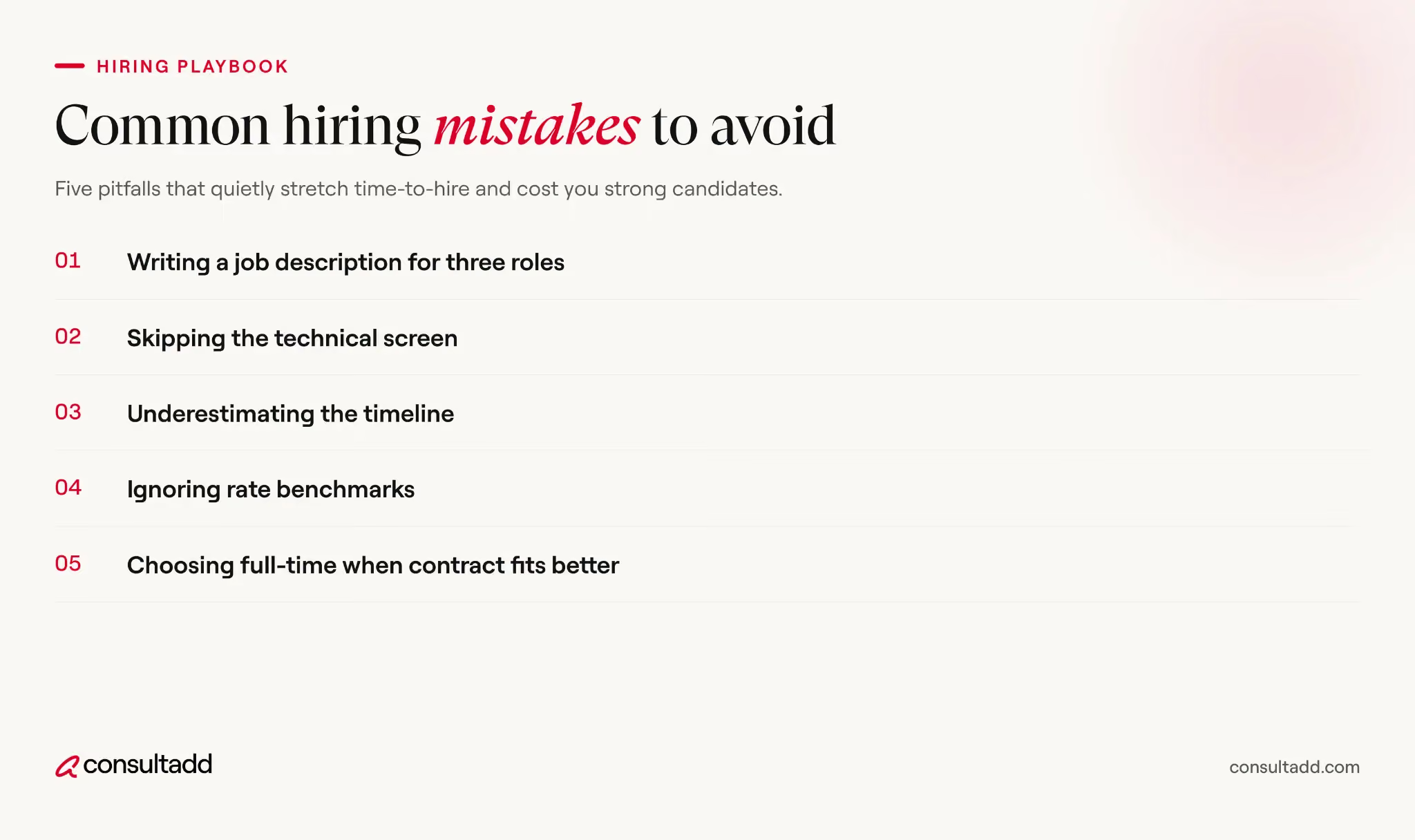
Writing a job description for three roles. Asking for deep MM, SD, and FI expertise in one posting shrinks your applicant pool without adding real value.
Skipping the technical screen. Certifications and resumes don't reveal how someone handles a live configuration problem. A scenario-based interview does.
Underestimating the timeline. Between sourcing, screening, and (if applicable) visa processing, a properly vetted SAP MM hire can take longer than the project deadline allows for.
Ignoring rate benchmarks. Offering below-market rates in a tight talent market means losing candidates to competing offers mid-process.
Choosing full-time when contract fits better. If the need is tied to a single migration or rollout, a contract hire is usually faster to bring on and easier to release once the project wraps.
Start Strong With Consultadd
With 15 years in business and 5,000+ successful staffing engagements, we don't just fill roles, we build reliability into your process. We've supported 65 staffing companies in the past year alone and maintain MSAs with industry leaders like Robert Half and TEKsystems.
Here's what working with Consultadd looks like:
- Talent sourced in under 24 hours
- Ready-to-deploy candidates, vetted for experience and compliance
- Lower turnover risk: we match long-term goals, not just short-term needs
- Seamless compliance: visa, documentation, onboarding? Handled.
- Dedicated 1:1 account managers for responsive, personalized support
- Top 100 candidate matches delivered in the past year
- Strong partnerships with universities to tap into fresh, committed talent
- Post-placement support so your investment grows beyond day one
For candidates, your next opportunity is more than just a job title, it's a chance to build skills, gain experience, and move your career forward. At Consultadd, we connect technology professionals with projects and employers that align with their goals, whether they're looking for contract, contract-to-hire, or long-term opportunities.
The tech job market moves fast, but the right guidance can make all the difference. Ready to take the next step in your career journey? Explore Opportunities >>
Key takeaways
- SAP MM hiring is being shaped by the 2027 S/4HANA migration deadline, which is pulling more companies into active hiring right now.
- Average US pay for SAP MM work sits around $73 an hour, with senior consultants earning well past $100,000 a year.
- Certifications are a starting filter, not proof of hands-on ability. Screen for real project experience underneath them.
- Contract-to-hire has become the go-to model because it lets employers validate fit before making a permanent commitment.
- Visa sponsorship and compliance timelines need to be part of the hiring plan from day one, not an afterthought.
FAQs
What does an SAP MM consultant actually do?
They manage the procurement, inventory, and material requirements planning processes inside SAP, working closely with vendors and cross-functional teams like SD and FI to keep the supply chain data accurate and the system running smoothly.
How much does it cost to hire an SAP MM consultant?
US hourly rates typically fall between $60 and $93, with the average sitting around $73 as of mid-2026. Full-time salaries for experienced consultants usually range from $60,000 to over $130,000 depending on seniority and location.
Is SAP MM still in demand with S/4HANA replacing older systems?
Yes. S/4HANA still requires materials management configuration, and the ongoing migration wave from legacy ECC systems has kept demand for MM consultants high through 2026.
Should I hire an SAP MM consultant on contract or full-time?
It depends on whether the need is tied to a specific project, like a migration or rollout, or an ongoing support function. Contract-to-hire is a common middle ground when you're not sure yet.
What certifications should I look for in an SAP MM candidate?
SAP Certified Application Associate credentials for Sourcing and Procurement are a reasonable baseline, but named project experience and cross-module integration knowledge matter more for actual job performance.
Do SAP MM hires typically require visa sponsorship?
Many do, often under the H-1B specialty occupation classification. That process involves a Department of Labor certification and can take months, so it's worth planning early if your candidate pool includes visa holders.

How To Measure Candidate Experience Without Guessing
Introduction
Most companies think they know how candidates feel about their hiring process. Then they run their first survey and find out they were wrong. Knowing how to measure candidate experience is really about replacing that guesswork with numbers you can act on.
The problem is that "candidate experience" sounds soft, like something you sense rather than track. It isn't. There are specific metrics, specific survey points, and specific formulas that tell you exactly where candidates are getting frustrated and where they're staying engaged.
This guide walks through what to measure, when to ask, and what the numbers actually mean once you have them.
TL;DR
- Measuring candidate experience means combining perception metrics (surveys, NPS) with behavioral metrics (drop-off, time-to-hire, acceptance rate).
- Candidate Net Promoter Score and Candidate Satisfaction Score are the two most common survey-based metrics.
- Application drop-off rate and recruiter response time reveal friction points before candidates ever tell you about them.
- Survey timing matters: ask too early and you get incomplete impressions, ask too late and candidates won't respond.
- A hiring market where job openings still outpace hires makes this data more valuable, not less.
Start with the two types of metrics
Candidate experience data splits into two categories, and most companies only track one.
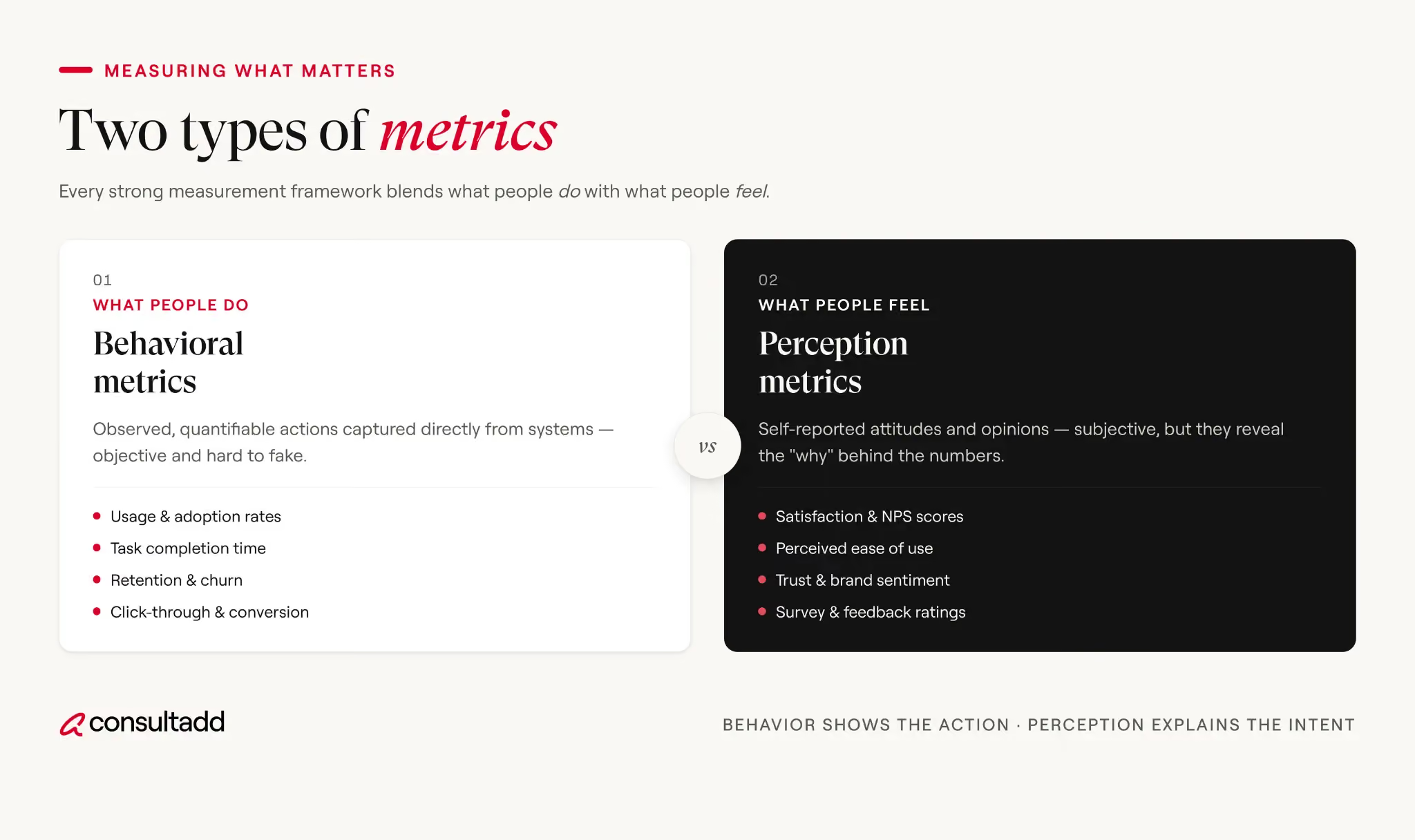
Perception metrics capture how candidates say they feel. This is survey data: satisfaction scores, NPS, open-ended feedback.
Behavioral metrics capture what candidates actually do. This is process data: how many drop off mid-application, how long it takes to get an offer out, how often that offer gets accepted.
You need both.
- A high satisfaction score paired with a falling offer acceptance rate usually points to a pay or timeline problem, not an experience problem.
- A low satisfaction score paired with strong acceptance rates might mean candidates are tolerating friction because they don't have other options right now.
Core candidate experience metrics to track
None of these numbers means much in isolation. A 42-day time to hire sounds slow until you check it against your industry average and your offer acceptance rate. If both are healthy, the number on its own isn't the problem.
When to survey candidates
Timing changes what kind of feedback you get. Ask right after an interview and candidates are still processing; ask weeks later and most won't respond at all.
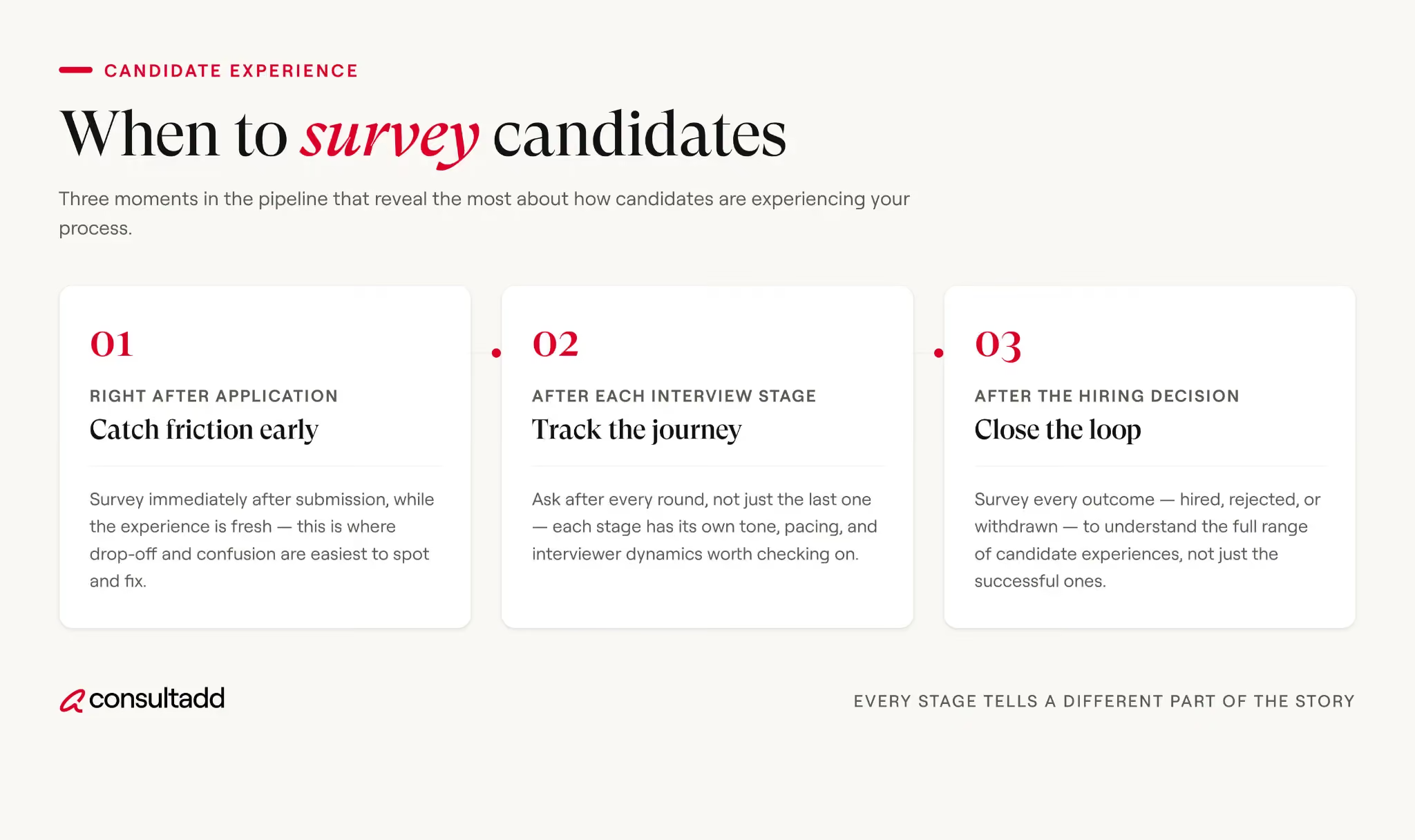
A reasonable cadence looks like this:
- Right after application submission, to catch friction in the application process itself.
- After each interview stage, the interaction is still fresh.
- After the hiring decision, whether the candidate was hired, rejected, or withdrew.
Rejected candidates are worth surveying too. They have no reason to soften their answers, and their feedback tends to be more direct than feedback from candidates you're about to hire.
Building a simple measurement checklist
What the numbers usually reveal
A few patterns show up often enough to be worth naming directly.
High application drop-off, low time to hire. Your process might be fast once someone applies, but the application form itself is the bottleneck. Long forms, redundant fields, and mandatory account creation all push this number up.
Good satisfaction scores, weak offer acceptance. This usually isn't an experience problem. Check compensation benchmarks and how long it takes between the final interview and the offer letter going out.
Slow recruiter response time across the board. This is the single easiest metric to fix, and it tends to move every other number when it improves.
Candidates consistently name unclear or delayed communication as one of the bigger frustrations in the hiring process, based on labor market research from the Society for Human Resource Management.
Why this matters more in a tight hiring market
The labor market context changes how much candidate experience actually costs you.
Recent Bureau of Labor Statistics data shows the hires rate sitting at 3.4% as of June 2026, with job openings still running ahead of actual hires in several months this year.
When employers are competing for a smaller pool of active, engaged candidates, a clunky process pushes good talent toward whichever competitor moves faster.
LinkedIn Talent Solutions research also points out that candidate experience starts before someone applies, shaped by employer reviews and reputation candidates encounter first.
That's worth remembering when the data only looks at what happens after someone hits submit.
Turning data into action
Measuring candidate experience is only useful if it changes something. A few practical moves:
- If drop-off spikes at a specific application field, remove or simplify that field first.
- If recruiter response time is inconsistent, set a standard response window and track adherence to it, not just the average.
- If cNPS is strong among hired candidates but weak among rejected ones, look at how rejection is communicated, not just how interviews are run.
Companies building out a full recruiting process from scratch often benefit from pairing this measurement work with a broader look at how to hire dedicated developers efficiently, since technical hiring tends to have its own drop-off points around assessments and take-home tests.
Start Strong With Consultadd
With 15 years in business and 5,000+ successful staffing engagements, we don't just fill roles, we build reliability into your process. We've supported 65 staffing companies in the past year alone and maintain MSAs with industry leaders like Robert Half and TEKsystems.
Here's what working with Consultadd looks like:
- Talent sourced in under 24 hours
- Ready-to-deploy candidates, vetted for experience and compliance
- Lower turnover risk: we match long-term goals, not just short-term needs
- Seamless compliance: visa, documentation, onboarding? Handled.
- Dedicated 1:1 account managers for responsive, personalized support
- Top 100 candidate matches delivered in the past year
- Strong partnerships with universities to tap into fresh, committed talent
- Post-placement support so your investment grows beyond day one
For candidates, your next opportunity is more than just a job title, it's a chance to build skills, gain experience, and move your career forward. At Consultadd, we connect technology professionals with projects and employers that align with their goals, whether they're looking for contract, contract-to-hire, or long-term opportunities.
The tech job market moves fast, but the right guidance can make all the difference. Ready to take the next step in your career journey? Explore Opportunities >>
Key takeaways
- Measuring candidate experience means tracking both perception metrics like cNPS and behavioral metrics like drop-off rate.
- Survey timing shapes response quality; ask soon after each touchpoint, not weeks later.
- Rejected candidates give the most honest feedback since they have nothing to gain by being diplomatic.
- Recruiter response time is often the fastest metric to improve and tends to move other numbers with it.
- A tighter labor market raises the cost of a poor process, since strong candidates have less patience for friction.
FAQs
What is the best metric for measuring candidate experience?
There isn't a single best metric. Candidate Net Promoter Score gives you a perception snapshot, while application drop-off rate shows you where the process itself is failing. Most recruiting teams need at least one metric from each category.
How often should we survey candidates?
Short surveys at each key touchpoint, application, interview, and decision, work better than one long survey at the end. This catches issues while they're still fresh instead of relying on memory weeks later.
Should we survey candidates we didn't hire?
Yes. Rejected candidates tend to give more direct feedback since they aren't trying to stay in your good graces. Skipping this group means missing some of your most useful data.
What's a good response rate for candidate experience surveys?
Response rates vary by industry, but short surveys sent immediately after a touchpoint typically outperform longer ones sent later. If your response rate is consistently low, the survey length or timing is usually the issue, not candidate apathy.
How does candidate experience affect offer acceptance?
Poor experience during interviews or slow communication can push candidates toward other offers before yours arrives. Tracking both metrics together shows whether a weak acceptance rate is an experience problem or a compensation problem.
Can small companies measure candidate experience without expensive tools?
Yes. A short survey tool and a shared spreadsheet can track the core metrics. What matters more than the tooling is consistency: asking the same questions at the same stages every time.

What Is Workforce Planning? A Practical Guide for HR Teams
Introduction
If you've ever sat in a headcount meeting where nobody could agree on how many people you actually need next quarter, you already know why workforce planning matters. It's the difference between hiring on gut feeling and hiring based on where the business is actually headed.
So, what is workforce planning? In simple terms, it's the process of figuring out how many people you need, with what skills, and when, so your organization can hit its goals without overspending on payroll or scrambling to fill gaps at the last minute.
It sits somewhere between HR strategy and finance, and when it's done well, most people outside HR never even notice it's happening. That's usually the sign it's working.
This guide breaks down what workforce planning actually involves, how the process works step by step, and where most teams get stuck.
TL;DR
- Workforce planning matches your current and future staffing levels to business goals, covering headcount, skills, and budget.
- It's different from day-to-day recruiting. Recruiting fills open roles. Workforce planning decides which roles should exist in the first place.
- The process runs in five stages: assess current workforce, forecast demand, spot gaps, build an action plan, then monitor and adjust.
- Only 29% of CHROs feel confident their organization can actually deliver on its workforce planning goals, according to Gartner.
- Getting it right means combining internal headcount data with external labor market signals, not just gut instinct from department heads.
What is workforce planning, exactly?
Workforce planning is a systematic way of aligning your people, budget, and skills with what the business needs to accomplish over a set period, usually the next one to three years.
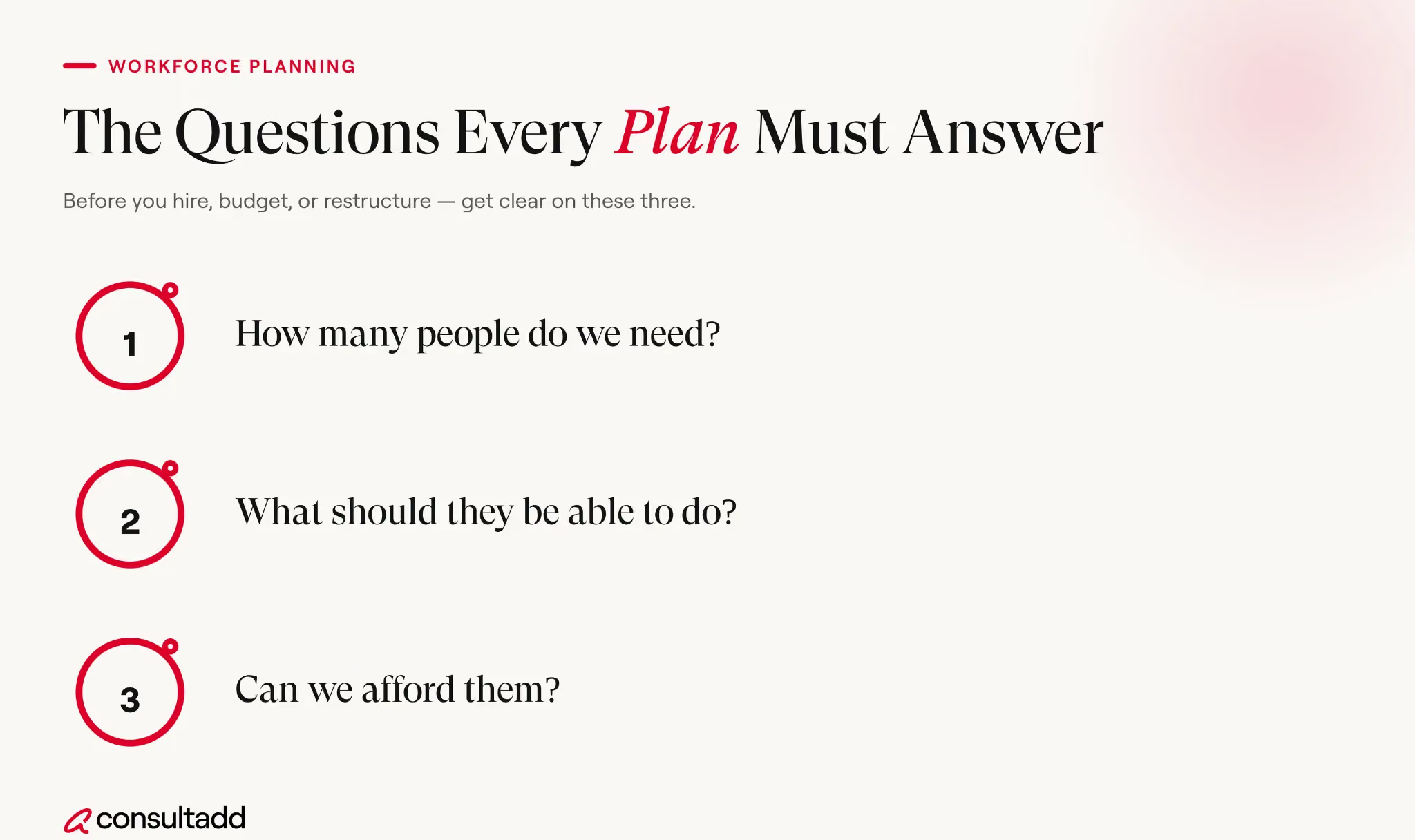
It answers three questions at once:
- How many people do we need
- What should they be able to do
- Can we afford them
Gartner's research points out that workforce planning typically centers on identifying and installing the people and capacities required for business strategy, along with diagnosing talent risks and building a plan to close those gaps.
That's a fair summary, though the practice looks different depending on company size. A 50-person startup might do this on a spreadsheet once a quarter. A 5,000-person enterprise usually runs it as a standing function with its own dashboards and dedicated staff.
The output isn't just a headcount number. It's a plan that covers hiring, internal mobility, training, and sometimes layoffs, all pointed at the same business target.
Workforce planning vs. recruiting vs. strategic workforce planning
People use these terms interchangeably, and that's where a lot of confusion starts. Here's how they actually differ.
Recruiting is tactical. It reacts to a requisition. Workforce planning is the layer above that decides whether the requisition should exist at all, and strategic workforce planning zooms out further to ask what the whole organization's talent shape needs to look like years from now.
Why workforce planning matters right now
Labor markets don't move the way they used to. The U.S. Bureau of Labor Statistics projects total employment growth of 3.1% from 2024 to 2034, a noticeably slower pace than the prior decade, driven largely by an aging population and slower labor force growth. That means the talent pool companies are competing over is growing more slowly than the demand for skilled workers in fields like healthcare, data, and technology.
At the same time, most HR leaders don't feel equipped to handle it. Gartner found that only 29% of CHROs are confident in their organization's ability to deliver on strategic workforce planning goals, even though workforce planning sits close to the center of nearly every major business decision.
A few concrete reasons this keeps landing on leadership agendas:
- Skill requirements shift faster than a typical hiring cycle can keep up with, especially in tech and healthcare.
- Budget owners want headcount decisions tied to revenue or output, not just "we're busy."
- Remote and contingent work has made the boundaries of a "workforce" less clear, so planning has to account for contractors and gig talent too.
- Turnover in specialized roles is expensive enough that most companies can't afford to plan reactively anymore.
The workforce planning process, step by step
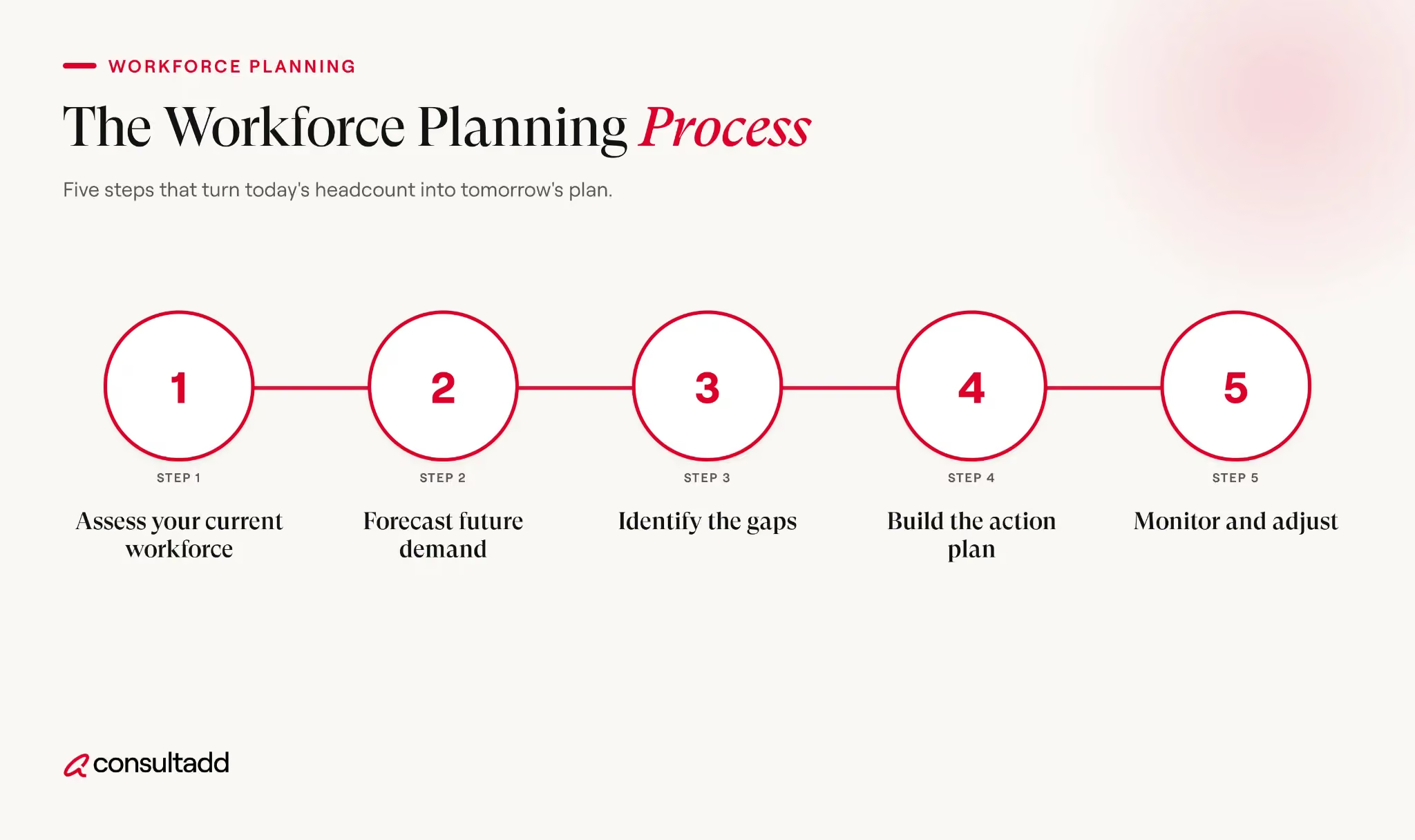
Most workforce planning frameworks follow a similar sequence, even if the labels differ. Here's the version that holds up across company sizes.
Step 1: Assess your current workforce
Start with a clear picture of what you have. That means headcount by department, skill inventories, tenure, performance data, and attrition trends. Skipping this step is the most common reason workforce plans fall apart later, because you can't measure a gap against a baseline you never established.
Step 2: Forecast future demand
Look at where the business is going, new products, market expansion, cost targets, and translate that into a rough headcount and skills forecast. This is usually a joint exercise between HR, finance, and department leaders, since each group sees a different piece of the puzzle.
Step 3: Identify the gaps
Compare what you have against what you'll need. Gaps usually show up in three forms: not enough people, the wrong skills, or people in the wrong locations or roles. Some companies also run a risk assessment here, flagging where a single departure would hurt disproportionately.
Step 4: Build the action plan
This is where the plan turns into decisions: hire externally, train internally, redeploy from another team, or bring in contract talent for a defined window. Not every gap needs a full-time hire.
Some are better solved with contract-to-hire arrangements or staff augmentation that buy time without locking in long-term headcount cost.
Step 5: Monitor and adjust
Workforce plans go stale fast. Revisit the plan on a set cadence, quarterly is common, and adjust for whatever changed: a new product line, a slower quarter, unexpected attrition. Treat the plan as a living document, not a report you file once a year.
Common workforce planning models
Not every company plans the same way. The model you pick usually depends on how predictable your demand is and how much data you already have.
Most mature organizations blend two or three of these rather than relying on just one. A tech company, for example, might run skills-based planning for engineering roles while using trend-based planning for support functions.
Where workforce plans usually break down
A few patterns show up again and again, regardless of industry.
Plans built entirely by HR, without finance or department leads at the table, tend to get overridden the moment budget season starts.
Plans that rely only on internal data miss what's happening in the broader labor market, like the BLS projections above showing where growth is actually concentrated.
And plans that get written once a year and never revisited become outdated within a couple of quarters, especially in fast-moving sectors like technology.
The fix isn't complicated, but it does take discipline: build cross-functional input into the process from the start, and treat the review cadence as non-negotiable.
Start Strong With Consultadd
With 15 years in business and 5,000+ successful staffing engagements, we don't just fill roles, we build reliability into your process. We've supported 65 staffing companies in the past year alone and maintain MSAs with industry leaders like Robert Half and TEKsystems.
Here's what working with Consultadd looks like:
- Talent sourced in under 24 hours
- Ready-to-deploy candidates, vetted for experience and compliance
- Lower turnover risk: we match long-term goals, not just short-term needs
- Seamless compliance: visa, documentation, onboarding? Handled.
- Dedicated 1:1 account managers for responsive, personalized support
- Top 100 candidate matches delivered in the past year
- Strong partnerships with universities to tap into fresh, committed talent
- Post-placement support so your investment grows beyond day one
For candidates, your next opportunity is more than just a job title, it's a chance to build skills, gain experience, and move your career forward. At Consultadd, we connect technology professionals with projects and employers that align with their goals, whether they're looking for contract, contract-to-hire, or long-term opportunities.
The tech job market moves fast, but the right guidance can make all the difference. Ready to take the next step in your career journey? Explore Opportunities >>
Key takeaways
- Workforce planning aligns headcount, skills, and budget with where the business is actually heading, not just where it's been.
- It's distinct from recruiting: recruiting fills roles, workforce planning decides which roles should exist.
- The five-step process, assess, forecast, identify gaps, plan, monitor, works across company sizes, though the depth varies.
- External labor market data, like BLS employment projections, should factor into forecasts alongside internal headcount trends.
- Flexible hiring models, including contract-to-hire, can close gaps without committing to permanent headcount too early.
FAQs
What is the main goal of workforce planning?
The main goal is making sure an organization has the right number of people, with the right skills, in the right roles, at the right time, without overspending on headcount it doesn't need yet.
How is workforce planning different from HR planning?
HR planning is a broader term covering policies, compliance, and employee relations. Workforce planning is narrower and focuses specifically on headcount, skills, and staffing decisions tied to business demand.
How often should a company update its workforce plan?
Quarterly reviews work well for most companies, though fast-changing industries like tech may need more frequent check-ins, especially after a major product launch or market shift.
What tools are used for workforce planning?
Common tools range from spreadsheets for smaller teams to dedicated HR analytics platforms and enterprise resource planning software for larger organizations tracking headcount across multiple departments or regions.
Who is responsible for workforce planning in a company?
It's usually a shared responsibility between HR leadership, finance, and department heads, since each group has visibility into a different piece of the staffing and budget picture.
Can small businesses do workforce planning too?
Yes. It doesn't require a dedicated team or expensive software. Even a simple annual review comparing current staff against next year's goals counts as workforce planning at a basic level.

Staffing Recruiting Industry Challenges 2026: Explained
Introduction
Ask ten staffing leaders what worries them most this year and the answers will overlap more than you'd expect. The staffing and recruiting industry challenges in 2026 aren't exotic.
They're old problems, cash flow, client retention, competition, wearing new clothes, plus a genuinely new one that didn't exist in this form two years ago: candidates who might not be real people at all.
This isn't a trends roundup dressed up with buzzwords. It's a look at what's actually pressuring agencies right now, backed by the numbers behind each problem, and what firms are doing about it.
TL;DR
- AI-generated candidates and deepfake interviews have gone from a rare incident to a volume problem agencies now have to plan around.
- Margins are getting squeezed from both directions: clients want lower rates through MSPs and VMS platforms, while payroll and compliance costs keep rising.
- Client consolidation means fewer, bigger vendor relationships, and agencies outside the preferred list are getting shut out earlier in the process.
- Skills-based hiring is now mainstream, which changes what agencies need to screen for and prove to clients.
- Cash flow mismatch, paying workers weekly while collecting from clients in 30 to 90 days, remains one of the most underrated risks in the industry.
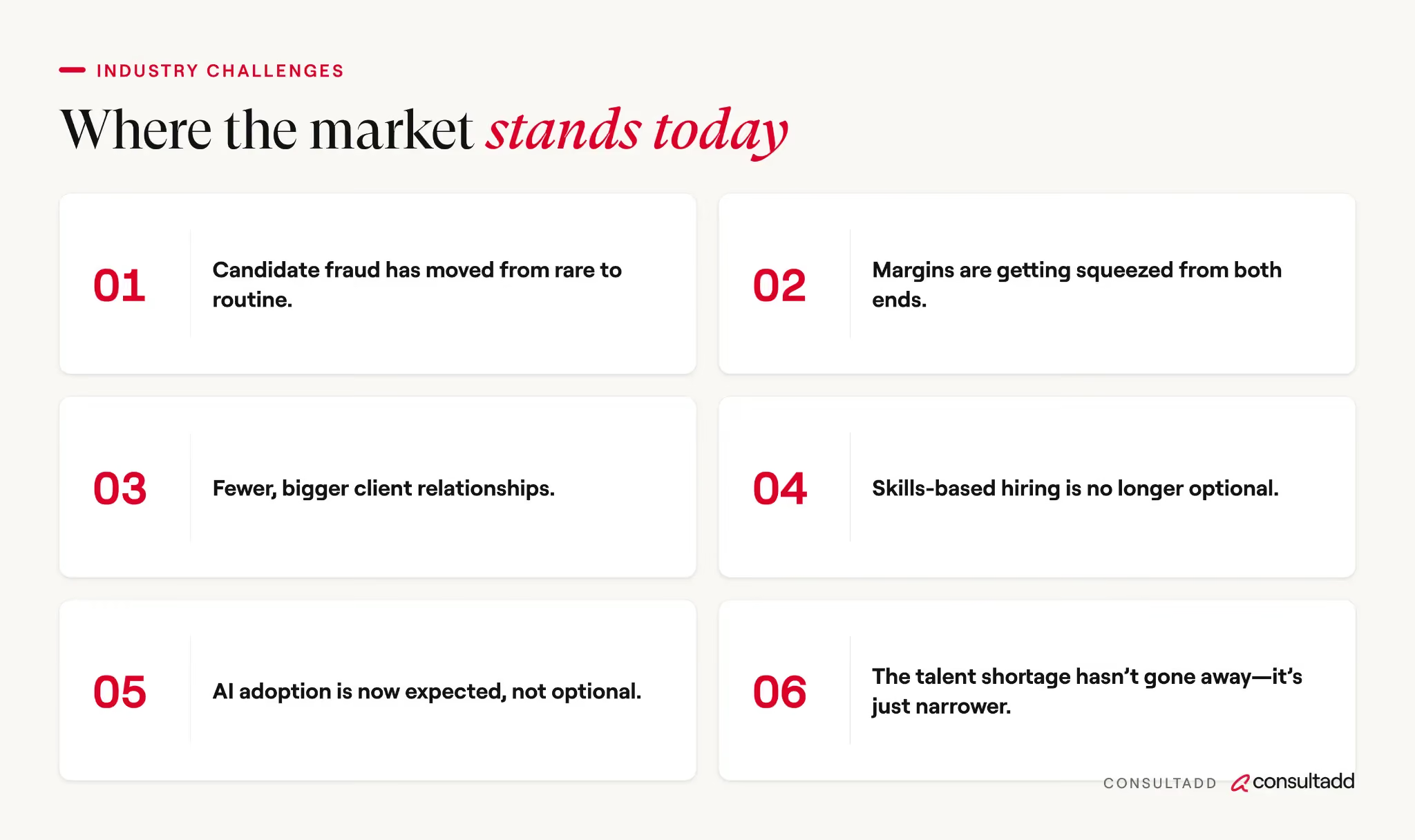
1. Candidate fraud has moved from rare to routine
This is the challenge that caught most of the industry off guard. Generative AI has made it cheap and fast to fabricate a convincing candidate, complete with a polished resume, faked credentials, and in some cases a synthetic face on a video call.
The numbers are hard to ignore:
- An analysis covering nearly 20,000 live interviews between July 2025 and January 2026 found that 38.5% showed signs of AI-cheating behavior, and the rate roughly tripled within a single three-month stretch.
- Separately, a survey of large organizations reported by Checkr found that 41% had already onboarded someone who turned out not to be who they claimed to be, meaning the interview happened, references checked out, and the fraud only surfaced weeks or months later.
For staffing agencies specifically, this isn't just an HR headache. A fraudulent placement can mean refunding a client, absorbing the cost of an investigation, and doing lasting damage to a relationship an agency spent years building.
Some firms are responding by reintroducing in-person rounds for sensitive roles, others are adding identity verification steps earlier in the process rather than treating it as a final formality.
2. Margins are getting squeezed from both ends
Clients want lower bill rates. Payroll taxes, statutory benefits, and compliance costs keep climbing.
Agencies are stuck in the middle, and the squeeze is getting tighter as more staffing spend routes through vendor management systems and managed service providers that negotiate rates at scale.
Cash flow deserves its own callout here, because it's easy to overlook until it's a real problem. Agencies typically pay their contractors weekly or biweekly but often don't collect from clients for 30, 60, or even 90 days.
When a client pushes for longer payment terms, that gap widens, and it's one of the more common reasons a growing agency runs into liquidity trouble even while winning new business.
3. Fewer, bigger client relationships
According to the American Staffing Association, clients are consolidating their staffing providers and in some cases building internal platforms to handle hiring themselves, which is pushing revenue and penetration rates down for firms that can't clearly answer the "why staffing" question.
That leaves agencies that aren't already on the preferred list fighting harder just to get a seat at the table, let alone win the work.
This shift is pushing staffing firms to answer a harder question than they used to: not just "can you fill this role," but "why should we use a staffing partner instead of doing this ourselves."
Firms that can point to something concrete, faster time-to-fill, lower turnover, deeper compliance coverage, have an easier time making that case than firms competing on price alone.
4. Skills-based hiring is no longer optional
Roughly 70% of employers now practice some form of skills-based hiring, evaluating candidates on demonstrated ability rather than degrees or brand-name employers.
That's a meaningful shift for staffing agencies, because it changes what a strong candidate submission actually needs to include. A resume with the right job titles used to be enough to get a client's attention.
Now agencies need:
- Work samples
- Structured assessments
- Verifiable project history to back up a submission, especially in technical roles where clients have gotten more skeptical of credentials alone
Agencies that built their sourcing process around keyword matching are having to retool, while firms that already screen for demonstrated skill are finding it easier to compete on quality instead of speed alone.
For a closer look at how this plays out in technical hiring specifically, our guide on IT staff augmentation breaks down what clients are actually screening for when they bring on contract technical talent.
5. AI adoption is now expected, not optional
Around 85% of staffing firms increased their use of AI tools in the past year, covering resume screening, candidate matching, and scheduling.
- The pressure isn't just about efficiency anymore.
- Agencies that lag on AI adoption risk losing submissions to firms that can get a qualified shortlist in front of a client hours faster.
The catch is that AI adoption brings its own compliance exposure.
- A growing number of states now regulate how automated tools can be used in hiring decisions, including requirements to notify candidates when AI is involved in screening or evaluation.
- An agency that adopts a screening tool without understanding those requirements can end up trading one risk for another.
Filling AI-related technical roles has its own separate challenge layered on top of this.
- Demand for AI and cloud skills has grown faster than almost any other category, and agencies still submitting candidates without that specific experience are finding those submissions rejected outright.
Our breakdown of strategies to close the AI skills gap covers how agencies are adjusting their sourcing for this specific demand.
6. The talent shortage hasn't gone away, it's just narrower
The broad labor shortage headlines from a few years ago have cooled, but shortages in specific verticals, healthcare, engineering, skilled trades, and specialized IT, remain persistent.
Roughly three out of four employers globally still report difficulty finding candidates with the right skills, a figure that has stayed near record highs for several years running.
This creates an uneven market: Some roles get flooded with applicants, many of them AI-polished or outright fake, while genuinely qualified candidates in scarce specialties get pursued by multiple agencies at once.
The result is that speed and relationship depth matter more in the scarce categories, while volume and screening rigor matter more everywhere else.
What this means for agencies going into the rest of 2026
None of these challenges are going to resolve on their own, and none of them are reasons to slow down.
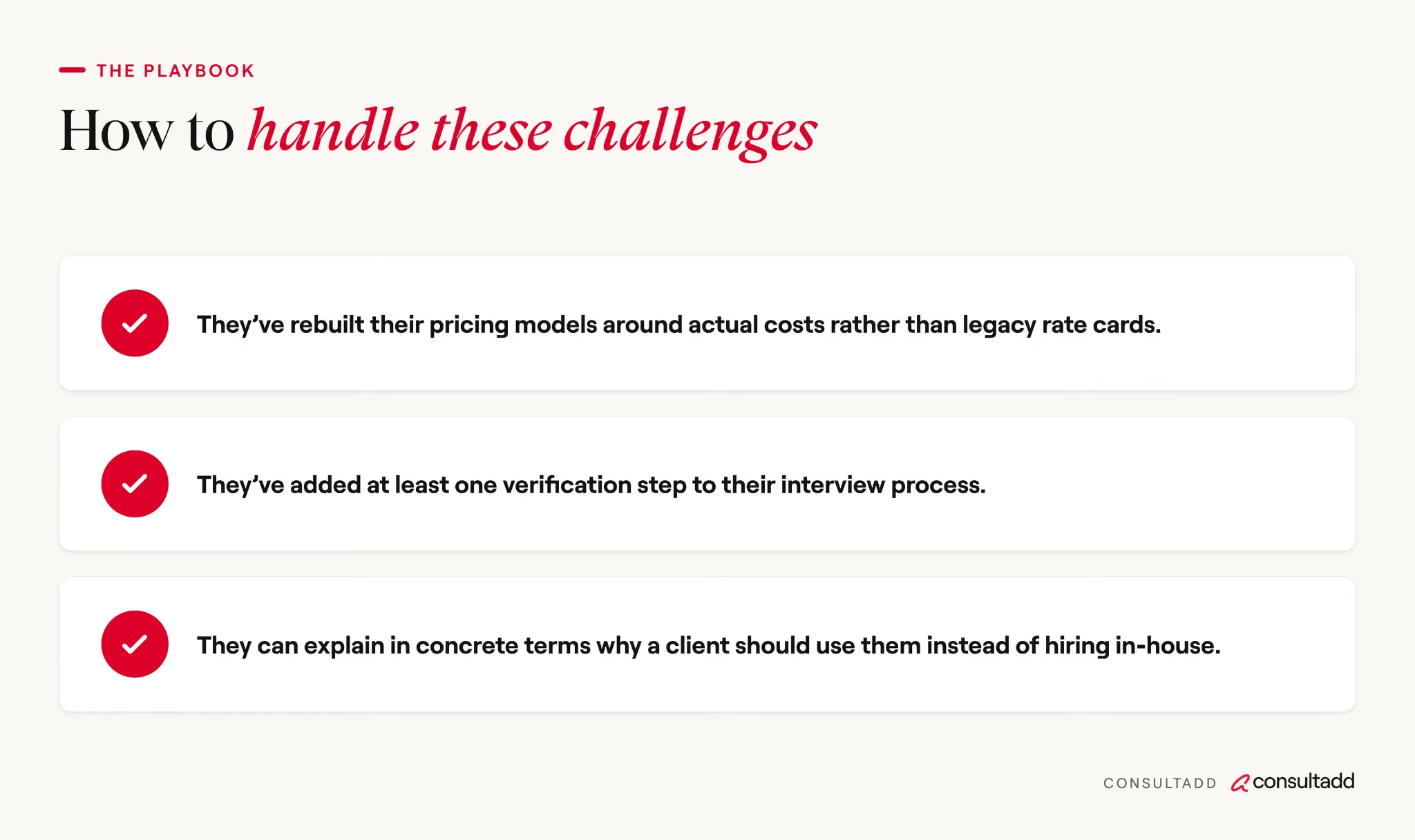
The staffing firms handling this well tend to share a few habits:
- They've rebuilt their pricing models around actual costs rather than legacy rate cards
- They've added at least one verification step to their interview process
- They can explain in concrete terms why a client should use them instead of hiring in-house
The agencies struggling the most tend to be the ones still competing purely on price and speed, with no real answer for why a client should stick with them once a cheaper or faster-looking alternative shows up.
Differentiation isn't a marketing exercise anymore. It's the actual survival strategy.
Start Strong With Consultadd
With 15 years in business and 5,000+ successful staffing engagements, we don't just fill roles, we build reliability into your process. We've supported 65 staffing companies in the past year alone and maintain MSAs with industry leaders like Robert Half and TEKsystems.
Here's what working with Consultadd looks like:
- Talent sourced in under 24 hours
- Ready-to-deploy candidates, vetted for experience and compliance
- Lower turnover risk: we match long-term goals, not just short-term needs
- Seamless compliance: visa, documentation, onboarding? Handled.
- Dedicated 1:1 account managers for responsive, personalized support
- Top 100 candidate matches delivered in the past year
- Strong partnerships with universities to tap into fresh, committed talent
- Post-placement support so your investment grows beyond day one
For candidates, your next opportunity is more than just a job title, it's a chance to build skills, gain experience, and move your career forward. At Consultadd, we connect technology professionals with projects and employers that align with their goals, whether they're looking for contract, contract-to-hire, or long-term opportunities.
The tech job market moves fast, but the right guidance can make all the difference. Ready to take the next step in your career journey? Explore Opportunities >>
Key Takeaways
- AI candidate fraud has become a volume problem, not an occasional incident, and needs a verification step built into the process.
- Margin pressure from both sides, client rate demands and rising costs, is pushing agencies toward niche specialization.
- Client consolidation means agencies need a clear answer for why they're worth using over building an in-house team.
- Skills-based hiring is now the default at most employers, changing what a competitive candidate submission looks like.
- Talent shortages persist in specific verticals even as broader hiring has cooled.
FAQs
What's the single biggest challenge facing staffing agencies in 2026?
There isn't a clean single answer, but candidate fraud and margin pressure are the two most agencies bring up unprompted. Fraud is newer and less understood, which makes it feel more urgent even though margin pressure has a longer track record of putting agencies out of business.
How are staffing agencies dealing with AI-generated fake candidates?
Common responses include adding identity verification earlier in the process, bringing back in-person interviews for sensitive roles, and training recruiters to recognize inconsistencies in video calls, like lighting or audio that doesn't match the environment.
Is the talent shortage still a major issue in 2026?
Yes, but it's uneven. Broad labor shortages have eased in some sectors, while healthcare, engineering, and specialized IT roles remain genuinely hard to fill.
What does skills-based hiring mean for staffing agencies specifically?
It means candidate submissions need more than a matching job title. Agencies increasingly need to show work samples, assessment results, or verifiable project history to satisfy clients who are screening for demonstrated ability over credentials.
Why is client consolidation a problem for smaller staffing firms?
Larger clients are narrowing their approved vendor lists and sometimes building internal recruiting teams, which shrinks the number of opportunities smaller agencies can compete for and raises the bar for getting on a preferred list in the first place.
How much does cash flow timing actually affect staffing agencies?
More than most people outside the industry realize. Agencies typically pay contractors weekly while waiting 30 to 90 days to collect from clients, and that gap can create real liquidity strain, especially during periods of fast growth or when clients push for longer payment terms.

Benefits of Outsourcing Recruitment and Selection
Introduction
Most companies don't outsource recruitment because hiring is broken. They outsource it because hiring is expensive, slow, and getting harder to staff internally at the level modern roles demand.
The benefits of outsourcing recruitment and selection show up in three places that matter to a P&L: what you spend per hire, how long a seat sits empty, and how often you get the hire wrong.
None of that means outsourcing is automatically the right call for every company or every role. It's a tool.
Used on the right roles, at the right volume, it can cut cost-per-hire noticeably and shrink time-to-fill by weeks. Used as a blanket fix for a broken internal process, it just moves the problem to someone else's desk.
This piece breaks down what the actual benefits are, backed by current benchmarks, and where outsourcing tends to pay off versus where it doesn't.
TL;DR
- Cost-per-hire for U.S. companies runs in the thousands of dollars per role, and specialized or executive roles can run several times higher. RPO providers cut that through scale and reused pipelines.
- Median time-to-fill sits above 60 days industry-wide. Dedicated outsourced recruiters with prebuilt candidate pools routinely fill roles faster.
- A bad hire can cost 30% or more of that person's first-year salary, according to the U.S. Department of Labor. Better screening reduces how often that happens.
- Outsourcing gives you access to specialized sourcing expertise and recruitment technology most internal teams can't justify building for themselves.
- It works best for scaling, specialized, or high-volume hiring. It works worst as a substitute for fixing a genuinely broken hiring process.
What outsourcing recruitment and selection actually means
Recruitment process outsourcing, usually shortened to RPO, means handing all or part of the hiring function to an external partner.
That can mean the full lifecycle, sourcing, screening, interview coordination, offer management, and onboarding support, or just a piece of it, like initial candidate screening or interview scheduling.
It's a different model from a traditional staffing agency, which typically fills one role at a time for a placement fee.
An RPO or outsourced recruiting partner is closer to an extension of your internal HR team, working from your employer brand and often plugged directly into your applicant tracking system.
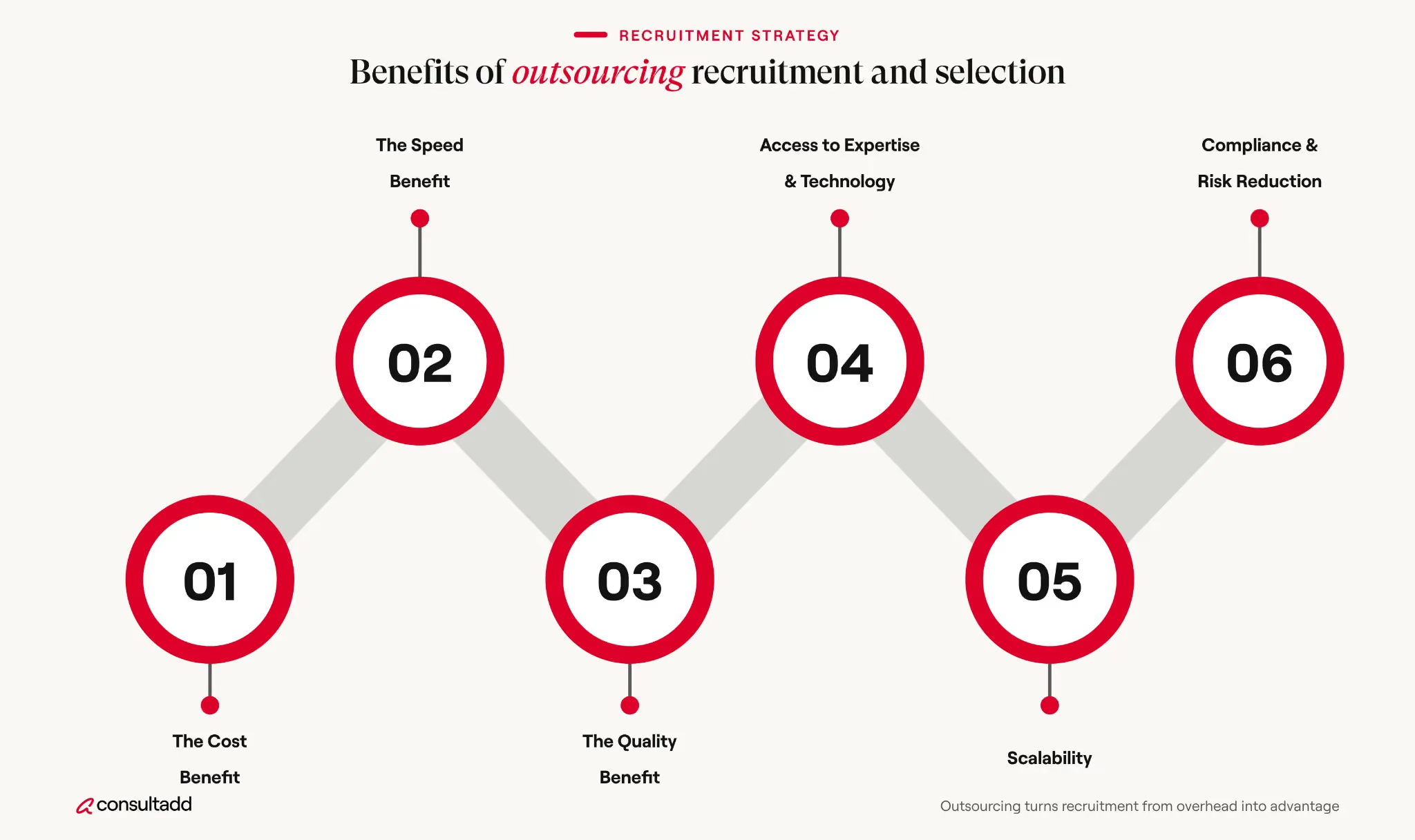
The cost benefit: lower spend per hire
Direct recruiting costs in the U.S. run in the range of several thousand dollars per non-executive hire, according to SHRM benchmarking data, with specialized technical and executive roles running considerably higher, sometimes by a factor of three or more.
Those numbers cover job board spend, recruiter time, agency fees, and screening tools. They don't include the cost of a role sitting vacant while you search.
Outsourced recruiting providers lower that number mainly through scale. A provider running dozens of similar searches at once has sourcing pipelines and screened candidate pools already built, instead of starting from zero for every new requisition.
That's the same logic behind why outsourcing work in general tends to reduce fixed overhead: you're not paying to build and maintain a capability you only need intermittently.
The speed benefit: shorter time-to-fill
Time-to-fill has been trending in the wrong direction for years. Industry benchmark reports put median time-to-fill in the 60-day range for U.S. companies, and every day a seat sits open carries a real cost in lost productivity, not just a delayed start date.
Outsourced recruiters move faster mainly because they're not starting cold. They already have relationships with passive candidates, existing screened pools for common role types, and dedicated bandwidth that an internal recruiter juggling ten open reqs doesn't have.
If you've ever had a niche role sit open for months while an internal team works through a backlog, that's the exact gap a staffing or recruiting partner is built to close.
The quality benefit: fewer bad hires
This is the benefit that gets the least attention and probably matters the most. The U.S. Department of Labor puts the cost of a bad hire at a minimum of 30% of that employee's first-year salary, and that's treated as a conservative floor across most industry sources.
For a $70,000 role, that's at least $21,000 in direct losses before counting the manager hours spent managing someone who isn't working out, or the disruption to the rest of the team.
Outsourced recruitment providers reduce bad-hire risk through more structured, repeatable screening.
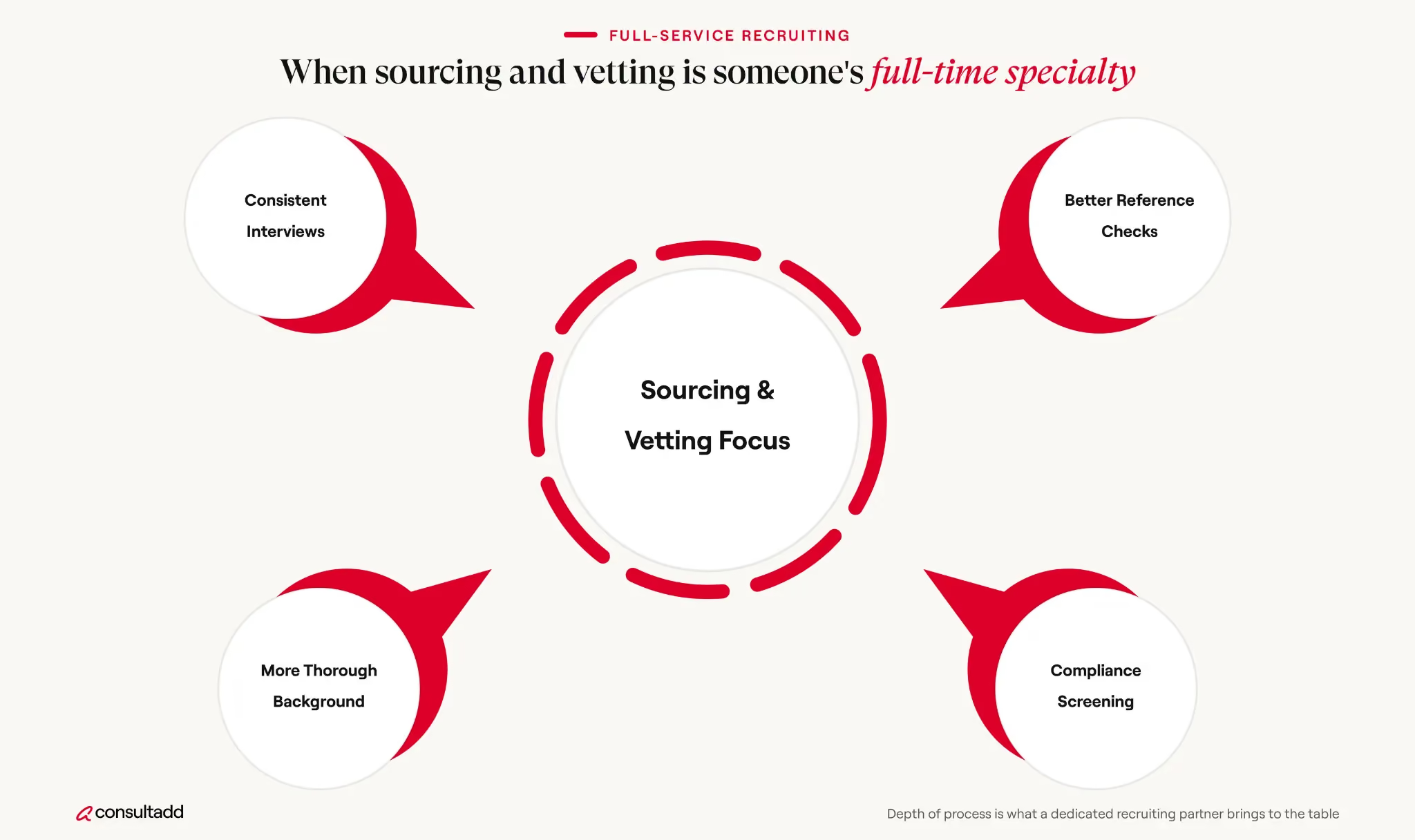
When sourcing and vetting is someone's full-time specialty rather than one of a dozen things an internal generalist handles, the assessment step tends to get more rigor:
- Consistent interview structures
- Better reference checks
- More thorough background
- Compliance screening before a candidate ever reaches a hiring manager.
Access to expertise and technology you wouldn't build alone
Most companies aren't going to build a dedicated sourcing team, invest in predictive hiring analytics, or maintain deep relationships across a niche talent market for a handful of roles a year. Outsourced providers can, because they're spreading that investment across many clients at once.
That shows up in practical ways:
- Recruiters who specialize in a given skill set or industry
- Established sourcing channels for hard-to-find talent
- AI-assisted tools that handle scheduling and first-pass screening so human recruiters spend their time on judgment calls rather than admin work.
If you're trying to build this kind of strategic sourcing capability internally, the tooling and process discipline alone can take longer to stand up than most hiring surges allow for.
Scalability without adding permanent headcount
Hiring volume rarely stays flat.
- A product launch, a new contract win, or a seasonal spike can mean you need to fill 20 roles in a quarter, then five the next.
- Building an internal recruiting team sized for peak demand means paying for idle capacity most of the year.
Outsourced recruitment flexes with that curve.
- You can scale a partnership up during a hiring surge and back down once the immediate need is met, without carrying a fixed recruiting headcount that outlives the reason you built it.
Compliance and risk reduction
Hiring compliance has more moving parts than most non-HR leaders realize: background check requirements, EEOC considerations, wage and hour classification, and increasingly, state-by-state variation for remote hires.
Getting any of it wrong creates legal exposure that's far more expensive than the hiring process itself.
Established outsourced recruiting partners run these checks as a standard part of their process, since it's the same compliance work repeated across every client they serve.
That consistency matters more than it sounds like on paper. A single missed background check or misclassified worker can turn into a legal problem long after the hire is made.
Where outsourcing works best, and where it doesn't
Outsourcing recruitment tends to pay off fastest in a few specific situations:
- High-volume hiring surges
- Specialized technical or niche roles where internal sourcing expertise is thin
- Companies without a mature in-house recruiting function to begin with
It tends to underdeliver when the underlying problem isn't sourcing capacity but something else, an unclear job description, an unrealistic salary band, or a hiring manager who takes six weeks to give interview feedback.
Handing that process to an outside partner doesn't fix those issues. It just means someone else is now trying to fill a role your own company hasn't set up to be filled quickly.
Before signing an RPO contract, it's worth being honest about which problem you're actually solving.
Start Strong With Consultadd
With 15 years in business and 5,000+ successful staffing engagements, we don't just fill roles, we build reliability into your process. We've supported 65 staffing companies in the past year alone and maintain MSAs with industry leaders like Robert Half and TEKsystems.
Here's what working with Consultadd looks like:
- Talent sourced in under 24 hours
- Ready-to-deploy candidates, vetted for experience and compliance
- Lower turnover risk: we match long-term goals, not just short-term needs
- Seamless compliance: visa, documentation, onboarding? Handled.
- Dedicated 1:1 account managers for responsive, personalized support
- Top 100 candidate matches delivered in the past year
- Strong partnerships with universities to tap into fresh, committed talent
- Post-placement support so your investment grows beyond day one
For candidates, your next opportunity is more than just a job title, it's a chance to build skills, gain experience, and move your career forward. At Consultadd, we connect technology professionals with projects and employers that align with their goals, whether they're looking for contract, contract-to-hire, or long-term opportunities.
The tech job market moves fast, but the right guidance can make all the difference. Ready to take the next step in your career journey? Explore Opportunities >>
Key takeaways
- Outsourcing recruitment lowers cost-per-hire mainly by spreading sourcing infrastructure across many clients instead of building it once per company.
- Dedicated outsourced recruiters shrink time-to-fill because they're working from pre-built pipelines instead of starting from zero.
- Better, more consistent screening reduces bad-hire rates, and the U.S. Department of Labor puts the cost of a bad hire at 30% or more of first-year salary.
- Outsourcing gives access to sourcing expertise, technology, and compliance processes most companies can't justify building for a handful of roles a year.
- It's most effective for scaling or specialized hiring, and least effective as a fix for a broken internal hiring process.
FAQs
What's the difference between recruitment process outsourcing and a staffing agency?
A staffing agency typically fills individual roles for a per-placement fee. An RPO partner takes ownership of the broader hiring process, sourcing, screening, interview coordination, and often onboarding, functioning more like an extension of the internal HR team.
How much does outsourcing recruitment actually save?
Savings vary by role and volume, but they come primarily from reduced job board and tooling spend, faster time-to-fill, and fewer costly bad hires, rather than a flat percentage discount on any single hire.
Is outsourcing recruitment only useful for large companies?
No. Smaller companies without a mature in-house recruiting function often see the biggest relative benefit, since they'd otherwise be building sourcing capability from scratch for a small number of roles.
Does outsourcing recruitment mean losing control over who gets hired?
No. Final hiring decisions typically stay with the client. The outsourced partner handles sourcing, screening, and process management, not the ultimate hire-or-pass call.
What kinds of roles benefit most from outsourced recruitment?
Specialized technical roles, high-volume seasonal hiring, and any hiring surge that would otherwise overwhelm an internal team's existing capacity tend to see the clearest benefit.
Can outsourcing recruitment fix a slow hiring process?
Only partially. It can add sourcing speed and capacity, but if the slowdown comes from internal issues like delayed interview feedback or unclear job requirements, those need to be fixed separately.

What Is A Hiring Freeze? Causes, Signs, And What's Next
Introduction
A hiring freeze is a temporary pause on recruiting, where a company stops filling open positions and posting new roles, usually to control costs or wait out some uncertainty before committing to a new headcount.
It's not the same as a layoff. Current employees keep their jobs. It just means the company isn't bringing anyone new on board for a while, and that "while" can range from a few weeks to close to a year depending on why the freeze started.
If you've had an offer delayed or a recruiter go quiet on you, or if you're a hiring manager trying to figure out what a freeze actually requires of your team, here's what it means in practice.
TL;DR
- A hiring freeze is a temporary halt on new hires, not a reduction of the existing workforce.
- Companies use freezes to control costs, wait out economic uncertainty, or pause during a merger, restructuring, or budget review.
- Freezes come in different forms: total, partial (with exceptions for critical roles), or department-specific.
- Freezes typically last a few months, though this varies a lot depending on what triggered it.
- Contract or contract-to-hire staffing is a common workaround companies use to get work done without technically breaking the freeze.
How a hiring freeze actually works
When a company announces a freeze, a few things usually happen at once. Open requisitions get put on hold. Recruiters stop actively sourcing. Offers already in the pipeline may get paused, delayed, or in worse cases, rescinded. What doesn't happen: current employees don't lose their jobs because of the freeze itself. That's the core distinction that trips a lot of people up.
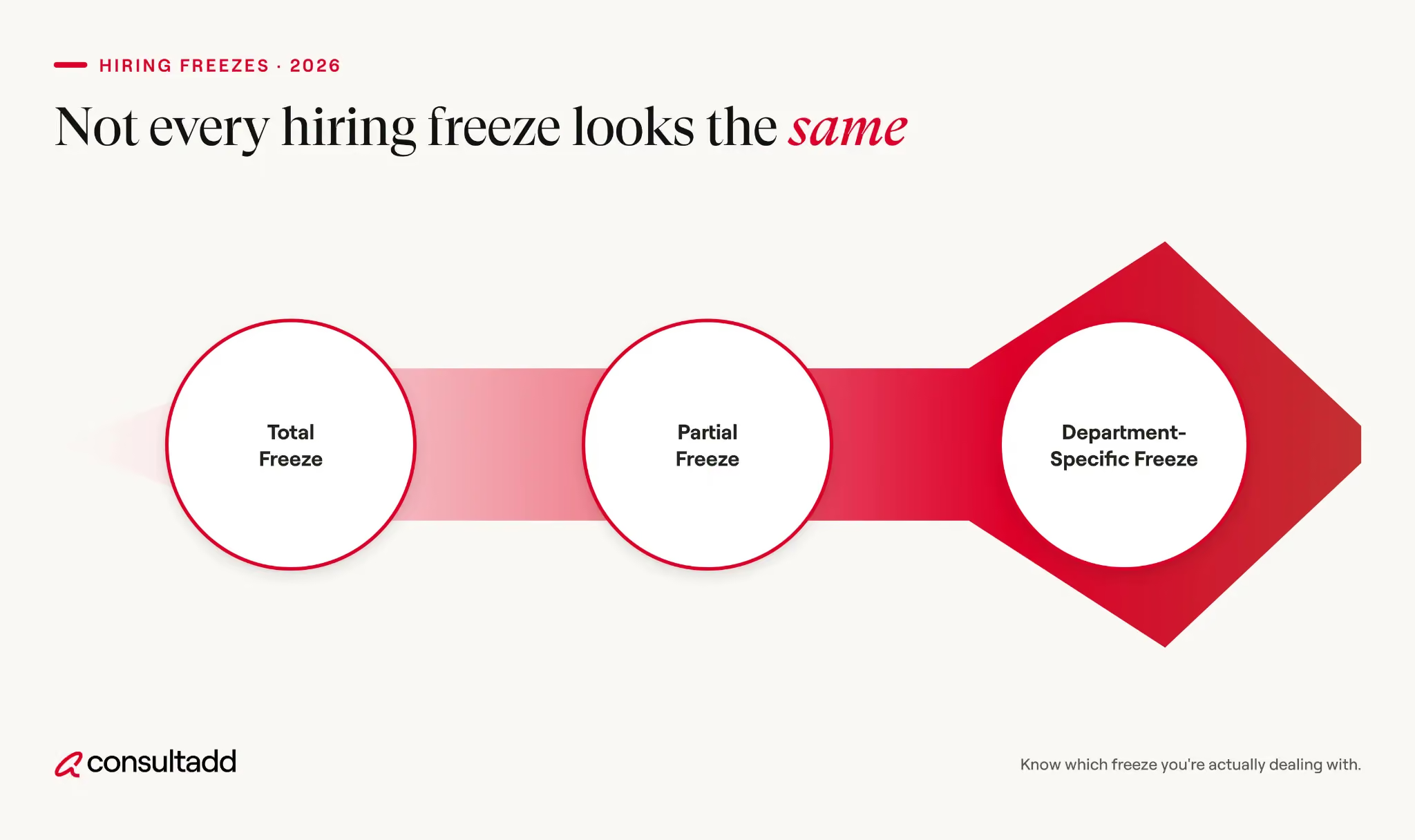
Not every freeze looks the same. There are generally three flavors:
- Total freeze. No new hires at all, across the entire company, no exceptions.
- Partial freeze. Non-essential roles are paused, but critical or revenue-generating positions can still move forward with approval.
- Department-specific freeze. Only certain teams or business units are affected, often tied to a specific budget or project being paused.
Most freezes lean partial rather than total. A company rarely wants to stop hiring for a role that's directly bringing in revenue, even during a broader cost-cutting push.
Why companies freeze hiring
The reasons usually fall into a handful of categories, and the reason behind a freeze tells you a lot about how long it's likely to last.
A freeze tied to routine budget planning is a very different signal than one announced right after a rough earnings call. Context matters more than the freeze itself.
Hiring freeze vs. layoff: what's the actual difference
These two terms get used almost interchangeably in casual conversation, but they're not the same thing, and the difference matters if you're trying to figure out where you stand.
A hiring freeze pauses new hiring. Nobody currently employed loses their job because of it.
A layoff is an involuntary reduction of the existing workforce, current employees are let go.
Companies sometimes use a freeze specifically to avoid getting to the point of layoffs, since attrition (people leaving on their own, retiring, or not being replaced) can shrink headcount naturally without anyone being terminated.
That said, a freeze can also come right before or during a round of layoffs, particularly when a company is cutting costs from multiple directions at once. Seeing a freeze alone isn't a reliable signal either way.
It's worth paying attention to what else is happening around it, like whether leadership is also talking about restructuring or missed targets.
Signs a hiring freeze might be coming (or already in effect)
- Job postings that were live for weeks suddenly disappear without being filled
- Recruiters go quiet mid-process, or interviews get pushed with vague timelines
- Internal transfers or promotions get more scrutiny than usual
- Leadership starts talking publicly about cost discipline or "doing more with less"
- Approved headcount from earlier in the year quietly doesn't get filled
None of these on their own confirms a freeze. Together, especially paired with a slowdown in company growth or a rocky earnings report, they're a reasonable signal to ask directly rather than guess.
What candidates should do during a hiring freeze
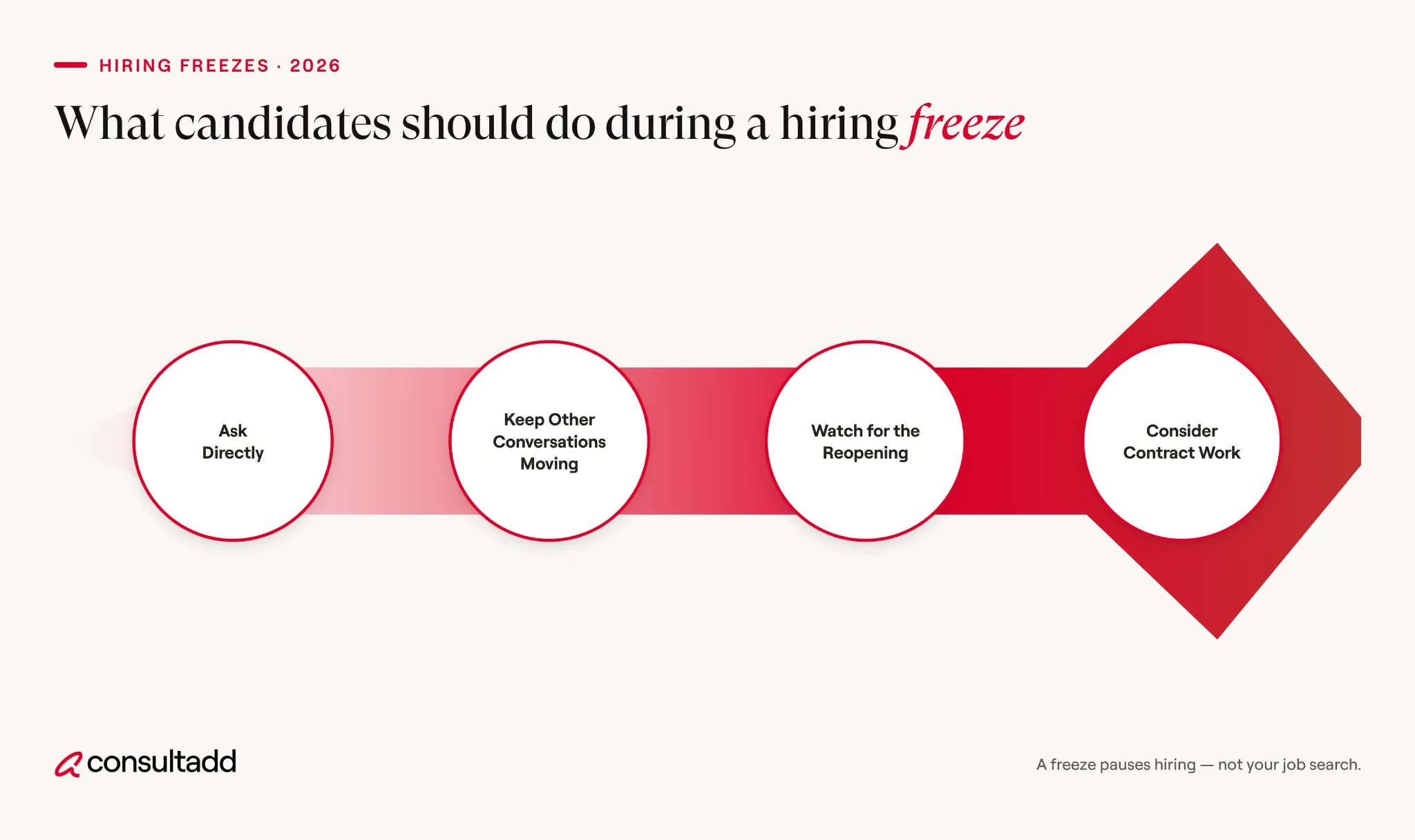
If you're mid-process with a company that just announced a freeze, the honest answer is that your options are limited, but not zero.
- Ask directly.
A short, polite note to your recruiter asking about the status of your application is reasonable. You're not being pushy by asking for a timeline.
- Keep other conversations moving.
Don't pause your own search waiting on one company. Freezes can run longer than anyone expects going in.
- Watch for the reopening.
Companies coming out of a freeze often move fast once it lifts, since the backlog of unfilled roles doesn't go away. Staying on a recruiter's radar can put you ahead of a fresh wave of applicants.
- Consider contract work as a bridge.
Some companies that won't approve a full-time hire during a freeze will still bring someone on as a contractor, since contract budgets sometimes sit outside the frozen headcount line.
If that's a route you're open to, it's worth understanding how contract-to-hire compares to a full-time offer before you say yes to one.
What employers should consider before calling a freeze
- A freeze feels like a quick, low-risk lever to pull, but it has real costs that don't always show up in the budget line it's meant to protect.
- Existing employees absorb the extra workload from unfilled roles, which can push burnout and turnover higher right when the company can least afford to lose people.
- Candidates who were mid-process often don't come back once the freeze lifts, especially if the communication during the freeze was vague or nonexistent.
- If the goal is cost control without stalling every project that depends on new capacity, contract or contract-to-hire staffing is worth a look before committing to a blanket freeze across the board.
- It lets teams bring in specific skills for a defined period without adding to permanent headcount, and it's a common approach among companies navigating budget uncertainty without wanting to lose momentum entirely.
Our breakdown of when it makes sense to use a staffing agency for tech roles goes through the trade-offs if this is a route you're weighing.
It's also worth being clear internally, before the freeze is announced, about what kind of contract arrangement makes sense for the roles you still need filled.
Start Strong With Consultadd
With 15 years in business and 5,000+ successful staffing engagements, we don't just fill roles, we build reliability into your process. We've supported 65 staffing companies in the past year alone and maintain MSAs with industry leaders like Robert Half and TEKsystems.
Here's what working with Consultadd looks like:
- Talent sourced in under 24 hours
- Ready-to-deploy candidates, vetted for experience and compliance
- Lower turnover risk: we match long-term goals, not just short-term needs
- Seamless compliance: visa, documentation, onboarding? Handled.
- Dedicated 1:1 account managers for responsive, personalized support
- Top 100 candidate matches delivered in the past year
- Strong partnerships with universities to tap into fresh, committed talent
- Post-placement support so your investment grows beyond day one
For candidates, your next opportunity is more than just a job title, it's a chance to build skills, gain experience, and move your career forward. At Consultadd, we connect technology professionals with projects and employers that align with their goals, whether they're looking for contract, contract-to-hire, or long-term opportunities.
The tech job market moves fast, but the right guidance can make all the difference. Ready to take the next step in your career journey? Explore Opportunities >>
Key takeaways
- A hiring freeze pauses new hiring, it doesn't reduce the existing workforce, which makes it fundamentally different from a layoff.
- Freezes come in total, partial, and department-specific forms, with partial freezes being the most common.
- The reason behind a freeze (budget cycle vs. cost-cutting before layoffs) matters more than the freeze itself when judging how worried to be.
- Candidates mid-process should ask directly for status rather than guess, and shouldn't pause their broader search while waiting.
- Contract or contract-to-hire staffing gives employers a way to keep critical work moving without adding to frozen permanent headcount.
FAQs
Does a hiring freeze mean layoffs are coming?
Not necessarily. Some freezes are routine, tied to annual budget cycles, and resolve on schedule. Others do precede layoffs, especially when paired with public statements about cost-cutting or missed financial targets. Context matters more than the freeze alone.
How long do hiring freezes usually last?
It varies widely by cause. A budget-cycle freeze might last a few weeks to a couple of months. Freezes tied to restructuring or a merger often run six months to a year.
If a company has a hiring freeze, can they still extend an offer to me?
It depends on the type of freeze. A total freeze typically means no, at least until it lifts. A partial freeze may allow exceptions for critical or revenue-generating roles with leadership approval.
Can a company hire contractors during a hiring freeze?
Often, yes. Many freezes apply specifically to permanent headcount, and contract or corp-to-corp arrangements sometimes fall outside that budget line, which is part of why contract staffing tends to pick up during freeze periods.
Is a hiring freeze legal?
Yes. There's no law requiring a company to hire, so a freeze itself isn't a legal issue. If a freeze leads into layoffs, separate laws around notice periods and severance may apply depending on the situation and location.
What should I do if my job offer gets delayed because of a freeze?
Ask your recruiter directly for a realistic timeline, and keep pursuing other opportunities in the meantime. Freezes can lift faster or slower than anyone expects, and it's not worth pausing your entire search on one uncertain outcome.