
Hiring & Recruitment

What Is Merit-Based Hiring? A Clear 2026 Guide
Introduction
Ask ten people what "hiring on merit" means and you'll get ten slightly different answers. Some picture a pure test of skill. Others hear a coded argument about diversity programs. The phrase carries a lot of weight right now, and that makes it easy to talk past each other.
So what is merit-based hiring, stripped of the noise? It's a way of selecting people based on their skills, experience, qualifications, and proven performance rather than on personal characteristics, connections, or bias. The idea is that the most capable person for the job gets the job.
Simple in theory. Trickier in practice, because "merit" has to be defined by someone, and how you define it decides who makes the cut. This guide covers what merit-based hiring actually means, how to build it, where it helps, where it can quietly go wrong, and how it fits with the law in 2026.
TL;DR
- Merit-based hiring selects candidates on skills, experience, and performance rather than background, identity, or connections.
- It overlaps heavily with skills-based hiring, which measures proven ability instead of relying on credentials like a specific degree.
- Done well, it reduces bias and widens the talent pool. Done carelessly, it can bake in old biases through the criteria you choose.
- It has moved to the center of the DEI debate, with some organizations shifting toward a "merit, excellence, intelligence" framing.
- Merit-based hiring still has to comply with anti-discrimination law, including Title VII and EEOC guidance.
What merit-based hiring actually means
At its core, merit-based hiring rests on one principle: the job should go to the person best able to do it. Ability and results decide the outcome, not who someone knows or what group they belong to.
In a merit-based system, you evaluate candidates against the actual requirements of the role. What skills does the work demand? What has this person accomplished? Can they demonstrate the ability, not just claim it?
The appeal is obvious. It promises fairness through consistency, since everyone is measured by the same yardstick. It also promises performance, because you're selecting for capability rather than comfort or familiarity.
But there's a catch worth naming early. Merit is not a fact sitting in the world waiting to be measured. Someone has to define it. And if the definition is sloppy, the process can feel objective while quietly favoring one kind of candidate over another. Hold that thought, because it comes back later.
Merit-based vs skills-based hiring
These two terms get used almost interchangeably, and they're closely related, but they're not identical.
Merit-based hiring is the broad principle: reward ability and results.
Skills-based hiring is a specific method for putting that principle into action. It measures what a candidate can actually do, often replacing a rigid credential filter like "bachelor's degree required" with a test of proven skill.
The practical difference shows up in who gets through the door. A degree requirement screens on where someone studied. A skills assessment screens on whether they can do the work. The second is usually a better predictor of performance, and it opens the door to talented people from nontraditional paths.
For most employers, the two work best together. Merit sets the goal, and skills-based methods are how you reach it honestly.
How merit-based hiring works in practice
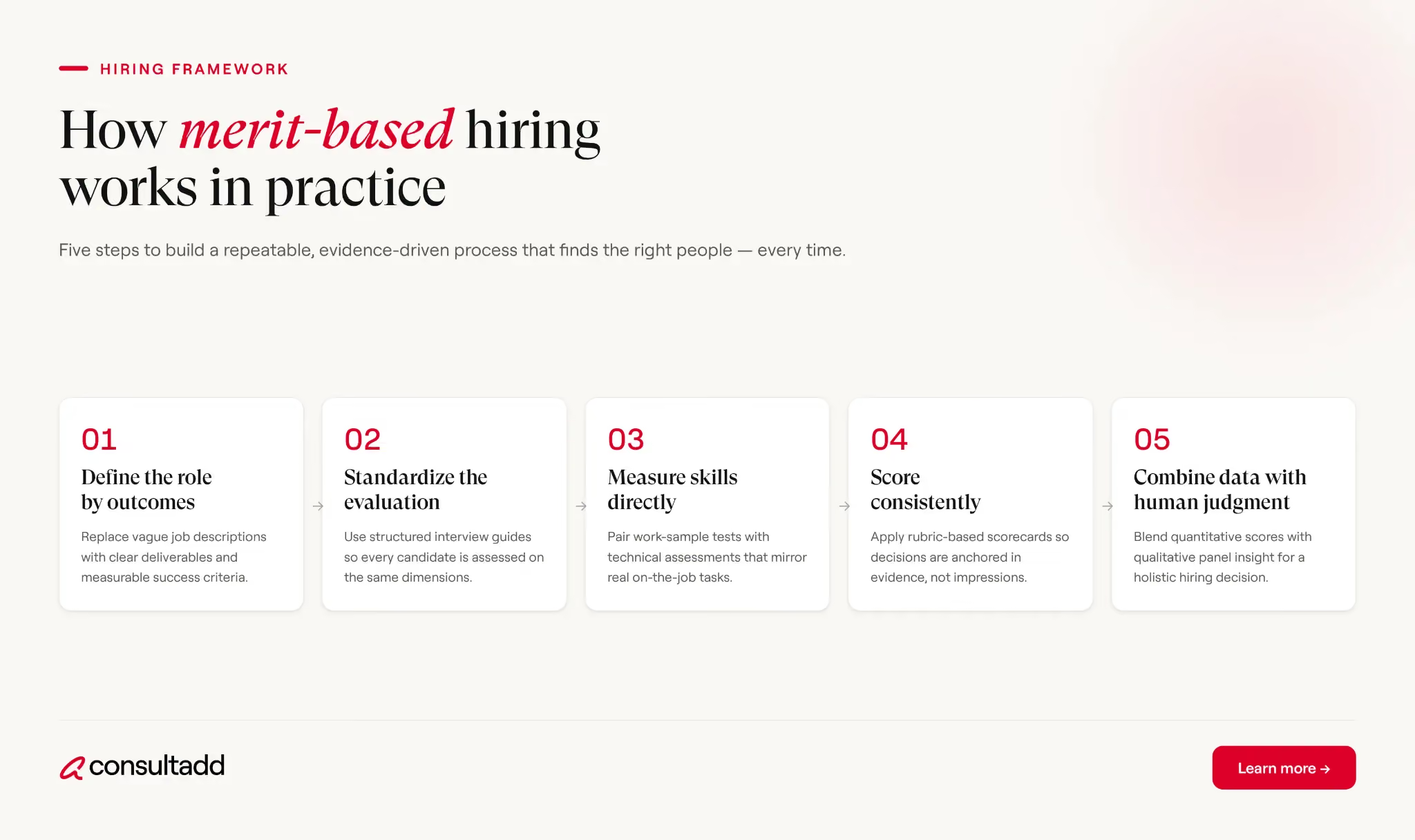
Talking about merit is easy. Building a process that actually delivers it takes structure. Here's what a merit-based approach looks like when it's done with care.
Define the role by outcomes.
List the specific, measurable things the person must be able to do, not a wish list of nice-to-haves. Ask what a degree or credential actually signals, and whether a direct skill check would tell you more.
Standardize the evaluation.
Use the same criteria and the same questions for every candidate so you're comparing like with like.
Measure skills directly.
Work samples, structured assessments, and practical exercises give you concrete evidence instead of impressions.
Score consistently.
Written scoring rationales and rotating interviewers reduce the chance that one person's gut feeling drives the decision.
Combine data with human judgment.
Numbers catch things people miss, and people catch context that numbers miss.
This is where a structured vetting process earns its keep.
Consultadd's guide to the candidate vetting process that cuts bad hires walks through how to standardize evaluation without turning it into a box-ticking exercise.
The theme running through all of it is consistency. A merit-based process isn't merit-based because you call it that. It's merit-based because every candidate faces the same fair test.
The benefits of hiring on merit
When it's built well, hiring on merit pays off in a few concrete ways:
- You get better performance, because you're selecting for demonstrated ability rather than pedigree or rapport.
- You reduce certain kinds of bias, since a structured, skills-first process leaves less room for a hiring manager's unconscious preferences to steer the outcome.
- You also widen the talent pool. When you stop screening solely on credentials and start measuring skills, you open the door to career changers, self-taught professionals, and people returning to the workforce after a gap. Some of the strongest candidates never fit the traditional mold.
- There's a business case too. Focusing on what people can do, backed by real assessment, tends to produce stronger hires and fewer expensive mistakes.
In technical fields especially, a computer science degree doesn't guarantee coding ability, which is why practical assessment matters. Consultadd's guide to technical recruitment makes this point directly for engineering roles.
The risks and blind spots
Here's where honesty matters, because merit-based hiring is often sold as flawless and it isn't.
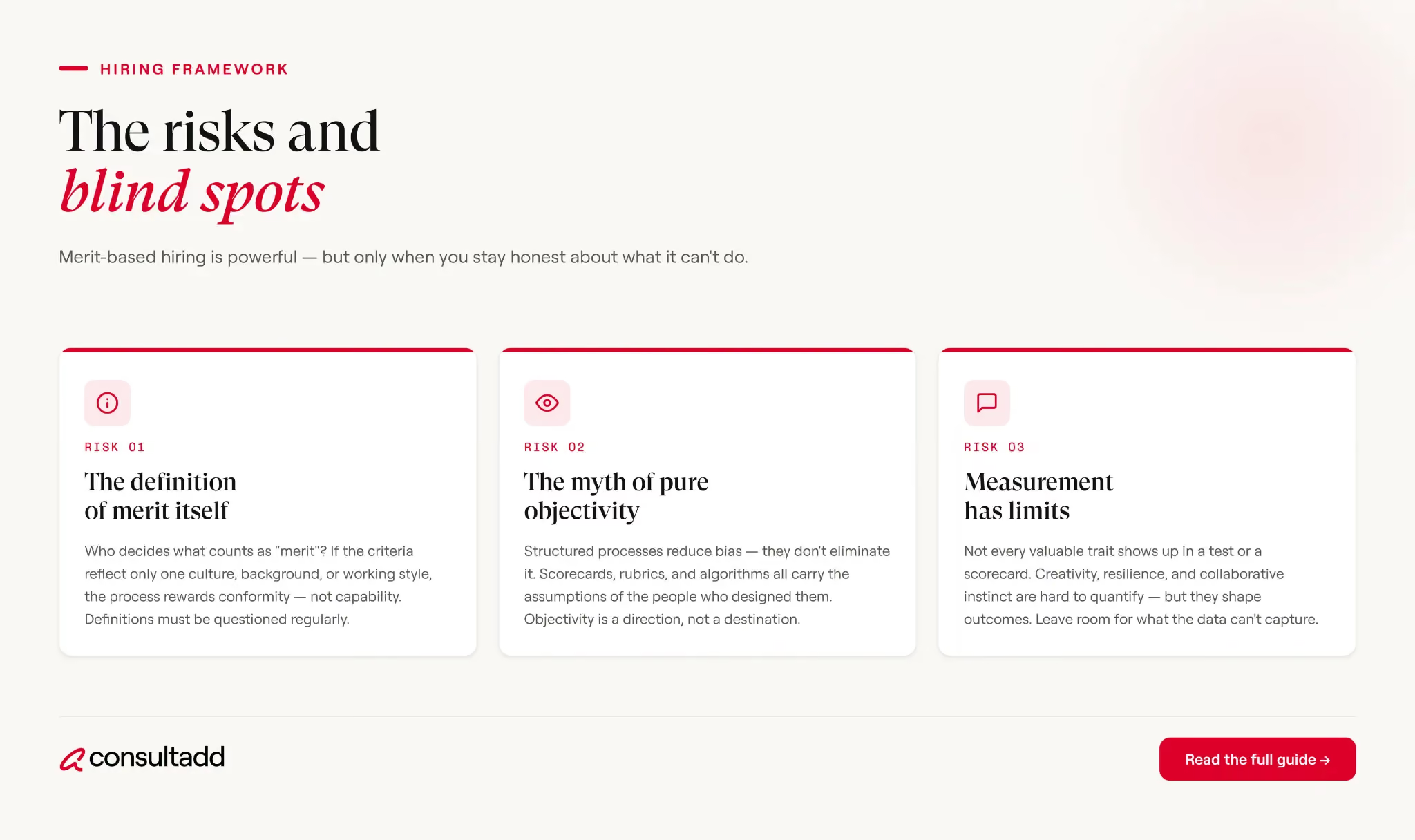
The biggest risk is the definition of merit itself. If the criteria you pick unintentionally favor one group, a process that feels objective can reinforce the very inequalities it claims to remove.
Requiring a specific degree or a particular test score, for example, can screen out capable people who never had access to those things. The bias doesn't disappear. It just hides inside the rubric.
There's also the myth of pure objectivity. Interviews, resume reviews, and even assessment design involve human choices, and human choices carry bias. Calling a process merit-based doesn't automatically make it neutral.
And measurement has limits. Skills tests capture some abilities well and others poorly. Judgment, collaboration, and adaptability are real forms of merit that are hard to score on a timed exercise. Lean too hard on what's easy to measure, and you can miss what actually matters for the role.
None of this means abandoning merit. It means designing for it carefully and checking your criteria against real outcomes instead of assuming they're fair.
Merit-based hiring and the DEI debate
You can't discuss this topic in 2026 without the wider debate around it. Merit-based hiring has become a flashpoint.
Over the past couple of years, many U.S. organizations have reexamined their diversity, equity, and inclusion programs in response to shifting federal guidance and legal pressure, including a 2025 executive order restricting certain DEI practices.
Out of that shift, some have adopted a framing sometimes called MEI, for merit, excellence, and intelligence, which puts capability and achievement at the center.
The debate tends to split into two camps.
- One argues that hiring should turn on talent and results alone, and that this is the fairest possible standard.
- The other argues that "merit" is never measured in a vacuum, and that ignoring structural barriers can quietly advantage people who already had a head start.
There's a reading that dissolves some of the conflict. Supporters of well-designed inclusion efforts have long argued that the point was always a genuine meritocracy, one where performance rather than privilege decides who gets ahead.
From that view, reducing bias and rewarding merit are the same project, not opposing ones. Reasonable people disagree here, and the aim of a hiring process isn't to win the argument. It's to be fair and to comply with the law.
Staying legal and fair
Whatever you call your approach, it operates inside a legal framework. Merit-based hiring is not a license to ignore anti-discrimination law.
In the U.S., that framework includes Title VII of the Civil Rights Act, which prohibits discrimination based on protected characteristics, along with guidance from the Equal Employment Opportunity Commission.
A process can be illegal even without intent to discriminate if its criteria disproportionately screen out a protected group and aren't justified by the job.
A few practical habits keep a merit-based process on solid ground. Tie every criterion to a genuine requirement of the role. Apply the same standards to everyone. Keep records of how decisions were made. And review your criteria periodically to check whether they're measuring ability or just filtering by proxy.
Fair and legal usually point the same direction. A process built on job-relevant skills, applied consistently and documented well, tends to produce both better hires and fewer legal headaches. When the stakes or the rules are unclear, it's worth involving someone who knows your local employment law.
Start Strong With Consultadd
With 15 years in business and 5,000+ successful staffing engagements, we don't just fill roles, we build reliability into your process. We've supported 65 staffing companies in the past year alone and maintain MSAs with industry leaders like Robert Half and TEKsystems.
Here's what working with Consultadd looks like:
- Talent sourced in under 24 hours
- Ready-to-deploy candidates, vetted for experience and compliance
- Lower turnover risk: we match long-term goals, not just short-term needs
- Seamless compliance: visa, documentation, onboarding? Handled.
- Dedicated 1:1 account managers for responsive, personalized support
- Top 100 candidate matches delivered in the past year
- Strong partnerships with universities to tap into fresh, committed talent
- Post-placement support so your investment grows beyond day one
For candidates, your next opportunity is more than just a job title, it's a chance to build skills, gain experience, and move your career forward. At Consultadd, we connect technology professionals with projects and employers that align with their goals, whether they're looking for contract, contract-to-hire, or long-term opportunities.
The tech job market moves fast, but the right guidance can make all the difference. Ready to take the next step in your career journey? Explore Opportunities >>
Key takeaways
- Merit-based hiring selects people on skills, experience, and performance rather than background, connections, or bias.
- It overlaps with skills-based hiring, which measures proven ability instead of relying on credentials alone.
- The main risk is how you define merit, since poor criteria can hide old biases inside a process that looks objective.
- It sits at the center of the DEI debate, and supporters on both sides often share the goal of a genuine meritocracy.
- Merit-based hiring must still comply with anti-discrimination law like Title VII and EEOC guidance.
FAQs
What is merit-based hiring in simple terms?
Merit-based hiring means choosing candidates based on their skills, experience, and proven performance rather than personal characteristics or connections. The goal is for the most capable person to get the job. It relies on evaluating everyone against the actual requirements of the role.
What is the difference between merit-based and skills-based hiring?
Merit-based hiring is the broad principle of rewarding ability and results. Skills-based hiring is a specific method that measures what a candidate can actually do, often replacing degree requirements with practical assessments. Skills-based hiring is one of the main ways to put merit-based principles into practice.
Does merit-based hiring conflict with diversity efforts?
Not necessarily. When merit criteria are well designed, they reduce bias and can widen access for underrepresented candidates. Poorly designed criteria, though, can reinforce existing inequalities. Many practitioners argue that fair, bias-free hiring and true merit are the same goal rather than opposing ones.
Is merit-based hiring legal?
Yes, and it's widely used, but it must comply with anti-discrimination laws such as Title VII and EEOC guidance. A process can still be unlawful if its criteria disproportionately exclude a protected group without being job-related. Tying every standard to genuine role requirements helps keep it compliant.
What are the main benefits of merit-based hiring?
It tends to improve performance by selecting for demonstrated ability, reduces certain hiring biases through structured evaluation, and widens the talent pool by looking past credentials. Focusing on what people can actually do also helps reduce costly hiring mistakes, especially in technical roles.
How do you build a merit-based hiring process?
Define roles by measurable outcomes, standardize your evaluation criteria, measure skills directly through assessments or work samples, and score candidates consistently. Combining objective data with human judgment produces the best results. Reviewing your criteria over time helps ensure they measure ability rather than acting as a proxy for background.

What Is Fill Rate in Staffing and Why It Matters
Introduction
If you work in staffing or recruiting, fill rate is one of the numbers that keeps you up at night. It's the difference between a thriving recruitment operation and one that's constantly scrambling to meet demand.
Fill rate measures the percentage of open positions your team successfully fills within a specified timeframe. If you have 10 open positions and hire for 8 of them within 30 days, your fill rate is 80%. That sounds straightforward, but the reality is messier. What gets counted as "filled"? How long is the timeframe? Does it matter whether the hire stayed past 90 days?
Understanding what fill rate actually is, how to measure it, and why it matters will help you identify gaps in your recruitment process and fix them before they damage your business.
TL;DR
- Fill rate measures the percentage of open positions filled within a defined period, calculated by dividing positions filled by total open positions.
- Industry benchmark for fill rate varies by role and region, but 75-85% is considered healthy for most staffing operations.
- Low fill rates indicate problems with job descriptions, compensation, sourcing strategy, or candidate screening processes.
- Tracking fill rate alone isn't enough; you also need time-to-fill, offer acceptance rate, and retention metrics for a complete picture.
- Improving fill rate requires speed in screening and hiring, clarity in job descriptions, and realistic expectations about candidate availability.
Understanding fill rate fundamentals
Fill rate is simple in theory but requires careful definition in practice. You're measuring how effectively your recruitment team converts open positions into placements.
The basic formula is straightforward:
Positions Filled ÷ Total Open Positions × 100 = Fill Rate (%)
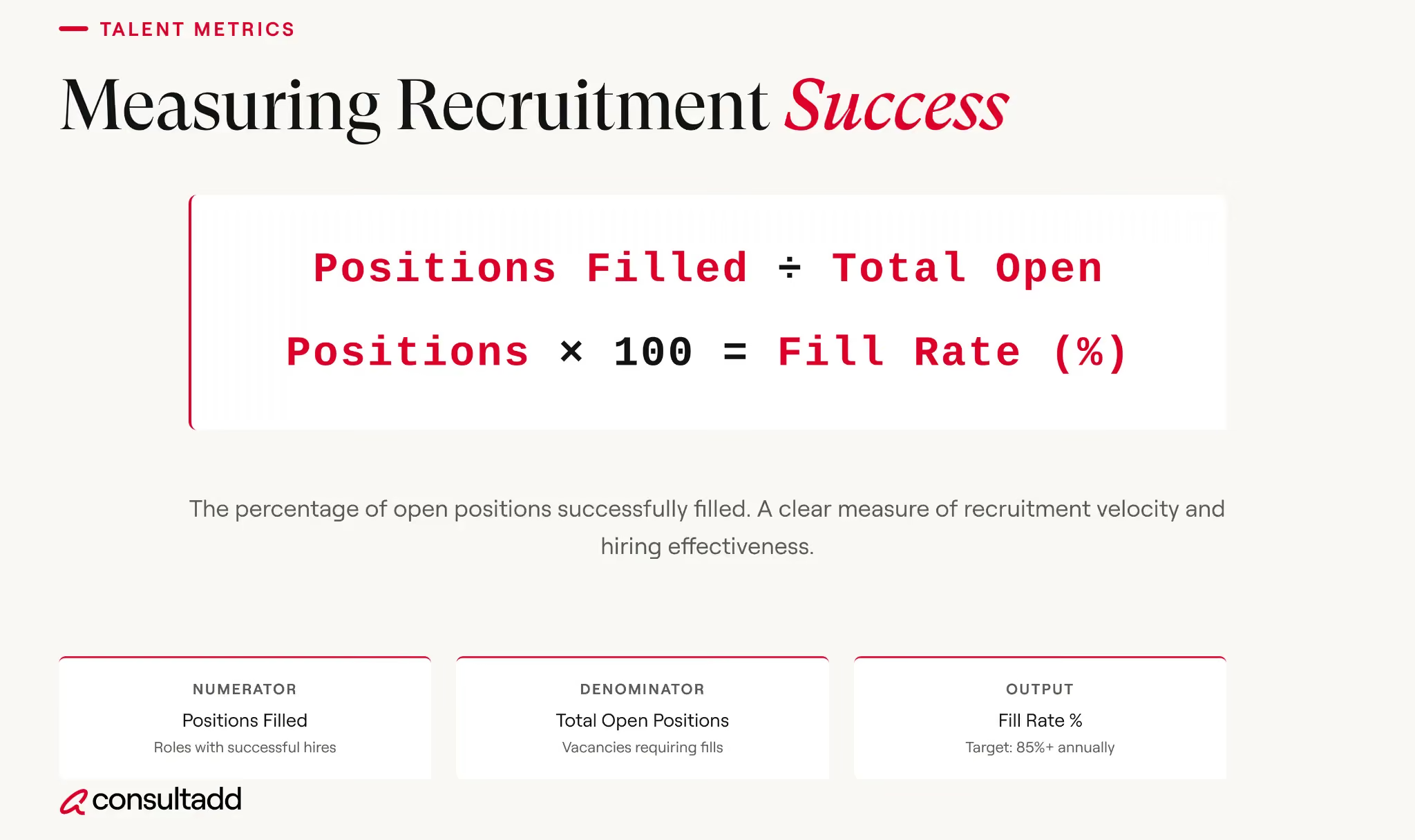
But "positions filled" needs clarification. Are you counting positions that have an accepted offer? Positions where the candidate started? Positions where the candidate is still employed after 90 days?
Most staffing companies define it as positions where a candidate has accepted an offer and begun work. Some track it further and only count placements that lasted 90+ days, which is more honest about whether the hire actually worked out.
The timeframe matters too. Monthly fill rates fluctuate wildly. A bad month where multiple senior roles go unfilled tanks your numbers, but it's often temporary. Quarterly or annual fill rates smooth out these variations and give a clearer picture of your actual performance.
How fill rate differs across industries
Fill rate isn't one-size-fits-all. A technology staffing company's fill rate expectations differ significantly from healthcare staffing or executive recruitment.
Technology roles are consistently harder to fill than administrative roles because supply doesn't match demand. Executive searches have lower fill rates because there are fewer candidates who meet the criteria and they're typically not actively looking. Healthcare has higher requirements because of licensing, but strong demand means placements happen.
Your internal benchmarks matter more than industry averages. If your tech staffing division has historically filled 78% of roles, dropping to 70% is a red flag even if 70% is within the industry range.
Why fill rate matters to your business
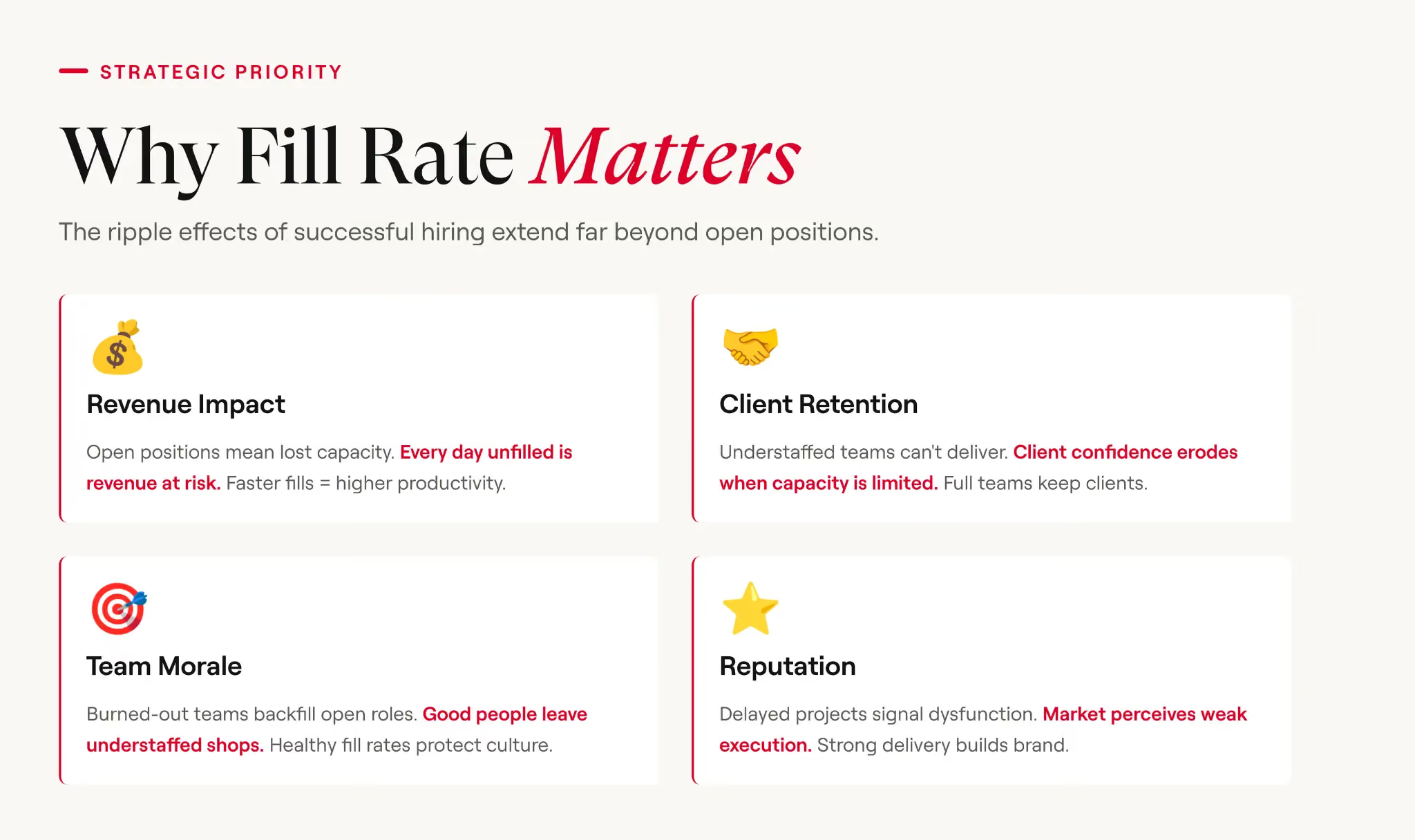
A low fill rate doesn't just mean you're missing placements. It directly impacts revenue, client satisfaction, and team morale.
Revenue impact
If you work on commission or revenue-sharing models, every unfilled position is money left on the table. An unfilled software engineer role might represent $15,000-30,000 in lost revenue. Ten unfilled positions over a quarter means significant business impact.
Client retention
Clients hire staffing companies to solve problems, not create them. If your team consistently can't fill their roles, they'll find another vendor. One client that fires you because of poor fill rates might have generated $100,000+ annually.
Team morale
Recruiters and staffing professionals get demoralized chasing unfillable positions. They spend weeks sourcing and screening candidates, prepare packages and proposals, negotiate with clients, and still can't close the deal. That's a recipe for high turnover in your own recruitment team.
Reputation
In tight labor markets, your reputation is currency. If candidates know your company struggles to place people, they'll be hesitant to engage. If clients know you consistently miss targets, they won't refer you.
What causes low fill rates
Low fill rates always trace back to specific, fixable problems. Finding which one is causing your issue is the key to improvement.
Unrealistic job requirements
The most common culprit is job descriptions that don't match the market. You're asking for five years of experience with a technology that's been around for three years. You're specifying a location in an expensive market but offering below-market compensation. You're listing "required" skills that only 5% of candidates actually have.
Review your unfilled positions. Can you find candidates who match your exact requirements? If the answer is no, your requirements are the problem. Consider which skills are genuinely required versus nice-to-have. Consider whether remote work opens your candidate pool. Consider whether you're asking for seniority levels that are scarcer than you realize.
Weak sourcing
Posting a job on a board and hoping candidates apply is a sourcing strategy that rarely works for competitive roles. You get applicants, yes, but they're often unqualified because job boards attract everyone.
Proactive sourcing changes everything. LinkedIn recruiting, direct outreach to candidates at competing companies, referral programs, university partnerships, and recruiting agencies all bypass the job board problem. They take more effort upfront but deliver better candidates faster.
Poor candidate screening
Some teams screen too conservatively and reject candidates who could do the job. Others screen carelessly and present unqualified candidates to clients. Both hurt fill rate.
Screening should focus on whether candidates can learn and perform, not whether they check every box. Someone with 4.5 years of experience when you asked for five isn't automatically disqualified. Someone who's switching from a related field isn't automatically unsuitable. But someone who lacks fundamental domain knowledge probably is.
Slow hiring processes
If your hiring takes six weeks from application to offer, top candidates will have other jobs by then. Candidates get frustrated. Clients get impatient. Momentum dies.
Compare your hiring speed to competitors. Can you do initial screening within 24 hours? Can you move from screening to interview within two days? Can you make an offer within a week of the final interview? If not, you're losing candidates who have multiple options.
Offer acceptance problems
Sometimes you find qualified candidates and they reject your offers. This usually means compensation is below market, the job description oversold the role, or the candidate interview process revealed problems.
Track your offer acceptance rate separately from fill rate. If you're presenting five candidates for every placement, that's a symptom. It usually means job descriptions aren't accurate, compensation is low, or screening is missing key details.
Measuring fill rate correctly
To track fill rate accurately, you need clear definitions and consistent measurement.
Define your periods. Will you measure monthly, quarterly, or annually? Monthly gives you early warning of problems but fluctuates wildly. Quarterly or annual is more stable but delays problem discovery.
Define what "filled" means. Does it require the candidate to start, to pass probation, or to complete 90 days? Staffing companies usually count it from start date, but some add retention requirements.
Track multiple metrics alongside fill rate:
Fill rate alone doesn't tell the full story. A 90% fill rate with a 60% offer acceptance rate means you're finding candidates but losing them in the process. A 70% fill rate with a 95% offer acceptance rate means you're being selective but very accurate.
Improving your fill rate
Once you know what's causing your problems, improvements follow naturally.
Expand your sourcing channels
Don't rely only on job boards. LinkedIn recruiting, direct outreach, recruitment agencies, referral programs, and universities all bring different candidates. Diversified sourcing is faster and higher-quality than single-channel dependence.
Streamline your hiring process
Candidates talk to multiple companies. Move fast or lose them. Parallel processes (screening while setting up interviews, interview scheduling while preparing offers) save weeks.
Refine your job descriptions
Write descriptions that attract the candidates you can actually find and hire. Be honest about what's required versus preferred. Highlight what makes the role interesting. If remote work is possible, say it. If flexibility exists on experience level, communicate that.
Invest in employer branding
Candidates choose based on reputation. If your company has a strong reputation for supporting employees, offering growth, and treating contractors fairly, you'll attract better candidates faster. If you have the opposite reputation, you'll struggle regardless of compensation.
Use data to predict problems
If you've historically filled 80% of technology roles but 60% of finance roles, invest more sourcing effort in finance positions earlier. If you know it takes 60 days to fill senior positions, start recruiting them earlier than junior roles.
Start Strong With Consultadd
With 15 years in business and 5,000+ successful staffing engagements, we don't just fill roles, we build reliability into your process. We've supported 65 staffing companies in the past year alone and maintain MSAs with industry leaders like Robert Half and TEKsystems.
Here's what working with Consultadd looks like:
- Talent sourced in under 24 hours
- Ready-to-deploy candidates, vetted for experience and compliance
- Lower turnover risk: we match long-term goals, not just short-term needs
- Seamless compliance: visa, documentation, onboarding? Handled.
- Dedicated 1:1 account managers for responsive, personalized support
- Top 100 candidate matches delivered in the past year
- Strong partnerships with universities to tap into fresh, committed talent
- Post-placement support so your investment grows beyond day one
For candidates, your next opportunity is more than just a job title, it's a chance to build skills, gain experience, and move your career forward. At Consultadd, we connect technology professionals with projects and employers that align with their goals, whether they're looking for contract, contract-to-hire, or long-term opportunities.
The tech job market moves fast, but the right guidance can make all the difference. Ready to take the next step in your career journey? Explore Opportunities >>
Key takeaways
- Fill rate measures what percentage of open positions you successfully filled within a timeframe, calculated by dividing positions filled by total open positions.
- Low fill rates result from unrealistic requirements, weak sourcing, poor screening, slow hiring, or offer rejection problems. Find which one applies to you.
- Track fill rate alongside time-to-fill, offer acceptance rate, and 90-day retention to understand your full recruitment performance.
- Improving fill rate requires faster hiring, better sourcing, more accurate job descriptions, and realistic expectations about available candidates.
- Staffing companies with 75-85% fill rates are usually performing well, but your internal benchmarks matter more than industry averages.
FAQs
What's a good fill rate for a staffing company?
A healthy fill rate is typically 75-85% depending on your industry. Technology and specialized roles tend to be lower (70-80%) because candidates are scarce and selective. General administrative or entry-level roles tend to be higher (80-90%). If you're consistently above 85%, you might be screening too loosely and hiring people who don't succeed. If you're consistently below 70%, your sourcing, requirements, or offer acceptance needs improvement.
How do we calculate fill rate when we have ongoing open positions?
For positions open throughout a period, count positions filled divided by the average number of open positions during that period. Example: If you had an average of 10 open positions in March and filled 7 of them, your March fill rate is 70%. This is more accurate than counting only positions that were open at the start of the month because it accounts for positions closed and reopened mid-month.
Should we count placements that don't last 90 days toward our fill rate?
Most staffing companies count placements from start date, but some only count placements lasting 90+ days. Counting from start date gives you recruitment performance metrics. Counting after 90 days gives you hiring accuracy metrics. Track both separately. A placement that ends at day 30 counts as filled (recruitment won) but indicates a hiring or fit problem that needs investigation.
What's the relationship between fill rate and time-to-fill?
Low fill rates often correlate with long time-to-fill, but not always. You might fill positions quickly (short time-to-fill) but have low fill rate because you're losing candidates to competitors. Or you might have high fill rate with longer time-to-fill because you're being selective. The ideal is high fill rate with short time-to-fill, which means fast and accurate hiring.
How does recruitment outsourcing affect fill rate?
Using a staffing agency or recruiting partner typically improves your fill rate in the short term because they bring candidates and handle sourcing. Your internal fill rate might appear lower (because fewer of your open roles close internally), but your overall business fill rate improves because total placements increase. This makes outsourcing effective if you're consistently missing targets.
Can fill rate be higher than 100%?
Yes, if you're counting candidates hired for multiple positions or fill more positions than you had open during the period. Example: If you had 8 open positions and hired 10 people (maybe for positions that opened mid-period or had multiple openings), your fill rate would be 125%. This usually indicates good momentum, but track it carefully because openings can get lost in the calculation.

DevOps Engineer Hiring: A Complete Recruitment Guide
Introduction
Finding the right DevOps engineer feels harder than it should be. You post a job listing, wait weeks, and still end up sifting through resumes from people who don't understand your infrastructure challenges. The problem isn't that DevOps talent doesn't exist. It's that most hiring processes don't match how DevOps engineers actually work.
DevOps engineer hiring has its own complexity because the role spans multiple domains. You're looking for someone who understands cloud platforms, infrastructure as code, containerization, and CI/CD pipelines, but also someone who can communicate with developers and maintain systems under pressure. That's not a common combination, which is why the competition for top talent is intense.
This guide walks you through the entire DevOps engineer hiring process. We'll cover what to look for, where to find candidates, how to evaluate their real skills, and how to close the deal before another company does.
TL;DR
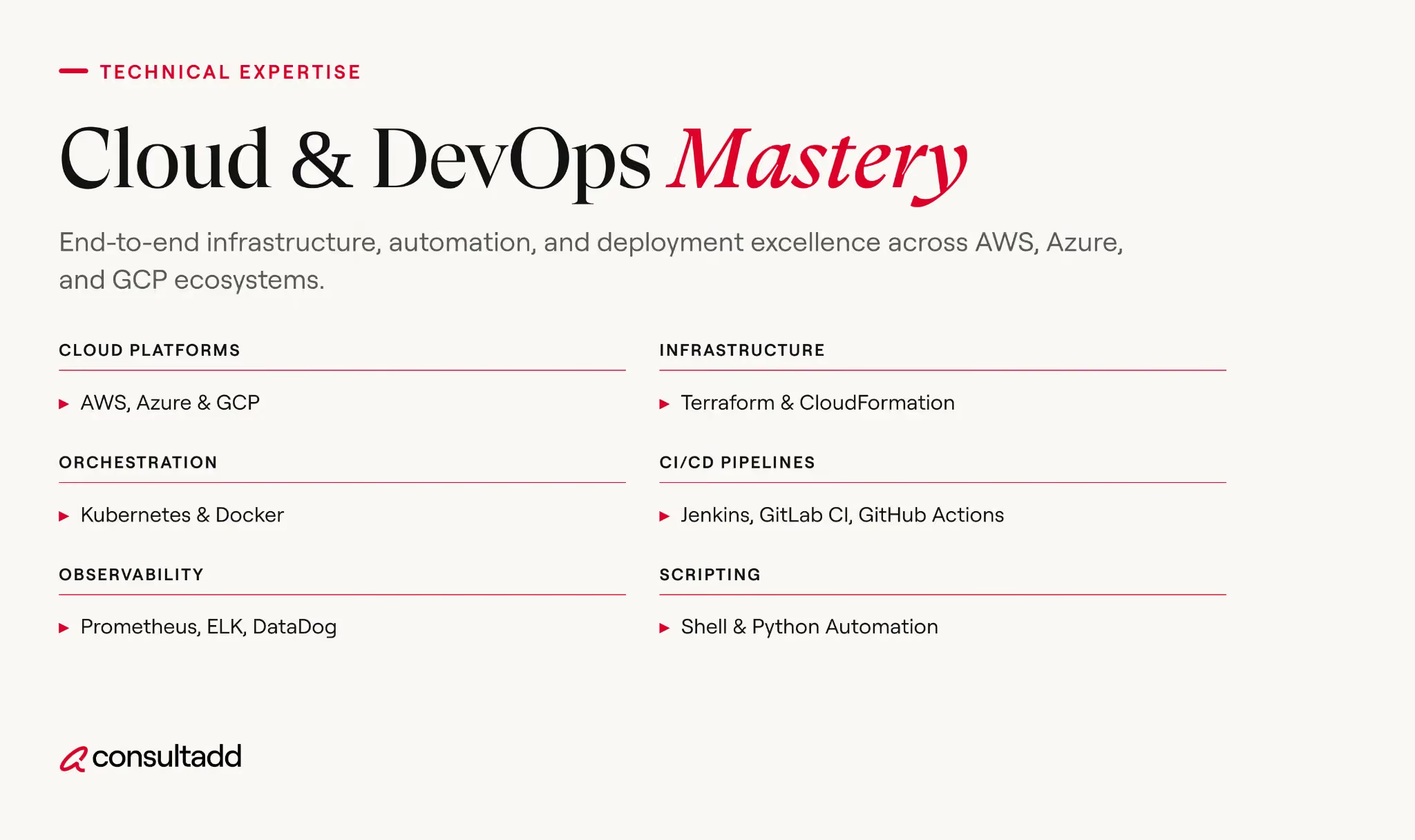
- DevOps engineer hiring requires looking beyond generic "cloud skills" to specific platform experience (AWS, Azure, Kubernetes, Terraform).
- Technical screening should focus on real infrastructure challenges candidates have solved, not theoretical knowledge or obscure tools.
- The best DevOps candidates are already employed and not actively looking, so proactive sourcing beats waiting for applications.
- Culture fit matters because DevOps engineers work across teams and need to handle on-call stress and incident response.
- Competitive compensation and clear growth paths are critical because demand for DevOps talent significantly outpaces supply.
Why DevOps engineer hiring is different
Most technical hiring focuses on a specific programming language or framework. DevOps hiring is broader and messier. You need someone comfortable jumping between cloud platforms, debugging infrastructure issues, and teaching developers better practices.
This breadth means two things: First, candidates with the exact profile you want are rare. Someone who's mastered Kubernetes deployment, terraform automation, AWS networking, and Prometheus monitoring represents years of accumulated experience. Second, a lot of unqualified people claim DevOps skills because the job title sounds impressive and pays well.
The result is that DevOps engineer hiring takes longer and requires more technical depth in your screening process.
Understanding what you're actually hiring for
Before posting a job, clarify what your team actually needs. This matters because DevOps roles vary widely depending on company size and infrastructure complexity.
A DevOps engineer at a startup building their first AWS infrastructure has a completely different focus than a DevOps engineer at a company managing thousands of containers across multiple cloud regions. One needs generalist troubleshooting skills. The other needs deep expertise in orchestration and observability.
Map out the three or four problems you need solved first. Does your team need someone to design and build cloud infrastructure from scratch? Or are you hiring someone to maintain and improve existing systems? Do you need Kubernetes expertise specifically, or is that a nice-to-have? Do you need someone who can mentor junior developers on deployment practices?
Your job description should reflect these priorities. Generic DevOps job postings attract hundreds of unqualified applicants. Specific descriptions attract fewer applications, but they're more likely to include people who can actually do the work.
Key skills to evaluate
Don't weight all skills equally. If you're hiring for AWS Kubernetes deployments, Kubernetes expertise should be weighted higher than Azure knowledge. Interview bias often happens because hiring managers focus on skills they personally understand, not the skills your team actually needs.
Where to find DevOps candidates
Internal referrals and passive recruiting
The best DevOps candidates aren't job hunting. They're employed at other companies, performing well, and have no reason to browse job boards. This is why referral programs and passive sourcing matter so much.
Ask your current engineers for referrals. Offer a bonus if the hire works out. The people your team already knows and trusts are your strongest candidates. They understand your tech stack faster, mesh with your culture quicker, and are less likely to leave in six months.
Targeted outreach on LinkedIn
If referrals aren't working, LinkedIn is where you find passive candidates. Filter by specific skills (AWS, Kubernetes, Terraform) and reach out directly. Personalize your message. Generic "We'd like to discuss a role" templates get ignored. Mention something specific about why the role fits their background.
GitHub and GitLab profiles
DevOps engineers who work in open source or maintain public repositories are easier to evaluate. Look at their code, their documentation, their design choices. This tells you more than a resume ever will.
Staffing partners and technical recruiters
If you're in a competitive market or hiring urgently, working with specialists can save time. Staffing companies that focus on infrastructure and cloud hiring already have relationships with qualified candidates. They screen out people who can't pass basic technical filters before your team wastes time interviewing.
Technical screening that works
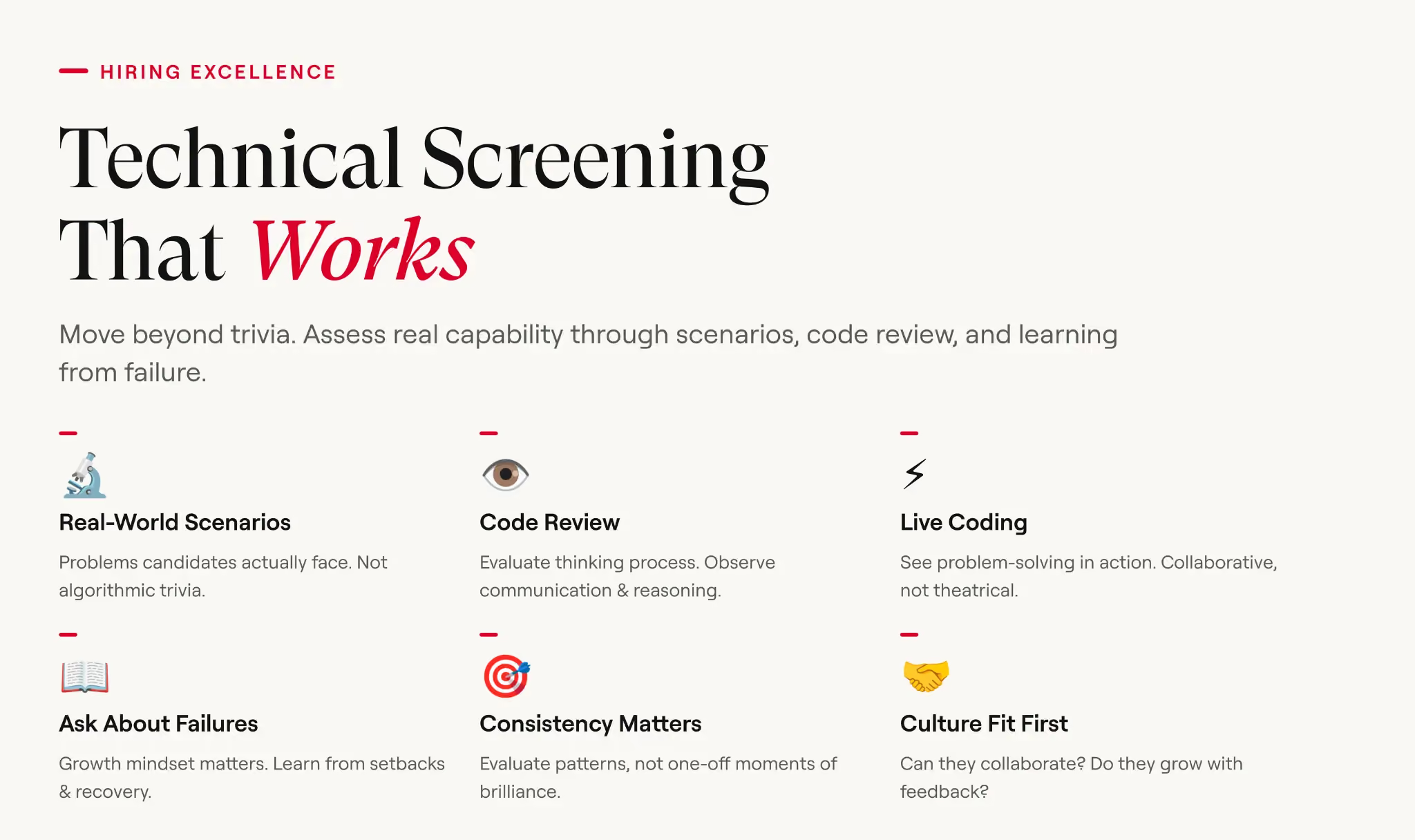
This is where most hiring processes fail. Companies either ask trivial questions ("What does CI stand for?") or focus on memorized details that don't predict performance.
Real-world scenarios beat trivia
Instead of asking "How do you use Terraform," describe a scenario: "Our infrastructure team wants to migrate 50 applications from our on-premises data center to AWS. We need to version control our infrastructure and make it reproducible. Walk me through how you'd approach this."
The answer tells you whether they understand IaC philosophy, whether they've managed large migrations, and whether they think about operational complexity. Someone who just completed an online Terraform course will struggle. Someone with real experience will have opinions about state management, testing, and disaster recovery.
Code review or live coding
Ask candidates to write simple infrastructure code during the interview or share examples from their GitHub. You're not looking for perfection. You're looking for whether they understand basic concepts, write readable code, and can explain their decisions.
A simple exercise: "Here's a failing CI/CD pipeline. Diagnose the issue." This takes 30 minutes and immediately shows whether someone understands how systems actually work.
Ask about failures
"Tell me about a time your deployment broke production" reveals more than success stories. How did they diagnose it? What systems did they check first? Did they blame developers or take responsibility for poor observability? Did they implement safeguards afterward?
The best DevOps engineers have war stories and learned from them.
Evaluating cultural fit and team dynamics
DevOps engineers spend their entire career solving other teams' problems. If someone can't handle interruptions, on-call responsibilities, or cross-team friction, they'll burn out in six months.
Look for evidence of collaboration. Have they worked with developers to improve deployment processes? Have they documented runbooks so others can respond to incidents? Have they mentored junior engineers?
On-call stress is real. Someone should ask directly: "How do you handle being paged at 3am for a production outage?" People who treat this as a normal part of the job tend to stay longer than people who see it as an imposition.
Also assess learning speed. DevOps tooling changes constantly. Someone who's learned three different orchestration platforms is more valuable than someone who's only ever used one, because they've demonstrated they can adapt.
Making the offer and closing
Once you find a strong candidate, move fast. Top DevOps engineers have multiple offers. A two-week interview process gives a competitor time to move in.
Compensation matters
DevOps engineer salaries are high because demand is high. If you're offering below-market rates, qualified candidates will pass. Research what companies similar to yours pay in your region. Use sites like Levels.fyi, Glassdoor, and LinkedIn salary data.
Beyond base salary, consider:
- Sign-on bonuses to offset stock vesting at their current company
- Professional development budget (conferences, certifications, training)
- Remote work flexibility (DevOps hiring is competitive globally)
- Clear promotion path (not everyone wants to move into management)
Address their concerns
Ask what matters to them in a new role. Some engineers want cutting-edge tech. Others want stability and avoiding firefighting. Some want small teams with high impact. Others want to learn from experienced architects.
When you understand what they actually want, you can position your role honestly. Overselling a role leads to quick departures.
Start Strong With Consultadd
With 15 years in business and 5,000+ successful staffing engagements, we don't just fill roles, we build reliability into your process. We've supported 65 staffing companies in the past year alone and maintain MSAs with industry leaders like Robert Half and TEKsystems.
Here's what working with Consultadd looks like:
- Talent sourced in under 24 hours
- Ready-to-deploy candidates, vetted for experience and compliance
- Lower turnover risk: we match long-term goals, not just short-term needs
- Seamless compliance: visa, documentation, onboarding? Handled.
- Dedicated 1:1 account managers for responsive, personalized support
- Top 100 candidate matches delivered in the past year
- Strong partnerships with universities to tap into fresh, committed talent
- Post-placement support so your investment grows beyond day one
For candidates, your next opportunity is more than just a job title, it's a chance to build skills, gain experience, and move your career forward. At Consultadd, we connect technology professionals with projects and employers that align with their goals, whether they're looking for contract, contract-to-hire, or long-term opportunities.
The tech job market moves fast, but the right guidance can make all the difference. Ready to take the next step in your career journey? Explore Opportunities >>
Key takeaways
- DevOps engineer hiring requires specificity. Generic job postings waste everyone's time. Focus on the actual infrastructure problems you need solved.
- Technical screening should use real-world scenarios and code review, not trivia. Ask about production failures and how candidates learned from them.
- Passive sourcing is more effective than job boards. Most top DevOps talent isn't actively looking. Tap your network and LinkedIn first.
- Speed matters. Once you identify a strong candidate, move from screening to offer within one week or lose them to competitors.
- Compensation is non-negotiable. Market rates for DevOps engineers are high because supply doesn't match demand. Budget accordingly.
FAQs
How long does it typically take to hire a DevOps engineer?
Expect 3-6 weeks from job posting to offer acceptance. If you're proactively sourcing (referrals, LinkedIn outreach), it can be faster, sometimes 2-3 weeks. Passive sourcing takes longer because you need multiple conversations to convince someone to consider a new role. Job boards attract fewer qualified candidates, so screening takes more time.
Should we hire a junior DevOps engineer or wait for senior experience?
Junior DevOps engineers (1-3 years) can handle routine infrastructure maintenance, help design systems, and grow into senior roles. They're less expensive and can learn your specific stack. Senior DevOps engineers (5+ years) move faster on complex infrastructure design and incident response. If your team has experienced mentorship available, juniors are often a better investment. If you need someone to own complex systems immediately, go senior.
What's more important: cloud platform expertise or leadership skills?
It depends on the role. Individual contributor DevOps engineers need deep platform expertise. DevOps leads or platform engineers need both. During screening, confirm they have relevant platform experience, then assess how they've worked with other teams. Someone who can explain complicated deployment processes to non-technical stakeholders is worth more than someone who codes in isolation.
How do we know if a candidate is overstating their DevOps experience?
Ask for specific examples. "Tell me about the largest Kubernetes cluster you've managed" or "Walk me through a production incident you diagnosed." Vague answers or generic knowledge suggests less experience than claimed. Ask them to explain their deployment pipeline in detail. Ask follow-up questions about tradeoffs they made. People with real experience can explain their decisions. People who learned from tutorials often can't.
Should we use recruitment agencies or hire directly?
Both work. Direct hiring gives you full control but takes longer because you're managing the entire process. Recruitment agencies handle sourcing and initial screening, so your team focuses on final interviews. If you're hiring frequently or need to fill roles urgently, agencies save time. If you're making a single hire and can invest the time, direct hiring gives you better long-term relationships and cost savings.
What's the biggest reason DevOps hires don't work out?
Mismatched expectations about on-call responsibilities and incident response. Someone hired for "infrastructure design" who expects never to be paged will struggle. Someone hired as a firefighter who wants to build systems from scratch will leave. Be explicit about what the role actually involves. If it's 20% on-call, say that upfront. If it's high-stress incident response, discuss how you support that. Alignment on day-to-day reality matters more than job title alignment.

What is Full Cycle Recruiting: A Complete Guide to End-to-End Hiring
Introduction
If you've spent time around recruiting teams, you've probably heard the term "full cycle recruiting." It sounds comprehensive, but what exactly does it mean? And more importantly, why should you care whether your recruiters are doing full cycle recruiting or just handling one piece of the hiring puzzle?
Full cycle recruiting is when a single recruiter owns the entire hiring process from start to finish. They source candidates, screen resumes, conduct initial interviews, coordinate with hiring managers, facilitate later-stage interviews, negotiate offers, and manage onboarding. One person, the entire cycle, start to finish. No handoffs between different specialists. No candidates falling through cracks because nobody owned the process end-to-end.
This is different from traditional recruiting models where different people handle different stages. One person sources candidates. Another person screens. A third person coordinates interviews. Yet another negotiates offers. By the time a candidate reaches an offer, three people have touched the process and nobody truly owns the outcome.
According to the Society for Human Resource Management (SHRM), full cycle recruiting has become increasingly common in tech and fast-growing companies because it reduces hiring time, improves candidate experience, and creates accountability. When one person owns the entire process, the incentive to hire well is clear. If the hire fails, they know why because they lived through the entire cycle.
TL;DR
- Full cycle recruiting means one recruiter owns the entire hiring process from sourcing through onboarding
- The process includes sourcing, screening, interviewing, offer negotiation, and onboarding coordination
- Full cycle recruiting reduces time-to-hire, improves candidate experience, and creates accountability
- It's common in tech, startups, and rapidly growing companies
- Challenges include recruiter burnout from wearing multiple hats and requiring diverse skill sets
Understanding the full cycle recruiting process
Full cycle recruiting isn't complicated in concept. One recruiter is responsible for the entire pipeline. But understanding each stage clarifies why this matters.
Stage 1: Sourcing
This is where the recruiter actively searches for candidates. They're not waiting for applications to come through a job board. They're reaching out directly. They're searching LinkedIn, GitHub, Stack Overflow, or specialized tech communities. They're asking network contacts for referrals. They're calling passive candidates who aren't looking but might be interested.
A good sourcer knows where talent lives. They understand which tech communities attract specific types of engineers. They know which universities produce graduates worth recruiting. They've built relationships in their industry, so people take their calls. Sourcing is part art, part science. The art is knowing where to look. The science is qualifying whether the candidate is actually a fit.
In a traditional recruiting model, a dedicated sourcer does this work. They're specialized in finding people. But they hand off to someone else once they've created a candidate list. In full cycle recruiting, the recruiter who sourced the candidates follows them through the entire process.
Stage 2: Screening
Once you have candidates, someone needs to filter them. Screening happens at two levels: resume screening and phone screening.
Resume screening is objective. Does the candidate have the required experience? Are there red flags? Gaps in employment? Misaligned skill sets? A screener looks at 100 resumes and might advance 10 to the next stage.
Phone screening goes deeper. The recruiter calls the candidate, has a 15-30 minute conversation, and assesses whether they're genuinely interested, can articulate their experience, and seem like a cultural fit. Phone screening eliminates candidates who look good on paper but don't hold up in conversation.
In full cycle recruiting, the same person doing sourcing now handles screening. They know why they sourced each candidate. They asked specific questions during phone screening. They can make an informed decision about moving people forward.
Stage 3: Interview Coordination
Now the candidate is ready for formal interviews with the hiring team. The recruiter coordinates logistics. They schedule interviews. They send calendar invites. They ensure interviewers know who they're interviewing and what they should assess. They collect feedback after each interview round.
This is administrative, but it's critical. Poor coordination frustrates candidates. Missed calendar invites make your company look disorganized. Interviewers who don't know what they're assessing ask random questions and produce inconsistent feedback.
In full cycle recruiting, the recruiter is the consistent point of contact. Candidates know who to reach out to with questions. The recruiter has continuity across all interview rounds. They can spot patterns in feedback. They know which concerns are real and which are just interviewer preferences.
Stage 4: Offer Negotiation
The hiring team decides to make an offer. Now the recruiter negotiates. They present the offer. They answer compensation questions. They address concerns. They negotiate if the candidate pushes back on salary or start date. They make sure both sides agree before anything is finalized.
Negotiation is a delicate skill. The recruiter needs to understand what's negotiable, what's not, and how to find creative solutions. If the company can't match salary, can they offer more vacation days? A signing bonus? Flexible work arrangements? A later start date to wrap up current commitments?
In full cycle recruiting, the recruiter knows the company's flexibility because they've built relationships with hiring managers throughout the process. They've already negotiated small things during interviews. Now it's just the final conversation. The candidate trusts them because they've been with them the whole way.
Stage 5: Onboarding Support
The offer is accepted. You'd think the recruiter's job is done. But in full cycle recruiting, they're not done. They coordinate onboarding. They ensure HR has everything they need. They brief the hiring manager on the candidate's background and any important context. They check in with the new hire after their first week to make sure things are going well.
This last stage is critical for retention. New hires who feel supported during their first month are more likely to stay. Recruiters who follow through on onboarding create a positive impression. They signal that the company cares about success, not just hiring.
Why companies choose full cycle recruiting
Companies adopt full cycle recruiting for specific reasons. Understanding these helps clarify whether it makes sense for your organization.
Speed to hire. Full cycle recruiting is faster. When one person owns the process, decisions happen quickly. They don't need to handoff candidates to three different people and wait for feedback. They control the timeline. A good full cycle recruiter can fill a role in 30-45 days. Traditional recruiting often takes 60-90 days because of handoffs and delays.
In competitive markets where top talent gets multiple offers, speed matters. If you take 90 days to hire and a competitor takes 45, the competitor wins the talent war. Full cycle recruiting keeps you competitive.
Better candidate experience. Candidates have one point of contact. They don't get handed from person to person. They don't repeat their background story to five different recruiters. One recruiter knows their entire story, understands their concerns, and advocates for them internally.
This matters for your employer brand. Candidates talk about their interview experience. A good full cycle recruiter creates positive word-of-mouth. Bad recruiting experiences create negative reviews on Glassdoor. Full cycle recruiting, when done well, creates positive candidate experiences.
Accountability for outcomes. When one person owns the whole process, accountability is clear. If a hire fails, you know who owns it. If placements have high turnover, the full cycle recruiter can't blame a screener for missing something. They owned every stage. This accountability drives better hiring decisions.
Cost efficiency through reduced headcount. One full cycle recruiter replaces three or four specialized recruiters. You get one experienced person instead of multiple junior specialists. While the full cycle recruiter might cost more, the total recruiting budget is lower.
Deeper relationships with hiring managers. Full cycle recruiters work closely with hiring managers throughout the process. They understand what hiring managers actually need (not what they say they need). They can push back when a job description is unrealistic. They can suggest candidates who don't exactly match the spec but would actually thrive in the role.
These deeper relationships improve hiring quality because the recruiter understands context that specialists miss.
The challenges of full cycle recruiting
Full cycle recruiting isn't perfect. It has real downsides that matter.
Recruiter burnout. Wearing multiple hats is exhausting. Sourcing requires creative problem-solving and persistence. Screening requires active listening and critical thinking. Negotiation requires diplomacy and problem-solving. Interview coordination requires organization and attention to detail. Onboarding support requires empathy and follow-through. Few people excel at all five. Many full cycle recruiters burn out trying.
This is why finding experienced full cycle recruiters is hard. Many talented recruiters specialize in one or two areas and don't want to wear every hat. Burnout leads to turnover, which ironically increases recruiting costs.
Skill diversity requirements. Full cycle recruiting requires diverse skills. A great sourcer might be terrible at negotiation. An amazing negotiator might hate coordination. This skill diversity is rare. It's easier to hire four good specialists than one amazing full cycle recruiter.
Bottleneck risk. When one person owns everything, they become a bottleneck. If your full cycle recruiter goes on vacation, hiring stops. If they quit, you're scrambling. If they get sick, nothing moves. Specialized recruiting distributes risk across multiple people.
Quality consistency depends on individual competency. A mediocre full cycle recruiter produces mediocre hiring. A great one produces great hiring. With specialized recruiting, you can have mediocre sourcers and great screeners. The system balances out. With full cycle, the individual recruiter's competency matters completely.
What makes an effective full cycle recruiter
Not every recruiter can do full cycle work well. The best ones share specific traits.
Deep technical knowledge or domain expertise. The best tech recruiters understand technology. They know what a microservices architect actually does. They understand the difference between front-end and full-stack development. They know what Docker and Kubernetes are (roughly). This knowledge helps them source well, screen effectively, and represent candidates fairly to hiring teams.
Domain expertise matters across industries. Finance recruiters understand financial concepts. Healthcare recruiters understand healthcare. This expertise builds credibility with candidates and hiring managers.
Relationship-building skills. Full cycle recruiting is built on relationships. With candidates. With hiring managers. With interviewers. With your own company's team. Effective full cycle recruiters are genuinely good at people. They listen. They remember details. They follow up. They stay in touch with people who weren't hired because they might be right for future roles.
Organization and process discipline. Full cycle recruiting requires process discipline. You can't forget where a candidate is in the pipeline. You can't miss a calendar invite. You can't forget to follow up on offer negotiations. Effective full cycle recruiters have systems. They track everything. They follow a repeatable process.
Flexibility and problem-solving. Full cycle recruiting throws curveballs. A candidate gets another offer. A hiring manager wants to change the job description mid-process. A key interviewer goes on leave. Effective full cycle recruiters adapt. They find creative solutions. They don't panic when the plan changes.
Empathy and integrity. This matters most. Candidates are considering big life decisions. Taking a new job means leaving their current company. Relocating. Adjusting to a new team. Effective full cycle recruiters respect this. They give honest feedback. They don't manipulate candidates. They represent both sides fairly.
This integrity builds trust. Candidates who trust their recruiter are more likely to accept offers. More likely to stay if challenges arise. More likely to refer their friends to work there.
Full cycle recruiting in different company sizes
Full cycle recruiting works differently depending on your organization.
Early-stage startups (10-50 people). Founders often do full cycle recruiting themselves initially. They're sourcing, screening, interviewing, and negotiating. They're too small to hire dedicated recruiters. Eventually, they hire their first recruiter. That person does full cycle recruiting for the entire company. As they grow, this one recruiter becomes overwhelmed and they either hire more full cycle recruiters or move toward specialization.
Growth-stage companies (50-500 people). This is where full cycle recruiting works best. You're growing but still lean. You might have 2-4 full cycle recruiters covering different departments or skill areas. Each full cycle recruiter owns specific hiring pipelines. They know their domains deeply. This model scales well because each full cycle recruiter is a specialist in their area while still owning the full cycle.
Enterprise companies (500+ people). Large companies usually move away from full cycle recruiting toward specialization. They have dedicated sourcers, screening teams, offer teams, and onboarding coordinators. The complexity and volume is too high for one person. However, some enterprises maintain full cycle recruiting for niche roles or leadership positions where the complexity of hiring justifies one person owning the cycle.
Building a full cycle recruiting function in-house
If you want to build full cycle recruiting internally, understand the requirements:
Hire for the person, not the job description. You need someone with foundational skills across multiple areas. But they don't need to be a master of everything. Hire for intelligence, curiosity, and people skills. Then train them on the specialized parts.
Provide clear processes and tools. Full cycle recruiting is chaotic without structure. Document your process. Use tools like LinkedIn Recruiter, Greenhouse, or similar platforms that let one person manage the entire pipeline. Create templates for job descriptions, phone screening questions, and offer letters. Consistency comes from process.
Focus on domain expertise. Give your full cycle recruiter time to build knowledge in your industry or function. Let them attend conferences. Let them build relationships with hiring managers. Let them learn what actually works in your company.
Plan for burnout and succession. Full cycle recruiting is demanding. Have a plan for your recruiter to take real vacations. Have backup processes so hiring doesn't stop when they're out. Plan for eventual succession or specialization. Don't expect one person to do full cycle recruiting forever without burning out.
Pair them with good hiring managers. A good full cycle recruiter can't succeed alone. They need hiring managers who respond quickly to feedback, make decisions promptly, and provide clear job requirements. Slow hiring managers and unclear requirements will burn out even the best recruiter.
The role of technology in full cycle recruiting
Technology enables full cycle recruiting but doesn't replace human judgment.
Applicant Tracking Systems (ATS): These organize candidates and track them through the pipeline. They let you manage multiple open roles, track candidate status, and generate reports. But an ATS doesn't make hiring decisions. A full cycle recruiter uses an ATS to stay organized, but their judgment matters.
LinkedIn Recruiter: This tool helps source passive candidates directly on LinkedIn. You can send messages, see response rates, and manage outreach. It dramatically increases sourcing efficiency. But it's not sourceless—someone (the full cycle recruiter) still makes every outreach decision.
Video interviewing platforms: Tools like HireVue or Spark Hire let candidates record responses to standard questions. This saves time on initial screening calls. But it's impersonal and should only be used to eliminate obvious mismatches, not to make meaningful assessment decisions.
Background check and skills testing services: These automate compliance requirements and technical verification. They're useful but supplement, not replace, recruiter judgment.
The best full cycle recruiters use technology intelligently. They automate repetitive tasks (scheduling, background checks, documentation). They keep human judgment for decisions that matter (sourcing decisions, screening conversations, negotiation strategy, cultural fit assessment).
Full cycle recruiting for different roles
Full cycle recruiting adapts to different types of positions.
Engineer/developer roles: Sourcing happens on GitHub, Stack Overflow, and through developer communities. Screening includes technical conversations or coding assessments. Interview coordination involves technical interviews with engineers. Negotiation focuses on salary, remote flexibility, and technology stack.
Sales roles: Sourcing happens through LinkedIn and industry events. Screening includes role-play scenarios where candidates pitch. Interview coordination involves multiple sales leaders. Negotiation includes commission structures and territory discussions.
Product management roles: Sourcing happens through product communities and design platforms. Screening involves product problem-solving exercises. Interview coordination includes product leaders and engineers. Negotiation focuses on scope, influence, and growth potential.
Leadership/executive roles: Sourcing is highly targeted and relationship-driven. Screening is thorough and covers strategic thinking. Interview coordination includes multiple stakeholders (board, executives, teams). Negotiation is complex and involves retention packages and long-term incentives.
Metrics that matter for full cycle recruiting
How do you know if your full cycle recruiting is working?
Time-to-hire: How long from job posting to accepted offer? Full cycle recruiting should be 30-45 days for most roles. If you're consistently taking 60+ days, something's wrong.
Quality of hire: Do people stay? Do they perform? Measure average tenure and performance ratings. Good full cycle recruiting produces people who stay and contribute.
Offer acceptance rate: What percentage of candidates accept offers? In competitive markets, this might be 70-80%. If it's below 50%, either your recruiting isn't selling the opportunity well, or your offers aren't competitive.
Cost per hire: Total recruiting spend divided by number of hires. This should be lower with full cycle than traditional recruiting because you're not paying multiple specialized recruiters.
Candidate satisfaction: Ask candidates about their experience. Did they feel respected? Was communication clear? Did they feel the company valued them? Net Promoter Score for candidates is a good metric. Even candidates who don't get hired should walk away impressed with your recruiting process.
Hiring manager satisfaction: Are hiring managers happy with the candidates? Do they feel the recruiter understands their needs? Do they trust the recruiter's judgment? Regular feedback from hiring managers tells you if your full cycle recruiting is working.
Start Strong With Consultadd
With 15 years in business and 5,000+ successful staffing engagements, we don't just fill roles, we build reliability into your process. We've supported 65 staffing companies in the past year alone and maintain MSAs with industry leaders like Robert Half and TEKsystems.
Here's what working with Consultadd looks like:
- Talent sourced in under 24 hours
- Ready-to-deploy candidates, vetted for experience and compliance
- Lower turnover risk: we match long-term goals, not just short-term needs
- Seamless compliance: visa, documentation, onboarding? Handled.
- Dedicated 1:1 account managers for responsive, personalized support
- Top 100 candidate matches delivered in the past year
- Strong partnerships with universities to tap into fresh, committed talent
- Post-placement support so your investment grows beyond day one
For candidates, your next opportunity is more than just a job title, it's a chance to build skills, gain experience, and move your career forward. At Consultadd, we connect technology professionals with projects and employers that align with their goals, whether they're looking for contract, contract-to-hire, or long-term opportunities.
The tech job market moves fast, but the right guidance can make all the difference. Ready to take the next step in your career journey? Explore Opportunities >>
Key takeaways
- Full cycle recruiting means one recruiter owns sourcing, screening, coordination, negotiation, and onboarding
- It produces faster hiring, better candidate experience, and clear accountability
- Full cycle recruiters need diverse skills: sourcing ability, screening judgment, organizational discipline, negotiation skill, and empathy
- Effective full cycle recruiting requires deep domain expertise, strong relationships, and process discipline
- Consultadd excels at full cycle recruiting through dedicated partnerships, rigorous vetting, and post-placement support
FAQs
What is full cycle recruiting exactly?
Full cycle recruiting is when a single recruiter owns the entire hiring process from start to finish. They source candidates, screen applications, coordinate interviews, negotiate offers, and support onboarding. Instead of handing candidates off to different people at each stage, one recruiter manages the complete journey. This creates accountability, improves speed, and ensures consistency throughout the hiring process.
How long does full cycle recruiting take?
Effective full cycle recruiting typically takes 30-45 days from job posting to accepted offer. This is faster than traditional recruiting models where handoffs between specialists add delays. Timeline varies by role complexity and candidate availability, but 30-45 days is standard. If you're consistently taking longer, either your full cycle recruiter is overwhelmed or your hiring managers are slow to make decisions.
Is full cycle recruiting better than specialized recruiting?
It depends on your situation. Full cycle recruiting is better for speed, consistency, and accountability. Specialized recruiting can be better for very high-volume hiring where you need deep specialization in sourcing, screening, or negotiation. Most growing tech companies find full cycle recruiting works best because speed matters and you value candidate experience.
How do I know if someone is a good full cycle recruiter?
Look for: (1) Deep domain expertise in your industry or function, (2) A track record of fast placements with high retention, (3) Strong relationships with candidates and hiring managers, (4) Process discipline and organization, (5) Honesty and integrity in how they communicate. Ask for references from both candidates they've placed and hiring managers they've worked with. A good full cycle recruiter should have positive reviews from both groups.
Can I build a full cycle recruiting function in my startup?
Absolutely. Early-stage startups often have one person doing full cycle recruiting. Start by hiring someone with foundational recruiting skills and domain expertise in your industry. Give them clear processes and good tools. Teach them your culture and business.
How does Consultadd do full cycle recruiting differently?
Consultadd approaches full cycle recruiting as long-term partnership, not transactions. They assign dedicated 1:1 account managers who own your hiring pipelines completely. They source talent in under 24 hours through active networks and direct outreach. They vet candidates rigorously for experience, compliance, and cultural fit.
What technology do full cycle recruiters use?
Good full cycle recruiters use: (1) Applicant Tracking Systems (ATS) like Greenhouse or Lever to organize pipelines, (2) LinkedIn Recruiter to source passive candidates, (3) Calendar and communication tools to coordinate interviews, (4) Assessment platforms for technical screening or skills testing, (5) Background check services for compliance. But technology enables full cycle recruiting; it doesn't replace it. The recruiter's judgment and relationships still matter most.

How to Improve the Recruitment Process: A Diagnostic Guide
Introduction
The fastest way to improve the recruitment process is to first find out which specific stage, sourcing, screening, interviewing, or offer and close, is actually causing the delay or losing candidates, and fix that stage directly instead of applying generic advice across the whole pipeline.
Most hiring teams skip this step. They add a job board, tweak a job description, or bring in more interviewers, without knowing whether any of that addresses where the process is actually breaking. That's why so many "improvement" efforts don't move the numbers.
This guide walks through a stage-by-stage way to diagnose your recruitment process, then match the fix to the actual problem rather than the generic one.
TL;DR
- Improving recruitment starts with diagnosis, not tactics. Find which stage is slow or leaky before changing anything.
- SHRM's 2025 benchmarking data shows screening and interviewing each average 8 to 9 days on their own, which is often where time quietly disappears.
- The average nonexecutive cost per hire is $5,475, and every extra day in the pipeline adds to that number, whether or not anyone's tracking it.
- Only 20% of organizations measure quality of hire, so most "improvements" are judged on speed alone, which can hide the cost of a bad hire.
- Fixing the wrong stage doesn't just fail to help. It can add processes for its own sake and slow things down further.
Diagnose before you fix
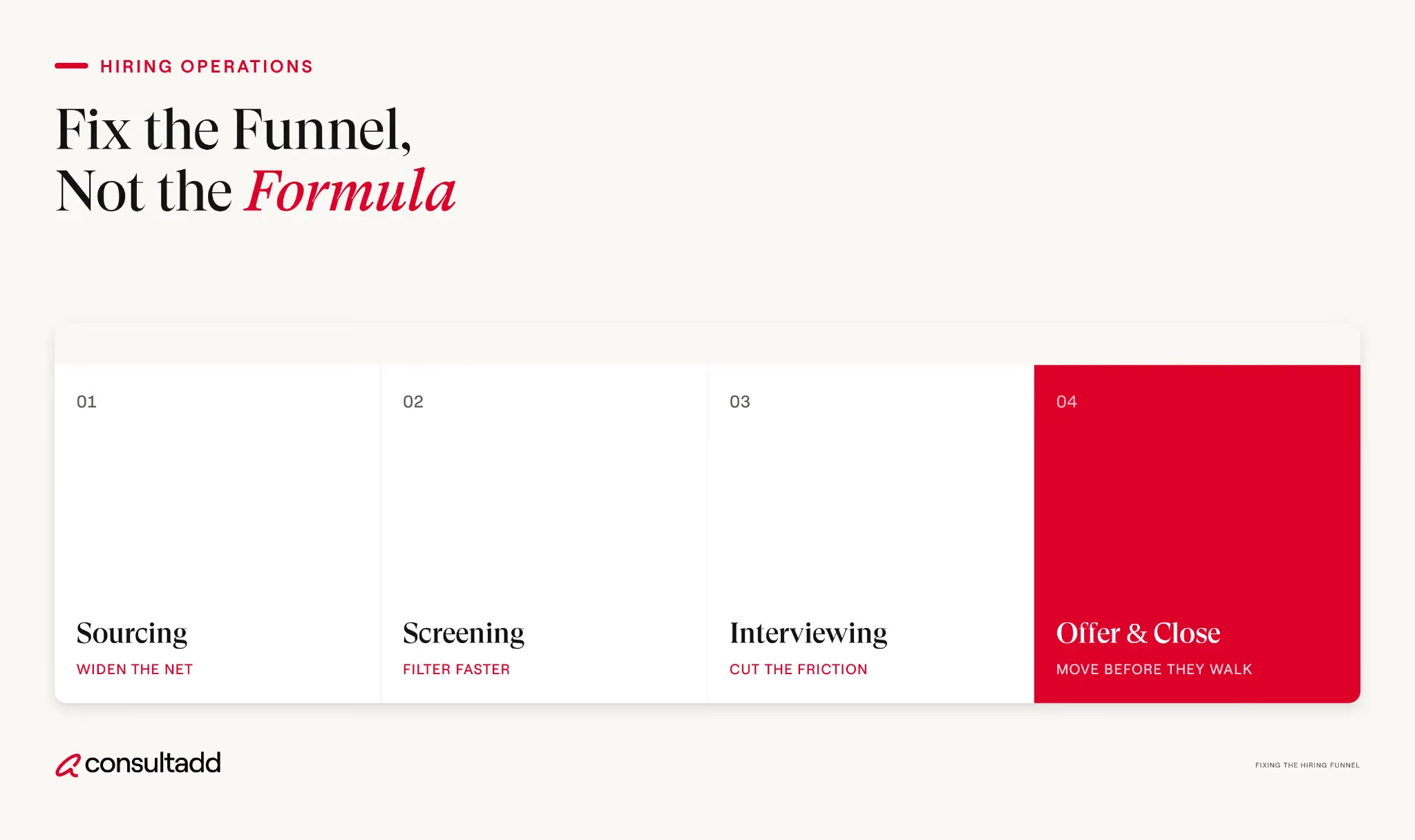
Recruitment breaks down in one of four places: sourcing, screening, interviewing, or offer and close.
Each stage has different symptoms and different fixes, and applying the wrong fix to the wrong stage is the most common reason improvement efforts stall out.
According to SHRM's 2025 Benchmarking Report, the process from job posting to offer acceptance is highly segmented, with screening and interviewing each averaging 8 to 9 days on their own.
That's useful, because it tells you where time typically piles up even in organizations that consider their process reasonably efficient.
If your screening or interview stage is taking noticeably longer than that, you've found your bottleneck without needing to guess.
Fix the stage that's actually broken
If sourcing is the problem:
- Rewrite the job posting around what the person will actually do in the first 90 days, not a list of every skill you could imagine wanting.
- Vague postings pull in the wrong applicants and repel qualified ones who don't see themselves in the role.
- Then check whether you're posting in the channels where your target candidates actually look, rather than defaulting to the same job board for every role.
If screening is the problem:
- Set explicit pass/fail criteria before you open a single resume, not after.
- Ambiguous criteria are why resumes sit untouched: nobody wants to be the one who screens out a candidate on a judgment call.
- A simple scorecard with three or four must-haves removes that hesitation and speeds up every review after the first one.
If interviewing is the problem:
- Cut the number of rounds before you optimize any of them.
- Structured interviews, where every candidate answers the same questions scored against the same rubric, consistently predict job performance better than open-ended conversation, and they're also faster to run and compare.
- If scheduling itself is the delay, that's a coordination problem, not a candidate quality problem, and it's usually the easiest one to fix with a shared calendar process.
If offer and close is the problem:
- Map out exactly who needs to approve an offer and how long each approval typically takes.
- Slow internal sign-off is one of the most common reasons a strong candidate accepts somewhere else, and it's entirely within your control to fix, unlike a competitor's counteroffer.
Measure outcomes, not just speed
Here's where a lot of "improved" processes quietly get worse: they get faster without getting better.
SHRM's benchmarking data found that only 20% of organizations formally measure quality of hire, which means most hiring teams are optimizing for time-to-fill and cost-per-hire without any real check on whether the faster process is producing worse hires.
You don't need a dashboard to start. A shared spreadsheet that logs the date a candidate enters and exits each stage will surface the bottleneck faster than most paid tools, because it forces you to actually look at where time goes instead of assuming.
Common mistakes that make the process worse, not better
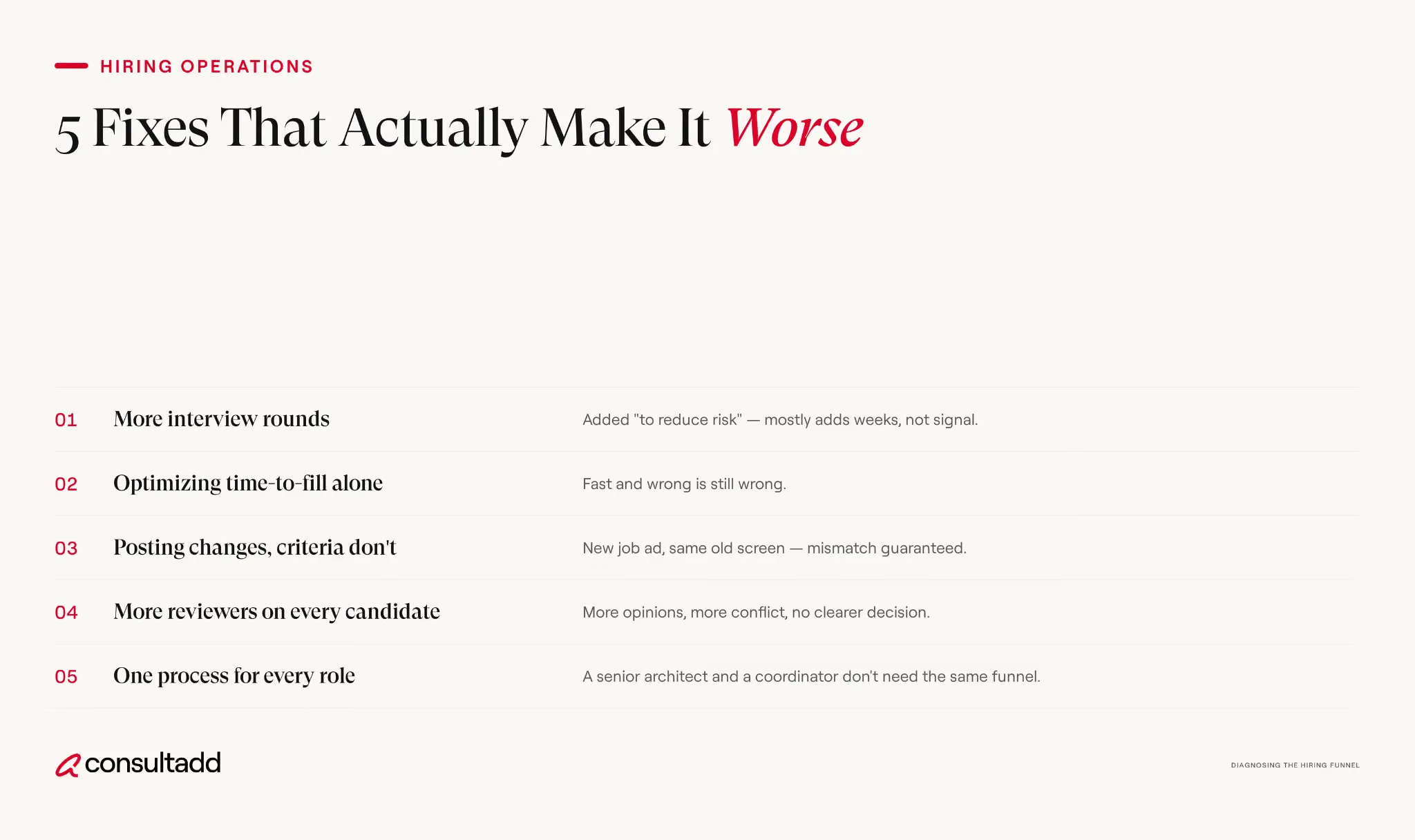
- Adding interview rounds to reduce risk. Every additional round adds days and increases the odds a strong candidate accepts elsewhere. If you don't trust the earlier rounds, fix those rather than stacking more on top.
- Optimizing for time-to-fill alone. A faster process that produces the same or worse quality of hire isn't an improvement; it's a different kind of expensive.
- Changing the job posting without changing the screening criteria. A better posting that still gets screened against vague criteria just produces a bigger pile of resumes nobody moves on.
- Bringing in more people to review candidates. More reviewers usually means more time spent reaching consensus, not faster decisions, unless each reviewer has a distinct, non-overlapping role.
- Treating every open role the same way. A niche technical hire and a high-volume entry-level role break down differently and need different fixes, not the same playbook.
If your process is struggling specifically because of limited internal recruiting capacity rather than a structural issue in the stages above, our overview of what a recruitment partner actually adds to your hiring process covers when outsourcing part of the pipeline makes sense versus when it just shifts the same bottleneck elsewhere.
Start Strong With Consultadd
With 15 years in business and 5,000+ successful staffing engagements, we don't just fill roles, we build reliability into your process. We've supported 65 staffing companies in the past year alone and maintain MSAs with industry leaders like Robert Half and TEKsystems.
Here's what working with Consultadd looks like:
- Talent sourced in under 24 hours
- Ready-to-deploy candidates, vetted for experience and compliance
- Lower turnover risk: we match long-term goals, not just short-term needs
- Seamless compliance: visa, documentation, onboarding? Handled.
- Dedicated 1:1 account managers for responsive, personalized support
- Top 100 candidate matches delivered in the past year
- Strong partnerships with universities to tap into fresh, committed talent
- Post-placement support so your investment grows beyond day one
For candidates, your next opportunity is more than just a job title, it's a chance to build skills, gain experience, and move your career forward. At Consultadd, we connect technology professionals with projects and employers that align with their goals, whether they're looking for contract, contract-to-hire, or long-term opportunities.
The tech job market moves fast, but the right guidance can make all the difference. Ready to take the next step in your career journey? Explore Opportunities >>
Key takeaways
- Diagnose which of the four stages, sourcing, screening, interviewing, or offer and close, is actually causing your delay before applying any fix.
- Screening and interviewing each average 8 to 9 days according to SHRM's 2025 data, which is a useful benchmark for spotting where your process runs long.
- The average cost per hire for non-executive roles is $5,475, and every added day in the pipeline compounds that cost even when nobody's tracking it directly.
- Only 20% of organizations measure quality of hire, so a faster process isn't automatically a better one unless you're checking outcomes too.
- Common fixes that backfire include adding interview rounds, adding reviewers, and optimizing speed without checking whether hire quality held up.
FAQs
What's the fastest way to improve a slow recruitment process?
Identify which stage, sourcing, screening, interviewing, or offer and close, is actually taking the longest before changing anything. Fixing the wrong stage adds effort without improving the timeline.
How long should recruitment stages typically take?
SHRM's 2025 benchmarking data shows screening and interviewing each averaging 8 to 9 days. If either stage in your process is running notably longer, that's likely your bottleneck.
Does a faster recruitment process mean a better one?
Not necessarily. Speed without a quality-of-hire check can hide the cost of rushed decisions. Only 20% of organizations formally track quality of hire, according to SHRM, which means most teams are optimizing on incomplete information.
Should I add more interview rounds to improve hiring decisions?
Generally no. Additional rounds add time and increase the risk of losing strong candidates to faster-moving employers. It's usually better to fix the structure of existing rounds than to add more of them.
What's a simple way to track where my recruitment process is breaking down?
Log the date each candidate enters and exits every stage in a basic spreadsheet. That alone usually reveals the bottleneck without needing dedicated software.
Is it worth using a staffing partner to improve the recruitment process?
It depends on whether the bottleneck is capacity, not enough recruiter time to run sourcing and screening well, or structural, like slow internal approvals. A staffing partner helps with the former but won't fix the latter on its own.

What Is a Hiring Manager in a Contract Staffing Chain?
Introduction
If you look it up, the answer to "what is a hiring manager" sounds simple: it's the person who owns the open position and makes the final call on who gets hired. That's true in a straightforward, direct-hire process.
It gets a lot less clear the moment a staffing agency, a vendor chain, or a C2C arrangement sits between you and the company that actually needs the work done.
That's the situation a lot of contract candidates and even some hiring companies find themselves in: multiple people who all look like the hiring manager, and no clear way to tell which one is actually deciding.
TL;DR
- A hiring manager is the person who owns the open role and makes the final hiring decision, usually the new hire's future supervisor.
- In a direct hire, that's one clear person. In a staffing or contract placement, you're often dealing with a recruiter, an agency account manager, and the end client's hiring manager at the same time.
- Only one of those people can actually approve you for the role. The other two influence the process but don't make the final call.
- Misreading who holds the decision costs candidates time, since they end up negotiating or following up with someone who has no authority to say yes.
- Asking directly who makes the final decision, early in the process, is the fastest way to find out where you actually stand.
The textbook definition
A hiring manager is the person responsible for filling a specific open position, typically a team lead or department manager who will supervise the new hire once they start.
Their job usually includes defining the role's requirements, interviewing top candidates, and making the final call on who gets an offer.
That's distinct from a recruiter, whose job is sourcing and screening candidates for the hiring manager to review.
The recruiter runs the process; the hiring manager owns the outcome. That distinction holds up fine in a typical direct-hire scenario, where there's one company and one clear reporting line.
Where the definition breaks down: contract and C2C placements
Once a role runs through a staffing agency, a vendor chain, or a corp-to-corp arrangement, "who's the hiring manager" stops having one answer.
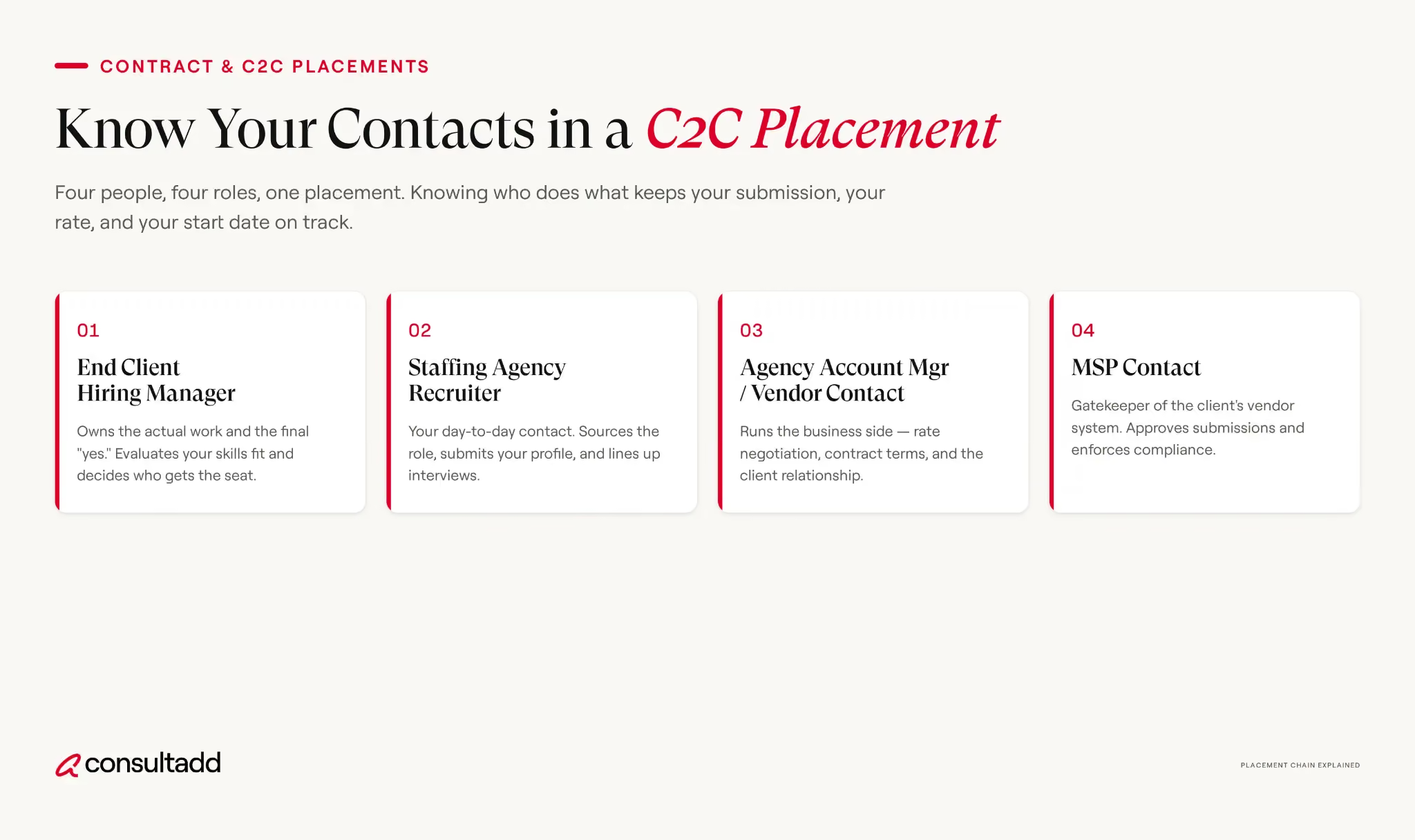
Depending on how the placement is structured, you might interact with:
- The end client's hiring manager. This is the person the textbook definition describes: they own the seat, they'll supervise you if you're placed, and they make the actual go or no-go call. In a staffing placement, you may or may not talk to them directly before an offer is made.
- The staffing agency recruiter. This person sources you, screens you, and submits your resume forward. They don't make the hiring decision, but they often control whether you're seen at all.
- The agency account manager or vendor contact. In C2C and multi-vendor placements, there's frequently a person managing the relationship between your staffing entity and the end client (or the next vendor up the chain). They can look like a decision-maker because they negotiate rate and terms, but the actual hire/no-hire call usually still sits with the end client's hiring manager.
- An MSP (managed service provider) contact, if the end client uses one to control its vendor list. This person manages process and compliance, not the hiring decision itself.
It's common for a candidate to go through two or three of these conversations without ever speaking directly to the person who actually approves the hire.
That's not necessarily a red flag; it's just how layered staffing engagements work.
But it means the standard advice about "impressing the hiring manager" doesn't map cleanly onto a contract placement unless you know which conversation that actually is.
How to figure out who's actually deciding
A few direct questions early in the process clear this up faster than guessing:
- Ask your recruiter or agency contact who at the client company will make the final decision, and whether you'll interview with them directly.
- If you're told there's a technical or panel interview, ask who's on the panel and who has veto power versus input only.
- If an offer or rate gets delayed, ask specifically whose sign-off it's waiting on. "The client" is not an answer; a name or title is.
- For multi-vendor placements, ask how many companies sit between you and the end client. That tells you how many approval layers exist before a decision reaches you.
Hiring delays are common even in direct-hire processes. SHRM's research on staffing metrics has tracked average time to fill in the range of several weeks
Every added layer of approval in a staffing chain tends to stretch that timeline further, since a request now has to travel up the chain and the decision has to travel back down.
Why this matters if you're negotiating or following up
If you're pushing for a faster answer or a rate adjustment, you want to be talking to the person who can actually say yes.
Negotiating hard with a recruiter or account manager who has no authority over the client's decision just burns goodwill without moving anything forward.
Once you know who the real decision-maker is, you can direct your follow-ups (through the appropriate channel) to the person whose answer actually matters, rather than escalating to someone who's only relaying information.
What this means if you're the one hiring
If you're the end client's hiring manager working with a staffing partner, the same confusion runs in reverse:
candidates may not realize you're the actual decision-maker, and may direct pushback or questions to your recruiter or account contact instead.
Being explicit early, letting the agency know you'll do a direct interview, or clarifying your role to the candidate when you do meet them, keeps the process moving and avoids the kind of miscommunication that slows down an otherwise strong hire.
If your hiring process is dragging for reasons beyond who's making the decision, this look at hiring and recruiting strategies covers the more common structural causes.
If you're evaluating whether to bring a contract hire on permanently once the engagement ends, our guide to how contract-to-hire actually works walks through that.
And if the placement is running through a corp-to-corp structure, it's worth understanding how the vendor chain itself affects rate and risk before assuming you know who's really in charge of the outcome.
Start Strong With Consultadd
With 15 years in business and 5,000+ successful staffing engagements, we don't just fill roles, we build reliability into your process. We've supported 65 staffing companies in the past year alone and maintain MSAs with industry leaders like Robert Half and TEKsystems.
Here's what working with Consultadd looks like:
- Talent sourced in under 24 hours
- Ready-to-deploy candidates, vetted for experience and compliance
- Lower turnover risk: we match long-term goals, not just short-term needs
- Seamless compliance: visa, documentation, onboarding? Handled.
- Dedicated 1:1 account managers for responsive, personalized support
- Top 100 candidate matches delivered in the past year
- Strong partnerships with universities to tap into fresh, committed talent
- Post-placement support so your investment grows beyond day one
For candidates, your next opportunity is more than just a job title, it's a chance to build skills, gain experience, and move your career forward. At Consultadd, we connect technology professionals with projects and employers that align with their goals, whether they're looking for contract, contract-to-hire, or long-term opportunities.
The tech job market moves fast, but the right guidance can make all the difference. Ready to take the next step in your career journey? Explore Opportunities >>
Key takeaways
- A hiring manager is the person who owns an open role and makes the final call on who's hired, usually the new hire's future supervisor.
- In staffing and C2C placements, that person is often one of three or four people you interact with, not the only one.
- Recruiters and account managers influence the process, but they typically can't approve a hire on their own.
- Asking directly who makes the final decision, and how many approval layers exist, saves time and avoids misdirected negotiation.
- If you're the hiring manager working through a staffing partner, being explicit about your role early keeps the process from stalling.
FAQs
What is a hiring manager, exactly?
A hiring manager is the person responsible for a specific open position, usually a team lead or department manager who will supervise the new hire and who makes the final decision on who gets the offer.
Is a hiring manager the same as a recruiter?
No. A recruiter sources and screens candidates and passes them along, while the hiring manager makes the final call on who's hired. In staffing and contract placements, there's often also an agency account manager or vendor contact between the two.
Who makes the final decision in a staffing agency placement?
Usually the end client's hiring manager, even though you may spend most of the process talking to a recruiter or account manager first. Ask directly whether you'll interview with the person who makes that call.
Why do I never seem to talk to the actual hiring manager in contract roles?
Layered staffing arrangements often route candidates through a recruiter and sometimes a vendor account manager before (or instead of) a direct conversation with the end client's hiring manager, especially in multi-vendor or C2C chains.
How do I know how many people are involved before a hiring decision is made?
Ask your recruiter or agency contact directly how many companies or approval layers sit between you and the end client. That number tells you how long a decision might take to travel back down.
Does it matter who I negotiate rate or start date with?
Yes. Negotiating with someone who doesn't have decision-making authority, like a recruiter relaying requests, usually just adds delay. Confirm who can actually approve changes before pushing hard on terms.