
Hiring & Recruitment

What Is Contract for Hire? Meaning, Pros, and Costs
Introduction
You get an offer, read the details, and stop at one line: "contract for hire." Nobody explains it in the job post, and the recruiter uses three different names for it on the same call.
So, what is contract for hire?
It's a hiring arrangement where you work a role for a fixed period, usually through a staffing agency, with the option for the client company to bring you on permanently at the end. You do the actual job from day one. The paperwork just sits somewhere else for a while.
Most people searching this term have already been offered one of these roles and want to know whether it's a real job or a stalling tactic.
Short answer: it's a real job, and roughly one in five conversions falls apart for reasons that have nothing to do with performance. The rest of this covers how the model works, what it costs each side, and the questions worth asking before you sign.
TL;DR
- Contract for hire (also called contract-to-hire, temp-to-hire, or C2H) means a fixed-term assignment with a built-in option to convert to a permanent role.
- During the contract, the staffing agency is your legal employer. It runs payroll, withholds taxes, and issues your W-2.
- Typical contract length runs three to twelve months. Six months is the most common in tech.
- Conversion is an option, not a guarantee. Budget freezes and reorgs kill more conversions than bad performance does.
- Hourly pay is often higher than the equivalent permanent salary, because benefits and job security usually start only after conversion.
What contract for hire actually means
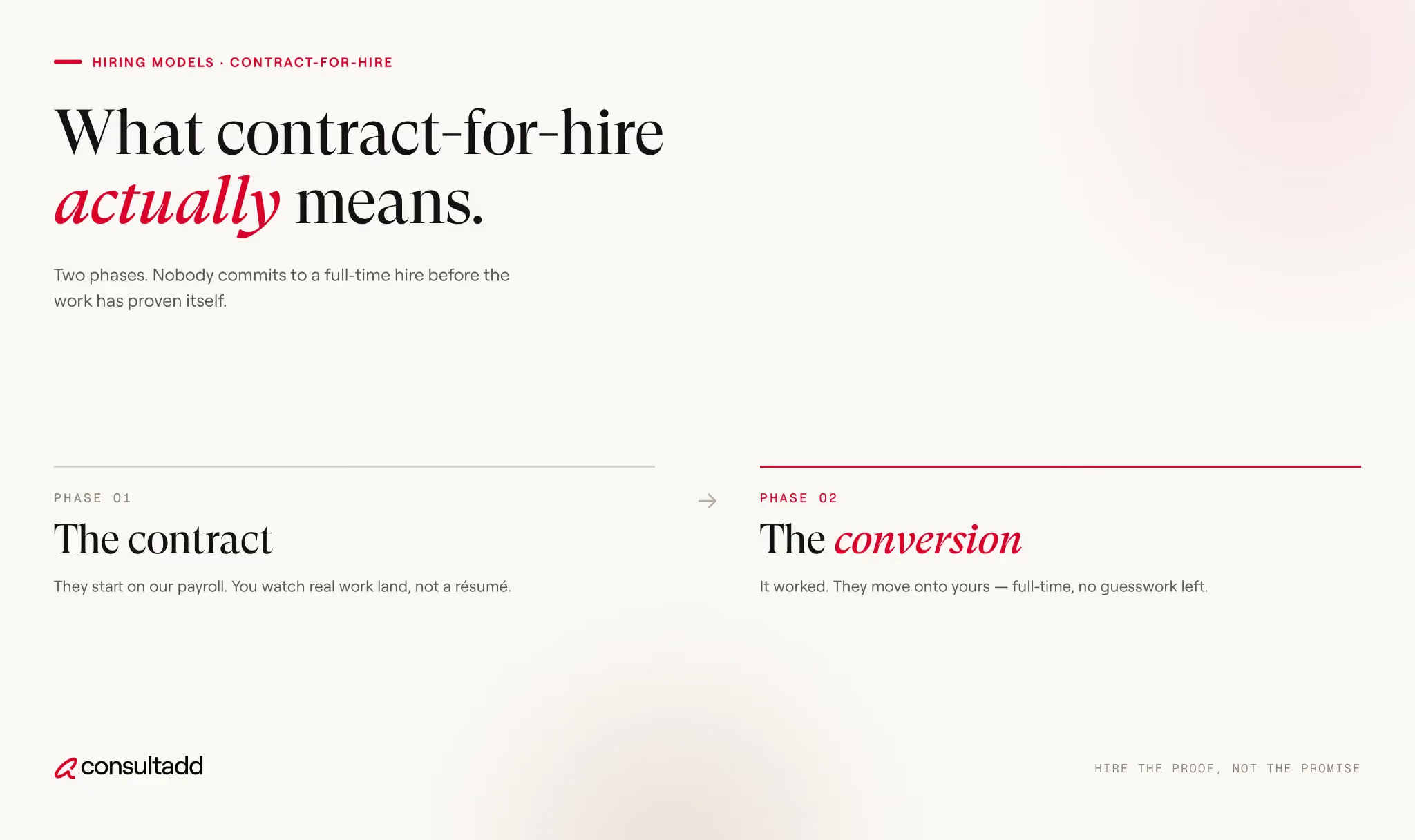
A contract for hire role has two phases.
Phase one is the contract.
- A staffing agency hires you, places you at a client company, and you work there on a defined assignment.
- Your manager, your standup, your tickets, your laptop: all of that comes from the client.
- Your paycheck comes from the agency.
Phase two is conversion.
- At the end of the contract term, the client decides whether to move you onto its own payroll as a permanent employee.
- If it does, the agency steps out.
- If it doesn't, the assignment ends and the agency looks for your next placement.
The naming is a mess and that's not your fault. Recruiters use "contract-to-hire," "temp-to-hire," "temp-to-perm," and "C2H" for the same thing.
"Contract for hire" is the phrasing a lot of candidates land on when they're typing it into Google. Same model.
Don't confuse it with "work made for hire" -
If your search turned up copyright pages, that's a different concept entirely. Under Section 101 of the Copyright Act, a "work made for hire" is about who owns the copyright in something an employee or commissioned contractor creates.
When a work is made for hire, the party that hired the individual counts as the author and copyright owner, not the person who actually created it. The U.S. Copyright Office covers this in Circular 30. It has nothing to do with staffing.
It's also not independent contracting -
This one trips up a lot of people.
A contract for hire worker is a W-2 employee of the staffing agency.
An independent contractor is self-employed, invoices on a 1099, and pays self-employment tax.
The distinction isn't cosmetic. The IRS states that misclassifying an employee as an independent contractor means the employer's share of taxes goes unpaid and the employee's share goes unwithheld, and a business that gets this wrong can be held liable for those employment taxes. You can read the agency's own summary in Worker Classification 101.
If a recruiter offers you a "contract for hire" role but wants you on a 1099, ask why.
Sometimes there's a legitimate corp-to-corp structure behind it, which we cover in the guide to C2C contract-to-hire opportunities. Sometimes it's just someone avoiding payroll taxes.
How the arrangement works, step by step
The mechanics are more predictable than the terminology suggests.
- The client company tells the staffing agency what it needs, including the contract length and the conversion intent.
- The agency sources and screens candidates, then submits a shortlist.
- The client interviews. This is usually shorter than a permanent loop, often one or two rounds.
- You accept an hourly rate and sign with the agency, not the client.
- The agency handles onboarding, background checks, work authorization, and payroll setup.
- You work the assignment. The agency invoices the client at a bill rate that covers your pay plus its employment costs and margin.
- Near the end of the term, the client decides on conversion. Sometimes it happens early.
Who employs you during the contract
- The staffing agency does.
BLS research on the temporary help services industry calls this the defining feature of the model: the contractual employment relationship sits with the employment services firm, not with the firm requesting the worker.
Practically, that means the agency owns your W-2, your timesheet approvals, your workers' comp, and whatever benefits it offers contractors.
Health coverage varies a lot between agencies. Ask before you sign, not after.
What happens at conversion
- Most client agreements include a conversion clause.
- It usually works one of two ways: the client pays a flat conversion fee to hire you directly, or the fee drops to zero once you've worked a set number of billable hours.
- That second structure is why a six-month contract often converts on month seven instead of month five.
- The fee schedule is doing the talking, not your review.
Contract for hire vs contract vs direct hire
These three sit next to each other on job boards and get confused constantly.
If you want the wider map of engagement models, including staff augmentation and managed services, the IT staffing services models guide lays them out side by side.
Why employers use it
Three reasons come up over and over in staffing conversations.
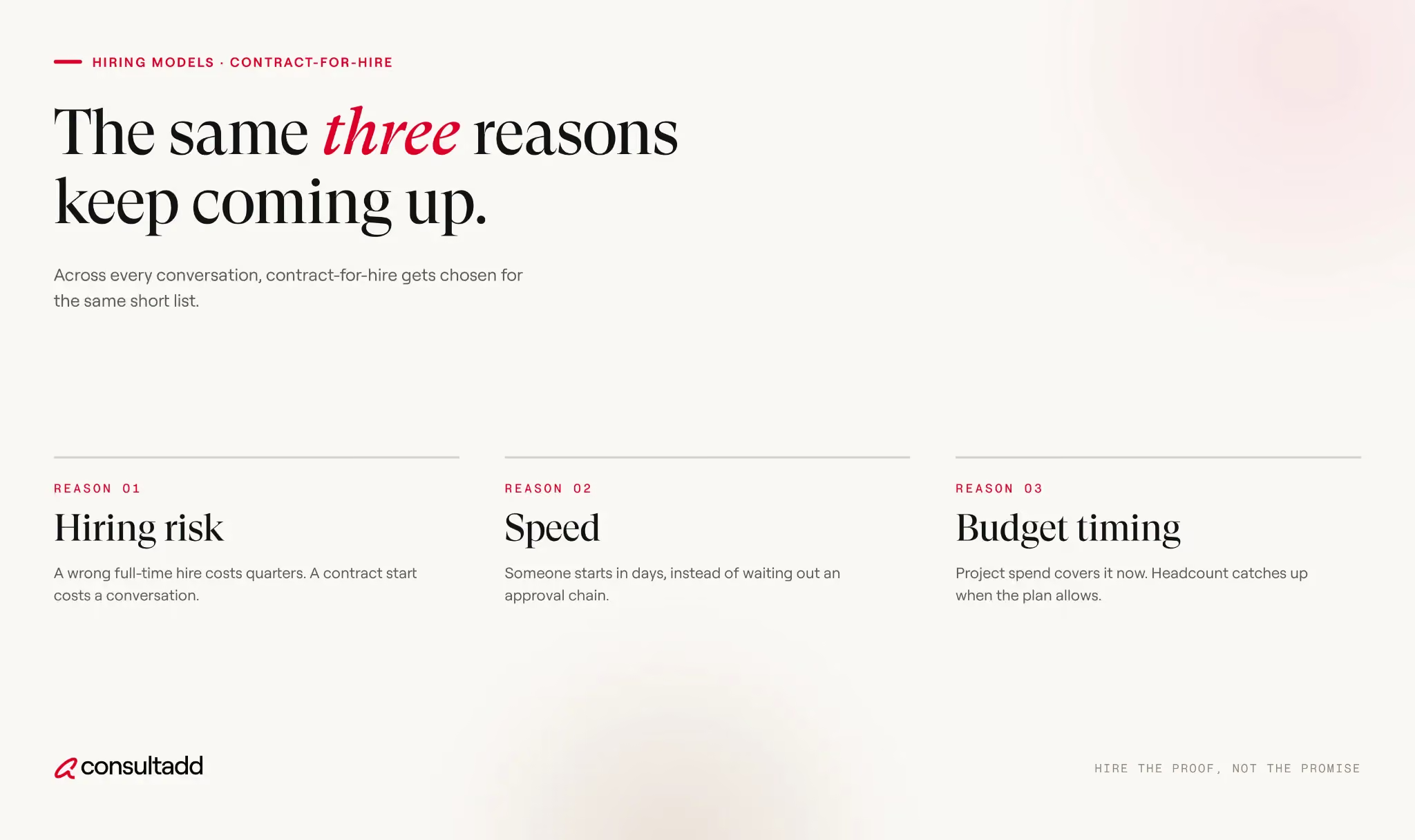
Hiring risk. A permanent hire commits a company to a salary, a benefits load, and months of ramp time based on a few hours of interviews. A contract for hire replaces some of that guesswork with observed work.
Speed. Permanent requisitions can sit for weeks waiting on headcount approval. Contract budgets often move faster because they come out of a different line. Agencies with active benches can submit candidates in days.
Budget timing. A team may know the work exists but not yet have approved a headcount. Contract for hire fills the seat now and converts once the budget lands.
This isn't a fringe pattern anymore. Analysis from KORE1 covering Q4 2025 through Q1 2026 found that contract-to-hire had become the default path for senior IT roles, with direct hire losing share in that segment quarter after quarter.
Consultadd's take on that shift is in IT contract staffing as a business strategy.
The volume shows up in federal data too. Staffing Industry Analysts, reading the June 2026 BLS Employment Situation, reported that temporary help services employment rose by 9,300 jobs and the temporary agency penetration rate held at 1.57%.
What it means for you as a candidate
The honest version, with both columns filled in.
One thing that isn't negotiable: a legitimate agency never charges you a fee. The client pays. If someone asks you for money to secure a placement, walk.
There's a longer read on the tradeoffs in contract to hire meaning, how it works, and who it's for.
Questions worth asking before you sign
Use this as a checklist. Ask the recruiter, and ask the hiring manager separately if you get the chance. If the answers don't match, that's information.
Where the model goes wrong
Two failure patterns are worth naming.
The first is the perpetual contract. The term ends, the extension arrives, conversion keeps sliding one quarter to the right. Set a personal deadline before you start and hold it.
The second is the phantom conversion. Some companies use contract for hire as cheap flexible labor and convert almost nobody. The role is honest work, but the permanent job at the end was never funded.
Both are avoidable with one conversation upfront. Neither is avoidable if you skip it.
So, what is contract for hire, in one line?
It's a fixed-term job with a permanent option attached, where a staffing agency employs you until the client takes over.
Used well, it gets you into a company faster than a permanent process would and lets you check the fit before you commit. Used badly, it's an extension treadmill.
The difference usually comes down to whether the permanent headcount is funded and whether anyone told you the truth about it. Ask early.
If the answer is straight, contract for hire is one of the more sensible ways to change jobs right now.
A closer look at both sides of that judgment call is in contract-to-hire benefits, pros, and cons.
Start Strong With Consultadd
With 15 years in business and 5,000+ successful staffing engagements, we don't just fill roles, we build reliability into your process. We've supported 65 staffing companies in the past year alone and maintain MSAs with industry leaders like Robert Half and TEKsystems.
Here's what working with Consultadd looks like:
- Talent sourced in under 24 hours
- Ready-to-deploy candidates, vetted for experience and compliance
- Lower turnover risk: we match long-term goals, not just short-term needs
- Seamless compliance: visa, documentation, onboarding? Handled.
- Dedicated 1:1 account managers for responsive, personalized support
- Top 100 candidate matches delivered in the past year
- Strong partnerships with universities to tap into fresh, committed talent
- Post-placement support so your investment grows beyond day one
For candidates, your next opportunity is more than just a job title, it's a chance to build skills, gain experience, and move your career forward. At Consultadd, we connect technology professionals with projects and employers that align with their goals, whether they're looking for contract, contract-to-hire, or long-term opportunities.
The tech job market moves fast, but the right guidance can make all the difference. Ready to take the next step in your career journey? Explore Opportunities >>
Key takeaways
- Contract for hire means a fixed-term assignment through a staffing agency with an option to convert to permanent employment at the end.
- You're a W-2 employee of the agency during the contract, not an independent contractor, and the IRS treats that distinction as a matter of substance rather than labels.
- Terms usually run three to twelve months, and conversion timing is often driven by the agency's fee schedule rather than your performance.
- Hourly pay tends to beat the equivalent permanent salary, while benefits and job security typically start at conversion.
- Ask about approved headcount and the client's real conversion rate before you sign. Those two answers predict the outcome better than anything else.
FAQs
Is contract for hire the same as contract-to-hire?
Yes. Contract for hire, contract-to-hire, temp-to-hire, temp-to-perm, and C2H all describe the same arrangement. The phrasing shifts between recruiters and job boards, but the structure is identical: a fixed term with a conversion option.
Do contract for hire employees get benefits?
During the contract, benefits come from the staffing agency, and coverage varies widely between agencies. Some offer full medical, dental, and 401(k) access. Others offer very little. Once you convert, you move onto the client's plan like any other employee.
How long does a contract for hire position last?
Most run three to twelve months, with six months being the most common in technology roles. Extensions are normal. If a client extends more than once without discussing conversion, treat that as a signal worth raising directly.
Can I turn down the permanent offer at the end?
Yes. Conversion is a decision both sides make. If the team, the work, or the salary isn't what you expected, you can decline and let the agency place you elsewhere. Declining doesn't usually damage your standing with a good agency.
Is contract for hire a bad sign about the company?
Not on its own. Plenty of well-run companies use it to move faster than their permanent hiring process allows or to fill a seat while headcount clears approval. It becomes a bad sign when nobody can tell you whether the permanent role is actually funded.
Do I pay the staffing agency anything?
No. The client company pays the agency, and the agency pays you. Reputable firms never charge candidates a placement fee. Any request for payment to secure a role is a reason to end the conversation.

AWS Developers for Hire: Costs, Models, and Screening
Introduction
Most searches for AWS developers for hire start from the same place: a project has a cloud component, the internal team is at capacity, and someone needs a person in a seat within weeks rather than months.
The question is rarely whether to hire. It is which hiring model fits the timeline, what the rate should actually be, and how to tell a real AWS engineer from a resume with a lot of service names on it.
This guide covers all three, with the cost benchmarks pulled from federal wage data rather than salary aggregators.
TL;DR
- "AWS developer" is not one role. Decide first whether you need an application developer who deploys to AWS, a DevOps or platform engineer, or a solutions architect, because they screen and price differently.
- The U.S. median wage for software developers was $135,980 in May 2025 per the Bureau of Labor Statistics, with the middle 80% falling between roughly $82,000 and $215,000. AWS skills sit toward the upper half of that band, not outside it.
- Four realistic models: direct hire, contract, contract-to-hire, and staff augmentation. Speed and commitment trade against each other.
- Certifications confirm vocabulary and breadth, not judgment. The AWS Certified Developer exam guide is still useful as a screening map, because it tells you exactly what domains to probe.
- The strongest signal in an interview is a candidate describing something that broke in production on AWS and what they changed afterward.
What an AWS developer actually does
The phrase covers at least four distinct jobs, and hiring the wrong one is the most common expensive mistake here. A team that needs someone to build serverless application logic does not need an architect, and an architect will be bored and gone in five months.
If you cannot say which row you are hiring for, that is the first thing to settle. Everything downstream, the rate, the screening questions, the job posting, depends on it.
One useful check: write down the three things this person will ship in their first 90 days. If those three things are all application features, you want the first row and you should weight language skill above AWS breadth.
Four ways to hire AWS developers
Direct hire is the right default for roles that will exist in three years. It is the wrong choice for a six-month migration, because you end up overstaffed the moment the project lands.
Contract and staff augmentation solve the timeline problem. The distinction is mostly scale and shape: contract tends to be one specialist for a defined scope, staff augmentation tends to be several engineers plugging into an existing team while you retain ownership of the roadmap.
Our buyer's guide to IT staff augmentation companies walks through how to evaluate partners in that model, and the IT contract staffing buyer's guide covers how the engagement mechanics and pricing actually work.
Contract-to-hire deserves more consideration than it usually gets for cloud roles specifically. AWS work is one of the areas where a resume and a two-hour interview genuinely under-predict performance, because so much of the skill is operational judgment that only shows up under load.
Freelance marketplaces are a fifth option and they work fine for small, bounded, low-risk pieces of work. They are a poor fit when the engineer needs production access, when compliance matters, or when someone has to be accountable six months from now.
What AWS developers cost in 2026
Start from real wage data rather than salary-aggregator averages, which are self-reported and skew high.
The Bureau of Labor Statistics puts the May 2025 median annual wage for software developers at $135,980, or about $65 an hour.
The distribution matters more than the median: the lowest 10% earned under $82,460 and the highest 10% earned over $214,670. Industry changes the picture too, with software publishers at a $164,550 median against $132,050 in computer systems design and related services.
Two honest caveats:
- BLS does not break out AWS as a skill, so treat these as the occupational band that AWS developers sit inside, generally in its upper half for experienced people.
- BLS wages exclude equity and annual bonuses, so for senior roles at large tech employers these are a floor on cash, not a ceiling on total compensation.
Converting to a contract bill rate is a separate calculation. A bill rate has to cover the engineer's pay plus employer payroll taxes, benefits, insurance, and the supplier's margin, so it always sits meaningfully above the equivalent salary hourly figure.
For direct hire through an agency, placement fees commonly run 15% to 30% of first-year salary, which on a $140,000 role is $21,000 to $42,000.
Geography still moves the number more than most single factors, even for remote roles, because compensation bands tend to anchor to where the engineer lives.
How to screen AWS skills
This is where most hiring processes are weakest, usually because the person running the screen is not a cloud engineer.
What certifications tell you, and what they don't
An AWS certification is a real signal about breadth and vocabulary. It is a weak signal about judgment, and it says nothing about whether someone has ever debugged a production incident.
Three credentials come up most for developer hiring, and all three are current in AWS's own exam guide index: Solutions Architect Associate (SAA-C03), Developer Associate (DVA-C02), and DevOps Engineer Professional (DOP-C02).
AWS revises and retires certifications periodically, so check the official AWS certification exam guides rather than a training vendor's list before you put a specific cert in a job requirement.
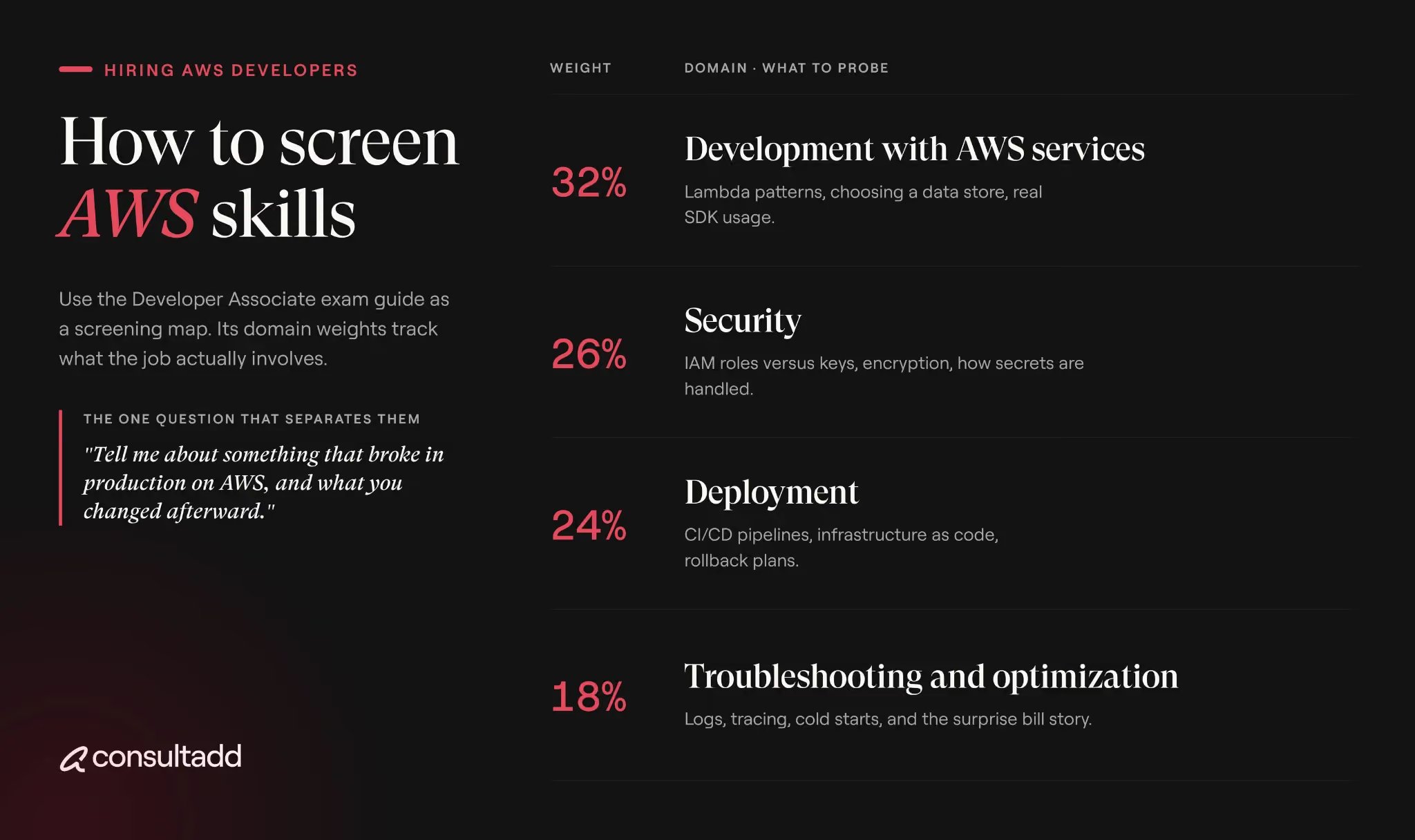
The more useful move is to treat the exam guide as a screening map. The Developer Associate exam guide weights its content like this, which is a reasonable proxy for what the role involves day to day:
AWS notes the exam runs 130 minutes with 50 scored questions and a passing scaled score of 720, which is worth knowing only so you understand a pass is a meaningful bar rather than a formality.
Questions that separate experience from keywords
Skip trivia. Nobody needs to recite S3 storage class names. Ask instead:
- Tell me about something that broke in production on AWS. What was the failure, how did you find it, and what did you change afterward?
- Walk me through how you handle secrets and credentials in a deployed application.
- When did you last get a surprising AWS bill, and what caused it?
- Where would you use a managed service instead of running it yourself, and where would you go the other way?
- How do you set up permissions for a new service? Talk me through the IAM decisions.
The cost question is unusually diagnostic. Engineers who have genuinely owned AWS environments all have a cost story, usually involving data transfer, an over-provisioned instance family, or logs nobody was rotating. Candidates who have only worked inside someone else's account typically have nothing.
For the technical stage itself, a short scoped exercise beats a whiteboard. Ask for something small and real, like a Lambda handler with the IAM policy it would need, or a review of a deliberately flawed CloudFormation template.
Writing a job description that filters properly
Vague postings produce vague applicant pools. Three fixes do most of the work.
Name the services. "Experience with AWS" filters nothing. "Lambda, API Gateway, DynamoDB, and CloudFormation in production" filters usefully.
Separate must-haves from nice-to-haves honestly, and keep must-haves to four or five items. Long requirement lists are the main reason strong candidates self-select out, and they disproportionately deter people who read requirements literally.
State the language and the scale. A Python-heavy serverless shop and a Java monolith being containerized onto ECS are different jobs that both call themselves AWS development.
Also be upfront about the engagement model and whether the role is remote, hybrid, or onsite. Ambiguity there wastes both sides' time at the offer stage more than anywhere else in the process.
If you are still weighing whether this is a staffing problem or a consulting one, our comparison of IT staffing and consulting companies draws the line between buying talent and buying advice.
Red flags worth taking seriously
Certifications with no matching project history. Three certs and no described production work is a study record, not an experience record.
Service lists without architecture. A resume naming 25 AWS services in a skills block, where the project descriptions never explain a single design decision, usually means exposure rather than ownership.
No cost awareness. Anyone who has run workloads on AWS at any scale has thought about spend. Silence here is informative.
Only greenfield stories. Most real AWS work is inheriting something awkward and improving it without downtime. Candidates who have only built from scratch often struggle with that.
Vagueness about their own contribution. "We migrated the platform" is not an answer. What did this person do?
Independent verification helps here, especially at volume. Structured processes usually combine resume screening, a skills assessment, a technical interview, and reference or background checks, each catching something the others miss.
Our breakdown of the online candidate vetting process covers how to sequence those stages without slowing the pipeline to a crawl.
How long hiring actually takes
The compressed timeline in the right-hand column depends entirely on whether your partner actually maintains a pre-vetted pool or starts recruiting the day you send the requirement. That is the single question worth pressing hardest when evaluating suppliers, because the pitch sounds identical either way.
Demand context, for what it is worth: BLS projects 10% employment growth for software developers from 2025 to 2035, faster than the average across occupations, with about 106,100 openings a year across the developer and QA group.
Staffing Industry Analysts puts U.S. IT staffing at roughly $37 billion, among the faster-growing staffing segments. Neither number tells you what your specific search will cost, but both explain why cloud searches rarely get easier by waiting.
Work authorization and compliance
Worth settling early rather than at the offer stage. Confirm work authorization status during screening, understand whether sponsorship is in play, and know who carries the employment relationship in a contract or augmentation arrangement, because that determines who handles I-9 verification, payroll taxes, and insurance.
If sponsorship comes up and you have not dealt with it before, how visa sponsorship works covers what the employer side actually involves and what it costs in time.
Start Strong With Consultadd
With 15 years in business and 5,000+ successful staffing engagements, we don't just fill roles, we build reliability into your process. We've supported 65 staffing companies in the past year alone and maintain MSAs with industry leaders like Robert Half and TEKsystems.
Here's what working with Consultadd looks like:
- Talent sourced in under 24 hours
- Ready-to-deploy candidates, vetted for experience and compliance
- Lower turnover risk: we match long-term goals, not just short-term needs
- Seamless compliance: visa, documentation, onboarding? Handled.
- Dedicated 1:1 account managers for responsive, personalized support
- Top 100 candidate matches delivered in the past year
- Strong partnerships with universities to tap into fresh, committed talent
- Post-placement support so your investment grows beyond day one
For candidates, your next opportunity is more than just a job title, it's a chance to build skills, gain experience, and move your career forward. At Consultadd, we connect technology professionals with projects and employers that align with their goals, whether they're looking for contract, contract-to-hire, or long-term opportunities.
The tech job market moves fast, but the right guidance can make all the difference. Ready to take the next step in your career journey? Explore Opportunities >>
Key takeaways
- Before you look at AWS developers for hire, decide which of the four cloud roles you actually need, because application developers, platform engineers, architects, and data engineers screen and price differently.
- Use BLS wage data as your cost anchor: a $135,980 median for software developers in May 2025, with the middle 80% spanning roughly $82,000 to $215,000, and remember contract bill rates sit above the salary-equivalent hourly figure.
- Match the hiring model to the work. Permanent and central means direct hire. Time-bound or uncertain means contract, contract-to-hire, or staff augmentation.
- Treat AWS certifications as evidence of breadth, and use the official exam domain weightings as a map for what to probe in interviews.
- The best screening questions are about failures, security decisions, and cost surprises. Those cannot be answered from a study guide.
FAQs
How much does it cost to hire an AWS developer?
Use the software developer occupational band as your anchor: a $135,980 U.S. median in May 2025, with the 10th percentile at $82,460 and the 90th at $214,670. Experienced AWS engineers generally sit in the upper half of that range. For contract engagements the bill rate runs above the salary-equivalent hourly rate because it also covers employer taxes, benefits, insurance, and supplier margin.
Should I hire an AWS developer full time or on contract?
Contract fits defined projects, migrations, and capacity gaps, and it gets someone working in days or weeks rather than months. Direct hire fits roles that will still exist in a few years and sit close to your core product. Contract-to-hire is a reasonable middle path for cloud roles specifically, since operational judgment is hard to assess in an interview.
Do AWS certifications actually matter when hiring?
They are a genuine signal of breadth and shared vocabulary, and they are useful for filtering large applicant pools. They do not demonstrate judgment or production experience. The more valuable use is reading the official exam guide domains and building your interview questions from them.
What is the difference between an AWS developer and a cloud engineer?
An AWS developer primarily writes and deploys application code that runs on AWS. A cloud engineer or platform engineer focuses on the infrastructure that code runs on, including networking, CI/CD, containers, and monitoring. The titles overlap in practice, so define the work rather than relying on the label in a resume.
How long does it take to hire an AWS developer?
A direct hire realistically takes two to four months from defining the role to a productive engineer, most of it in sourcing, interviews, and notice periods. Contract or staff augmentation can compress that to days or a few weeks, but only when the partner maintains an already-vetted pool rather than starting a search on receipt of the requirement.
How do I evaluate AWS skills if nobody on my team knows AWS?
Use a two-part approach. Ask experience questions that are hard to fake, particularly about production failures, IAM and secrets decisions, and unexpected bills. Then bring in an external technical screen or a staffing partner who runs one, and ask to see the actual assessment rather than a summary rating.

What Is Strategic Workforce Planning? A 2026 Guide
Introduction
Most companies plan their budgets three years out and their workforce three weeks out. A role opens, someone scrambles to fill it, and the hire is judged on how fast the seat gets filled rather than whether it was the right seat. That gap between long-term strategy and short-term hiring is exactly what strategic workforce planning closes.
So what is strategic workforce planning? It's the ongoing process of aligning your workforce, its size, skills, roles, and cost, with where the business is heading. The goal is simple to state and hard to do: the right people, with the right skills, in the right roles, at the right time and cost.
Think of it as a roadmap for your talent. You figure out where you are, where the business is going, and the best route to staff the journey. This guide covers what it means, why it matters more in 2026, the framework to follow, and how to close the gaps you find.
TL;DR
- Strategic workforce planning aligns your workforce with business strategy, so you have the right skills in the right roles at the right cost.
- It's proactive and long-term, unlike operational headcount planning, which reacts to immediate vacancies.
- The framework runs five steps: analyze your current workforce, forecast demand, spot the gaps, build a plan, then measure and adjust.
- Good planning focuses on critical roles, following the 80/20 rule, rather than trying to map every position equally.
- Closing gaps comes down to build, buy, or borrow: train existing staff, hire new talent, or bring in flexible contract workers.
What is strategic workforce planning?
Strategic workforce planning is the process of analyzing your current workforce and mapping the steps needed to meet future business goals. It ties talent decisions to strategy, so your people plan supports where the company is going rather than just where it stands today.
At its core, it answers four questions about your workforce.
- Do you have the right size, meaning the correct number of people without overstaffing or chronic vacancies?
- The right shape, meaning the right mix of skills and seniority?
- The right cost?
- And the right agility to adapt as things change?
Get these four aligned with your strategy, and hiring stops being a fire drill. It becomes a deliberate part of how the business grows.
Strategic vs operational workforce planning
People often confuse strategic workforce planning with everyday headcount planning. They're related, but they operate on different horizons.
Operational planning fills immediate seats. A role opens, you hire for it. It's reactive and short-term, and every company does it whether they mean to or not.
Strategic workforce planning is proactive and tied to the future. It looks years ahead, anticipates the skills the business will need, and plans for internal mobility, reskilling, restructuring, and sometimes reducing headcount where the business has moved on.
Both matter. But if you only ever do the operational kind, you're always one step behind your own strategy.
Why strategic workforce planning matters in 2026
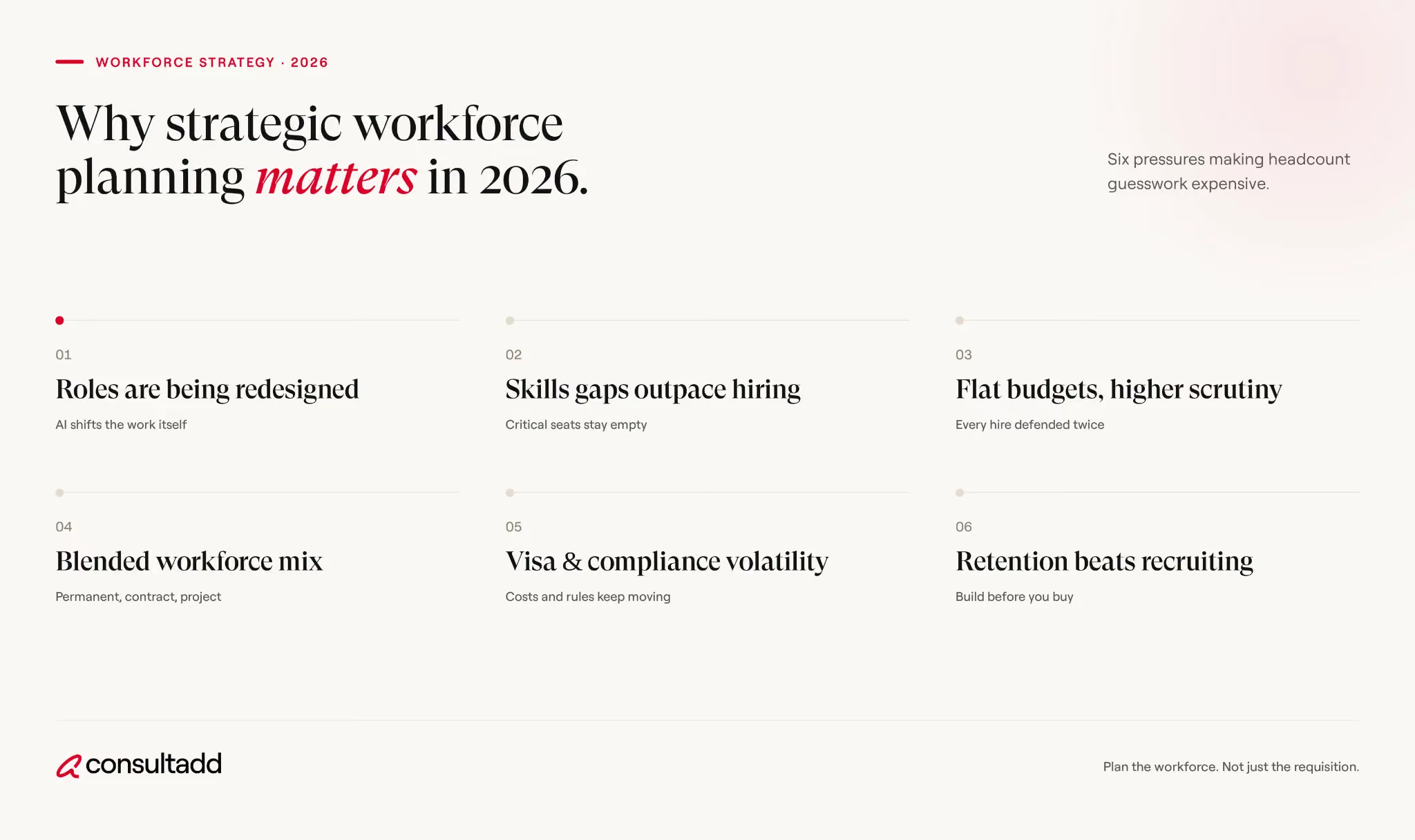
The case for planning ahead has never been stronger, and one force explains most of it: the pace of change in what work requires.
Skills are shifting fast, largely because of AI.
Gartner's 2026 research with chief HR officers, drawn from more than 400 CHROs across dozens of industries and multiple regions, named shaping work in the human-machine era as one of the top priorities for the year.
That's a planning problem before it's a hiring problem. You can't react your way through a change that reshapes entire roles.
Beyond that, good planning delivers concrete benefits.
It closes skills gaps before they stall projects. It reduces turnover risk by anticipating retirements and resignations.
It controls labor cost by preventing both overstaffing and expensive emergency hires. And it gives you the agility to scale up or down as conditions change.
Demand forecasting also leans on external signals, not just internal ones.
Public data such as the Bureau of Labor Statistics employment projections can inform how you think about future skill availability and labor market direction.
The through-line is that planning turns talent from a cost you manage into a lever you use.
The strategic workforce planning framework
While the details vary by organization, most workforce planning follows the same five-step arc. Work through them in order.
- Analyze your current workforce. Establish the baseline. Who's in your workforce, what skills do they bring, what does it cost, and how is the work organized? This is also where you spot where risk is already building.
- Forecast future demand. Translate business strategy into the workforce you'll need, in both scale and capability. Accurate business forecasts drive this, so involve leaders beyond HR.
- Identify the gaps. Compare what you have against what you'll need, factoring in expected turnover, retirements, and internal supply. The difference is your skills gap.
- Build the plan. Decide how to close each gap, whether through training, hiring, internal moves, or flexible talent. This is where insight becomes action.
- Implement, measure, and adjust. Put the plan into motion and track it with clear metrics. Workforce planning is ongoing, not a one-time exercise, so revisit it as the business shifts.
Skills data ties steps two and three together. Tracking capabilities, gaps, and development progress is how you close the distance between what you have and what you're building toward.
The principles behind good workforce planning
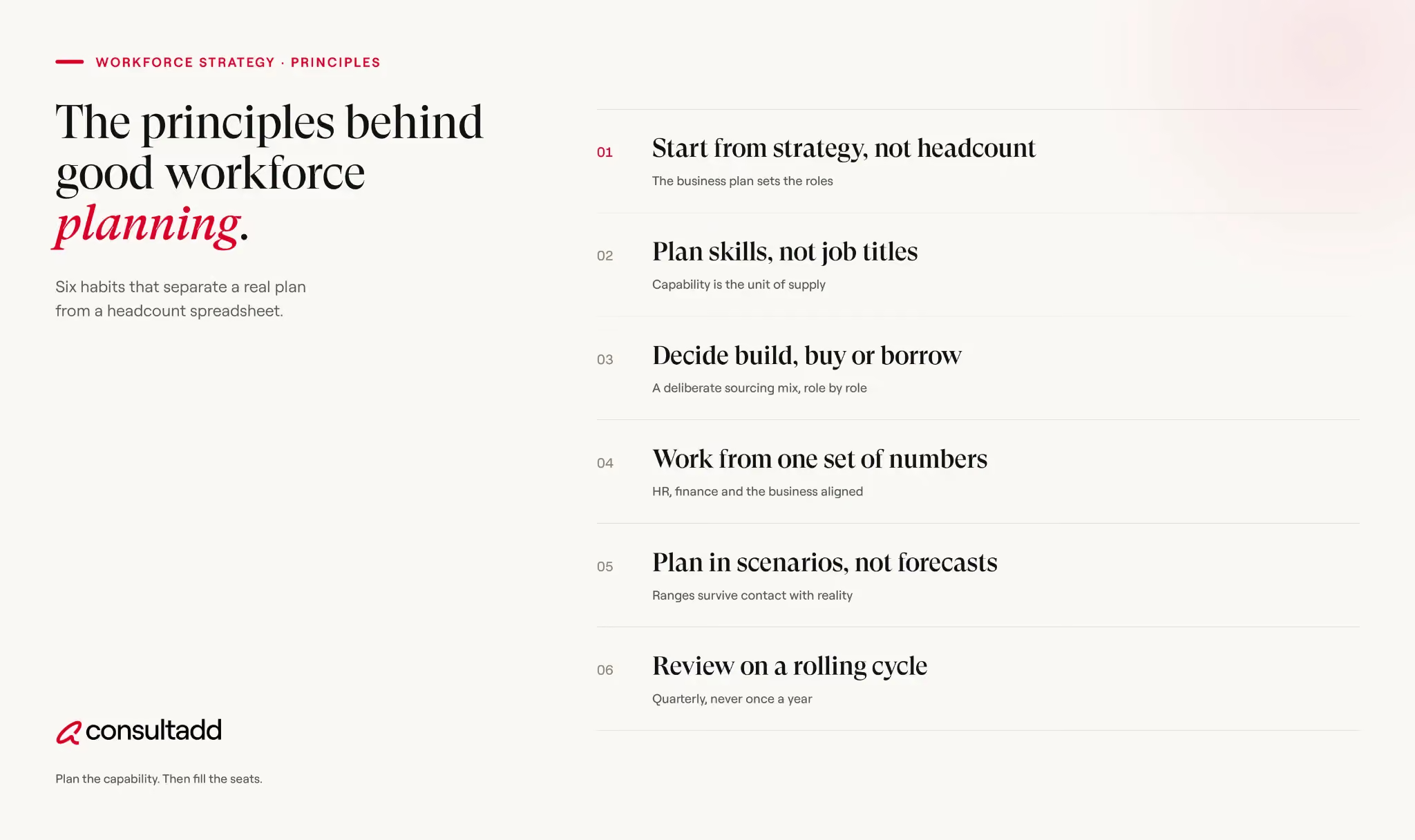
A framework tells you what to do. These three principles tell you how to do it well.
First, align to strategy.
Your organizational strategy is the long-term plan for what the company wants to achieve over the next several years, and it should be the guideline for your workforce plan. If the two aren't connected, you're planning in a vacuum.
Second, focus on critical roles.
Good planning follows the 80/20 rule: a small share of roles drives most of your results. Rather than mapping every position with equal effort, concentrate on the critical roles that contribute most to the outcomes you care about.
Third, keep a long-term view.
Workforce planning is about tactical and strategic decisions, so it takes a multi-year perspective rather than reacting to this week's staffing pressure. That long lens is what separates it from ordinary recruiting.
Build, buy, or borrow: closing the skills gap
Once you've found the gaps, you have three ways to close them. Smart plans use all three, matched to the situation.
Building works when you have time and want to grow people from within. Buying makes sense for core roles you'll rely on for years, and a strong hiring process matters here.
Consultadd's technical recruitment guide covers how to hire critical skills well, while its high-volume hiring strategies help when you're scaling a function quickly.
Borrowing is the leverage companies underuse. Contract and contingent talent lets you add specialized skills fast, cover a project, or scale flexibly without permanent overhead, which is exactly the agility strategic planning calls for.
Consultadd's breakdown of the contract-to-hire model shows how the borrow approach can also become a low-risk path to a permanent hire.
The best workforce plans don't pick one approach. They blend building, buying, and borrowing to hit the right size, shape, cost, and agility as the business evolves.
Start Strong With Consultadd
With 15 years in business and 5,000+ successful staffing engagements, we don't just fill roles, we build reliability into your process. We've supported 65 staffing companies in the past year alone and maintain MSAs with industry leaders like Robert Half and TEKsystems.
Here's what working with Consultadd looks like:
- Talent sourced in under 24 hours
- Ready-to-deploy candidates, vetted for experience and compliance
- Lower turnover risk: we match long-term goals, not just short-term needs
- Seamless compliance: visa, documentation, onboarding? Handled.
- Dedicated 1:1 account managers for responsive, personalized support
- Top 100 candidate matches delivered in the past year
- Strong partnerships with universities to tap into fresh, committed talent
- Post-placement support so your investment grows beyond day one
For candidates, your next opportunity is more than just a job title, it's a chance to build skills, gain experience, and move your career forward. At Consultadd, we connect technology professionals with projects and employers that align with their goals, whether they're looking for contract, contract-to-hire, or long-term opportunities.
The tech job market moves fast, but the right guidance can make all the difference. Ready to take the next step in your career journey? Explore Opportunities >>
Key takeaways
- Strategic workforce planning aligns your workforce with business strategy so you have the right skills, in the right roles, at the right cost.
- It's proactive and long-term, unlike operational planning, which reacts to immediate vacancies.
- The framework runs five steps: analyze the current workforce, forecast demand, identify gaps, build the plan, then measure and adjust.
- Strong planning aligns to strategy, focuses on critical roles using the 80/20 rule, and keeps a multi-year view.
- Close skills gaps by blending build, buy, and borrow, using contract talent for the flexibility that planning calls for.
FAQs
What is strategic workforce planning in simple terms?
It's the process of making sure your organization has the right people, with the right skills, in the right roles at the right time and cost. It connects your talent decisions to your business strategy, looking years ahead rather than just filling today's open jobs. Think of it as a roadmap for your workforce.
What is the difference between strategic and operational workforce planning?
Operational planning fills immediate vacancies and is reactive and short-term. Strategic workforce planning is proactive and long-term, anticipating the skills and roles the business will need in the future. Operational planning asks "who do we hire now," while strategic planning asks "what workforce will our strategy require."
What are the steps in the strategic workforce planning process?
Most frameworks follow five steps: analyze your current workforce, forecast future demand based on business strategy, identify the gaps between the two, build a plan to close them, and then implement, measure, and adjust. Because business needs change, the process is ongoing rather than a one-time project.
Why is strategic workforce planning important?
It closes skills gaps before they stall projects, reduces turnover risk, controls labor costs, and gives you the agility to adapt. In 2026, with AI rapidly reshaping what roles require, planning ahead matters more than ever. It turns talent from a cost you manage into a strategic advantage.
What is the build, buy, borrow framework?
It's a way to close workforce gaps using three options. Build means training and developing existing employees. Buy means hiring new permanent staff. Borrow means bringing in contract or contingent talent for specialized or short-term needs. Most effective plans blend all three depending on the role and timeline.
How often should you update a workforce plan?
Strategic workforce planning is continuous, not a set-and-forget document. Most organizations review it at least annually, aligned with business planning cycles, and revisit it whenever strategy shifts significantly. Tracking metrics throughout the year lets you adjust before small gaps become big problems.

The Executive Recruitment Process Explained
Introduction
Hiring a mid-level engineer and hiring a chief financial officer are not the same job scaled up. They're different work entirely. One draws from people actively looking. The other means persuading someone who's performing well, isn't looking, and is already being courted by three other companies to take your call.
That's the heart of the executive recruitment process: a structured, confidential, proactive method for identifying and securing senior leaders, usually vice president level and above. It relies on direct outreach and deep assessment rather than job postings and applications, because the people you want aren't reading job postings.
This guide walks through the full process, the stages, the fee models, realistic timelines, and how top candidates are actually evaluated, so you understand what a serious executive search involves and why it's built the way it is.
TL;DR
- Executive recruitment is a proactive, confidential process for hiring senior leaders, typically VP-level and above, including C-suite and board roles.
- It targets passive candidates through direct outreach and market mapping, not job ads, because the best leaders aren't actively looking.
- The process runs roughly seven stages, from intake brief to onboarding, and commonly takes three to six months.
- The main fee models are retained (upfront, exclusive) and contingency (paid on placement), with retained fees often 25% to 35% of first-year pay.
- The stakes are high: a failed executive hire can cost two to three times the role's annual salary, so rigorous assessment is the whole point.
What is the executive recruitment process?
The executive recruitment process, often called executive search, is the specialized practice of finding, assessing, and placing senior leaders. Think CEOs, CFOs, CHROs, VPs, and board members, the roles that set a company's direction.
What separates it from standard recruiting is the approach. Instead of posting a role and waiting for applications, executive search proactively identifies specific individuals, maps the market, and reaches out directly. Much of it happens confidentially, sometimes without even naming the hiring company until a candidate is genuinely engaged.
It's also deeply consultative. A good search starts by understanding the company's strategy, culture, and the actual problem the new leader needs to solve, not just a list of qualifications. The output isn't a pile of resumes. It's a short list of qualified, assessed, and interested leaders.
That difference in method exists for a reason, which is worth understanding before the stages make sense.
Why executive hiring is different
Executive roles carry outsized consequences, and the process is shaped around that reality.
The first factor is the candidate pool.
- The people best qualified to run a function or a company are usually already doing so somewhere else.
- They're passive, performing well, and fielding multiple approaches at once.
- You can't wait for them to apply. You have to give them a reason to move.
The second factor is the cost of getting it wrong.
- A failed executive hire is one of the most expensive mistakes a company can make.
- Replacement costs routinely run two to three times the role's annual salary once you count lost productivity, team disruption, the time leaders spend covering the gap, and the cost of restarting the search.
- For a C-suite role, that's a material business risk, not a recoverable inconvenience.
The third factor is fit.
- At this level, capability alone isn't enough.
- Leadership style, values, and the ability to align with the company's direction matter as much as the resume.
- That's why the assessment goes far deeper than a standard interview loop.
The seven stages of the executive recruitment process
While firms describe it slightly differently, a rigorous executive search follows the same core arc. Here are the seven stages that structure most engagements.
- Intake and discovery. The firm meets with stakeholders to understand the company, the strategy, and what success in the role actually looks like. This deep briefing shapes everything downstream.
- Position specification. The team turns that discovery into a detailed success profile: the competencies, experience, and leadership qualities the role genuinely requires.
- Market research and talent mapping. Researchers map the market to identify specific target individuals, including people at competitors and adjacent industries.
- Candidate outreach. The firm approaches those targets directly and discreetly, describing the opportunity compellingly while protecting the client's confidentiality until candidates are qualified.
- Assessment and evaluation. Interested candidates go through structured interviews, competency assessment, and often psychometric testing and case work.
- Shortlist and client interviews. The firm presents a short list of vetted candidates, and the client interviews them, frequently across multiple stakeholders.
- Offer, negotiation, and onboarding. The firm advises on compensation, helps close the offer, and supports the executive's transition into the role.
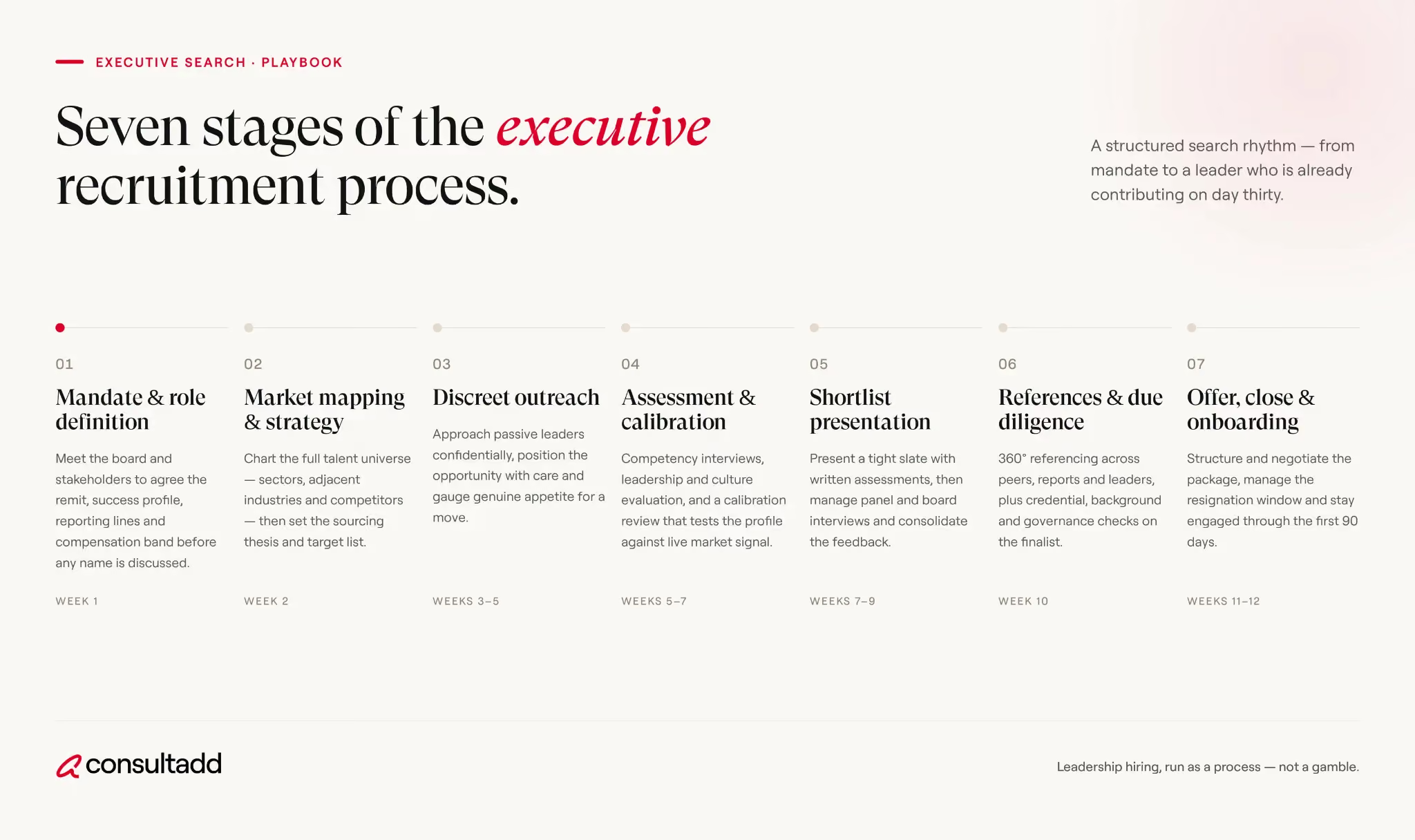
The best firms don't stop at placement. Support through onboarding and integration is part of why executive-search hires tend to have stronger retention.
Retained vs contingency: choosing a model
The most important structural choice in executive recruitment is the fee model, because it shapes how the search is run.
Retained search means the firm is engaged exclusively and paid upfront, usually in structured installments, and works the assignment until it's filled.
Contingency means the firm is paid only when a placement is made, with no exclusivity. The right choice depends on the seniority, confidentiality, and strategic weight of the role.
Retained search usually includes a replacement guarantee, commonly around 12 months, which reflects the firm's commitment to the outcome rather than just the placement. For the most senior and sensitive roles, that exclusivity and confidentiality are exactly what you're paying for.
How long does executive recruitment take?
Executive search takes longer than standard hiring because thoroughness is the point. A typical engagement runs three to six months from brief to accepted offer, though it varies with seniority and difficulty.
Industry benchmarks in 2026 give a rough guide by level. Treat these as planning ranges, not promises, since a confidential or highly specialized search can run longer.
There's a tension worth naming here. A thorough 90-to-180-day process is built for completeness, but the strongest candidates typically have two to four active conversations at any moment.
Move too slowly and you lose top-of-pool people to faster competitors. The best searches balance rigor with momentum rather than treating speed and quality as opposites.
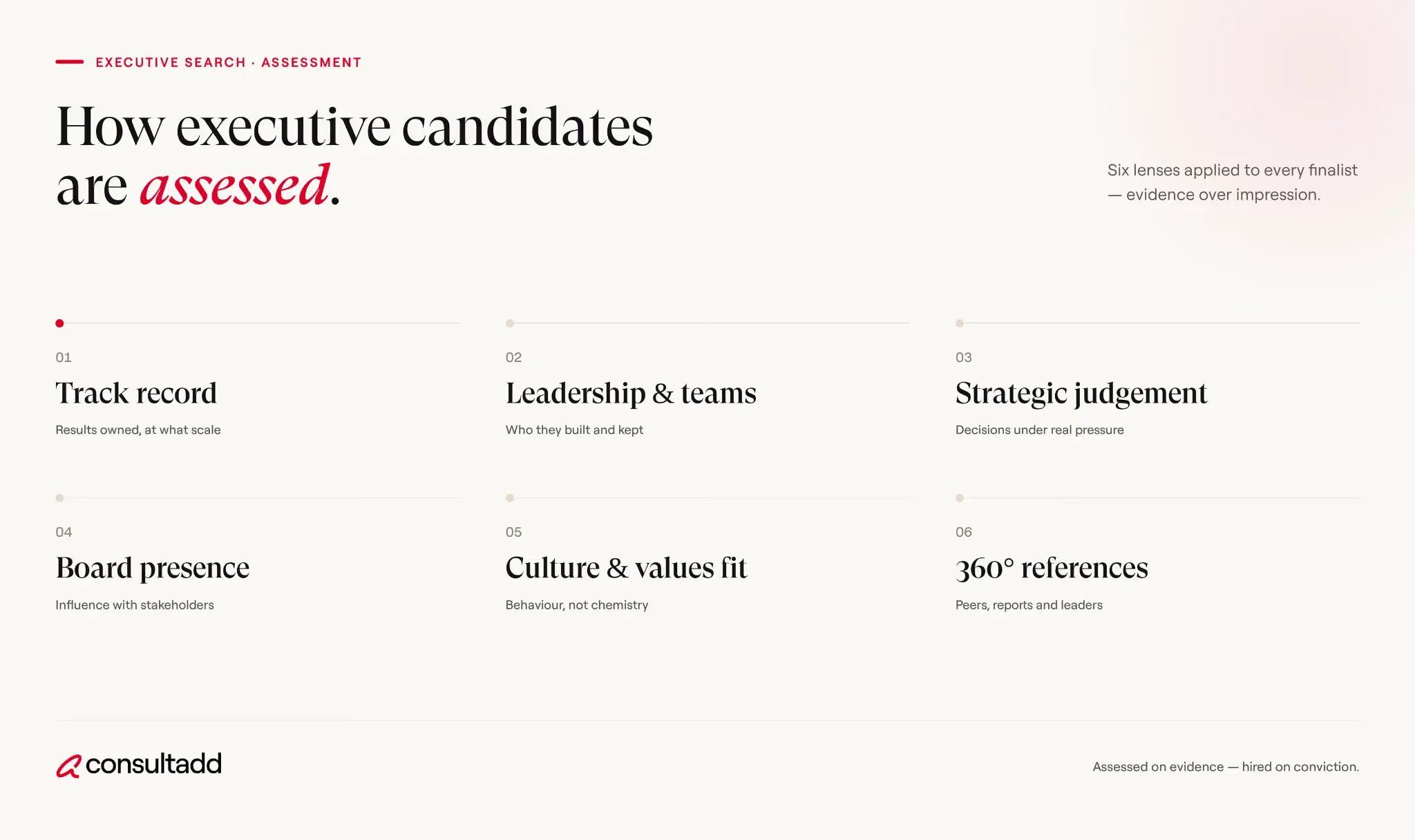
How executive candidates are assessed
Assessment is where executive search earns its fee. Because the cost of a wrong hire is so high, evaluation goes well beyond a resume review and a few interviews.
A strong process combines several methods.
- Behavioral and panel interviews probe how a leader actually operates.
- Case or scenario work tests strategic thinking and judgment under pressure.
- Psychometric testing adds a structured read on leadership style.
And in-depth reference checks, often 360-degree, gather perspectives from people who've worked above, alongside, and below the candidate.
The aim is to validate three things: proven capability, leadership behavior, and alignment with the company's culture and direction.
This kind of rigor isn't unique to the C-suite, though. The same discipline applies to any high-stakes hire.
For senior technical leadership specifically, our technical recruitment guide covers how to assess depth rather than surface credentials.
According to guidance from SHRM, quality of hire and consistent, structured evaluation are among the strongest protections against an expensive hiring mistake, and that logic only intensifies at the executive level.
What's changing in executive search in 2026
The fundamentals of executive recruitment are stable, but the operating environment has shifted, and it's worth knowing how.
Leadership turnover is up. Research reported by Harvard Business Review, citing Conference Board and Egon Zehnder data, put CEO succession at 12.5% in 2025, a notable jump from the prior year. More succession means more organizations need a disciplined approach to leadership hiring at once.
AI has also entered the sourcing side. The strongest results in 2026 pair relationship-driven headhunting with AI-powered market mapping and research. That combination has compressed timelines: some firms using AI-assisted sourcing reported average C-suite search times dropping toward nine weeks, down from around fourteen a year earlier. The human relationship still closes the hire, but the research that feeds it is faster.
Candidate expectations have risen too. Senior leaders being approached weigh the credibility of the firm, the quality of the relationship, and the strength of the opportunity before they even engage. A sloppy or impersonal approach doesn't get a callback at this level.
The throughline is simple:
Executive recruitment rewards preparation, discretion, and rigor. Get the brief right, assess deeply, and keep the process moving, and you give a new leader the best chance to succeed. Rush it or cut corners, and you risk the most expensive hiring mistake a company can make.
Start Strong With Consultadd
With 15 years in business and 5,000+ successful staffing engagements, we don't just fill roles, we build reliability into your process. We've supported 65 staffing companies in the past year alone and maintain MSAs with industry leaders like Robert Half and TEKsystems.
Here's what working with Consultadd looks like:
- Talent sourced in under 24 hours
- Ready-to-deploy candidates, vetted for experience and compliance
- Lower turnover risk: we match long-term goals, not just short-term needs
- Seamless compliance: visa, documentation, onboarding? Handled.
- Dedicated 1:1 account managers for responsive, personalized support
- Top 100 candidate matches delivered in the past year
- Strong partnerships with universities to tap into fresh, committed talent
- Post-placement support so your investment grows beyond day one
For candidates, your next opportunity is more than just a job title, it's a chance to build skills, gain experience, and move your career forward. At Consultadd, we connect technology professionals with projects and employers that align with their goals, whether they're looking for contract, contract-to-hire, or long-term opportunities.
The tech job market moves fast, but the right guidance can make all the difference. Ready to take the next step in your career journey? Explore Opportunities >>
Key takeaways
- The executive recruitment process is a proactive, confidential method for hiring senior leaders through direct outreach and deep assessment, not job ads.
- It exists because top leaders are passive, heavily pursued, and expensive to get wrong, with bad hires costing two to three times annual salary.
- The process runs about seven stages, from intake and talent mapping to assessment, offer, and onboarding.
- Retained search suits strategic and confidential roles, while contingency fits less senior ones, with retained fees often 25% to 35% of first-year pay.
- Executive searches typically take three to six months, and the strongest ones balance rigor with enough speed to keep top candidates engaged.
FAQs
What is the executive recruitment process?
It's a structured, confidential method for hiring senior leaders such as C-suite executives, VPs, and board members. Rather than posting jobs, it proactively identifies and approaches specific individuals, then assesses them deeply. The process typically runs seven stages from an intake brief through to onboarding.
How long does executive recruitment take?
Most executive searches take three to six months. Industry benchmarks in 2026 suggest roughly 90 to 120 days for VP-level roles, 120 to 180 days for C-suite, and 90 to 150 days for board positions. Specialist boutiques with warm talent networks can move faster, sometimes closing in 30 to 60 days.
What is the difference between retained and contingency executive search?
Retained search means the firm is paid upfront and works exclusively on the role until it's filled, which suits senior, confidential, or strategic hires. Contingency search means the firm is paid only when it places a candidate, often competing with other firms. Retained is the standard model for C-suite roles.
How much do executive search firms charge?
Retained firms commonly charge 25% to 35% of the placed executive's first-year total compensation, usually paid in structured installments. Many also include a replacement guarantee, often around 12 months. Contingency firms charge a percentage of salary but only collect it upon a successful hire.
How is executive recruiting different from regular recruiting?
Executive recruiting targets passive senior leaders through direct, confidential outreach rather than job postings, and the candidate pool is thin and heavily pursued. The assessment is far deeper, often including psychometric testing and 360-degree references. The stakes are also higher, since a failed executive hire is disproportionately costly.
How are executive candidates assessed?
Assessment combines behavioral and panel interviews, case or scenario work, psychometric testing, and in-depth, often 360-degree reference checks. The goal is to validate capability, leadership behavior, and cultural alignment, not just experience on paper. This rigor exists because the cost of a wrong hire at this level is so high.

How to Improve the Recruitment Process with 7 Proven Steps
Introduction
Most hiring teams don't have a talent problem. They have a process problem. The right candidate applies, sits in a queue for two weeks, gets a competing offer, and accepts it before your panel finishes its debrief. The person was there. The process lost them.
That's the frustrating truth about how to improve the recruitment process: the biggest gains usually come from fixing your own bottlenecks, not from finding more applicants. Speed, clarity, and a respectful candidate experience win more hires than a bigger pipeline does.
This guide walks through where the time actually goes, which fixes move the needle, and how to measure whether you're improving. Work through it in order, or jump to the bottleneck you already suspect.
TL;DR
- Improving recruitment is mostly about removing friction in your own process, not sourcing more applicants.
- Measure first. You can't fix a bottleneck you haven't located, so track time-to-hire, time-to-fill, and quality of hire.
- Speed matters because candidates accept offers based on momentum. A responsive process beats a slow one, even at similar pay.
- Automate the busywork like screening and scheduling, but keep humans on judgment and relationship.
- Standardize your interviews so every candidate is judged on the same criteria, which improves both fairness and quality.
Why your recruitment process needs a tune-up
A slow process costs you the best people, because the best people don't stay on the market long. The number to sit with: the average US hiring process takes roughly 42 days from job opening to accepted offer, according to SHRM's benchmarking. For many roles, that's plenty of time to lose a strong candidate.
The encouraging news is that the trend finally moved the right way in 2026. After three years of processes getting slower, median time-to-fill for non-executive roles dropped by about five days year over year, and SHRM credits much of that to automating repetitive recruiting work. Teams with the most effective practices fill roles roughly five days faster than everyone else.
Five days doesn't sound dramatic until you remember that offers are won on momentum. Candidates who move through a tight, responsive process tend to accept. Candidates parked between rounds show up to the offer stage holding competing options.
So the goal isn't just faster for its own sake. It's fewer places for a good candidate to slip away.
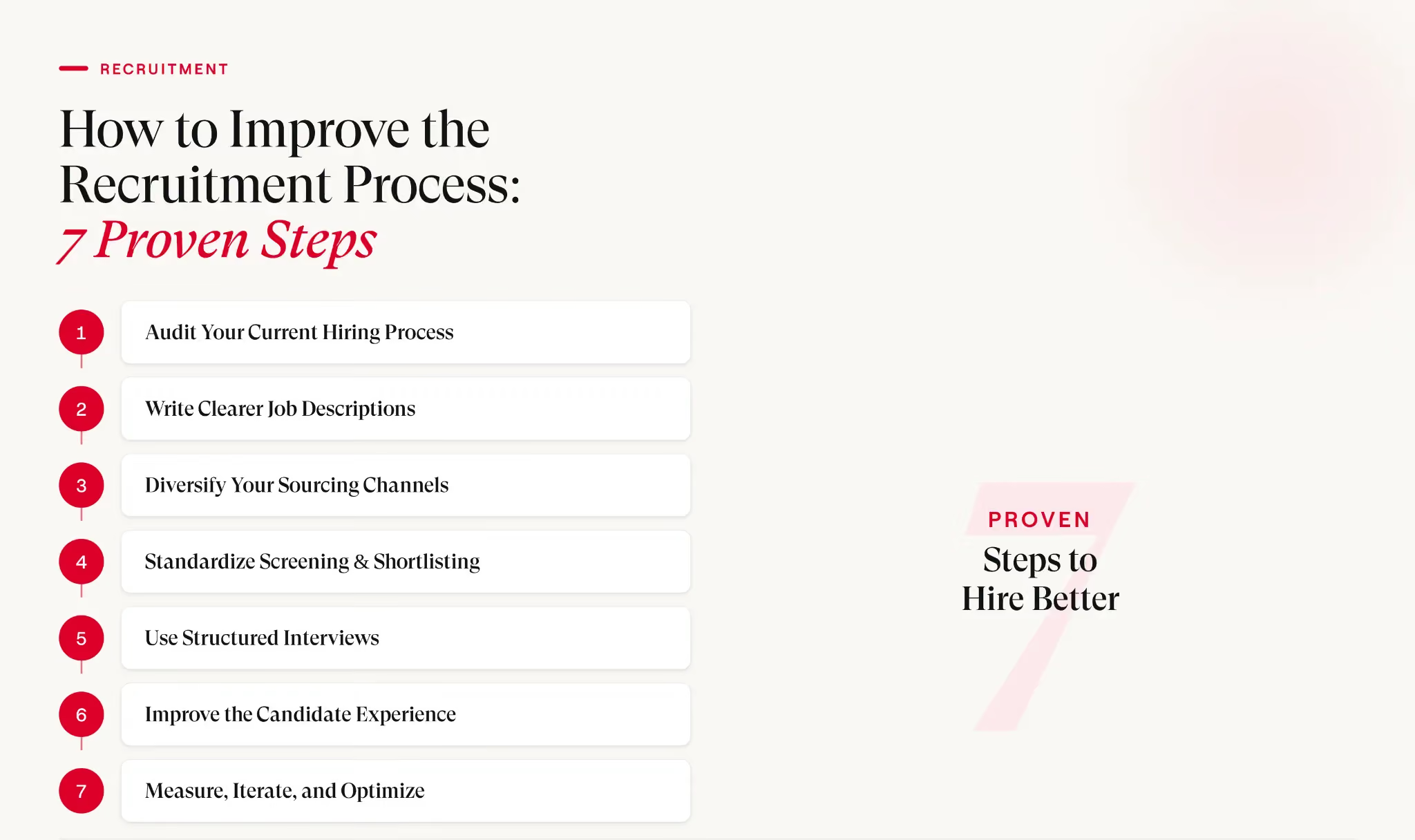
STEP 1: Start by measuring what you have
You can't fix a bottleneck you haven't found. Before changing anything, measure your current process so you know where the days actually go.
Track a small set of metrics consistently.
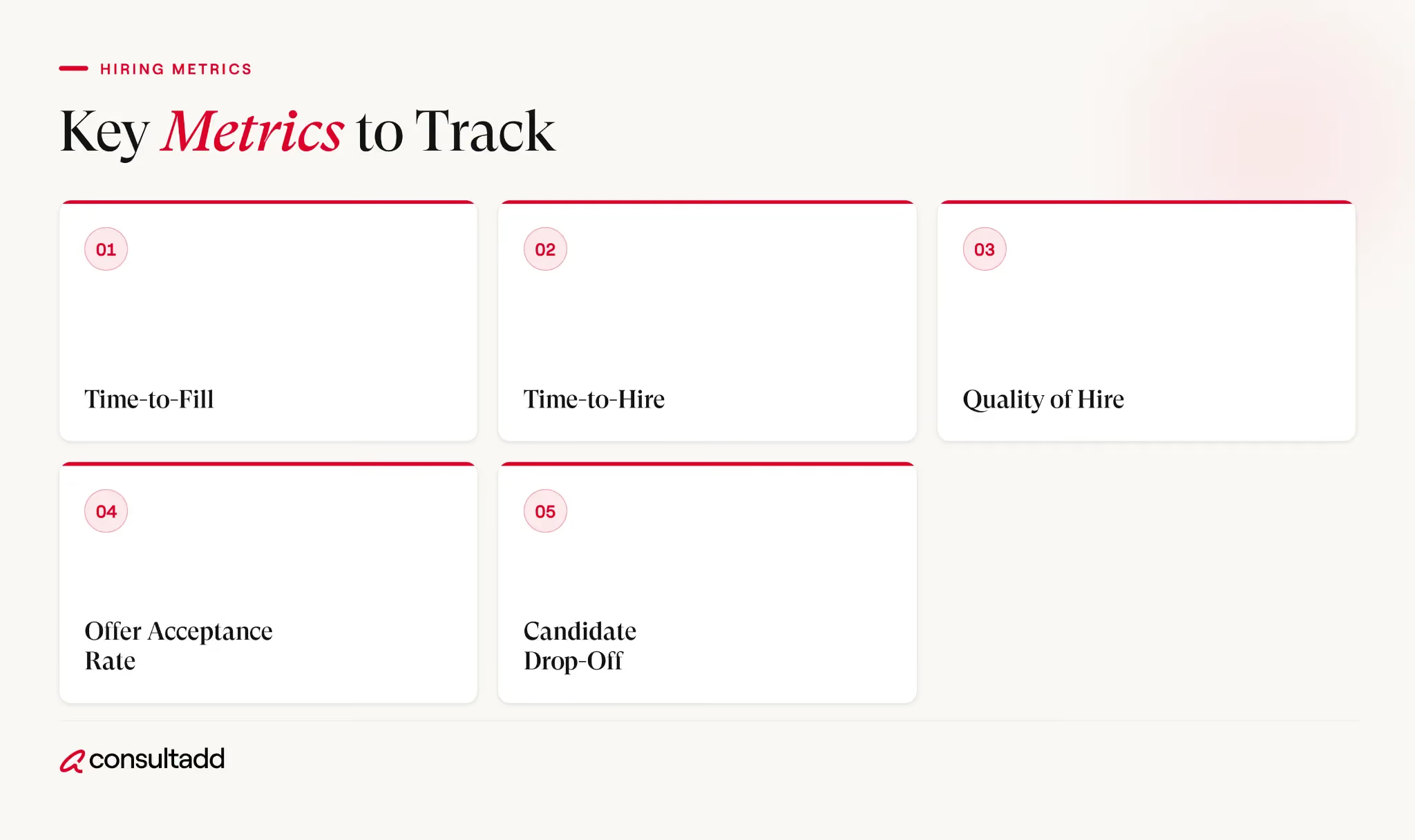
Keep your start and end points identical across roles, and exclude evergreen or always-open positions, which inflate your averages and hide the real picture.
Segment these by department and role so you can see exactly which stage is slow. Then pick one bottleneck, fix it, prove the saving, and move to the next.
Teams that improve fastest work one problem at a time rather than reinventing everything at once.
STEP 2: Sharpen your job descriptions
This is the cheapest fix on the list and one of the most overlooked. A vague job description produces a vague shortlist, and no screening tool can rescue it.
If your posting lists ten must-have skills that really belong to three different jobs, you'll either scare off good applicants or drown in mismatched ones. Name the two or three skills the role genuinely requires, describe the actual work, and be honest about level.
Clarity pays off twice. It attracts better-matched candidates up front, and it gives everyone downstream, including any screening automation, precise criteria to evaluate against.
If you're hiring technical roles, Consultadd's guide to technical recruitment covers how to translate a real job into a description that filters well.
STEP 3: Fix sourcing and re-engage your existing talent
A lot of teams treat every open role as a fresh start, which wastes the pipeline they already have. Some of your best candidates are sitting in your own applicant tracking system from previous searches.
Industry data in 2026 suggests a large share of eventual hires were already in the company's ATS before the new search began. Re-engaging past applicants and silver-medalists is faster than sourcing cold, and it costs almost nothing.
Beyond that, build talent pools for the roles you hire repeatedly, so you're not starting from zero each time. For high-volume needs especially, a ready pipeline is the difference between scrambling and scaling.
ConsultAdd's high-volume hiring strategies go deeper on keeping pre-screened talent on standby.
STEP 4: Automate the busywork with AI
The front of the funnel is where recruiters lose the most hours, and it's where automation helps most. Some 2026 analyses put AI-assisted timelines from first contact to offer around 28 days, versus roughly 41 days for manual processes, with most of that gap at the sourcing and screening stages.
Use automation for the repetitive, judgment-light work: parsing resumes, ranking applicants against clear criteria, sending status updates, and scheduling. Self-serve interview booking alone removes the multi-day email ping-pong that quietly adds days to every round.
A word of caution, though. AI matching is only as good as the criteria you feed it, which is why the job description fix comes first. And the goal isn't to remove the human element.
It's to reach it faster, so recruiters spend their time connecting with strong candidates instead of pushing paper. Tell candidates when AI is used and assure them a human reviews the results.
STEP 5: Standardize interviews for fairer, better decisions
Inconsistent interviews are where quality quietly leaks out. When every interviewer asks different questions and scores on gut feel, you're comparing impressions, not candidates.
A structured approach fixes this. Ask the same core questions for a given role, score answers against a defined rubric, and write down the rationale. Evaluating everyone against the same criteria produces a stronger, more comparable shortlist.
There's a compliance benefit too. Consistent, job-related evaluation helps you meet EEOC anti-discrimination expectations and reduces the room for bias to creep in.
Pairing structured interviews with a solid candidate vetting process gives you both fairness and quality without slowing things down.
STEP 6: Protect the candidate experience and keep momentum
Candidates judge your company by how your process treats them, and they vote with their acceptance. The two things they care about most are simple: clear communication and not being left waiting.
Keep people informed with timely updates and a clear next step at every stage. A receipt that says "we got your application" isn't communication.
Candidates want to know what happens next and when. Timely updates measurably increase the odds someone finishes the process and accepts an offer.
Momentum is the quiet driver of acceptance rates. Every day a candidate sits idle between rounds is a day a competitor can move.
Reduce unnecessary steps, run debriefs quickly, and don't let a strong candidate cool off while your calendar sorts itself out. The tighter the experience, the more offers you win.
STEP 7: Know when to bring in a staffing partner
Sometimes the fastest way to improve your process is to hand part of it to someone who does this at scale. If your team is small, your volume spikes, or you keep losing candidates to slow sourcing, a staffing partner can close the gap.
A good partner works from a pre-vetted talent pool, so the slowest stages, sourcing and initial screening, get compressed dramatically. You review a short list of qualified people instead of sifting hundreds of resumes. They also absorb the vetting and compliance work that eats your team's time.
The flexibility helps too. Contract and contract-to-hire models let you scale up for a project and evaluate fit before committing.
Consultadd's breakdown of the contract-to-hire model shows how that lowers hiring risk.
None of this replaces a well-run process. It amplifies one. Fix your bottlenecks, measure your gains, and bring in help where it buys back the most time.
Start Strong With Consultadd
With 15 years in business and 5,000+ successful staffing engagements, we don't just fill roles, we build reliability into your process. We've supported 65 staffing companies in the past year alone and maintain MSAs with industry leaders like Robert Half and TEKsystems.
Here's what working with Consultadd looks like:
- Talent sourced in under 24 hours
- Ready-to-deploy candidates, vetted for experience and compliance
- Lower turnover risk: we match long-term goals, not just short-term needs
- Seamless compliance: visa, documentation, onboarding? Handled.
- Dedicated 1:1 account managers for responsive, personalized support
- Top 100 candidate matches delivered in the past year
- Strong partnerships with universities to tap into fresh, committed talent
- Post-placement support so your investment grows beyond day one
For candidates, your next opportunity is more than just a job title, it's a chance to build skills, gain experience, and move your career forward. At Consultadd, we connect technology professionals with projects and employers that align with their goals, whether they're looking for contract, contract-to-hire, or long-term opportunities.
The tech job market moves fast, but the right guidance can make all the difference. Ready to take the next step in your career journey? Explore Opportunities >>
Key takeaways
- The biggest recruitment gains usually come from removing friction in your own process, not from sourcing more applicants.
- Measure before you change anything, tracking time-to-hire, time-to-fill, quality of hire, and where candidates drop off.
- Speed wins hires because candidates accept on momentum, so cut waiting and move quickly on strong people.
- Automate repetitive work like screening and scheduling, but keep humans on judgment and communication.
- Standardize interviews and vetting so every candidate is judged on the same criteria, improving fairness and quality.
FAQs
How long should the recruitment process take?
It depends on the role. The US average is around 42 days from opening to accepted offer, but benchmarks vary widely: retail and hospitality often run 14 to 30 days, technology and engineering 40 to 58 days, and executive roles 60 to 120. Compare yourself against your specific industry rather than a single global average.
What is the difference between time-to-hire and time-to-fill?
Time-to-hire counts the days from when a candidate enters your pipeline to when they accept the offer, so it measures process speed as the candidate feels it. Time-to-fill counts from when the role is approved and posted to offer acceptance, so it also includes sourcing time. Tracking both shows whether your problem is sourcing or process.
How can I speed up hiring without lowering quality?
Fix specific bottlenecks rather than rushing every stage. Automate scheduling and initial screening, re-engage candidates already in your ATS, and shorten debriefs. Standardized interviews let you move faster while keeping evaluation consistent, so speed and quality improve together instead of trading off.
Does AI actually improve recruitment?
Used well, yes, mainly by cutting time spent on repetitive tasks like resume parsing, scheduling, and status updates. Some 2026 analyses show meaningfully faster timelines for AI-assisted processes. The gains depend on good inputs, though. Vague job criteria produce vague shortlists, and a human should still review AI recommendations.
What metrics should I track to improve recruitment?
Start with time-to-fill, time-to-hire, quality of hire, offer acceptance rate, and candidate drop-off by stage. Keep your definitions consistent across roles and segment by department so you can spot the slow stages. These few metrics tell you where to focus without drowning you in data.
How do I reduce candidate drop-off?
Communicate clearly and keep the process moving. Give candidates a specific next step at every stage, use self-scheduling to remove delays, and avoid long gaps between rounds. Drop-off usually spikes where people are left waiting or unsure, so momentum and clear communication are your best tools.

Hiring a Python Developer: Costs, Skills & Tips 2026
Introduction
The word "Python" on a resume tells you almost nothing on its own. It sits on the profile of someone who automates spreadsheets for $80,000, and on the profile of someone who ships production machine learning models for triple that. Same skill listed. Very different hires.
That's the real challenge of hiring a Python developer in 2026. Demand is high, the title is broad, and pay ranges are wide enough to be confusing. Knowing what you actually need, what it should cost, and how to screen for it is what separates a good hire from an expensive mismatch.
This guide breaks down the current market, the skills worth screening for, realistic costs, and a hiring process that holds up. Whether you're filling one role or scaling a team, it should save you time and a few costly mistakes.
TL;DR
- Python is the most in-demand programming language in 2026, which makes strong developers competitive to hire and slow to land.
- "Python developer" covers a wide range, so define whether you need backend, data engineering, or ML work before you post.
- US salaries run roughly $75K for juniors to $170K+ for senior and ML specialists, with contractors around $60 to $150+ per hour.
- Add 20 to 35% on top of base pay for total cost, and expect agency placement fees of 15 to 25% of first-year salary.
- Screen for demonstrated skills, not just credentials, since most hiring managers now weigh portfolios over degrees.
Why hiring a Python developer is harder than it looks
Python isn't just popular. It's the most widely used programming language going into 2026, leading the TIOBE index by a wide margin over every other language. That popularity is exactly why hiring is competitive.
The demand comes from where software is heading. The major machine learning frameworks, including PyTorch, TensorFlow, and scikit-learn, are Python-native, so nearly every company building AI-enabled products needs Python engineers. Web backends, data pipelines, and automation all lean on it too.
The supply side isn't keeping pace. The Bureau of Labor Statistics projects software developer roles to grow 15% through 2034, with roughly 129,200 openings a year, and the qualified candidate pool isn't expanding at the same rate. That gap is why a strong senior developer can field several offers at once.
So the difficulty isn't finding people who write Python. It's finding the right one, fast, before someone else does.
What a Python developer actually does
Before you write the job post, get clear on the role, because two very different jobs often hide behind the same title.
A Python developer builds systems that run in production. Think APIs, web applications, backend services, and data pipelines. The priority is reliability: code that holds up under real traffic and real data.
A data scientist, by contrast, builds models and analysis, often in notebooks, optimizing for the right answer rather than production stability. Both write Python. They're not interchangeable, and hiring one when you needed the other is a common and expensive error.
Within Python development itself, there are lanes. Backend web work leans on Django, FastAPI, or Flask. Data engineering centers on tools like Airflow and Spark.
ML engineering means production model deployment with frameworks like PyTorch. Name the lane you need before you start, and your whole process gets sharper.
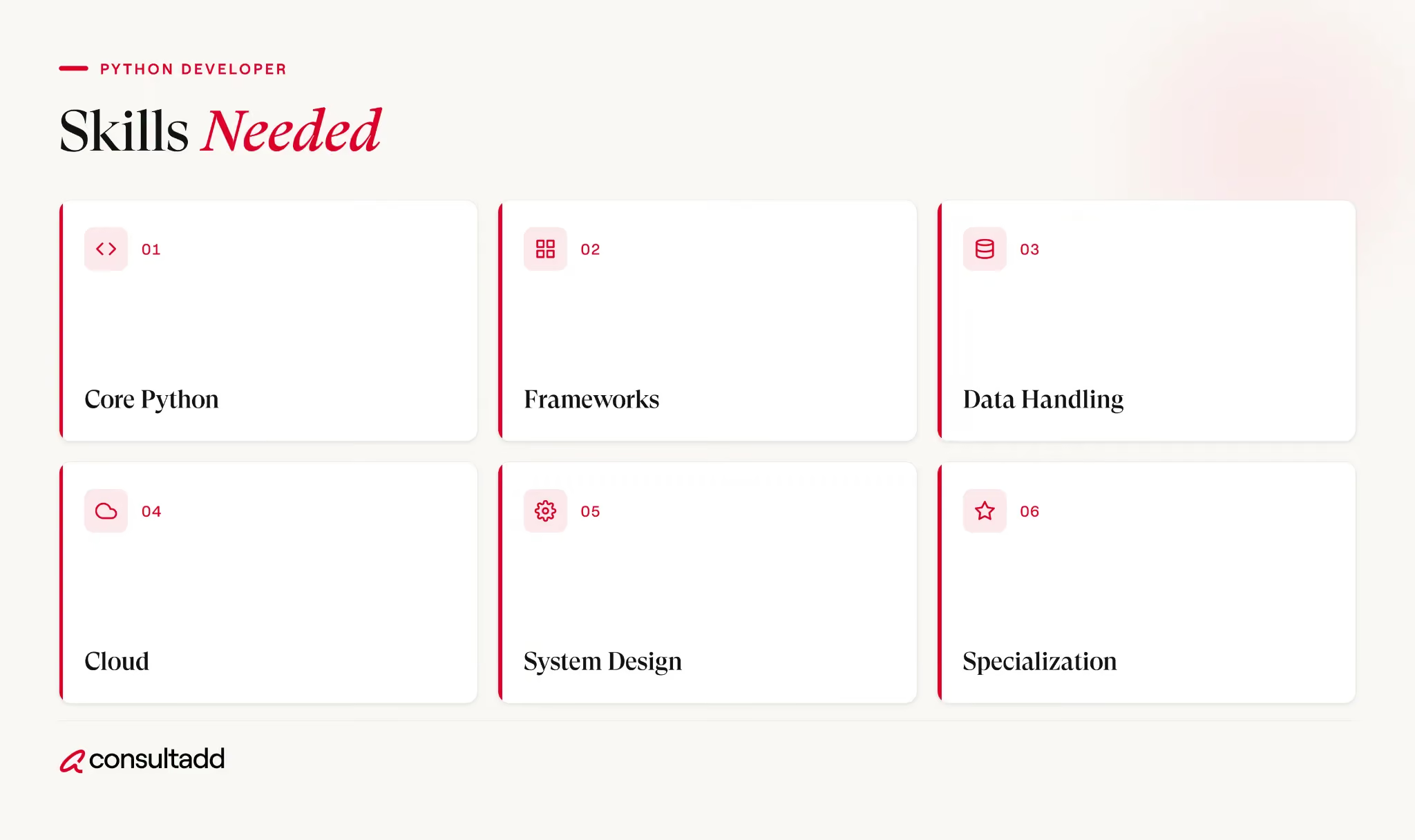
The skills to screen for
Once you know the lane, you can screen for what matters instead of a vague wish list. Here's how the main skill areas break down.
A word of caution on job descriptions. Listing Python, Django, pandas, ML pipelines, and cloud infrastructure all in one post is a fast way to attract nobody, because that's several people's jobs. Prioritize the two or three skills the role genuinely needs.
And screen for proof, not pedigree. A large share of hiring managers now weigh portfolio evidence over where a candidate studied, so practical assessments and past work tell you more than a degree line.
Consultadd's guide to technical recruitment goes deeper on building that kind of skills-first evaluation for engineering roles.
Contract vs full-time: choosing the model
Not every Python need is a full-time hire. The right model depends on the shape of the work, not on which sounds cheaper.
Contract works well for a defined build with a real deadline, like a FastAPI rewrite or a new data pipeline. Full-time makes sense when you need someone to own a system for years and grow with the codebase.
There's also a middle path. Contract-to-hire lets you evaluate someone on real work before committing to a permanent offer, which lowers the risk of a bad hire.
Consultadd's breakdown of the contract-to-hire model covers when that "try before you buy" approach pays off.
A hiring process that actually works
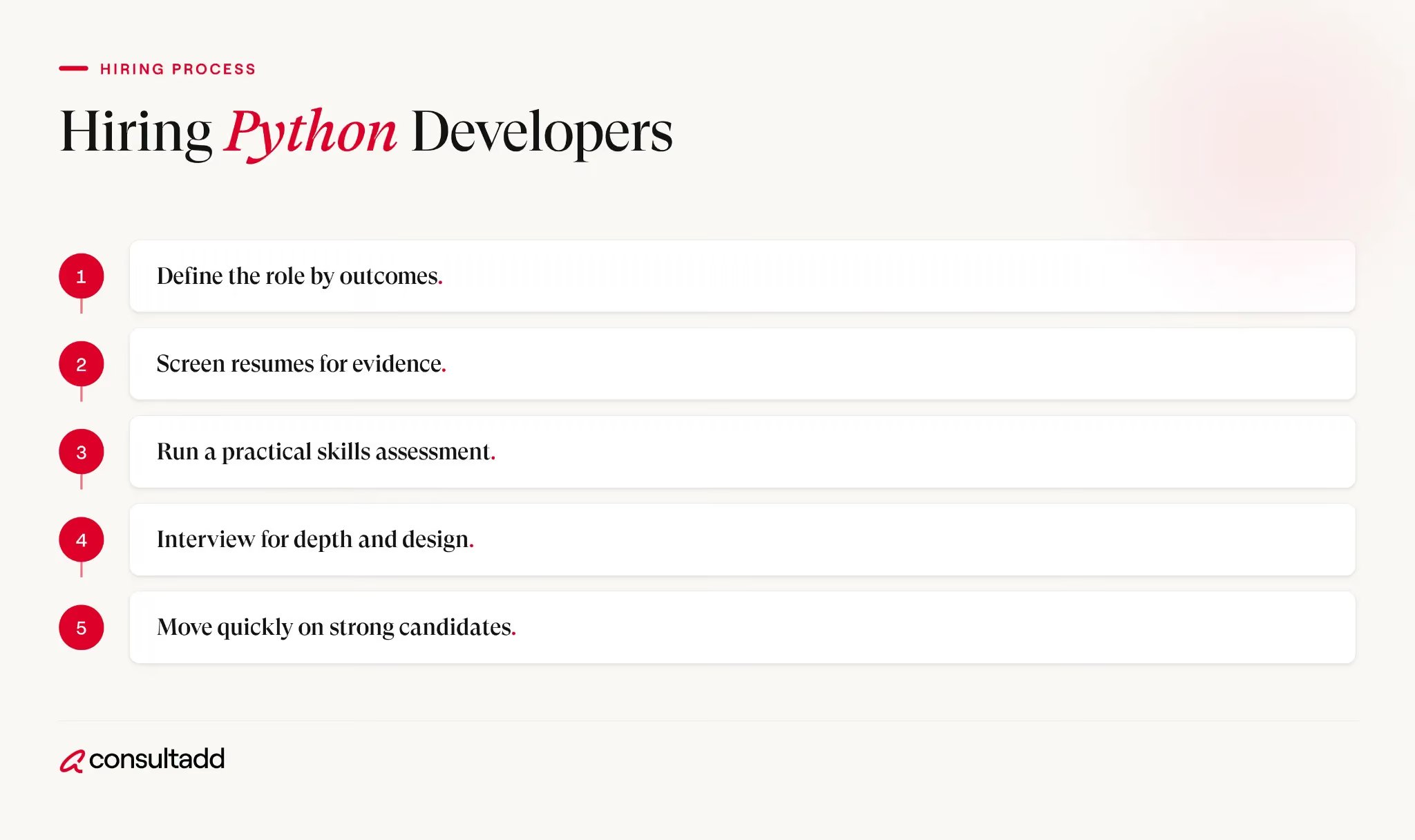
A strong process protects you from both slow hiring and bad hiring. Here's a sequence that keeps things moving without cutting corners.
- Define the role by outcomes.
Write down what the person must be able to build, and pick the two or three skills that actually matter. Skip the kitchen-sink job post.
- Screen resumes for evidence.
Look for shipped projects and relevant frameworks, not just keyword matches.
- Run a practical skills assessment.
A real coding exercise or work sample exposes the gap between claimed and actual ability faster than any interview question.
- Interview for depth and design.
For mid and senior roles, probe system design and past decisions, not just syntax.
- Move quickly on strong candidates.
Good developers get multiple offers. Set internal SLAs, like 24 hours for feedback, so you don't lose people to a slow loop.
That last point deserves emphasis. In this market, a slow, indecisive process loses more good candidates than a tough one does.
A structured candidate vetting process keeps quality high while still letting you move fast.
Where a staffing partner fits in
If your team is small or your timeline is tight, sourcing and vetting Python developers well for every role gets hard. This is where a staffing partner earns its place.
- A specialized partner handles the sourcing and technical screening, then hands you a short list of people who already cleared the checks.
- Instead of sifting hundreds of resumes and trying to tell excellent offshore talent from merely available talent, you review a handful of pre-vetted candidates matched to your stack.
- For roles touching proprietary data or model weights, that vetting also carries a security benefit.
- The payoff is speed without a quality drop.
- When the hardest senior ML hires can take two to three months on your own, a partner with a ready talent pool can compress that meaningfully.
Hiring a Python developer comes down to clarity and speed: know the lane you need, screen for real skill, budget honestly, and don't let a strong candidate sit.
Get those right, and the rest of the process tends to follow.
Start Strong With Consultadd
With 15 years in business and 5,000+ successful staffing engagements, we don't just fill roles, we build reliability into your process. We've supported 65 staffing companies in the past year alone and maintain MSAs with industry leaders like Robert Half and TEKsystems.
Here's what working with Consultadd looks like:
- Talent sourced in under 24 hours
- Ready-to-deploy candidates, vetted for experience and compliance
- Lower turnover risk: we match long-term goals, not just short-term needs
- Seamless compliance: visa, documentation, onboarding? Handled.
- Dedicated 1:1 account managers for responsive, personalized support
- Top 100 candidate matches delivered in the past year
- Strong partnerships with universities to tap into fresh, committed talent
- Post-placement support so your investment grows beyond day one
For candidates, your next opportunity is more than just a job title, it's a chance to build skills, gain experience, and move your career forward. At Consultadd, we connect technology professionals with projects and employers that align with their goals, whether they're looking for contract, contract-to-hire, or long-term opportunities.
The tech job market moves fast, but the right guidance can make all the difference. Ready to take the next step in your career journey? Explore Opportunities >>
Key takeaways
- Python is the most in-demand language in 2026, so strong developers are competitive to hire and quick to accept other offers.
- The title is broad, so define whether you need backend, data engineering, or ML work before you post the role.
- US salaries run roughly $75K for juniors to $170K+ for senior and ML specialists, with a 20 to 40% premium for AI expertise.
- Budget for total cost, adding 20 to 35% over base pay and 15 to 25% of salary for agency placement fees.
- Screen for demonstrated skills over credentials, and move fast, because a slow process loses good candidates.
FAQs
How much does it cost to hire a Python developer?
In the US in 2026, base salaries run roughly $75,000 for juniors to $170,000 or more for senior and ML specialists. Contractors typically charge $60 to $150+ per hour depending on seniority and specialization. Remember to add 20 to 35% over base pay for total cost, plus any agency placement fee.
What skills should a Python developer have?
It depends on the role, but core Python, a main framework like Django or FastAPI, and SQL are common baselines. Cloud experience with AWS, GCP, or Azure is now expected in most listings, along with Docker and testing. For ML roles, look for PyTorch or TensorFlow and production deployment experience.
Should I hire a Python developer full-time or on contract?
Contract works best for scoped projects of three to twelve months or specialized short-term needs. Full-time makes sense when you need someone to own a system long term and grow with the codebase. Contract-to-hire is a middle path that lets you evaluate a developer on real work before committing.
How long does it take to hire a Python developer?
It varies by seniority. Junior and mid-level roles can move in a few weeks, while senior ML or lead engineers often take two to three months given the small talent pool. Hiring through job boards alone tends to add several weeks compared to working with a staffing partner.
What is the difference between a Python developer and a data scientist?
A Python developer builds production systems like APIs, backends, and data pipelines, prioritizing reliability. A data scientist builds models and analysis, often in notebooks, optimizing for accurate results over production stability. Both use Python, but they solve different problems and aren't interchangeable.
Do Python developers need a computer science degree?
Not necessarily. Many hiring managers in 2026 weigh portfolio evidence and practical skills over formal degrees. A strong track record of shipped projects and good performance on a skills assessment often matters more than where, or whether, a candidate studied computer science.