
Contracts
.png)
How Long Does It Take to Get a Work Visa? US Timelines
Introduction
A candidate accepts your offer on Monday and asks when they can start. If they need a work visa, the honest answer could be "in about three weeks" or "next October." It depends almost entirely on which visa they need and where they are right now.
So, how long does it take to get a work visa in the US? A Canadian professional on a TN can get a decision at the border on the same day. A non-cap H-1B or O-1 petition with premium processing can get a USCIS decision in 15 business days, though the full process usually takes longer than that.
A new cap-subject H-1B runs on an annual calendar, so registration in March leads to an October 1 start at the earliest.
This guide breaks the timeline down by visa type and by stage, so employers and candidates can plan a realistic start date. It covers US work visas only, and it isn't legal advice. Your immigration attorney should confirm the details for any specific case.
TL;DR
- Work visa timelines in the US range from same-day (TN for Canadians at the border) to most of a year (new cap-subject H-1B).
- Every employer-sponsored visa moves through similar stages: documents, labor filing, USCIS petition, and often a consular interview.
- Premium processing speeds up the USCIS decision to 15 business days for most work petitions, but it doesn't speed up the lottery, the Labor Department, or the consulate.
- Since September 2025, most applicants must interview in their country of nationality or residence, which can mean longer appointment waits.
- Some candidates can start sooner than you'd expect, such as H-1B holders changing employers and students on OPT.
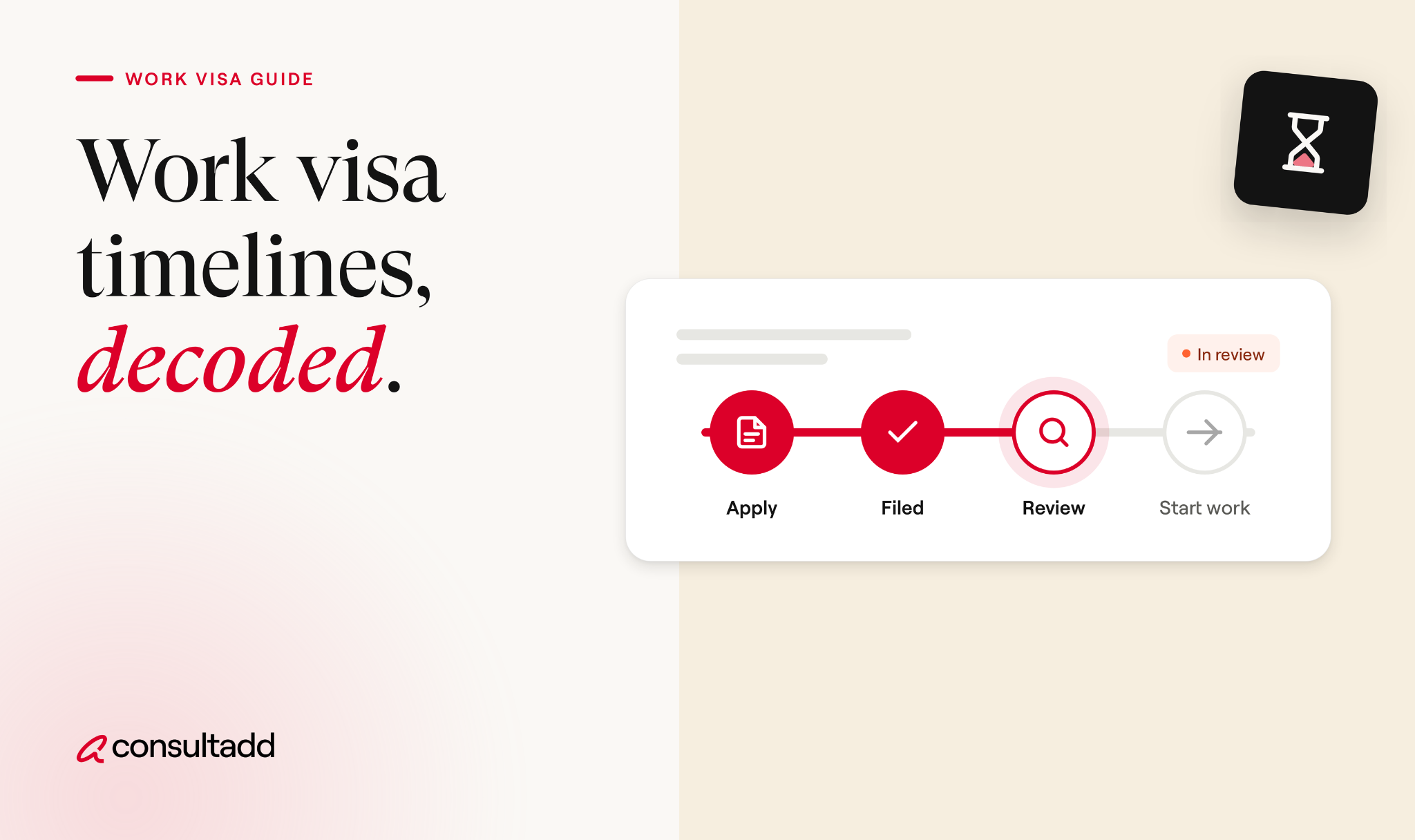
Work visa timelines by visa type
The visa type sets the outer limits of your timeline. This table gives a realistic picture for the visas tech employers use most often.
If you're unsure which category a candidate falls into, our guide to whether you're legally authorized to work in the US explains the difference between employer-tied visas and work permits.
The stages every work visa goes through
Most employer-sponsored visas follow the same basic path. The total time is the sum of these stages, and the delays usually come from just one or two of them.
The labor filing
For H-1B and E-3 workers, the employer first files a Labor Condition Application. The Department of Labor reviews LCAs within seven working days for completeness and obvious errors.
This step rarely causes long delays, but a typo in the wage level or worksite can force you to start over.
The USCIS petition and premium processing
This is where most of the variation sits. USCIS publishes current averages on its processing times tool, and regular processing for some petition types has stretched to many months.
Premium processing shortens that. For most I-129 work petitions, USCIS commits to acting within 15 business days. For OPT and STEM OPT work permit applications, the window is 30 business days.
Two things to understand about premium processing:
- First, "acting" can mean a Request for Evidence instead of an approval.
- Second, it only speeds up USCIS. It does nothing for the lottery, the Labor Department, or the consulate.
The consular interview
If the worker is outside the US, they usually need a visa stamp from a US embassy or consulate. This step has become harder to predict.
In September 2025, the State Department told nonimmigrant applicants to schedule interviews in their country of nationality or residence.
Applicants who book elsewhere should expect longer waits. Before you set a start date, check the State Department's global visa wait times page for the specific consulate.
H-1B processing time: cap-subject vs cap-exempt
The H-1B gets its own section because its timeline depends on whether the job is subject to the annual cap.
For a new cap-subject H-1B, the calendar controls everything. Employers register candidates in March. Selected employers can file petitions from April 1, and the earliest start date is October 1. If a candidate isn't selected, the next chance is the following year.
Two recent changes affect planning:
- A wage-weighted selection system took effect for the FY2027 season, which gives higher wage levels better odds.
- The $100,000 payment on certain new H-1B petitions has been extended through September 2027 by proclamation but blocked in court, so its status could change. Check the USCIS H-1B page before filing.
Cap-exempt cases and H-1B holders changing employers skip the lottery. With premium processing, those cases can move in weeks.
We go deeper on H-1B processing time with premium vs regular processing and on what sponsoring an H-1B visa involves in separate guides.
What slows down a work visa
Most delays aren't random. They come from a short list of causes, and most are preventable
The RFE row deserves extra attention. With premium processing, USCIS stops the clock when it issues an RFE and starts a new 15-business-day window after it gets your response. A slow response can easily cost more time than the premium fee saved.
How hiring teams shorten the US work visa timeline
Recruiters who place visa holders every week tend to use the same handful of moves. None of them are shortcuts around the rules. They're about filing the right thing at the right time.
1. Hire candidates who can start while their case is pending
Some candidates can begin work before a final decision:
- H-1B holders changing employers. Under H-1B portability, an eligible worker can usually start with the new employer once the new petition is filed, without waiting for approval.
- Students on OPT or STEM OPT. They already have work permission through their EAD. If an H-1B petition is filed for them in time, cap-gap rules can extend their work authorization until October 1.
Our comparison of H-1B vs OPT explains how the two connect.
2. Collect documents before the offer is final
A common pattern from the staffing side: a Java developer accepts an offer, then spends three weeks getting a foreign degree evaluated. Nothing is filed in the meantime. Asking for degree certificates, transcripts, past visa approvals, and recent pay stubs during the final interview round removes that dead time.
3. Use premium processing where it actually helps
Premium processing is worth it when USCIS is the bottleneck, such as an H-1B transfer for a project starting next month. It's less useful when the real wait is a consular appointment in the candidate's home country, because the petition will sit approved while the candidate waits for an interview.
4. Match the visa to the candidate early
A Canadian engineer in a TN-eligible role may be able to start within days. An Australian may qualify for an E-3 without any lottery. Asking about citizenship (where lawful and appropriate) and current status at the screening stage avoids defaulting to the slowest option.
Planning a start date around how long it takes to get a work visa
Start with the candidate's current status, not the visa you're used to filing. That one question changes the answer to how long it takes to get a work visa more than anything else.
Then plan backwards. Add up the stages that apply, use premium processing where USCIS is the slow part, check consular wait times for anyone abroad, and add a buffer of a few weeks for RFEs or administrative processing.
Put that date in the offer letter as an estimate, not a promise, and tell the candidate early if anything shifts.
Start Strong With Consultadd
With 15 years in business and 5,000+ successful staffing engagements, we don't just fill roles, we build reliability into your process. We've supported 65 staffing companies in the past year alone and maintain MSAs with industry leaders like Robert Half and TEKsystems.
Here's what working with Consultadd looks like:
- Talent sourced in under 24 hours
- Ready-to-deploy candidates, vetted for experience and compliance
- Lower turnover risk: we match long-term goals, not just short-term needs
- Seamless compliance: visa, documentation, onboarding? Handled.
- Dedicated 1:1 account managers for responsive, personalized support
- Top 100 candidate matches delivered in the past year
- Strong partnerships with universities to tap into fresh, committed talent
- Post-placement support so your investment grows beyond day one
For candidates, your next opportunity is more than just a job title, it's a chance to build skills, gain experience, and move your career forward. At Consultadd, we connect technology professionals with projects and employers that align with their goals, whether they're looking for contract, contract-to-hire, or long-term opportunities.
The tech job market moves fast, but the right guidance can make all the difference. Ready to take the next step in your career journey? Explore Opportunities >>
Key takeaways
- The visa type sets your timeline: TN can be same-day, while a new cap-subject H-1B follows an annual calendar ending in an October 1 start.
- Most sponsored visas pass through documents, a labor filing, a USCIS petition, and often a consular interview.
- Premium processing gets a USCIS decision in 15 business days for most work petitions but doesn't speed up the lottery or the consulate.
- Consular wait times now matter more, since most applicants must interview in their country of nationality or residence.
- H-1B transfers and OPT holders can often start sooner, so check a candidate's current status before choosing a visa path.
FAQs
How long does it take to get a work visa in the US?
It depends on the visa. A TN for Canadians can be decided at the border the same day, while non-cap petitions with premium processing get a USCIS decision in 15 business days. A new cap-subject H-1B follows an annual cycle, so registration in March means an October 1 start at the earliest.
How long does it take to get an H-1B visa?
For a new cap-subject H-1B, plan on about seven months from March registration to an October 1 start, if the candidate is selected. Cap-exempt cases and H-1B transfers skip the lottery and can move in weeks with premium processing. Add consular appointment time if the worker is abroad.
Can I speed up my work visa application?
Premium processing shortens the USCIS decision to 15 business days for most work petitions. Filing a complete petition with all documents also helps avoid a Request for Evidence. Premium processing doesn't affect the H-1B lottery or consular appointment waits.
How long does it take to get a visa interview appointment?
Wait times vary a lot by embassy and consulate, and they change often. The State Department publishes current estimates on its global visa wait times page. Since September 2025, most applicants must book in their country of nationality or residence, which can mean longer waits in busy locations.
Can I start working while my work visa is processing?
Usually not, but there are exceptions. Eligible H-1B holders changing employers can typically start once the new petition is filed, and students on OPT can work under their existing work permit. Cap-gap rules can also extend OPT work authorization while an H-1B petition is pending.
How long does a TN visa take?
Canadian citizens can apply at a port of entry or preclearance location and often get a decision the same day. Mexican citizens must apply for a TN visa at a US consulate, so their timeline depends on appointment availability. In both cases, a clear support letter from the employer matters most.
.webp)
OPT vs CPT: which one to use, and when, as an F-1 student
Introduction
Most F-1 students learn the definitions of CPT and OPT in their first week of orientation. The harder part comes later, when a real offer shows up and you have to decide which one to use, and what it will cost you down the road.
The short answer to OPT vs CPT:
CPT covers work that's a required part of your degree while you're still enrolled.
OPT gives you up to 12 months of work in your field per degree level, usually after graduation, with up to 24 more months if you have a qualifying STEM degree.
Which one fits depends on your timing, your program's rules, and whether you're planning for an H-1B.
This guide walks through six common situations. If you need the basic definitions first, start with our guide to what OPT and CPT are.
This article is general information, not legal advice. Your DSO and, where needed, an immigration attorney have the final word on your case.
TL;DR
- CPT is for training that's a required part of your curriculum, authorized by your DSO before your program ends. OPT is authorized by USCIS and is usually used after graduation.
- Part-time CPT (20 hours a week or less) doesn't reduce your OPT. Twelve months or more of full-time CPT at one degree level removes your post-completion OPT.
- STEM graduates can add a 24-month STEM OPT extension, which gives more time for H-1B lottery attempts.
- August 2026 SEVP guidance narrowed when schools can approve CPT, including Day 1 CPT. Optional internships may no longer qualify.
- An October 2026 DHS proposal would add large fees for OPT recommendations. It's not in effect, and current OPT rules still apply.
OPT vs CPT at a glance
The CPT and OPT difference comes down to who approves it, when you can use it, and whether you need a job first.
According to DHS's Study in the States, CPT is authorized by your DSO in SEVIS, while OPT requires approval from USCIS and an Employment Authorization Document before you can start.
Six scenarios and which program fits
1. A summer internship after your first year
If your program requires an internship for credit, CPT is usually the better choice. It keeps your full 12 months of OPT for after graduation.
If the internship is optional, check with your DSO before assuming CPT will work. Under the August 2026 SEVP guidance, many schools are no longer approving CPT for elective internships.
Pre-completion OPT is the fallback, but every month you use comes out of your post-completion OPT.
2. A part-time internship during the semester
Part-time CPT is the cleanest option here, as long as your school considers the role part of your curriculum. Part-time CPT doesn't count toward the 12-month full-time limit, so it won't touch your OPT.
3. Your first full-time job after graduation
This is what post-completion OPT is for. You can apply as early as 90 days before your program end date and up to 60 days after it.
Our guide on how long before graduation you can apply for OPT covers that window and the 30-day deadline after your DSO's recommendation.
You don't need an offer to apply. Once OPT starts, you have up to 90 days of unemployment, so don't wait until the last minute to job hunt.
4. A STEM graduate planning for an H-1B
If your degree is on the DHS STEM list, plan around OPT plus the STEM OPT extension. Study in the States notes that the STEM OPT extension adds 24 months, and the employer must use E-Verify and provide at least 20 hours of training a week. You'll also need a Form I-983 training plan.
That combined 36 months usually gives you more than one shot at the H-1B lottery. It's also why STEM students should be careful with full-time CPT. Losing your initial 12 months of OPT also costs you the STEM extension, since the extension builds on post-completion OPT.
Our comparison of H-1B vs OPT explains how that transition works.
5. A job offer during school, but no required internship course
Before August 2026, many schools approved CPT for elective internship courses. That's much harder now. If your program doesn't require practical training for all students, your DSO may not be able to approve CPT.
Pre-completion OPT can still work, but it needs USCIS approval, which can take months. Start early, and ask the employer whether they can push the start date.
6. OPT is ending and you're considering Day 1 CPT
Day 1 CPT means enrolling in a graduate program that requires practical training from the first term. Federal rules still allow it, but the August 2026 guidance put these programs under closer review.
SEVP wants the training to be required for every student in the program, not just F-1 students who need work authorization.
If you're considering this route, ask the school in writing how its curriculum meets the current guidance, and talk to an immigration attorney before you enroll.
A program that later loses its approval can leave you without status or work authorization.
The 12-month full-time CPT rule
This is the rule that catches the most students. If you use 12 months or more of full-time CPT (over 20 hours a week) at one degree level, you can't use post-completion OPT at that level.
Months add up across semesters. Three summers of full-time CPT plus one full-time semester can push you over without you noticing. Track your total each term and ask your DSO to confirm it.
Part-time CPT doesn't count toward this limit, no matter how long you use it. That's why many students stay part-time during semesters and keep full-time CPT for one summer.
For tips on finding roles that qualify, see our CPT job guide for F-1 students.
What changed for OPT and CPT in 2026
Two developments matter for anyone weighing OPT vs CPT right now.
In August 2026, SEVP sent two broadcast messages to school officials (dated August 12 and August 24) with a narrower reading of when training is "integral" to a curriculum.
The guidance didn't change the CPT regulation, but it pushed schools to approve CPT only when the training is required for everyone in the program. Many universities have since tightened their CPT policies.
In October 2026, DHS published a proposed rule on Optional Practical Training fees. It would charge schools $70,000 for a student's first OPT recommendation and $30,000 for later ones, including STEM OPT.
The proposal says schools could pass these costs to students or employers. CPT isn't covered by the proposal.
Rules in this area are moving fast. Check with your DSO before making a decision based on any of the above.
What employers and staffing firms check
From the hiring side, the paperwork for each program looks different. Recruiters at IT staffing firms see students lose offers over avoidable mix-ups, like starting a day before the CPT date on their I-20.
For CPT, employers look at page 2 of your I-20, which lists the employer name and start and end dates. You can't work before that start date or for a different employer.
For OPT, employers look at your EAD card and its validity dates. For STEM OPT, the employer must be enrolled in E-Verify and complete the I-983 training plan with you. Contract and staffing roles can work on STEM OPT, but the training relationship has to be with the employer who signs the I-983, so ask early how that's set up.
Not sure how to answer work authorization questions on applications?
Our guide on whether you're legally authorized to work in the US walks through how F-1 students usually answer.
How to plan your OPT vs CPT timeline
The best OPT vs CPT decision usually starts in your first semester, not when the offer arrives. Map out your program end date, any required internships, and whether your degree qualifies for STEM OPT.
Then work backward:
- Use part-time CPT during semesters if your program allows it.
- Keep full-time CPT well under 12 months in total.
- Avoid pre-completion OPT unless there's no other option.
- Request your OPT recommendation early in the 90-day window before graduation.
- If you're in STEM, look for employers enrolled in E-Verify before your initial OPT ends.
If you plan this way, you'll usually have a clear choice when an offer shows up.
Start Strong With Consultadd
With 15 years in business and 5,000+ successful staffing engagements, we don't just fill roles, we build reliability into your process. We've supported 65 staffing companies in the past year alone and maintain MSAs with industry leaders like Robert Half and TEKsystems.
Here's what working with Consultadd looks like:
- Talent sourced in under 24 hours
- Ready-to-deploy candidates, vetted for experience and compliance
- Lower turnover risk: we match long-term goals, not just short-term needs
- Seamless compliance: visa, documentation, onboarding? Handled.
- Dedicated 1:1 account managers for responsive, personalized support
- Top 100 candidate matches delivered in the past year
- Strong partnerships with universities to tap into fresh, committed talent
- Post-placement support so your investment grows beyond day one
For candidates, your next opportunity is more than just a job title, it's a chance to build skills, gain experience, and move your career forward. At Consultadd, we connect technology professionals with projects and employers that align with their goals, whether they're looking for contract, contract-to-hire, or long-term opportunities.
The tech job market moves fast, but the right guidance can make all the difference. Ready to take the next step in your career journey? Explore Opportunities >>
Key takeaways
- Use CPT for training your curriculum requires during school, and save OPT for after graduation whenever you can.
- Part-time CPT is free to use; 12 months of full-time CPT at one degree level removes your post-completion OPT.
- STEM graduates should plan around OPT plus the 24-month STEM extension, which requires an E-Verify employer and a Form I-983.
- Since August 2026, CPT for optional internships and Day 1 CPT programs faces closer review, so confirm your school's current policy.
- The proposed OPT fees aren't in effect yet, so current rules still apply while the rule moves through public comment.
FAQs
Is CPT or OPT better for an internship?
CPT is usually better if the internship counts toward your degree, because it doesn't use up your OPT time. If your school won't approve CPT for the role, pre-completion OPT is an option, but those months come out of your 12-month total. Ask your DSO which applies before you accept the offer.
Can I use CPT and OPT for the same job?
Yes, it's common to start a role on CPT during school and continue with the same employer on OPT after graduation. You'll need separate authorizations, and there may be a gap while USCIS processes your OPT. Apply early in the 90-day window to keep that gap short.
Does CPT need a job offer?
Yes. You must have the training position before your DSO can authorize CPT, and the authorization names that specific employer. OPT is different, since you can apply before you have a job.
Can I work for multiple employers on OPT?
Yes, on standard OPT you can work for more than one employer as long as each role relates to your major. You must report each employer through the SEVP Portal or your DSO. STEM OPT is stricter, because each employer needs its own I-983 and E-Verify enrollment.
Is Day 1 CPT still allowed in 2026?
Federal rules still allow CPT from the first term for graduate programs that require it. The August 2026 SEVP guidance made schools apply that requirement more strictly. Get the school's explanation in writing and speak with an immigration attorney before you enroll.
How long does OPT approval take compared with CPT?
CPT can be approved by your DSO within days, since it doesn't go to USCIS. OPT goes through USCIS and often takes a few months, though premium processing is available for an extra fee. That's why it pays to file OPT early in your window.

What Does Type of Employment Mean? Types and Examples
Introduction
You're filling out a job application, a rental form, or your LinkedIn profile, and there it is: a field labeled "type of employment." It looks simple until you realize you're not sure which answer it wants.
So, what does type of employment mean? It describes the arrangement you work under.
Most forms are asking one of three things: how many hours you work (full-time or part-time), how long the job lasts (permanent, temporary, or contract), or how you're paid and classified (employee or self-employed).
This guide explains each common type, what different forms are really asking, and how to answer when your situation doesn't fit neatly into a dropdown.
TL;DR
- Type of employment describes your work arrangement: your schedule, how long the job lasts, or whether you're an employee or self-employed.
- Common types include full-time, part-time, temporary, seasonal, contract, contract-to-hire, freelance, and internship.
- There's no single federal definition of full-time. The Department of Labor leaves it to employers, while the IRS uses 30 hours a week for health coverage rules.
- The same field means different things on different forms, so answer based on what that form needs to know.
- If you work through a staffing agency, the agency is usually your employer, and your type of employment is often "contract" or "temporary."
What type of employment means in plain terms
"Type of employment" and "employment type" are used interchangeably. Both describe the terms you work under, not your job title or industry.
The confusion comes from the fact that forms bundle three different questions into one label.
Look at the dropdown options. If they say full-time and part-time, the form wants your schedule. If they include contract or freelance, it wants a mix. If it asks about W-2 or 1099, it wants your tax classification.
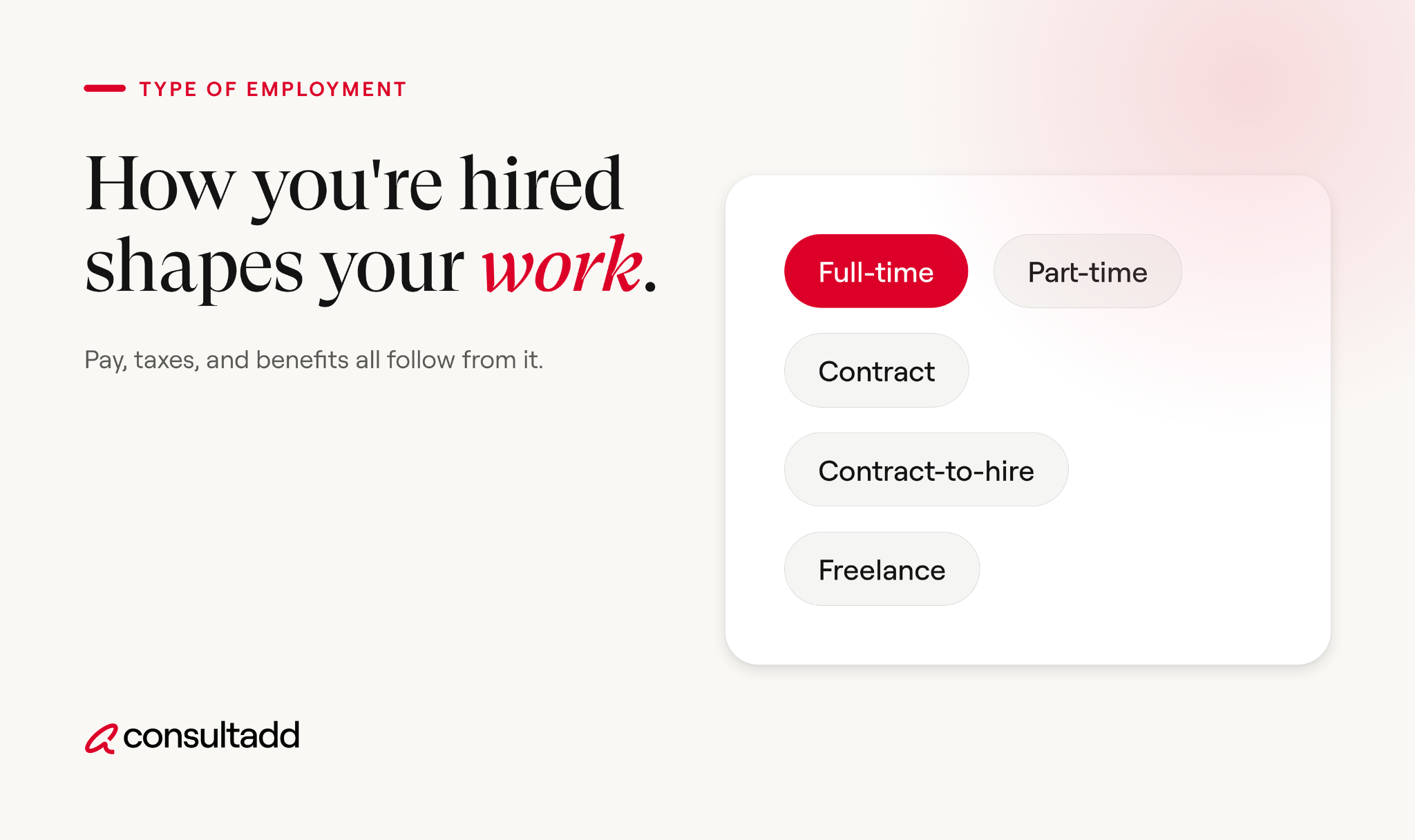
Common types of employment explained
These are the types you'll see most often on U.S. forms and job postings.
1. Full-time employment
You work a regular schedule set by your employer, usually 35 to 40 hours a week, often with benefits like health insurance and paid time off.
There's no single federal number for full-time. The Department of Labor says the Fair Labor Standards Act doesn't define full-time or part-time employment and leaves it generally to the employer.
You can read that answer in the DOL FLSA Advisor.
The IRS does use a number for one purpose. For employer health coverage rules, a full-time employee is one who works on average at least 30 hours a week, or 130 hours a month.
The details are on the IRS page on identifying full-time employees.
2. Part-time employment
You work fewer hours than the employer's full-time standard. Part-time roles may come with fewer benefits, but labor protections still apply.
Whether you're called full-time or part-time doesn't change how the FLSA applies to you.
3. Temporary employment
The job has a defined end, like covering a leave of absence or a short project. Temp workers are often hired and paid through a staffing agency.
4. Seasonal employment
A temporary job tied to a time of year, such as holiday retail, tax season, or summer work.
5. Contract employment
You're hired for a set period or project. In IT, contract work usually runs a few months to a year and is often renewed.
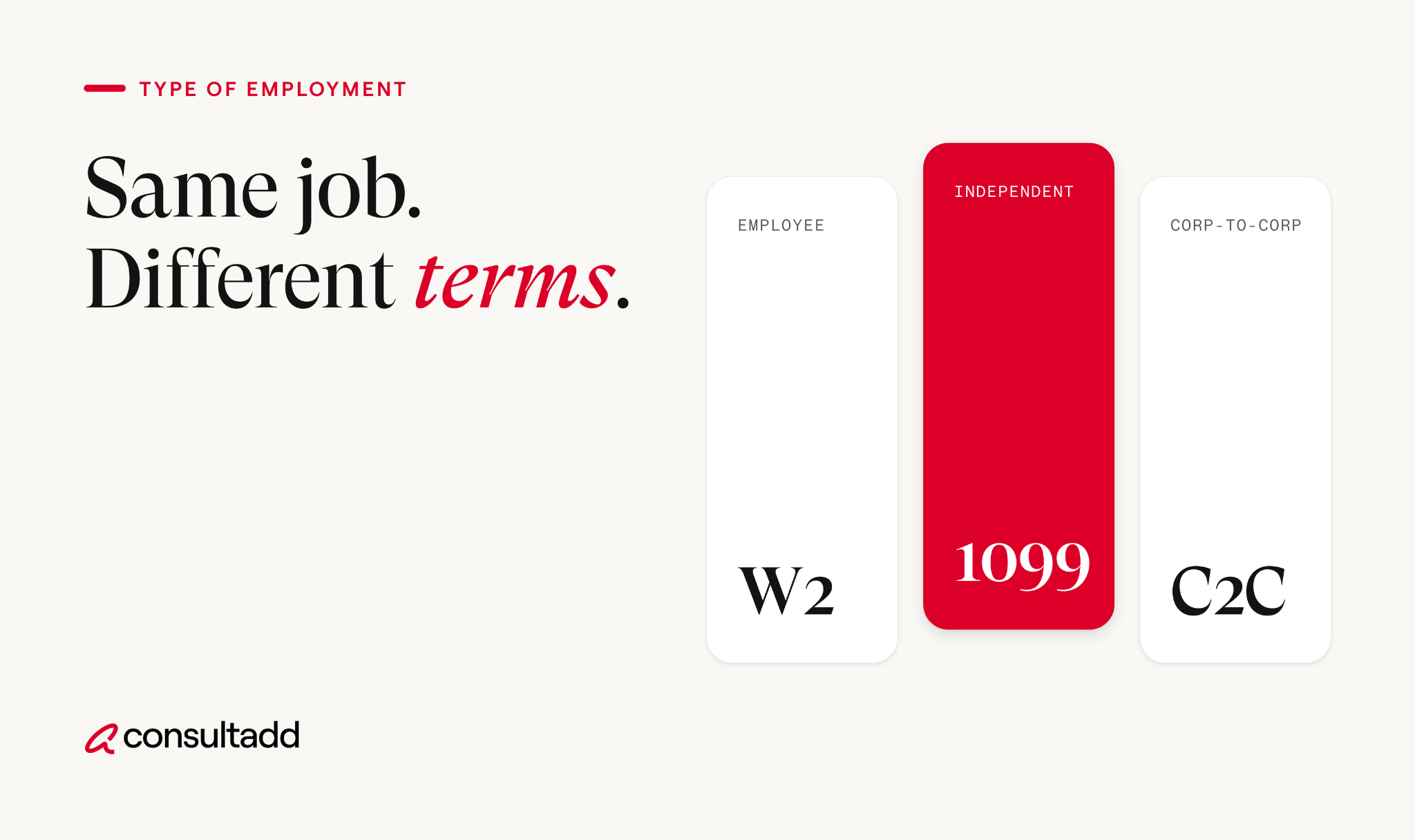
You may be paid as a W-2 employee of a staffing firm, as a 1099 contractor, or through your own company (C2C).
If you're weighing those three setups, our guide to W2 vs C2C vs 1099 explains the tax and benefits differences.
6. Contract-to-hire
You start as a contractor with the option of becoming a permanent employee after a trial period.
Our guide to contract-to-hire covers how conversion usually works.
7. Freelance or self-employed
You work for yourself and take on clients. You handle your own taxes and usually get a 1099-NEC instead of a W-2.
If you work through your own registered business, see our explainer on C2C employment.
8. Internship and apprenticeship
Training-focused roles, often short-term, for students or people entering a field.
Internships may be paid or unpaid depending on the role and the law that applies.
9. Per diem and on-call
You work as needed with no set schedule. This is common in healthcare and some support roles.
Types of employment at a glance
"Usually" matters in this table. Benefits and pay arrangements vary by employer and by contract, so check your offer letter for the real terms.
What does type of employment mean on different forms?
The same field asks for different things depending on who's asking and why.
1. On a job application
Employers usually want to know which arrangement you're applying for (full-time, part-time, or contract) or what you did in past roles.
Answer with the type you actually held, not the one that sounds better. Background checks often confirm it.
2. On LinkedIn and job sites
LinkedIn's "employment type" dropdown includes options like full-time, part-time, self-employed, freelance, contract, internship, apprenticeship, and seasonal.
Pick the one that matches the arrangement. If you were a contractor placed at a well-known company, list the contract role honestly and mention the client in the description if your agreement allows it.
3. On loan, mortgage, and rental applications
Lenders and landlords want to know how stable and verifiable your income is.
They'll often ask whether you're salaried, hourly, self-employed, or contract, and they may ask for pay stubs, W-2s, or tax returns to match.
Self-employed and contract workers are often asked for more documentation, so have it ready.
4. On staffing agency onboarding forms
Agencies usually ask how you'll be engaged: W-2 through the agency, 1099, or C2C through your company. This decides who withholds taxes and what benefits you get, so confirm it before you discuss a rate.
How to answer when your job doesn't fit one box
Plenty of real jobs fall between categories. Here's how to handle the common ones.
1. You're a contractor placed through a staffing agency
Your employer is usually the staffing agency, not the client company where you work. On most forms, your type of employment is "contract" or "temporary," and your employer is the agency.
This trips up a lot of IT consultants. In our experience, background checks are a common place for it to surface, because the client company has no record of employing you.
Listing the agency as the employer and the client in the description avoids that mismatch.
2. You work full-time hours on a contract
Some forms ask about schedule, others about duration. If you can only pick one, "contract" usually tells the reader more. Where there's a notes field, add "full-time hours, 12-month contract."
3. You have more than one job
List each job separately with its own type. A form asking for your "primary" employment wants the one that provides most of your income.
4. You're self-employed and also a W-2 employee
Report both if the form allows multiple entries. Lenders in particular will want to see each income source and its documents.
5. You're between contracts
If a staffing firm still employs and pays you between projects, you're still employed by that firm.
Our explainer on what a bench candidate is covers how that works in IT staffing.
Why your type of employment matters
The label isn't just paperwork. It can affect your pay, protections, and plans.
Benefits
Health insurance, paid leave, and retirement plans are usually tied to full-time employee status.
Under the ACA rules, larger employers are measured on whether they offer coverage to employees averaging 30 or more hours a week.
Taxes
W-2 employees have taxes withheld by their employer. Self-employed workers and 1099 contractors usually pay their own, including self-employment tax.
Labor protections
Minimum wage and overtime protections under the FLSA apply to employees, whether full-time or part-time. They generally don't apply to genuine independent contractors, which is why classification matters.
The Department of Labor explains the risks of worker misclassification.
Visa status
For workers on visas, the type of employment has to match the visa's rules. H-1B status, for example, requires a real employer-employee relationship, so a solo 1099 or C2C setup usually doesn't work.
Our guide to what an H1 visa is covers the basics.
This is general information, not legal or tax advice. If your situation is unusual, check with a tax professional or employment attorney.
Bottom line
So, what does type of employment mean?
It's a short label for the arrangement you work under: your hours, how long the job lasts, and whether you're an employee or self-employed. Most forms only care about one of those, and the dropdown options usually tell you which.
Answer with what's true and what your records will show. If you're a contractor, name the agency as your employer and the client in the description.
And when the field doesn't fit your job, use any notes space to explain in a few words rather than forcing the wrong box.
Start Strong With Consultadd
With 15 years in business and 5,000+ successful staffing engagements, we don't just fill roles, we build reliability into your process. We've supported 65 staffing companies in the past year alone and maintain MSAs with industry leaders like Robert Half and TEKsystems.
Here's what working with Consultadd looks like:
- Talent sourced in under 24 hours
- Ready-to-deploy candidates, vetted for experience and compliance
- Lower turnover risk: we match long-term goals, not just short-term needs
- Seamless compliance: visa, documentation, onboarding? Handled.
- Dedicated 1:1 account managers for responsive, personalized support
- Top 100 candidate matches delivered in the past year
- Strong partnerships with universities to tap into fresh, committed talent
- Post-placement support so your investment grows beyond day one
For candidates, your next opportunity is more than just a job title, it's a chance to build skills, gain experience, and move your career forward. At Consultadd, we connect technology professionals with projects and employers that align with their goals, whether they're looking for contract, contract-to-hire, or long-term opportunities.
The tech job market moves fast, but the right guidance can make all the difference. Ready to take the next step in your career journey? Explore Opportunities >>
Key takeaways
- Type of employment describes your work arrangement, covering your schedule, the job's length, or your classification as an employee or self-employed.
- The most common types are full-time, part-time, temporary, seasonal, contract, contract-to-hire, freelance, internship, and per diem.
- Federal wage law doesn't define full-time, but the IRS uses 30 hours a week or 130 hours a month for employer health coverage rules.
- Read the form's options to see what it's asking, and answer with what your employer's records will confirm.
- Contractors placed through staffing agencies should usually list the agency as employer and "contract" or "temporary" as the type.
FAQs
What does type of employment mean on a job application?
It asks about the arrangement for the job you're applying for or held in the past. Common answers are full-time, part-time, temporary, contract, or internship. Choose the option that matches the actual terms, since background checks often verify it.
What are the main types of employment?
The main types are full-time, part-time, temporary, seasonal, contract, contract-to-hire, freelance or self-employed, internship, and per diem. They differ in hours, length, benefits, and who pays you. Many forms only list a few of these, so pick the closest match.
How many hours is full-time employment?
There's no single federal rule for wages and overtime, and the Department of Labor leaves the definition to employers. Many employers use 35 to 40 hours a week. For employer health coverage under the ACA, the IRS uses an average of 30 hours a week or 130 hours a month.
Is contract work considered full-time employment?
It can be both. A contract describes how long the job lasts, while full-time describes your hours, so many contractors work full-time hours on a fixed-term contract. If a form only allows one answer, "contract" is usually more accurate.
What is employment status vs. type of employment?
Employment status usually means whether you're currently employed, unemployed, or self-employed. Type of employment describes the arrangement of a specific job, like full-time or contract. Some forms use the two terms interchangeably, so read the options before answering.
What type of employment should I list if I work through a staffing agency?
List "contract" or "temporary," depending on the options, and name the staffing agency as your employer since it usually runs your payroll. You can mention the client company in the job description. This keeps your application consistent with what a background check will show.
.webp)
What Is Contract To Hire? How It Works For Employers
Introduction
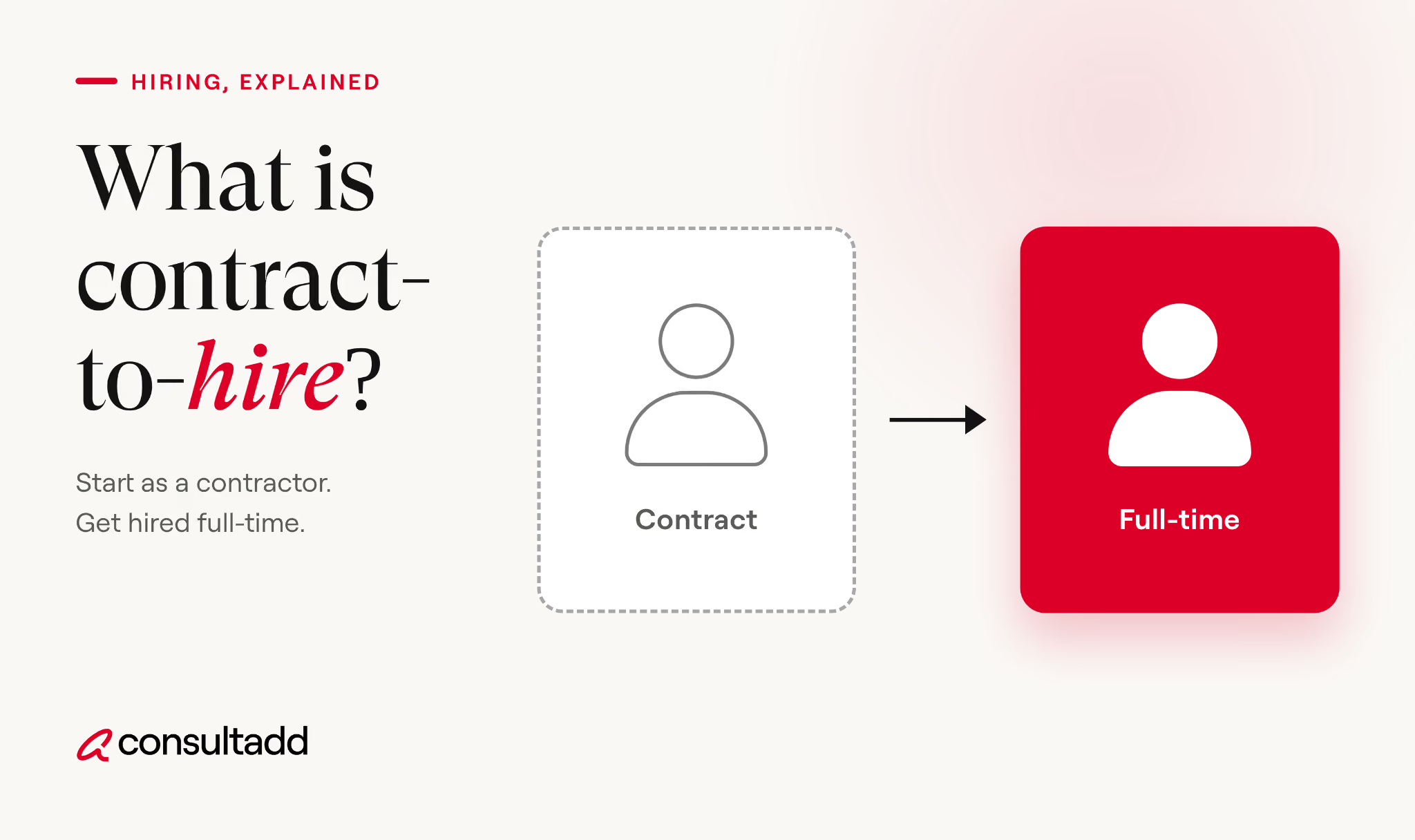
What is contract to hire? It's a hiring model where a person starts on a fixed-term contract, usually through a staffing agency that acts as the legal employer, and the client company has the option to hire them as a permanent employee when the contract ends.
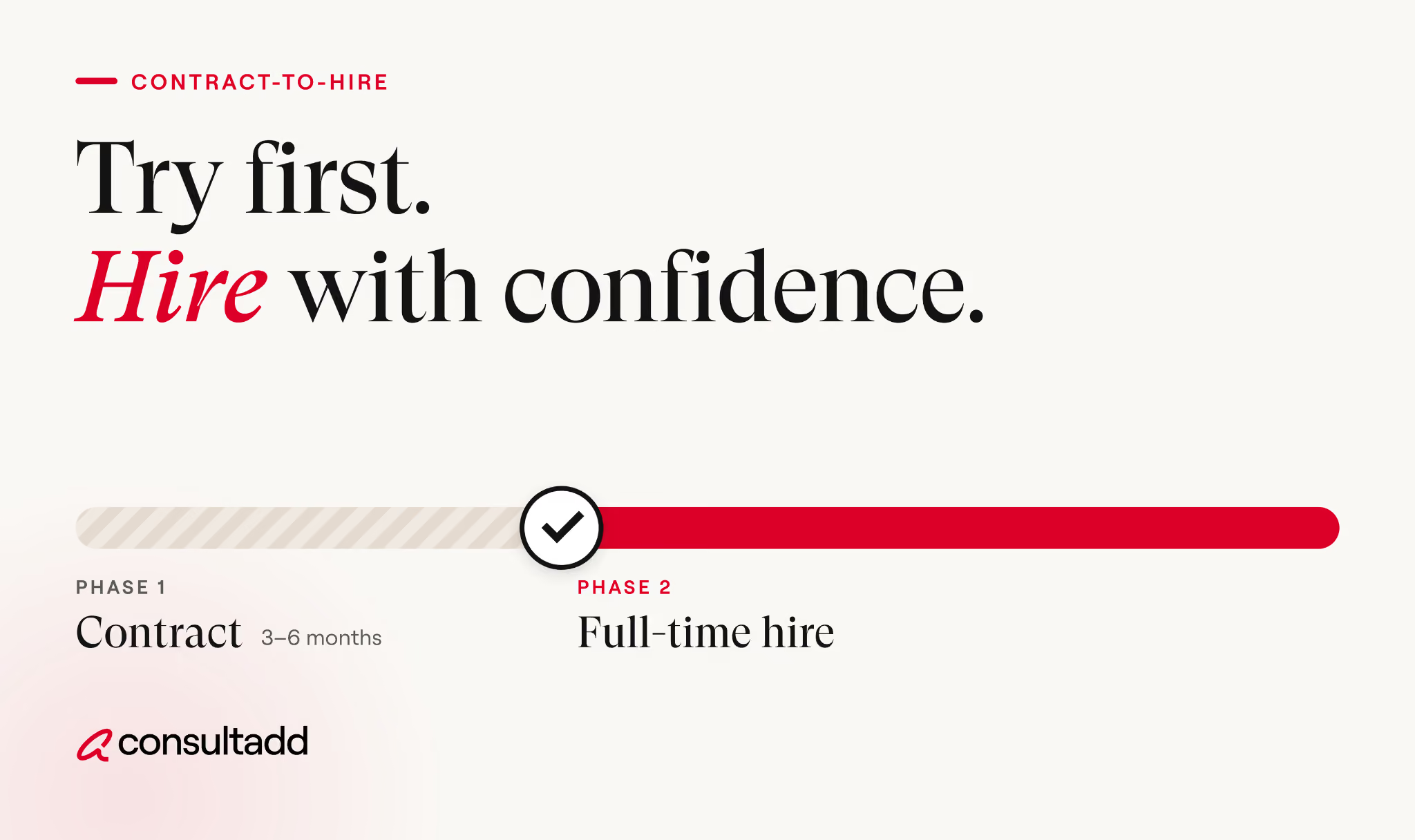
Most contracts run three to six months. If the fit is right, the worker converts to the client's payroll. If not, the assignment simply ends.
For hiring managers, it means you get to see real work before making a salary commitment.
This guide covers the employer side: how the process runs, what it costs, how conversion fees work, and when the model is the wrong choice.
TL;DR
- Contract to hire means a worker starts on a fixed-term contract with the option to convert to a permanent employee at the end.
- A staffing agency is usually the employer of record during the contract, handling payroll, taxes, and I-9 verification.
- You pay a bill rate that includes the worker's pay plus the agency's markup, and possibly a conversion fee if you hire before an agreed date.
- The model works best for roles where skills are hard to judge in interviews and poorly for senior candidates who already have permanent offers.
- Write the conversion criteria, timeline, and fees into the agreement before the worker starts, not at the end.
What is contract to hire?
Contract to hire, also called temp to perm, is an arrangement with three parties: the client company where the work happens, the staffing agency that employs the worker during the contract, and the worker.
During the contract period, the worker does the same job a permanent employee would. They join stand-ups, take tickets, and report to your manager. The difference is on paper. Their paycheck, tax withholding, and any benefits come from the agency, not from you.
At the end of the term, you make one of three calls: convert the worker to a permanent employee, extend the contract, or end the assignment.
Who does what in a contract to hire arrangement
A quick example
Say a healthcare software company needs a DevOps engineer to finish a cloud migration. The hiring manager isn't sure the role will justify permanent headcount after the project, and interviews haven't shown how candidates handle production incidents.
A contract to hire setup lets them bring an engineer on for four months through an agency. By month three, the manager has watched the engineer run on-call rotations and ship infrastructure changes. That's a far better basis for a permanent offer than three rounds of interviews.
If you're looking at this from the candidate side, our guide to contract to hire meaning for job seekers covers pay, benefits, and what to ask before accepting an offer.
How the contract to hire process works for employers
The process isn't complicated, but most problems come from skipping the early steps. Here's how a well-run engagement usually goes.
- Define the role and the conversion criteria. Before anyone is sourced, decide what "good" looks like at month three. Name specific outcomes, such as owning a service end to end or closing tickets without help.
- Agree on terms with the staffing partner. Settle the bill rate, contract length, conversion fee schedule, and the earliest date you can convert without a fee.
- Source, screen, and interview. Interview candidates as you would for a permanent role, and tell them up front that the role is contract to hire.
- Onboard through the agency. The agency completes the I-9 and payroll setup. You handle system access, equipment, and team introductions.
- Run a midpoint review. Give the worker direct feedback against the criteria from step one. Surprises at the end hurt both sides.
- Make the conversion decision. Decide two to four weeks before the contract ends so there's time for an offer and negotiation.
- Convert or close out. Issue your offer letter, enroll the worker in your benefits, and confirm the end date with the agency.
A typical employer timeline
Timelines vary by role. Our stage-by-stage look at how long the hiring process takes shows where delays usually build up.
What contract to hire costs
During the contract, you don't pay the worker directly. You pay the agency an hourly bill rate.
That rate covers the worker's pay plus the agency's markup, which funds employer payroll taxes, workers' compensation, any benefits, recruiting costs, and the agency's margin.
How a bill rate is built
The numbers below are an illustration, not market rates. Actual markups vary by agency, role, location, and volume.
When you compare this to a salaried hire, compare it against the full cost of a permanent employee: salary, your payroll taxes, benefits, recruiting fees, and onboarding time.
Comparing a bill rate to base salary alone makes contract to hire look more expensive than it is.
Conversion fees and buyout clauses
Most agreements include a conversion fee, sometimes called a buyout, if you hire the worker before a set number of hours or weeks. The agency recovers its recruiting cost through the markup over time, and an early conversion cuts that short.
Common structures include a sliding fee that drops the longer the worker stays on contract, and a no-fee conversion after a minimum period.
Get the schedule in writing before the worker starts. Fee disputes at conversion time are avoidable, and they sour the relationship with both the agency and the person you want to hire.
Contract to hire vs direct hire vs contract staffing
Each model fits a different hiring problem. This comparison is from the employer's point of view.
For a closer look at the trade-offs, our breakdown of contract to hire benefits, pros, and cons walks through each one.
When contract to hire makes sense, and when it doesn't
Good fits
Contract to hire works well when a skill is hard to test in an interview.
Think of a data engineer working inside a messy legacy pipeline, or a Salesforce developer who has to learn your custom objects. A few weeks of real work shows more than any take-home test.
It also helps when headcount approval is uncertain. Some managers use the contract period to prove a role's value before asking for a permanent slot.
Poor fits
Senior candidates with several permanent offers rarely accept contract to hire roles. If you're hiring a principal engineer in a tight market, the model can shrink your candidate pool.
It's also a poor fit when you already know the role is permanent and trust your interview process. The contract period then mostly adds cost and delay.
Watch visa status too. If a candidate works through an agency on an H-1B, converting them means your company has to file its own petition.
Plan that legal work before the contract starts, not in the final week.
Compliance points employers should get right
Contract to hire is a W2 arrangement through the agency, and the label matters less than how the relationship works in practice.
The U.S. Department of Labor's guidance on employment relationships under the FLSA explains that classification depends on the economic reality of the relationship, not on what the contract calls the worker.
If someone describes a 1099 or corp-to-corp setup as contract to hire, look closely before you sign.
A few other points to settle with your staffing partner:
- Co-employment. You direct the daily work, so you share some responsibility for a safe, non-discriminatory workplace. Keep pay, benefits, and HR decisions such as discipline with the agency.
- Benefits during the contract. Agency benefits are often thinner than permanent packages. Bureau of Labor Statistics data from July 2023 shows 16.6 percent of temporary help agency workers had employer-provided health insurance, compared with 54.4 percent of workers in traditional arrangements.
- Non-solicitation terms. Your agreement likely bars you from hiring the worker outside its conversion terms for a set period. Read this clause before any informal talk about a permanent role.
- Equal treatment. Contract workers should get the same training, tools, and respect as permanent staff. It's also the only way to get an accurate read on their performance.
Classification also shapes taxes and benefits on the worker's end.
Our comparison of W2, C2C, and 1099 contract types explains who the legal employer is under each one.
How to make the conversion decision
Base the decision on the criteria you wrote down at the start, using evidence from the whole contract period rather than impressions from the last two weeks.
The last row gets overlooked. In the BLS July 2023 survey on contingent work, 44.8 percent of contingent workers said they would have preferred a permanent job. Many contract workers will welcome an offer, but not all. Ask directly, well before the end date.
Expect a salary conversation, too. A contract hourly rate and a permanent salary aren't directly comparable, because the salary comes with your benefits. Show the worker the full package, not just the base number.
Is contract to hire right for your next hire?
Contract to hire gives you months of real performance data before a permanent commitment. In exchange, you pay an hourly markup and may lose some senior candidates who want a permanent offer on day one.
It works when you set conversion criteria and fees up front, review performance at the midpoint, and decide early enough to make a proper offer.
If you're comparing staffing partners to run the process, our guide to the best IT staffing firms covers what to check, from screening depth to placement speed.
Start Strong With Consultadd
With 15 years in business and 5,000+ successful staffing engagements, we don't just fill roles, we build reliability into your process. We've supported 65 staffing companies in the past year alone and maintain MSAs with industry leaders like Robert Half and TEKsystems.
Here's what working with Consultadd looks like:
- Talent sourced in under 24 hours
- Ready-to-deploy candidates, vetted for experience and compliance
- Lower turnover risk: we match long-term goals, not just short-term needs
- Seamless compliance: visa, documentation, onboarding? Handled.
- Dedicated 1:1 account managers for responsive, personalized support
- Top 100 candidate matches delivered in the past year
- Strong partnerships with universities to tap into fresh, committed talent
- Post-placement support so your investment grows beyond day one
For candidates, your next opportunity is more than just a job title, it's a chance to build skills, gain experience, and move your career forward. At Consultadd, we connect technology professionals with projects and employers that align with their goals, whether they're looking for contract, contract-to-hire, or long-term opportunities.
The tech job market moves fast, but the right guidance can make all the difference. Ready to take the next step in your career journey? Explore Opportunities >>
Key takeaways
- Contract to hire lets you evaluate a worker on real work for a fixed term before deciding on a permanent offer.
- The staffing agency is the employer of record during the contract, so you pay a bill rate rather than a salary.
- Conversion fees and no-fee dates belong in the agreement before day one, not in a negotiation at the end.
- The model suits hard-to-assess skills and uncertain headcount, and it struggles with senior candidates holding permanent offers.
- Good conversion decisions rest on written criteria, a midpoint review, and a direct conversation about the worker's interest.
FAQs
What happens at the end of a contract to hire period?
The client company either makes a permanent offer, extends the contract, or ends the assignment. If the worker accepts an offer, they move from the agency's payroll to the client's payroll and benefits. Any conversion fee is settled between the client and the agency.
Do contract to hire employees get benefits?
During the contract, any benefits come from the staffing agency, and they're often more limited than a permanent package. Once the worker converts, they become eligible for the client company's benefits under its normal rules.
Can you negotiate salary when converting from contract to hire?
Yes, and most conversions involve some negotiation. The worker should compare the full permanent package, including benefits and paid time off, against their contract hourly rate. Employers should expect this conversation and prepare a total compensation figure.
Can a contract to hire worker quit before the contract ends?
Usually, yes. The worker is an employee of the staffing agency, and most of those arrangements are at-will. They should still give notice, since leaving early can affect their relationship with the agency and the client.
What is a conversion fee in contract to hire?
A conversion fee is a charge the client pays the staffing agency for hiring the worker before a minimum period set in the agreement. It compensates the agency for recruiting costs it hasn't yet recovered through the hourly markup. Many agreements reduce the fee over time or waive it after a set number of hours.
Is contract to hire the same as temp to perm?
The two terms describe the same model: a temporary assignment with a planned path to permanent employment. "Contract to hire" is more common in IT and professional roles, while "temp to perm" shows up more in administrative and light industrial staffing.

Part Time Contract IT Jobs: Roles, Pay and How to Land One
Introduction
Some tech professionals want fewer hours. A parent who can work 20 hours a week. A senior engineer easing toward retirement. A developer with a full-time job who wants a second income stream or a new skill on their resume.
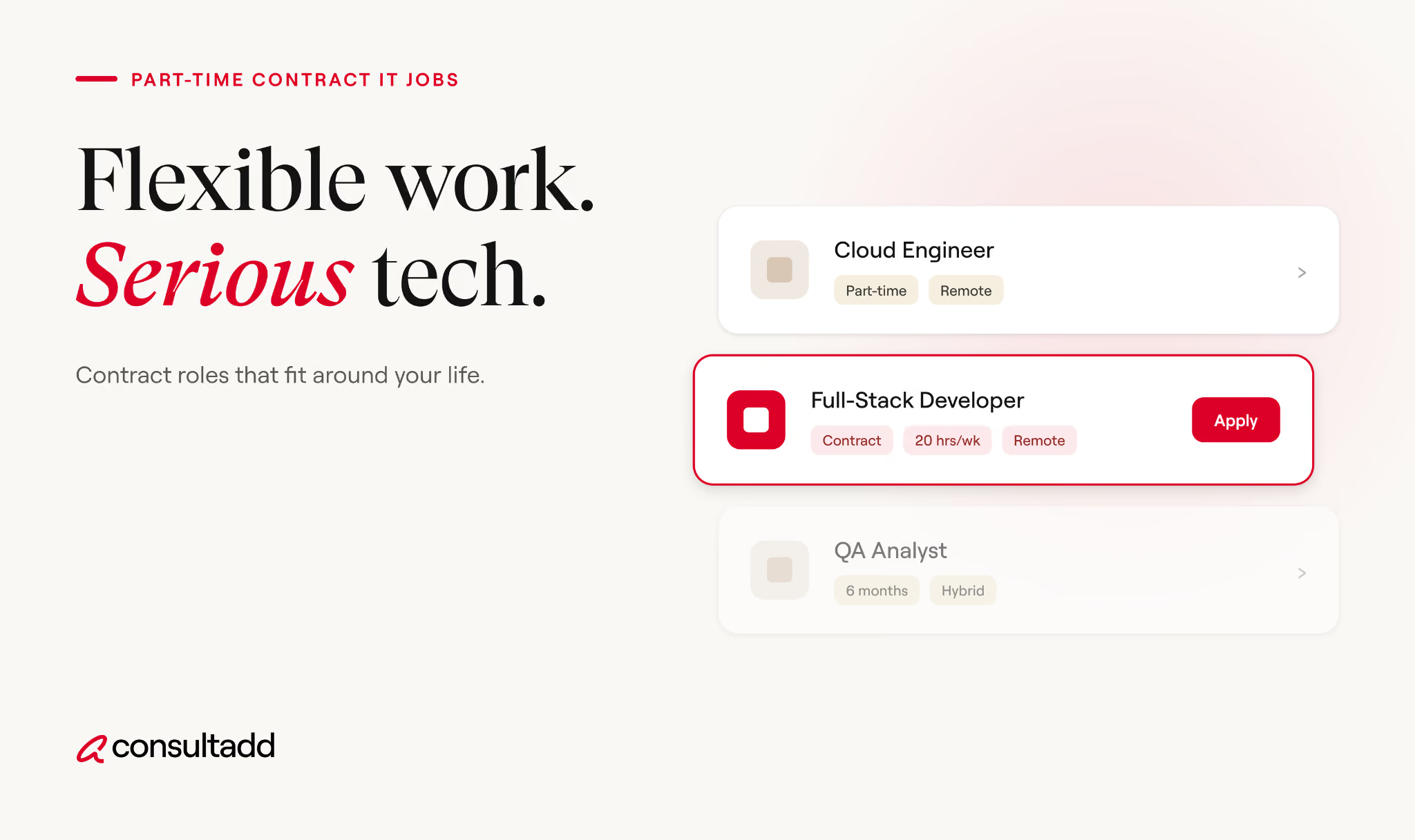
Part time contract IT jobs fit all three. They're technology roles with a defined scope or end date where you work fewer hours than a standard full-time week, usually paid by the hour.
They're also harder to find than full-time contracts. Most IT contracts in the U.S. still expect around 40 hours a week.
This guide covers which roles do offer part-time hours, how those contracts are usually structured, what to charge, where to look, and the tax, visa and employment-agreement points that change when you work part time.
TL;DR
- Part time contract IT jobs exist, but they're a smaller slice of the market than full-time contracts. Specialists and experienced professionals find them most easily.
- IT support, QA, data and analytics, cloud and security reviews, and fractional leadership roles offer reduced hours more often than core development.
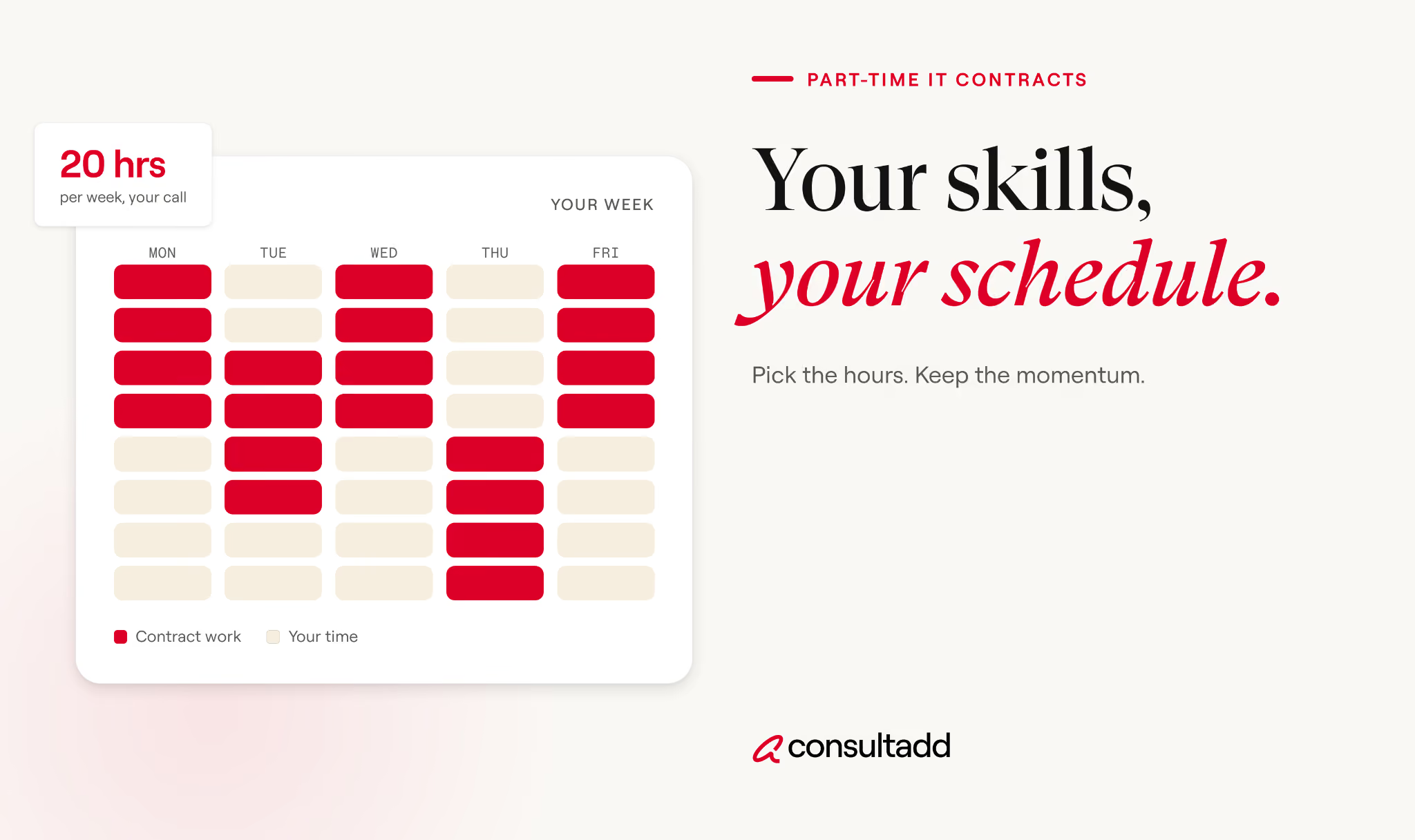
- Part-time contracts usually take one of five forms: fixed weekly hours, a retainer, on-call support, a fixed-scope project or after-hours coverage.
- Agree on a minimum number of weekly hours and response times in writing. Undefined part-time work tends to creep.
- If you have a full-time job, check your employment agreement for conflict-of-interest and IP clauses before you accept anything.
What part time contract IT jobs are
A part time contract IT job combines two things: contract terms (a defined project or end date, usually hourly pay) and reduced hours (fewer than a full-time schedule).
There's no single legal definition of part time. The U.S. Department of Labor notes that the Fair Labor Standards Act doesn't define full-time or part-time employment, so each employer sets its own threshold. For statistics, the Bureau of Labor Statistics counts people working 1 to 34 hours a week as part time.
Plenty of people work part time without wanting to. BLS reported that 4.5 million people worked part time for economic reasons in September 2026, meaning they'd have preferred full-time work.
This guide is for the other group: people who want fewer hours on purpose and want those hours to be in tech.
The pay arrangement also matters. A part-time contract can be W-2 through a staffing firm, 1099 as an independent contractor, or C2C through your own company.
Our guide to the three types of employment explains how part-time, full-time and contract work differ underneath the hours.
IT roles that offer part-time contracts most often
Not every IT role splits well into part-time hours. Work that needs constant coordination with a full-time team, like core product development, is harder to do on 15 hours a week. Work that's specialized, bounded or periodic splits much more easily.
From the staffing side, a pattern shows up again and again. The candidates who land part-time contracts most easily are senior specialists.
A client will happily take 20 hours a week from someone who can do in 20 hours what a mid-level contractor does in 40. Early-career candidates usually find full-time contracts easier to get.
How part-time IT contracts are usually structured
"Part time" covers several different arrangements. Knowing which one you're being offered helps you price it and protect your schedule.
Which structure to ask for
- If you need predictable income, fixed weekly hours or a retainer works best.
- If you have another job, a fixed-scope project gives you the most control over when you work.
- On-call work pays for your availability, so make sure the availability is actually paid, not just the hours you log.
Pay rates and minimum hours
Part-time contract work is almost always paid by the hour or by the project. Rates depend on the same things full-time contract rates do: skill, seniority, location, industry and pay structure.
A few things are specific to part-time work:
- Ask for a minimum weekly or monthly commitment. A contract that says "up to 20 hours a week" can mean 3 hours in a slow week. A minimum protects your income and makes it easier to plan around.
- Price your availability. If a client expects you to answer within an hour during business days, that limits what else you can do. On-call or retainer fees should reflect it.
- Account for overhead. On a 1099 or C2C contract, you pay your own taxes, benefits and equipment, and you have unpaid time between clients. That overhead doesn't shrink just because your hours did.
- Compare like with like. A W-2 part-time rate and a 1099 rate for the same hours aren't equivalent.
Our guide to W-2 vs C2C vs 1099 contracts shows how to compare them.
For general contract rate context by role, our guide to IT contract jobs covers how to compare an hourly rate with a salary.
Where to find part-time contract IT work
Part-time roles get filled through the same channels as other contract work, but with a different mix. Many are never posted as "part time" at all.
They start as a conversation about a full-time contract that the client would accept at fewer hours.
Staffing agencies. Tell recruiters up front that you want part-time work and how many hours you can commit. A recruiter who knows that can pitch you for roles where the client is flexible, rather than submitting you to full-time reqs you'll turn down.
Your own network. Former managers and colleagues are the most common source of part-time work for experienced IT professionals. A team that already knows your work is far more willing to accept reduced hours.
Small and mid-size businesses. Many need IT help but can't justify a full-time hire. Managed service gaps, one-off cloud setups and security reviews often go to part-time contractors.
Job boards with filters. Use "part time" and "contract" filters together, and also search terms like "fractional," "retainer" and "hours flexible."
Converting a full-time contract. If you're already on a contract and the workload drops, ask whether the client would keep you at reduced hours rather than ending the engagement.
Our guide on how to find contract work goes deeper on running these channels together. If you want remote part-time roles, see how staffing agencies place remote candidates.
Taking a part-time contract alongside a full-time job
Many people looking for part time contract IT jobs already have a full-time job. That's common, but it comes with a few checks most people skip.
1. Read your employment agreement first
Look for these clauses before you accept outside work:
- Outside employment or moonlighting rules. Some employers require approval for any second job.
- Conflict of interest. Working for a competitor, client or vendor of your employer is usually off limits.
- Intellectual property assignment. Some agreements claim ownership of anything you build, even on your own time, if it relates to the employer's business.
- Use of company resources. Never use your employer's laptop, accounts, code or working hours for contract work.
If anything is unclear, ask HR or get legal advice before you start. This is general information, not legal advice.
2. Protect your schedule
Agree in writing on when you're available. "Evenings and Saturdays, response within one business day" sets clear expectations. Avoid contracts that need you on calls during your main job's working hours.
3. Be realistic about hours
Adding 15 hours a week to a 40-hour job is manageable for some people for a while. Adding 25 usually isn't sustainable. Start smaller than you think you can handle and increase only if it's working.
Taxes, visas and paperwork
Fewer hours don't mean fewer obligations. A few things work differently from a standard full-time job.
1. Taxes on 1099 and C2C work
If you're paid as an independent contractor, taxes aren't withheld from your payments. The IRS explains that you may need to make estimated tax payments during the year to cover income tax and self-employment tax.
Many part-time contractors set aside a share of every payment so tax time isn't a shock. On a W-2 part-time contract through a staffing firm, taxes are withheld for you, which is simpler if this is your first contract.
2. Benefits
Part-time contractors rarely get benefits. If you're on a W-2 contract through a staffing firm, ask what's offered at your hours. If you're on 1099 or C2C, budget for health coverage and retirement savings yourself.
3. Work authorization and visa limits
Visa holders need extra care. Many work visas tie you to a specific employer and job, so taking a second part-time role may require its own approval or petition. For H-1B holders, USCIS rules on H-1B specialty occupations govern who can employ you and on what terms.
4. Watch for scams
Part-time remote IT roles are a common target for fake job offers. The FTC's guidance on job scams lists warning signs, including offers made by text with no interview and requests to pay for equipment or training. A real client interviews you and never asks you to pay to start.
A checklist before you sign a part-time IT contract
Run through these before you accept. Most part-time contract problems come from things nobody wrote down.
For a fuller walkthrough of contract terms, see our guide to what to check in a work contract agreement.
Choosing the right part time contract IT jobs for you
The best part time contract IT jobs match three things: a role that splits naturally into fewer hours, a structure that fits your schedule, and terms that protect your time and income.
Before you start searching, write down three numbers: the minimum hours you need, the maximum you can handle and the hourly rate you won't go below.
Then tell every recruiter and contact those numbers up front. Clear limits make it much easier for the right part-time contract to find you.
Start Strong With Consultadd
With 15 years in business and 5,000+ successful staffing engagements, we don't just fill roles, we build reliability into your process. We've supported 65 staffing companies in the past year alone and maintain MSAs with industry leaders like Robert Half and TEKsystems.
Here's what working with Consultadd looks like:
- Talent sourced in under 24 hours
- Ready-to-deploy candidates, vetted for experience and compliance
- Lower turnover risk: we match long-term goals, not just short-term needs
- Seamless compliance: visa, documentation, onboarding? Handled.
- Dedicated 1:1 account managers for responsive, personalized support
- Top 100 candidate matches delivered in the past year
- Strong partnerships with universities to tap into fresh, committed talent
- Post-placement support so your investment grows beyond day one
For candidates, your next opportunity is more than just a job title, it's a chance to build skills, gain experience, and move your career forward. At Consultadd, we connect technology professionals with projects and employers that align with their goals, whether they're looking for contract, contract-to-hire, or long-term opportunities.
The tech job market moves fast, but the right guidance can make all the difference. Ready to take the next step in your career journey? Explore Opportunities >>
Key takeaways
- Part time contract IT jobs are less common than full-time contracts, and experienced specialists land them most easily.
- Support, QA, data, cloud, security, DBA and fractional leadership roles offer reduced hours more often than core development.
- Know which structure you're offered: fixed hours, retainer, on-call, fixed-scope project or after-hours coverage.
- Put minimum hours, availability, response times and overage rules in writing before you start.
- If you have a full-time job or a work visa, check your employment agreement and immigration status before accepting any second role.
FAQs
Are part-time contract IT jobs common?
They're less common than full-time contracts, since most IT contracts expect around 40 hours a week. They're more available for specialized or periodic work like IT support, QA, security reviews, database administration and fractional leadership. Many part-time roles also start as full-time contracts that the client agrees to scale down.
How many hours is a part-time IT contract?
There's no fixed standard. Many part-time IT contracts fall between 10 and 30 hours a week, and retainers are often set as a number of hours per month. BLS counts anyone working 1 to 34 hours a week as part time for statistical purposes.
Can I do a part-time IT contract while working full time?
Often, yes, but check your employment agreement first. Look for rules on outside employment, conflicts of interest and intellectual property, and never use your employer's equipment or working hours for contract work. Visa holders should confirm that a second job is allowed for their status.
How are part-time IT contractors paid?
Most are paid by the hour, either as W-2 employees of a staffing firm, as 1099 independent contractors, or through their own company on C2C terms. Some fixed-scope projects pay a flat fee per deliverable. On 1099 or C2C contracts, you handle your own taxes, including estimated payments.
Do part-time contractors get benefits?
Usually not. Some staffing firms offer limited benefits to W-2 contractors, so ask what's available at your expected hours. On 1099 or C2C contracts, you'll need to arrange health coverage and retirement savings yourself.
What IT skills are best for part-time contract work?
Skills tied to bounded or periodic work tend to be easiest to sell part time. Examples include cloud cost reviews, security assessments, database tuning, test automation, IT support and BI reporting. Senior experience helps, because clients are more willing to accept fewer hours from someone who works quickly without much supervision.
.webp)
Work Contract Agreement: What to Check Before You Sign
Introduction
A work contract agreement is the document that says what you'll do, what you'll be paid, and what happens when the work ends. Most people skim it, find the rate, and sign.
Then six months later they discover a 30-day notice requirement, a non-solicit that blocks their next job, or an IP clause that covers their weekend side project.
This guide walks through the clauses that matter, the red flags worth catching, how to negotiate, and a checklist to run before you sign. It's written mainly for contractors and new hires reviewing an agreement, though hiring managers drafting one will find the same points useful.
TL;DR
- A work contract agreement sets out scope, pay, term, termination, and what you can and can't do after the job ends.
- The clauses that cause the most trouble later are termination, IP, non-compete, and non-solicit.
- Vague scope and unclear payment terms are the most common red flags, and both are easy to fix before signing.
- More is negotiable than most people assume, especially notice periods, payment timing, and restrictive covenants.
- A contract label doesn't decide your worker status. How the work actually happens does.
What a work contract agreement is
A work contract agreement is a written agreement between a worker and the party paying for their work. That party might be an employer, a staffing firm, or a client hiring you directly as a contractor.
It goes by many names: employment agreement, contractor agreement, consulting agreement, assignment agreement, or simply "the contract." The name matters less than what's inside.
The type of agreement you sign depends on how the work is set up.
If you're unsure which arrangement you're in, our guide on what contract work means explains W2, 1099, corp-to-corp, and contract-to-hire side by side.
Key clauses in a work contract agreement
Every agreement is different, but these contract clauses show up in almost all of them. Read each one with a simple question in mind: what happens to me if things go wrong?
1. Parties and worker status
Check that the names are right, including your legal name or your company's legal name. The agreement should state whether you're an employee or an independent contractor. If that's missing or unclear, ask.
2. Scope of work
The scope of work describes what you're being hired to do. Good scope language is specific: the role, the main responsibilities, the deliverables, and who you report to.
Vague scope like "other duties as assigned" isn't unusual in employment agreements. In a contractor agreement, it's a problem, because it can turn a fixed project into open-ended work at the same rate.
3. Term and start date
Look for the start date, the end date or expected length, and whether the contract renews automatically. If it's an assignment through an agency, check whether the end date can be extended and on what terms.
4. Pay rate, hours, and payment terms
This section should state your rate, how it's calculated (hourly, daily, salary, or fixed fee), and when you get paid. For contractors, payment terms matter as much as the rate. Net 15 and net 60 are very different if you're covering your own rent.
Also check how hours are tracked and approved. Timesheet disputes are one of the most common reasons contractor payments get delayed.
5. Overtime and expenses
If you're a non-exempt employee, overtime rules apply under federal and state law. If you're a contractor, the agreement should say whether hours beyond an agreed limit are billable.
For expenses like travel, equipment, or software, look for what's reimbursable and how to claim it.
6. Termination clause
The termination clause explains how either side can end the agreement. Look for the notice period, whether it's the same for both sides, and what happens to unpaid invoices or accrued pay if the contract ends early.
Some agreements let the client end the contract immediately while requiring you to give 30 days' notice. That imbalance is worth pushing back on.
7. Confidentiality
Expect a confidentiality clause. It should cover genuinely confidential information, like client data, source code, and business plans, and say how long the obligation lasts.
Overly broad clauses that treat everything as confidential forever are harder to comply with.
8. Intellectual property
The intellectual property clause decides who owns what you create. In most work arrangements, the client or employer owns work produced for them. That's normal.
The issue is scope. Some IP clauses claim anything you create during the contract period, including personal projects done on your own time and equipment.
If you have side projects or open-source work, list them as excluded prior inventions before signing.
9. Non-compete and non-solicit
A non-compete clause restricts where you can work after the contract ends. A non-solicit clause restricts you from recruiting the client's employees or customers, or in staffing, from working directly for the client without going through the agency.
Enforceability depends heavily on state law, covered in the legal section below. Either way, read these carefully, because they're the clauses most likely to affect your next job.
10. Conversion and buyout terms
If the role might turn permanent, the agreement may include conversion terms or a buyout fee the client pays to hire you directly.
Our breakdown of what contract for hire means covers how those terms usually work.
11. Dispute resolution and governing law
This tells you which state's law applies and how disputes get resolved: in court, through arbitration, or through mediation first.
An agreement governed by the law of a state you've never worked in is worth asking about.
12. Insurance and liability (contractors)
Independent contractors and corp-to-corp entities are often asked to carry general liability or professional liability insurance and to indemnify the client.
Our guide to C2C contract clauses goes deeper on liability caps and indemnity.
Red flags to catch before you sign
Most bad contracts aren't malicious. They're templates nobody updated. Still, a few patterns should make you slow down.
How to negotiate contract terms
Contract negotiation feels awkward, but it's normal. Recruiters see revised agreements every week, and a reasonable request rarely costs anyone an offer.
A few things tend to be negotiable:
- Notice periods, especially when they're one-sided.
- Payment timing for contractors, such as moving from net 45 to net 15.
- Non-compete and non-solicit scope, including length, geography, and which clients they cover.
- IP carve-outs for prior inventions and personal projects.
- Rate reviews for longer assignments, such as a review after six or twelve months.
Ask in writing, keep it specific, and explain the reason briefly. "Can we make the notice period two weeks for both sides?" works better than "I'm not comfortable with the termination section."
Rate itself is often negotiated earlier, during the offer stage. Once you're at the contract stage, focus on terms that protect you if the job ends sooner than planned.
Work contract agreement checklist
Run through this before you sign. If you can't answer a question from the document itself, ask.
- Are both parties named correctly, with legal names?
- Does the agreement state whether you're an employee or a contractor?
- Is the scope of work specific enough that you'd know when you're done?
- Are the start date, end date, and renewal terms clear?
- Is your rate written down, along with how and when you'll be paid?
- Is it clear how hours are tracked and approved?
- Does the termination clause give both sides the same notice?
- Does the IP clause exclude your prior work and personal projects?
- Are any non-compete or non-solicit terms limited in time and scope?
- Have you seen every document the agreement refers to?
- Do you know which state's law applies and how disputes are handled?
- Do you have a signed copy saved somewhere you can find it later?
What changes when you work through a staffing firm
When you take a contract role through a staffing firm, there are usually at least two agreements. One is between the staffing firm and the client. The other is between you and the staffing firm. You typically sign only the second one.
That matters for a few reasons. Your agreement may reference client policies or flow-down terms from the client contract, so ask to see anything you're expected to follow. The non-solicit clause often protects the agency's relationship with the client, which can limit your ability to go direct for a period after the assignment.
On W2 contracts, the staffing firm is your legal employer, handles payroll and tax withholding, and completes your employment paperwork. The client directs your daily work.
Our IT contract staffing buyer's guide explains who employs whom in more detail.
Legal points worth knowing
This is general information, not legal advice. For anything high-stakes, have an employment attorney review the agreement.
Worker status depends on facts, not labels:
- Calling someone an independent contractor in the agreement doesn't settle the question. Regulators look at how the work actually happens, including who controls the schedule, tools, and methods.
- The IRS guidance on independent contractors and employees covers the factors it looks at.
Our post on the rules for 1099 workers explains them in plain terms.
Non-competes are mostly a state-law question:
- The FTC's 2024 rule banning most non-competes never took effect.
- A federal court blocked it in August 2024, and in September 2025 the FTC voted 3-1 to drop its appeals and accept the rule's vacatur.
- The FTC's rule page now states that the rule isn't in effect or enforceable.
- The agency has said it will review non-compete agreements case by case under its existing powers.
- That leaves state law in charge, and states vary widely. Some ban most non-competes, others enforce reasonable ones.
Wage and hour rules still apply:
- If you're classified as an employee, federal and state rules on minimum wage and overtime apply regardless of what the contract says.
- The Department of Labor's Fair Labor Standards Act overview is a good starting point.
Signing a work contract agreement with confidence
A work contract agreement is worth an hour of careful reading. Check the scope, the pay terms, the termination clause, and anything that limits what you can do after the job ends.
Ask about what's unclear, push back on what's one-sided, and get every promise in writing.
Before your next signature, print the checklist above and go through it line by line. If three or more answers are "I'm not sure," that's your list of questions for the recruiter or client.
Start Strong With Consultadd
With 15 years in business and 5,000+ successful staffing engagements, we don't just fill roles, we build reliability into your process. We've supported 65 staffing companies in the past year alone and maintain MSAs with industry leaders like Robert Half and TEKsystems.
Here's what working with Consultadd looks like:
- Talent sourced in under 24 hours
- Ready-to-deploy candidates, vetted for experience and compliance
- Lower turnover risk: we match long-term goals, not just short-term needs
- Seamless compliance: visa, documentation, onboarding? Handled.
- Dedicated 1:1 account managers for responsive, personalized support
- Top 100 candidate matches delivered in the past year
- Strong partnerships with universities to tap into fresh, committed talent
- Post-placement support so your investment grows beyond day one
For candidates, your next opportunity is more than just a job title, it's a chance to build skills, gain experience, and move your career forward. At Consultadd, we connect technology professionals with projects and employers that align with their goals, whether they're looking for contract, contract-to-hire, or long-term opportunities.
The tech job market moves fast, but the right guidance can make all the difference. Ready to take the next step in your career journey? Explore Opportunities >>
Key takeaways
- Read the scope of work, payment terms, and termination clause before looking at anything else.
- IP, non-compete, and non-solicit clauses affect your future work, so check their scope closely.
- One-sided notice periods and payment tied to the client's invoice cycle are common, fixable red flags.
- Notice periods, payment timing, and restrictive covenants are usually open to negotiation.
- The FTC's non-compete rule isn't in effect, so state law decides whether a non-compete holds up.
FAQs
What should be included in a work contract agreement?
A solid agreement names both parties, states your worker status, and describes the scope of work, term, pay rate, and payment schedule. It should also cover termination, confidentiality, intellectual property, and any non-compete or non-solicit terms. Governing law and dispute resolution round it out.
Is a work contract legally binding?
Generally, yes, once both parties sign and the agreement meets basic contract requirements. Individual clauses can still be unenforceable if they conflict with state or federal law, such as an overly broad non-compete in a state that restricts them. A contract also can't waive rights the law gives employees, like minimum wage or overtime.
Can I negotiate a work contract?
Yes, and it's more common than most people think. Notice periods, payment timing, IP carve-outs, and the scope of non-compete or non-solicit clauses are often adjustable. Make specific requests in writing and explain your reasoning briefly.
What happens if I break a work contract early?
It depends on the termination clause. Many agreements allow either side to end the contract with a set notice period, while others include penalties for early exit. Read that section before signing, and ask to remove or cap penalties if they seem excessive.
Is a non-compete in a work contract enforceable?
It depends on your state. The FTC's nationwide non-compete ban never took effect, so state law decides. Some states ban most non-competes, while others enforce ones that are reasonable in length, geography, and scope.
What's the difference between a work contract and an offer letter?
An offer letter usually summarizes the basics: title, pay, start date, and sometimes benefits. A work contract agreement is more detailed and sets out the legal terms, including termination, IP, confidentiality, and restrictive covenants. Some employers use only an offer letter, while contract roles almost always come with a full agreement.