
IT Staffing

Tech recruiting companies: how they work and what they cost
Introduction
Most hiring managers don't start looking at tech recruiting companies until a role has been open too long. The backend position is past its second month, the team is covering the gap with late nights, and the internal recruiter is juggling a dozen other reqs.
Tech recruiting companies are outside firms that find, screen, and present technical candidates for your open roles. They get paid either when someone is hired or through an hourly rate for contract work. The catch is that "recruiting company" covers several very different business models, and picking the wrong one costs you weeks.
This guide explains how each model works, what you're actually paying for, and how to tell a good firm from one that just forwards resumes.
TL;DR
- Tech recruiting companies fall into four main models: contingency, retained search, recruitment process outsourcing (RPO), and contract staffing.
- Contingency firms get paid only when you hire, retained firms get paid upfront for an exclusive search, and staffing agencies bill hourly for contractors they employ.
- Recruiting places someone on your payroll. Staffing puts someone on the agency's payroll while they work for you.
- Fees, guarantees, and candidate ownership rules matter as much as the candidates themselves, so read the agreement closely.
- The best way to judge a technical recruiting firm is to ask how they screen, what share of their submittals get hired, and who handles compliance.
What tech recruiting companies actually do
A tech recruitment agency handles the parts of hiring that eat the most hours. That means finding candidates, getting them to reply, checking whether they can do the work, and keeping them interested until an offer lands.
The good ones also translate. A hiring manager might ask for "a senior DevOps engineer," but what the team needs is someone who has run Terraform on AWS in production and is fine with an on-call rotation. A recruiter who knows the difference saves everyone a round of wasted interviews.
Demand explains why so many companies lean on outside help. The U.S. Bureau of Labor Statistics projects employment of information security analysts to grow 29% from 2024 to 2034, against 9% for computer occupations overall and 3% for all occupations.
When demand for a skill runs that far ahead, internal teams rarely have the sourcing capacity to keep up on their own.
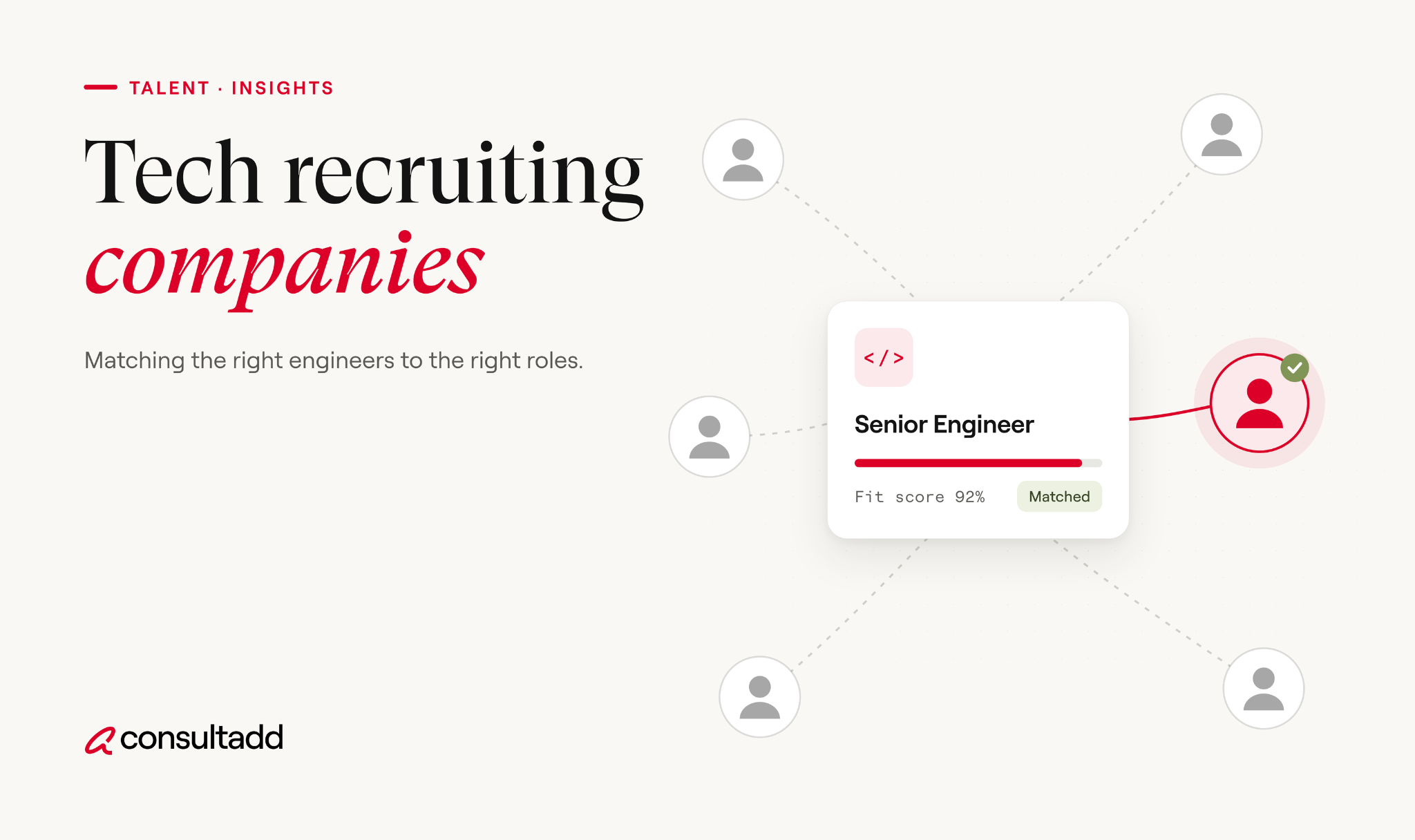
What happens behind a shortlist
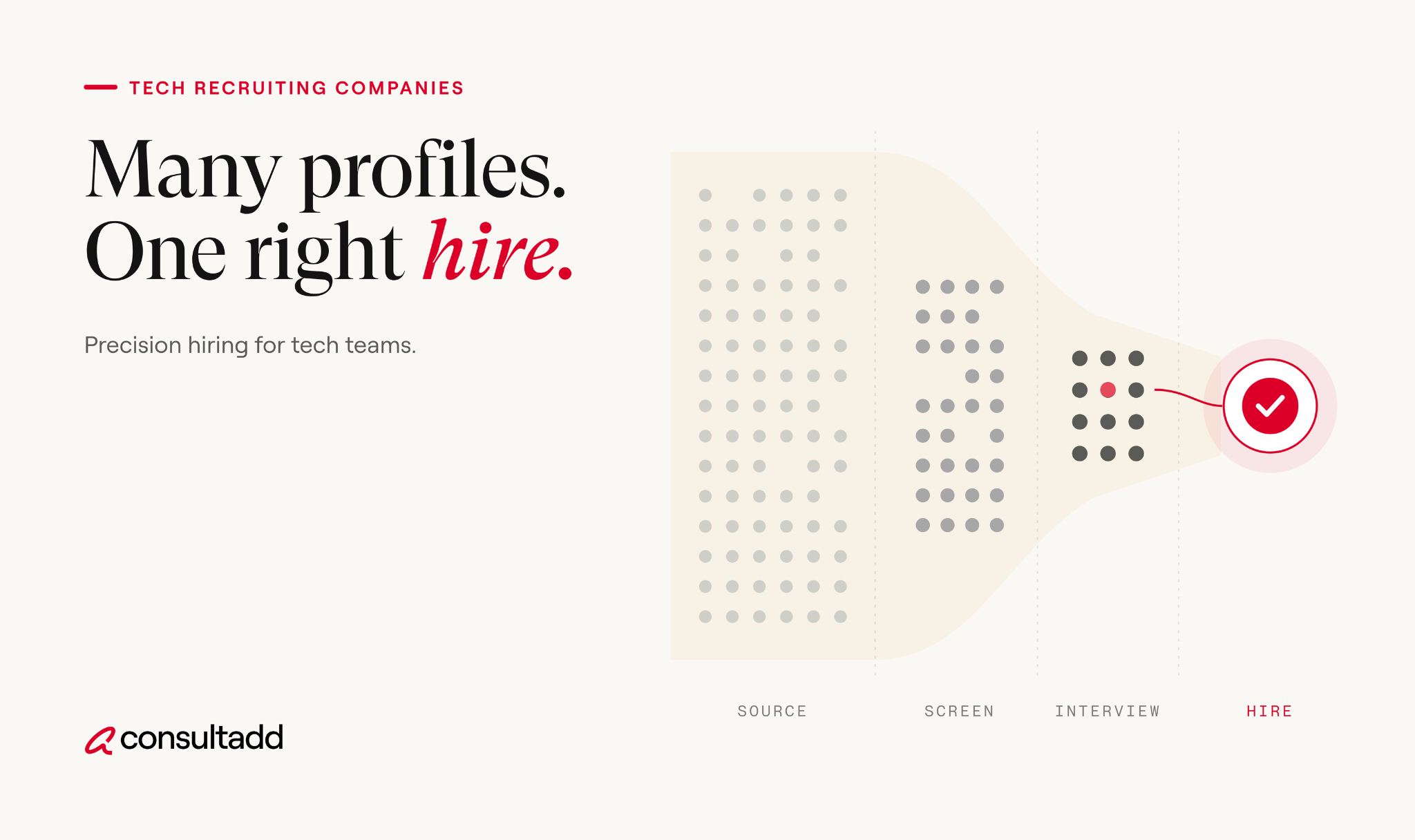
From the outside, you see three resumes in your inbox. Here's what usually happened before that:
- Intake call. The recruiter meets the hiring manager to pin down must-have skills, nice-to-haves, salary range, and deal-breakers.
- Sourcing. They search their own database, past placements, referrals, LinkedIn, and places like GitHub.
- Recruiter screen. A first call checks interest, salary expectations, work authorization, and availability.
- Technical screen. Stronger firms run a skills check or have a technical interviewer verify experience.
- Submittal. Only candidates who pass go to you, usually with notes on why they fit.
- Interview coordination and close. The recruiter schedules rounds, collects feedback, and helps negotiate the offer.
Most of the value sits in steps 3 and 4. Anyone can find resumes. Filtering out the people who list Kubernetes but have never deployed to it is the hard part.
Consultadd's guide to technical recruitment goes deeper on what good screening looks like.
Types of tech recruiting companies
This is where most buyers get confused. Two firms can both call themselves IT recruiting companies and run completely different businesses.
Contingency recruiting firms
A contingency firm earns its fee only if you hire someone it submitted. You can sign with several at once, and nobody gets paid unless a placement happens.
That makes contingency low-risk for you, but it shapes the recruiter's behavior. They're juggling many clients and will put their time into roles that look easiest to fill. If your role is vague or your process is slow, you may quietly drop down their list.
Retained search firms
A retained firm is paid in stages, usually starting when the search kicks off. In return, you get an exclusive, structured search with regular reporting.
Retained search makes sense for senior roles like a VP of Engineering, CTO, or head of security, where the candidate pool is small and most people aren't job hunting. The trade-off is that you pay part of the fee even if the search doesn't produce a hire.
Recruitment process outsourcing (RPO)
An RPO provider runs part or all of your recruiting function. Their recruiters often work inside your applicant tracking system and represent your brand to candidates.
RPO fits companies with steady, high-volume hiring, such as a firm adding 30 engineers over a year. For one or two roles, it's usually more structure than you need.
Tech staffing agencies and contract talent partners
A tech staffing agency places contractors. The agency employs the worker, runs payroll, and bills you an hourly rate while you direct the day-to-day work.
This covers contract, contract-to-hire, and staff augmentation. There's also a less visible layer: talent partners that supply pre-vetted contract candidates to staffing firms themselves rather than to end clients.
If contract work is your main need, see Consultadd's IT contract staffing buyer's guide and its explainer on IT staff augmentation.
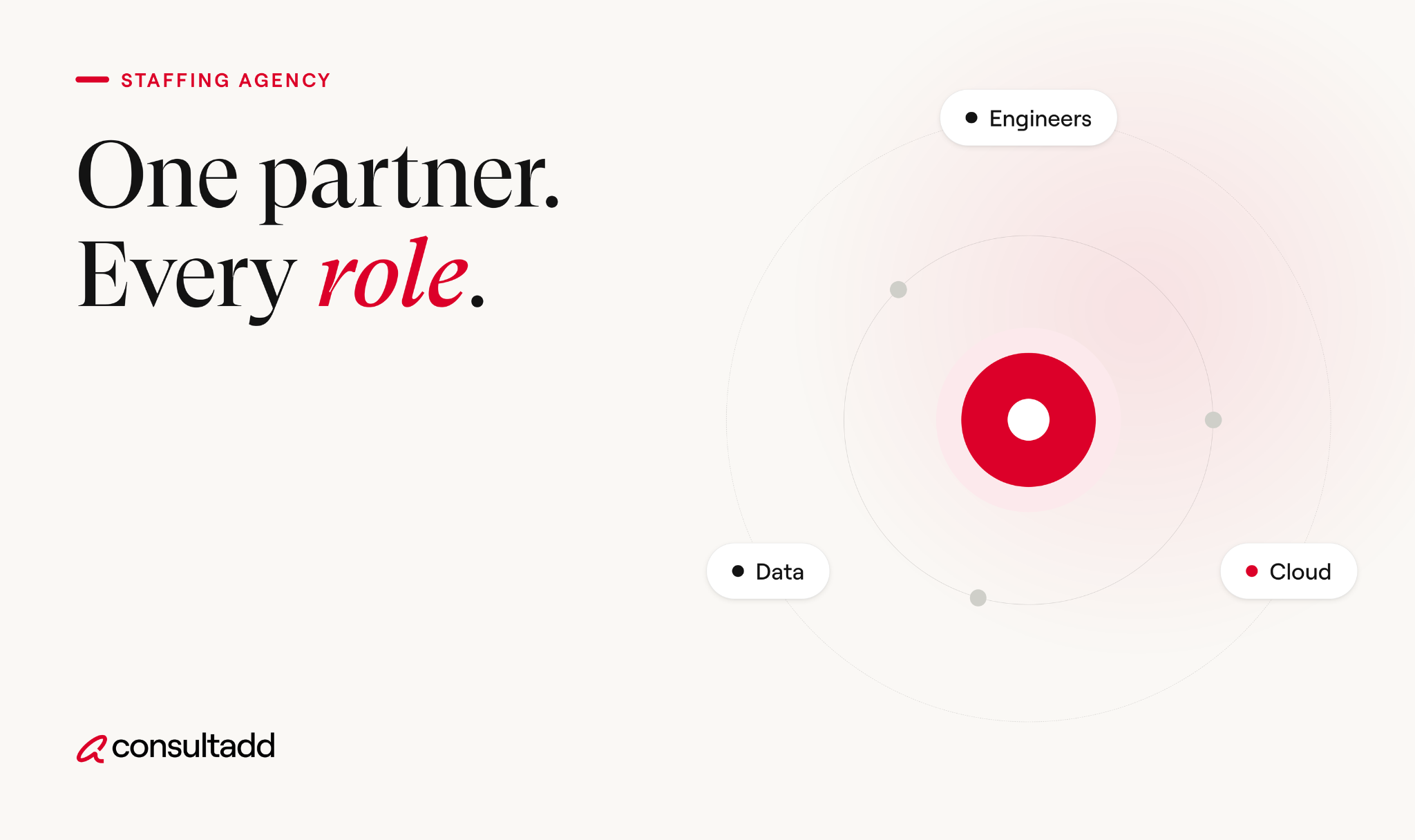
Recruiting vs staffing: which one do you need?
People use "recruiting" and "staffing" as if they mean the same thing. They don't, and the difference changes your costs, your risk, and who handles paperwork.
Recruiting ends with the person on your payroll. Staffing keeps the person on the agency's payroll for as long as the contract runs.
Compliance is the piece buyers tend to skip. USCIS requires every U.S. employer to complete Form I-9 for each person it hires, citizens included. In a staffing setup, that duty belongs to the agency, which is one reason the employment relationship should be spelled out in writing.
Classification matters too. In one case, the U.S. Department of Labor recovered $352,000 in back pay for 653 workers after a Detroit-area staffing agency misclassified them as independent contractors. Before you sign, ask who holds the W-2 and how the agency classifies its workers.
How tech recruiter fees work
For direct hire, recruiter fees are usually set as a percentage of the hire's first-year base salary. The exact percentage depends on seniority, how hard the skill set is to find, and whether the firm has exclusivity. Get it in writing before any candidate is submitted.
Retained fees follow the same logic but get paid in installments, often at kickoff, at shortlist, and at placement.
Contract staffing works differently. You pay a bill rate per hour, which bundles the worker's pay, employer payroll taxes, insurance, any benefits, and the agency's margin.
Consultadd's guide to remote IT staffing services breaks down what sits inside a bill rate.
What a fee covers and what it doesn't
A placement fee pays for sourcing, screening, coordination, and the close. It usually doesn't cover relocation, background checks beyond the basics, or skills tests from third-party platforms.
Ask directly. Surprise line items on an invoice damage the relationship fast.
Guarantees and replacement periods
Most direct-hire agreements include a guarantee. If the new hire leaves or is let go within a set window, the firm either finds a replacement or refunds part of the fee.
Read the conditions. Some guarantees exclude layoffs or role changes, and some offer replacement only, never a refund. A fee that looks cheap often comes with a short or narrow guarantee.
How to vet a technical recruiting firm {#how-to-vet}
You don't need a 40-question RFP. A short call with the right questions tells you most of what you need.
If you want named firms to compare, Consultadd has a list of the top IT staffing companies in the USA and a practical buyer's guide to IT staffing firms.
Red flags to walk away from
- They send resumes before having an intake call with the hiring manager.
- They can't explain how they verify technical skills.
- Submitted candidates don't know which company they've been submitted to.
- They push you to raise the salary range before seeing your requirements.
- Their fee terms change once you're interested in a candidate.
A pattern we see often: a company signs with five contingency agencies for one cloud engineer role. Within a week, they're buried in resumes, several of them duplicates, and two agencies are arguing over who submitted the same person first. One or two firms with real access to the hiring manager usually beat a wide blast.
For a wider look at the trade-offs, read Consultadd's take on whether to use a staffing agency for tech roles.
Where to start with tech recruiting companies
Pick the model before you pick the firm. If the role is permanent and clearly defined, a contingency or retained partner makes sense. If the scope is uncertain or tied to a project, contract staffing gives you room to adjust.
Then run a small test. Give one or two firms a single live req and track three things: time to first qualified candidate, how many submittals reach a second interview, and how the firm communicates when things stall. A month of real data tells you more than any pitch deck.
The right tech recruiting companies won't be the ones with the biggest name. They'll be the ones whose candidates show up already understanding the role.
If you're also planning hiring for next year, Consultadd's IT staffing trends piece covers which skills are getting harder to find.
Start Strong With Consultadd
With 15 years in business and 5,000+ successful staffing engagements, we don't just fill roles, we build reliability into your process. We've supported 65 staffing companies in the past year alone and maintain MSAs with industry leaders like Robert Half and TEKsystems.
Here's what working with Consultadd looks like:
- Talent sourced in under 24 hours
- Ready-to-deploy candidates, vetted for experience and compliance
- Lower turnover risk: we match long-term goals, not just short-term needs
- Seamless compliance: visa, documentation, onboarding? Handled.
- Dedicated 1:1 account managers for responsive, personalized support
- Top 100 candidate matches delivered in the past year
- Strong partnerships with universities to tap into fresh, committed talent
- Post-placement support so your investment grows beyond day one
For candidates, your next opportunity is more than just a job title, it's a chance to build skills, gain experience, and move your career forward. At Consultadd, we connect technology professionals with projects and employers that align with their goals, whether they're looking for contract, contract-to-hire, or long-term opportunities.
The tech job market moves fast, but the right guidance can make all the difference. Ready to take the next step in your career journey? Explore Opportunities >>
Key takeaways
- "Tech recruiting company" covers four models (contingency, retained, RPO, and staffing), and each one suits a different kind of hiring need.
- Direct-hire recruiting puts the worker on your payroll, while contract staffing keeps them on the agency's payroll and makes the agency responsible for I-9s and payroll.
- Placement fees, bill rates, and guarantee terms vary widely, so get everything in writing before any candidate is submitted.
- Ask how a firm screens technically and what share of its submittals get hired. Those two answers separate real partners from resume forwarders.
- Test a firm on one or two live roles before committing more of your hiring to it.
FAQs
What do tech recruiting companies do?
They find, screen, and present candidates for technical roles such as software engineers, cloud architects, and security analysts. Most also coordinate interviews and help close offers. Staffing-focused firms go further and employ contractors on your behalf.
How much do tech recruiting companies charge?
For direct hire, the fee is usually a percentage of the new hire's first-year base salary, set in your agreement. Retained firms split their fee into stages, while staffing agencies charge an hourly bill rate for each contractor. The exact numbers depend on role seniority, skill scarcity, and exclusivity.
What is the difference between a recruiting agency and a staffing agency?
A recruiting agency helps you hire someone onto your own payroll and earns a one-time fee. A staffing agency employs the worker itself and bills you hourly while that person works for you. Some firms offer both, so ask which model a proposal is based on.
Is it worth using a recruiting firm for tech roles?
It's often worth it for specialized or senior roles, or when your internal team doesn't have the capacity to source. For easy-to-fill roles with plenty of applicants, an agency fee may not pay off. The deciding factor is usually how much an open seat is costing you each week.
How long does it take a tech recruiting company to fill a role?
It depends on the role, the market, and how fast your own interview process moves. Contract roles tend to fill faster because agencies often have pre-vetted candidates ready. Slow feedback from the hiring team is one of the most common reasons searches drag.
Do candidates pay tech recruiting companies?
No. Legitimate recruiting and staffing firms are paid by the employer, not the candidate. If a firm asks a job seeker for a placement fee, treat it as a warning sign.

Best Practices for Successful IT Staffing
Introduction
Most IT placements that fall apart don't fail at the offer stage. They fail much earlier, on a vague intake call, a rushed screen, or a visa question nobody asked until week two.
The best practices for successful IT staffing aren't complicated. They come down to getting the requirement right, vetting candidates properly, moving quickly without cutting corners, and staying on top of compliance and communication from start to finish.
This guide walks through eight practices we rely on across thousands of staffing engagements. Whether you run a staffing firm, recruit in-house, or manage vendors for a tech team, each one is something you can put to work on your next open requisition.
TL;DR
- Start every search with a detailed intake that separates real requirements from nice-to-haves.
- Match the engagement model (contract, contract-to-hire, or direct hire) to the actual business need.
- Vet technical skills with real conversations and exercises, not keyword matching.
- Handle compliance, visas, and documentation early so offers don't stall at the finish line.
- Track a few clear metrics and keep supporting placements after day one to reduce early turnover.
Why IT staffing is harder than general staffing
Technical roles are narrow. A "Java developer" requisition can mean Spring Boot microservices on AWS, a legacy monolith in a bank, or Android work. Two candidates with the same title on their resume can be a perfect fit and a total mismatch for the same job.
Demand also stays high. The U.S. Bureau of Labor Statistics projects software developer employment to grow 10 percent from 2025 to 2035, with about 106,100 openings a year across developers, QA analysts, and testers. Strong candidates often have several options, and they move fast.
Then there's compliance. Many IT professionals in the U.S. work on visas, through vendor chains, or as contractors, which adds paperwork that general staffing rarely deals with.
All of this means small process gaps cost more in IT staffing. The practices below are about closing those gaps.
8 best practices for successful IT staffing
1. Run a real intake call before you source anyone
A job description is a starting point, not a requirement. Most are copied from older postings, and many list more tools than the role actually uses.
A good intake call with the hiring manager answers questions the job description doesn't:
- What will this person work on in the first 90 days?
- Which two or three skills are truly required on day one?
- What does the current team look like, and what gap is this hire filling?
- Is the role remote, hybrid, or onsite, and is that flexible?
- What's the realistic budget or bill rate?
- Are there any visa or citizenship restrictions, such as client or government requirements?
- Who's on the interview panel, and how quickly can they schedule?
That last question matters more than people expect. A great candidate can be gone in a week if interviews take three weeks to book.
Write down the answers and send them back to the hiring manager to confirm. It takes ten minutes and prevents a lot of "that's not what we meant" conversations later.
2. Choose the right engagement model
Not every opening should be a full-time hire. Picking the wrong model creates problems that no amount of good recruiting can fix.
Contract staffing works best for defined projects, short-term capacity gaps, or specialized skills the team won't need forever. A cloud migration or a six-month integration project are common examples.
Contract-to-hire fits when a team wants to see someone's work before committing. It lowers hiring risk for the client and gives the candidate real production experience. It works best when the conversion terms and timeline are clear from the start.
Direct hire makes sense for core, long-term roles where knowledge of the product and team builds value over time.
The mistake we see most often is a client choosing contract for a role that's really permanent, then losing the person after a few months to a full-time offer elsewhere. Talk through the business need before you settle on a model.
3. Build a pre-vetted pipeline before you need it
Reactive sourcing is slow. If every new requisition starts with a blank search, you're already behind firms that can submit qualified candidates within a day.
A healthy pipeline includes:
- Candidates you've already screened, sorted by core stack and experience level
- Notes on their availability, rate expectations, location preferences, and work authorization
- Regular check-ins so you know when someone becomes available
- Relationships with universities and training programs for entry-level talent
This doesn't mean holding candidates on a bench indefinitely. It means knowing who's out there and what they want, so you can move fast when the right role opens.
At Consultadd, this is how we source talent in under 24 hours. The speed comes from the screening work that happened before the requisition arrived.
4. Vet technical skills properly, not just keywords
Keyword matching is the fastest way to send a client the wrong candidate. A resume can mention Kubernetes ten times without the person ever having managed a cluster in production.
Real technical candidate screening includes a few layers:
- A recruiter screen that checks experience depth, not just presence. Ask what they built, what their specific part was, and what went wrong.
- A technical conversation or assessment matched to the role. A short coding exercise for developers, a scenario discussion for DevOps, a design question for senior engineers.
- A project deep dive where the candidate walks through one piece of real work in detail.
- Reference checks focused on specific skills and working style, not just dates of employment.
Recruiters don't need to be engineers to do this well. They need a set of role-specific questions and the habit of asking follow-ups. "Tell me more about that" catches a lot of padded resumes.
For role-specific screening ideas, see our guide on how to hire the best software engineers and our breakdown of screening AWS developers. For a sense of which skills employers treat as non-negotiable, our post on key IT skills employers want is a useful reference.
5. Move fast, but don't skip steps
Speed matters in IT staffing. Strong candidates often interview with several companies at once, and the team that makes a clear offer first usually wins.
But speed without quality backfires. Sending five unvetted resumes in an hour damages client trust faster than sending two strong ones the next morning.
A few ways to move quickly without cutting corners:
- Set target timelines for each stage, such as submittal within 24 to 48 hours of intake
- Pre-book interview slots with the hiring manager during the intake call
- Prepare candidates for each interview so first rounds go well
- Collect feedback within a day of every interview, from both sides
- Have offer approvals lined up before the final round, not after
If a client's process is slow, say so. Explaining that a top candidate has another offer in hand is useful information, not pressure.
6. Handle compliance and documentation early
Compliance problems rarely show up at the start of a search. They show up at the offer stage, when a work authorization question or a missing document delays a start date or kills the placement.
Every U.S. employer must verify identity and work eligibility. USCIS requires that both employers and employees complete Form I-9, Employment Eligibility Verification, for each person hired. For contractors placed through staffing firms, responsibility depends on who the legal employer is, so that needs to be clear in your agreements.
Good compliance habits include:
- Asking about work authorization during the first screen, not at the offer
- Confirming client restrictions, such as U.S. citizenship requirements for some government projects
- Knowing the visa timelines that affect start dates, including H-1B transfers
- Keeping documentation organized and current for every placement
- Running background checks early when the client requires them
Our guide on sponsoring an H-1B visa explains what tech employers and candidates should know about the process. Visa and employment law details change, so check current rules or consult an immigration attorney for specific cases.
7. Communicate constantly with candidates and clients
Most bad staffing experiences come down to silence. A candidate interviews and never hears back. A hiring manager asks for an update and gets nothing for three days.
Clear, regular communication solves a lot:
With candidates: tell them honestly how the role compares to what they want, prepare them for each interview, and give real feedback after every round, even when it's a rejection. Candidates you treat well become referrals and future placements.
With clients: send short, regular updates on pipeline status, share market feedback when a rate or requirement is unrealistic, and flag risks early, such as a candidate weighing a competing offer.
A dedicated account manager for each client helps here. One person who knows the account, the team, and the open roles responds faster and catches problems sooner than a shared inbox.
8. Measure what matters and support placements after day one
You can't improve an IT staffing process you don't measure. You also don't need a complicated dashboard. A few numbers tell most of the story:
- Time to submit: how long from intake to the first qualified candidate
- Submit-to-interview ratio: how many submitted candidates get interviews
- Interview-to-offer ratio: how many interviews turn into offers
- Offer acceptance rate: how many offers candidates accept
- Early retention: how many placements are still in the role at 90 days
A low submit-to-interview ratio usually points to a weak intake or poor vetting. A low offer acceptance rate often means rate or role expectations weren't aligned with the candidate early on.
Early retention is where post-placement support pays off. Check in with both the placed professional and the client in the first few weeks. Small issues, like unclear onboarding or a mismatch on remote work, are easy to fix early and expensive to fix after someone has already resigned.
Placements that last are what build long-term client relationships. That's worth more than any single fill.
Common IT staffing mistakes to avoid
Even experienced teams slip into habits that hurt results. These come up often:
- Treating the job description as the full requirement. Without an intake call, you're guessing.
- Submitting volume instead of quality. Five weak resumes cost more trust than they earn.
- Ignoring rate reality. If the budget is below market for the skill set, say so early and offer options.
- Leaving compliance for the end. Work authorization questions belong in the first screen.
- Going quiet after placement. The first 90 days decide whether a placement sticks.
- Overselling the role to candidates. A candidate who joins with the wrong expectations usually leaves early.
Putting the best practices for successful IT staffing into action
None of these practices require new software or a bigger team. They require consistency.
If you're not sure where to start, pick the stage where placements break down most often for you. For many teams, that's the intake call or the technical screen. Fix that first, measure the change, then move to the next one.
The best practices for successful IT staffing come down to a simple pattern: understand the need clearly, find and vet people carefully, move quickly, keep everyone informed, and stay involved after the start date. Teams that do these things consistently fill roles faster and keep the people they place.
Staffing firms that want help with sourcing, vetting, or compliance can also work with a partner like Consultadd. Our 360 Recruiter program supports recruiters with ready-to-deploy candidates and the compliance work behind them.
Start Strong With Consultadd
With 15 years in business and 5,000+ successful staffing engagements, we don't just fill roles, we build reliability into your process. We've supported 65 staffing companies in the past year alone and maintain MSAs with industry leaders like Robert Half and TEKsystems.
Here's what working with Consultadd looks like:
- Talent sourced in under 24 hours
- Ready-to-deploy candidates, vetted for experience and compliance
- Lower turnover risk: we match long-term goals, not just short-term needs
- Seamless compliance: visa, documentation, onboarding? Handled.
- Dedicated 1:1 account managers for responsive, personalized support
- Top 100 candidate matches delivered in the past year
- Strong partnerships with universities to tap into fresh, committed talent
- Post-placement support so your investment grows beyond day one
For candidates, your next opportunity is more than just a job title, it's a chance to build skills, gain experience, and move your career forward. At Consultadd, we connect technology professionals with projects and employers that align with their goals, whether they're looking for contract, contract-to-hire, or long-term opportunities.
The tech job market moves fast, but the right guidance can make all the difference. Ready to take the next step in your career journey? Explore Opportunities >>
Key takeaways
- A detailed intake call that separates must-haves from nice-to-haves prevents most mismatched submittals.
- The engagement model should follow the business need, whether that's contract, contract-to-hire, or direct hire.
- Technical vetting needs real conversations, exercises, and project deep dives, not keyword matching.
- Compliance and work authorization questions belong at the start of the process, not the offer stage.
- Tracking a few metrics and supporting placements in the first 90 days improves fill quality and retention.
FAQs
What are the best practices for IT staffing?
The core practices are running a detailed intake, choosing the right engagement model, vetting technical skills properly, and handling compliance early. Fast, clear communication with both candidates and clients and post-placement support also make a big difference. Together, they reduce mismatches and early turnover.
How do you improve the IT staffing process?
Start by finding where placements break down most often, such as weak intakes, slow interviews, or offer declines. Track a few metrics like time to submit and submit-to-interview ratio. Fix one stage at a time and measure the change before moving on.
What is the difference between contract, contract-to-hire, and direct hire?
Contract staffing places a professional for a set period or project. Contract-to-hire starts as a contract with the option to convert to full-time after a trial period. Direct hire means the client employs the person permanently from day one.
How do staffing firms vet IT candidates?
Good firms combine a detailed recruiter screen, a role-specific technical assessment, and a deep dive into the candidate's past projects. Reference checks focused on specific skills add another layer. The goal is to confirm real experience, not just matching keywords.
What compliance issues come up in IT staffing?
Common issues include work authorization, visa timelines such as H-1B transfers, Form I-9 verification, background checks, and client-specific requirements like citizenship for government projects. Contracts also need to be clear about who the legal employer is. Raising these early prevents delays at the offer stage.
How fast should an IT staffing firm submit candidates?
Many firms aim to submit qualified candidates within 24 to 48 hours of a clear intake. Speed depends on having a pre-vetted pipeline. Quality still matters more than speed, since weak submittals damage client trust.

IT Recruiting NY: A 2026 Guide to Hiring Tech Talent
Introduction
IT recruiting NY teams do is different from hiring almost anywhere else in the U.S. Pay runs higher, two layers of salary transparency law apply, and New York City regulates the AI tools many recruiters now use to screen resumes.
This guide covers what the New York tech market looks like, what you'll pay, which rules apply, and how to pick the right recruiting model.
It's written for hiring managers and staffing firms filling technology roles in the New York area.
TL;DR
- Tech pay in the New York metro sits well above the national average, so budget from local data, not national salary guides.
- New York State requires pay ranges in job postings, and that covers recruiters and agents too.
- NYC Local Law 144 requires a bias audit and candidate notice if you use automated tools to screen candidates.
- In-house, agency, contract staffing and behind-the-scenes staffing partners each fit different situations.
- The fastest New York searches start with a tight intake, an honest pay range and a clear onsite schedule.

What the New York IT recruiting market looks like
The New York metro is bigger than the five boroughs. The Bureau of Labor Statistics defines the New York-Newark-Jersey City metro area to include Long Island, Westchester, Rockland and Putnam, plus twelve New Jersey counties, including Hudson and Bergen.
That matters for sourcing. A strong candidate for a Manhattan role may live in Jersey City or Nassau County, and your commute and hybrid policy decide whether they'll even take the call.
Where the demand comes from
New York's tech hiring leans heavily on finance, media and marketing. BLS data for May 2025 shows financial managers employed at 1.75 times the national rate in the New York metro and marketing managers at 2.27 times.
Tech leadership is concentrated here too. The metro had 62,430 computer and information systems managers in May 2025, at 1.53 times the national concentration.
More tech managers usually means more open engineering reqs underneath them, and more teams competing for the same people.
Which roles are hardest to fill
From the staffing side, the pressure points in New York match the national picture. Cloud, data and AI roles move slowest, and mid-level engineers are scarce.
Our IT staffing trends analysis found that ML engineers earn 20% to 40% more than equivalent software engineers, and New York employers pay that premium on top of an already high base.
What tech talent costs in New York
National salary guides will undershoot a New York offer. Start with local data.
The computer and mathematical group is a wide category. It includes everyone from support specialists to senior architects. Treat it as a direction, then pull role-level figures from the BLS OEWS data for the New York area before you set a range.
Budget for more than salary
Contract roles in New York also carry state benefit obligations, including paid sick leave and New York Paid Family Leave.
When a staffing firm or partner is the employer of record, those costs sit inside the bill rate. Ask what's included before you compare rates side by side.
New York laws that shape IT recruiting
This is where IT recruiting in New York gets more complicated than in most states. Two sets of rules affect almost every tech search.
This table is a summary for planning, not legal advice. Check the details with employment counsel.
Pay transparency covers recruiters, not just employers
The New York State Department of Labor explains that Section 194-b requires businesses with four or more employees to list compensation ranges and job descriptions for advertised jobs, promotions and transfers. The law has been in effect since September 17, 2023.
Here's the part staffing firms sometimes miss. Legal analyses of the 2023 amendments note that agents and recruiters fall within the law's definition of employer. Temporary help firms, as defined in state labor law, are exempt. If your recruiter posts a New York role, the posting needs a real range. The DOL's employer fact sheet is the clearest short read on the requirements.
Jobs performed in New York City may also fall under the city's own pay transparency law. The state DOL notes that complaints about NYC roles can go to either the state or the NYC Commission on Human Rights.
AI screening tools need an audit in NYC
If your applicant tracking system scores or ranks candidates for New York City jobs, Local Law 144 likely applies. You need an independent bias audit from the past year, a public summary, and notice to candidates at least 10 days before the tool is used.
The NYC Department of Consumer and Worker Protection publishes the audit and notice requirements.
Enforcement is getting more attention. A December 2025 New York State Comptroller audit found weaknesses in how the city handled complaints, and recommended more proactive investigation.
Our stage-by-stage IT recruitment playbook covers how to inventory the tools in your hiring stack.

IT recruiting models in New York: which one fits
New York has no shortage of recruiters. The real choice is the model.
Fees vary widely by firm and role. As one illustration, our guide on IT staffing vs. consulting companies walks through a scenario with permanent placement fees at 20% of first-year salary.
Get the fee structure in writing before you hand over a req.
If you're new to how agencies work, our explainer on what a staffing agency does and what it costs covers the basics.
When contract staffing makes sense in New York
Contract works when the work has a defined scope or a deadline. It also helps when a full-time search would take longer than the project lasts. Contract-to-hire lets you see how someone works inside your team before you commit to a New York salary.
Our IT staff augmentation guide covers the contract model in more depth.
How to run an IT recruiting process in New York
The general process looks the same everywhere. These New York-specific adjustments are where searches speed up or stall.
- Run a real intake. Agree on must-have skills, the onsite schedule and the pay range before anything gets posted.
- Set the range from local data. Use New York metro figures and check that the posting meets state and city transparency rules.
- State the schedule plainly. "Hybrid" means different things to different teams. Say how many days onsite and where.
- Audit your screening tools. If software ranks candidates for NYC roles, confirm the Local Law 144 audit and notice are in place.
- Keep interview rounds tight. Strong New York candidates usually have more than one process going.
- Move fast on offers. Delays between final round and offer lose more candidates here than almost anything else.
For the full stage-by-stage view, including intake and conversion metrics, see our IT recruitment playbook.
How to choose an IT recruiter in New York
Use this checklist when you compare tech recruiters in New York.
One detail worth flagging for staffing firms: some partners work behind the scenes. You keep the client relationship and submit the candidates, while the partner sources, screens and employs the consultants.
If that's the model you need, our IT staffing partner in New York page explains how it works.
Mistakes to avoid in New York tech hiring
- Using national salary data to set a New York offer.
- Posting a role without a pay range, or with a range so wide it means nothing.
- Running AI screening for NYC roles without a bias audit.
- Leaving the onsite schedule vague until the final interview.
- Adding interview rounds when the market rewards speed.
- Choosing a recruiter by price alone, without asking how they screen.
Final thoughts on IT recruiting NY employers can rely on
IT recruiting in NY comes down to three things. Budget from local pay data, follow the state and city rules from the first posting, and pick a recruiting model that matches how urgent and how defined the role is.
Get those right and you spend less time re-opening reqs. If you're a staffing firm with a New York req that's running out of time, a behind-the-scenes partner can help you fill it while you keep the client relationship.
Start Strong With Consultadd
With 15 years in business and 5,000+ successful staffing engagements, we don't just fill roles, we build reliability into your process. We've supported 65 staffing companies in the past year alone and maintain MSAs with industry leaders like Robert Half and TEKsystems.
Here's what working with Consultadd looks like:
- Talent sourced in under 24 hours
- Ready-to-deploy candidates, vetted for experience and compliance
- Lower turnover risk: we match long-term goals, not just short-term needs
- Seamless compliance: visa, documentation, onboarding? Handled.
- Dedicated 1:1 account managers for responsive, personalized support
- Top 100 candidate matches delivered in the past year
- Strong partnerships with universities to tap into fresh, committed talent
- Post-placement support so your investment grows beyond day one
For candidates, your next opportunity is more than just a job title, it's a chance to build skills, gain experience, and move your career forward. At Consultadd, we connect technology professionals with projects and employers that align with their goals, whether they're looking for contract, contract-to-hire, or long-term opportunities.
The tech job market moves fast, but the right guidance can make all the difference. Ready to take the next step in your career journey? Explore Opportunities >>
Key takeaways
- The New York metro pays tech workers well above the national average, so set ranges from local BLS data.
- New York State's pay transparency law applies to recruiters and agents, not only direct employers.
- NYC Local Law 144 requires a bias audit and candidate notice for automated screening tools.
- Match the recruiting model to the role: contract for defined work, direct hire for long-term ownership.
- Clear schedules, short interview loops and fast offers win more New York candidates than bigger job ads.
FAQs
How much do IT professionals earn in New York?
BLS data for May 2025 shows a mean hourly wage of $67.04 for computer and mathematical occupations in the New York metro, against $57.73 nationally. Pay varies a lot by role and seniority. Check role-level BLS data for the New York area before setting a range.
Do recruiters have to include salary ranges in New York job postings?
Yes, in most cases. New York Labor Law 194-b covers employers with four or more employees, and its definition includes agents and recruiters. Temporary help firms, as defined in state labor law, are exempt.
What is NYC Local Law 144?
It regulates automated employment decision tools used to screen candidates for New York City jobs. Employers and agencies need an independent bias audit within the past year, a public summary of results and advance notice to candidates. The NYC Department of Consumer and Worker Protection enforces it.
How long does it take to hire an IT professional in New York?
It depends on the role and the model. Common roles through an established recruiter can move in a few weeks, while niche cloud, data and AI roles take longer. Contract staffing is usually the fastest route when you need someone soon.
Should I use a contingency agency or contract staffing in New York?
Use a contingency agency when you want a permanent hire and can wait for the right fit. Choose contract staffing for projects, backfills or urgent needs. Contract-to-hire works well when you want to test fit before committing to a New York salary.
What should I look for in an IT recruiting agency in NYC?
Look for specific experience with your roles and stack, a clear technical screening process and knowledge of New York's transparency and AI hiring rules. Ask who employs contract consultants and how work authorization is verified. Speed matters, but only if the profiles are actually qualified.

Staffing Agency: What It Is, How It Works And What It Costs
Introduction
Most people first deal with a staffing agency when something is urgent. A project needs two extra engineers next week, or a job seeker needs work between full-time roles. Both sides end up asking the same questions: who actually employs the worker, who pays whom, and what's the catch?
This guide answers those questions plainly. It covers what a staffing agency does, how the money flows, the main types of agencies, and the contract terms worth checking before you sign anything.
TL;DR
- A staffing agency finds, screens and places workers with client companies, and on contract roles it usually employs those workers directly.
- On contract placements, agencies earn the difference between the bill rate the client pays and the pay rate the worker receives.
- On direct-hire placements, agencies charge a one-time fee, commonly a percentage of the new hire's first-year salary.
- Agencies range from general temp firms to specialists in IT, healthcare and executive search, so match the agency to the role.
- Before signing, check the markup, conversion fee, replacement guarantee and non-solicitation terms. Candidates should never pay an agency to get placed.
What is a staffing agency?
A staffing agency is a company that supplies workers to other businesses. It recruits candidates, screens them, and places them in temporary, contract, contract-to-hire or permanent roles with client companies.
For temporary and contract roles, the agency is usually the employer of record. The worker does the job at the client, but the agency runs payroll, withholds taxes, carries workers' compensation insurance and handles employment paperwork.
The industry is large. According to the American Staffing Association (ASA), nearly 2.0 million temporary and contract employees worked for U.S. staffing companies in an average week in 2025. The ASA also counted around 27,000 staffing and recruiting companies operating close to 54,000 offices in 2021.
Most agencies offer more than one service. The ASA lists temporary and contract staffing, recruiting and permanent placement, outsourcing and outplacement, and HR consulting as the main ones.
How a staffing agency works
Every staffing arrangement has three parties. Confusion usually starts when people aren't sure who's responsible for what.
On a direct-hire placement, the picture changes. The agency recruits and screens, the client hires the person onto its own payroll, and the agency steps out after the start date.
If you want to see what happens between intake and day one, our post on how staffing agencies handle vetting and onboarding walks through each stage.
How staffing agencies make money
This is the part most clients and candidates are least clear on, so it's worth spelling out.
Contract and temporary placements
The agency bills the client an hourly bill rate. It pays the worker a lower hourly pay rate. The gap between the two is the markup.
Here's a simple, hypothetical example. A contract developer earns a pay rate of $60 per hour. The agency bills the client $80 per hour. That $20 doesn't all go to profit. It has to cover:
- Employer payroll taxes
- Workers' compensation and liability insurance
- Benefits, where the agency offers them
- Recruiting, screening and background check costs
- Payroll processing, invoicing and account management
- The agency's margin
Markups vary widely by role, location, contract length and whether benefits are included. That's why a single "standard" markup figure is rarely useful. Ask for the breakdown instead.
Direct-hire placements
For permanent roles, the agency charges a one-time placement fee once the candidate starts. As our guide to IT staffing service models explains, this fee usually falls between 15% and 25% of the hire's first-year salary.
Most agreements include a guarantee period. If the hire leaves early, the agency replaces them or refunds part of the fee.
Contract-to-hire conversions
When a contractor converts to the client's payroll, many agencies charge a conversion fee. The fee often shrinks the longer the contractor has worked through the agency, and some contracts waive it after a set number of hours.
Bill rates can look expensive next to a salary. But a full-time employee also carries benefits, taxes and onboarding costs.
Our breakdown of IT contract staffing costs shows how that comparison usually plays out.

Types of staffing agencies
"Staffing agency" covers very different businesses. A firm that fills warehouse shifts operates nothing like one placing cloud engineers.
The ASA's occupational breakdown shows the spread: 36% of staffing employees work in industrial roles, 24% in office and administrative roles, 21% in professional and managerial roles, 11% in engineering, IT and scientific roles, and 8% in health care.
The last row surprises people. Some staffing companies don't serve end clients at all. They supply candidates to other agencies.
Our guide to staff augmentation company types explains how that model works and who it suits.
For technology hiring specifically, our list of top IT staffing companies in the USA compares the larger firms by size and specialty.
Staffing agency vs recruiting firm vs RPO
These terms overlap, and many companies offer all three. The practical differences:
- Staffing agency: fills individual roles, often employing contract workers directly.
- Recruiting or search firm: focuses on permanent hires and is paid a placement fee. The client employs the hire from day one.
- RPO provider: runs part or all of a company's recruiting function on an ongoing basis, usually under the client's brand.
If you're hiring at high volume across many roles, recruitment process outsourcing may fit better than placing roles one at a time.
When it makes sense to use a staffing agency
A staffing agency is usually worth it when:
- The role is urgent and an empty seat is already costing you.
- The work has a defined end date and you don't want permanent headcount.
- The skill set is specialized and your team rarely sources it.
- You want to test fit through contract-to-hire before committing.
- You'd rather not take on payroll and compliance for short-term workers.
It's less useful when your internal team already fills the role well, or when the position needs a long, culture-heavy search.
For a balanced look at the trade-offs, read our candid breakdown of using a staffing agency for tech roles.
Contract terms to check before you sign with a staffing agency
Most disputes between clients and agencies trace back to terms nobody read closely. Before signing, look for these:
- Bill rate and markup transparency. Ask what the bill rate includes and whether the agency will share the pay rate.
- Conversion fee. Check how much it costs to hire a contractor permanently and whether the fee drops over time.
- Guarantee or replacement period. Find out what happens if a placement leaves or doesn't work out in the first weeks.
- Non-solicitation clause. Confirm how long you're barred from hiring the agency's workers directly outside the agreement.
- Employer of record and insurance. Confirm the agency carries workers' compensation and general liability coverage for its workers.
- Screening standards. Get in writing which background checks, reference checks and skills assessments happen before submission.
- Subcontracting. Ask whether candidates come from the agency's own payroll or from subvendors further down the chain.
- Termination terms. Check the notice period for ending an assignment early.
For a longer evaluation checklist on technical roles, see our guide on how to choose the right IT staffing agency.
Staffing agency red flags
For employers, watch for agencies that:
- Send large batches of resumes that barely match the requirement
- Can't explain how they vetted a candidate
- Won't say whether candidates come from their own payroll or a subvendor
- Submit the same candidate you've already received from another firm
For candidates, the biggest red flag is a request for money. The FTC's guidance on job scams is clear that legitimate placement firms are paid by employers, not job seekers.
Other warning signs include vague job details, an agency that won't name the client after you've signed an RTR, and pressure to share bank details before an offer.
If you want a starting point for finding reputable firms, the ASA runs a member directory of staffing agencies, and its members agree to the association's code of ethics.
Working with a staffing agency as a job seeker
Staffing agencies are often the fastest route into contract work, especially in tech. The ASA reports that 64% of staffing employees use staffing companies to fill a gap between jobs or to help land a job.
A few habits help:
- Ask whether the role is W-2, C2C or 1099, and who your employer of record will be.
- Confirm pay rate, benefits, overtime rules and assignment length before signing.
- Read every right to represent (RTR) and make sure it names one specific job.
- Keep a list of where each agency has submitted you, so you're never double-submitted.
Our candidate guide to staffing agencies for remote jobs goes deeper on agency types and pay structures.
Choosing a staffing agency that fits
A good staffing agency does more than forward resumes. It understands the role, vets candidates properly, handles employment and compliance cleanly, and is upfront about what it charges.
Match the agency type to the role, read the contract terms closely, and judge the firm by the quality of its first few submittals, not the size of its pitch.
Start Strong With Consultadd
With 15 years in business and 5,000+ successful staffing engagements, we don't just fill roles, we build reliability into your process. We've supported 65 staffing companies in the past year alone and maintain MSAs with industry leaders like Robert Half and TEKsystems.
Here's what working with Consultadd looks like:
- Talent sourced in under 24 hours
- Ready-to-deploy candidates, vetted for experience and compliance
- Lower turnover risk: we match long-term goals, not just short-term needs
- Seamless compliance: visa, documentation, onboarding? Handled.
- Dedicated 1:1 account managers for responsive, personalized support
- Top 100 candidate matches delivered in the past year
- Strong partnerships with universities to tap into fresh, committed talent
- Post-placement support so your investment grows beyond day one
For candidates, your next opportunity is more than just a job title, it's a chance to build skills, gain experience, and move your career forward. At Consultadd, we connect technology professionals with projects and employers that align with their goals, whether they're looking for contract, contract-to-hire, or long-term opportunities.
The tech job market moves fast, but the right guidance can make all the difference. Ready to take the next step in your career journey? Explore Opportunities >>
Key takeaways
- A staffing agency recruits and places workers, and on contract roles it usually acts as the employer of record.
- Contract revenue comes from the markup between bill rate and pay rate, which also covers taxes, insurance and recruiting costs.
- Direct-hire placements typically carry a one-time fee of 15% to 25% of first-year salary, often with a guarantee period.
- Agency types differ sharply, so pick a firm that specializes in the roles you're filling.
- Read conversion fees, guarantees and non-solicitation terms before signing, and treat any candidate fee as a red flag.
FAQs
What does a staffing agency do?
A staffing agency recruits, screens and places workers with client companies. For temporary and contract roles, it usually employs the worker and handles payroll, taxes and insurance while the client directs the daily work. For permanent roles, it recruits candidates the client then hires directly.
How much does a staffing agency charge?
For contract roles, the agency adds a markup to the worker's pay rate, and that markup varies by role, location and benefits. For direct-hire roles, the fee is commonly 15% to 25% of the new hire's first-year salary. Ask any agency for a clear breakdown before you sign.
Do staffing agencies charge job seekers?
Legitimate staffing agencies are paid by the employer, not the candidate. If an agency asks you to pay for placement, training or an interview, treat it as a likely scam. The FTC warns job seekers against paying up front for the promise of a job.
What is the difference between a staffing agency and a temp agency?
A temp agency is one type of staffing agency that focuses on short-term assignments. Staffing agencies more broadly also handle longer contracts, contract-to-hire roles and permanent placements. Many firms do all of these.
Can a staffing agency job become permanent?
Yes. In a contract-to-hire arrangement, the worker starts on the agency's payroll and can convert to the client's payroll later. The client may pay a conversion fee, which often decreases the longer the worker has been on assignment.
Are staffing agency workers employees of the agency?
On most temporary and contract placements, yes. The agency is the employer of record and handles wages, tax withholding and workers' compensation. Some arrangements, like corp-to-corp contracts, work differently, so confirm the setup before you start.

What Is a Temp Agency? How It Works, Costs and Pay
Introduction
If you've been told to "try a temp agency," or your manager wants extra hands for a three-month project, you've probably wondered what you're signing up for.
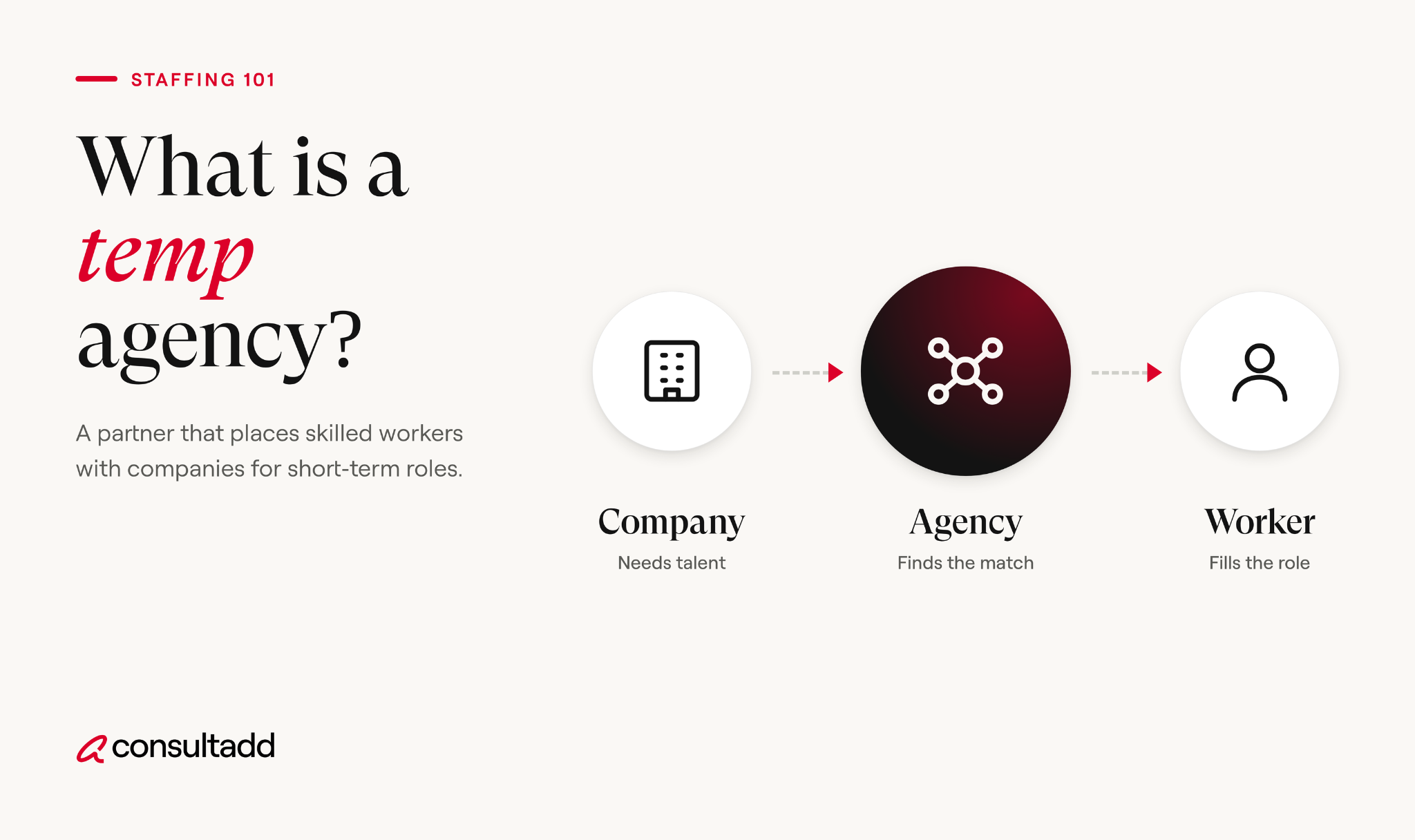
So, what is a temp agency? It's a company that hires workers and places them on short-term assignments at other businesses. The agency is the legal employer. The business where you show up each day directs the work.
That split explains most of what follows: who pays you, who handles your taxes, who's responsible for your safety, and what happens when the assignment ends. This guide walks through it from both sides, the worker's and the employer's.
TL;DR
- A temp agency employs workers and sends them to client businesses for short-term assignments, usually lasting days to several months.
- The agency handles payroll, taxes and paperwork, while the client business (the host employer) supervises the daily work.
- Clients pay the agency an hourly bill rate; legitimate temp agencies never charge workers a placement fee.
- Under OSHA guidance, the agency and the host employer share responsibility for a temp worker's safety.
- Temp work suits seasonal peaks, leave coverage, short projects and people who want flexible or trial-run jobs.
What is a temp agency, exactly?
A temp agency, also called a temporary staffing firm, recruits workers and keeps them on its own payroll. When a client business needs short-term help, the agency sends one of its workers on assignment. The worker does the job at the client's site, or remotely, under the client's direction.
The agency is the "employer of record." It issues your paycheck, withholds taxes, files your W-2, and completes your I-9 work eligibility check. The client is usually called the host employer.
The term "temp" can be misleading.
OSHA defines temporary workers as people supplied to a host employer and paid by a staffing agency, regardless of whether the job itself is actually temporary. Some temp assignments last a week. Others run for a year or more.
Temp work is a large part of the US job market. The Bureau of Labor Statistics counted about 2.49 million jobs in temporary help services in September 2026, down 10,900 from August.
That figure moves with the economy, which is why staffing analysts watch it closely as an early signal of hiring trends.
How do temp agencies work, step by step
The process looks a little different depending on which side you're on. Here's how it typically runs.
For workers
- Apply and register. You submit a resume or profile, and the agency interviews you about your skills, availability and pay expectations.
- Screening. Expect skills tests, reference checks and sometimes a background check or drug screen, depending on the role.
- Onboarding. You fill out tax forms and an I-9, and set up direct deposit with the agency.
- Assignment. When a client need matches your profile, the agency calls with details: pay rate, hours, location and expected length.
- Work and get paid. You submit timesheets (often through an app), and the agency pays you weekly or biweekly.
- Next step. When the assignment ends, the agency can place you somewhere new. Sometimes the client offers you a permanent job instead.
One thing that surprises first-time temps: registering doesn't guarantee work.
Agencies don't promise immediate placement and usually run an interview and vetting process to check your skills and fit. The more flexible you are on schedule and location, the faster you'll typically get called.
For employers
- Define the need. Share the role, skills, schedule, location, start date and expected duration.
- Agree on terms. The agency quotes a bill rate and sets out conversion terms if you might hire the person permanently.
- Review candidates. For light industrial or admin roles, the agency may simply send a qualified worker. For skilled roles, you'll usually see a short list first.
- Supervise the work. You direct daily tasks and approve timesheets.
- Pay one invoice. The agency bills you; it handles wages, payroll taxes, unemployment insurance and workers' compensation.
In practice, the speed is what most clients are paying for. A warehouse manager who learns on Thursday that three people are out next week can often have replacements by Monday.
Filling those seats through a normal hiring process would take weeks.
Who pays whom
Money flows in one direction: from the client to the agency to the worker. The worker never pays the agency.
The client pays an hourly bill rate. The worker earns an hourly pay rate. The difference is the agency's markup, which covers payroll taxes, insurance, recruiting costs, any benefits the agency offers, and its profit.
Markups vary widely by industry, skill level and location, so there's no single standard number.
If an agency asks you for a registration fee, a training fee or money for equipment, walk away.
Consultadd's guide to staffing agencies for remote jobs covers this red flag and others in more detail.
Temp agency vs staffing agency and other models
People use these terms loosely, and many firms offer more than one service. The real difference is who employs the worker and for how long.
A temp agency focuses on short-term placements. A staffing agency usually offers temp work too, plus contract, temp-to-hire and direct-hire placements.
In other words, most temp agencies are a type of staffing agency, but not every staffing agency is mainly a temp agency.
If you want the bigger picture on agencies that cover all of these models, read what to expect when working with a staffing agency.
For the trial-period route, see what contract to hire means and who it suits.
Pros and cons of temporary staffing
Temporary staffing works well in some situations and poorly in others. Here's a fair look at both sides.
For workers
Temp work gives you income quickly and lets you try different workplaces without long commitments.
It's a common way back into work after a gap, and plenty of temps get hired permanently by a client they impressed.
The trade-offs are real, though. Assignments can end early, often for budget reasons that have nothing to do with your performance. Benefits through agencies tend to be thinner than what permanent employees get, and hours may not be steady between assignments.
For employers
The main advantages are speed and flexibility. You can scale up for a busy quarter and scale back without layoffs. The agency handles recruiting and payroll administration.
On the downside, the hourly cost is higher than paying the same person directly. Temps also need time to learn your systems, and turnover between assignments can mean retraining.
For a closer look at the employer side in tech hiring specifically, see the pros and cons of using a staffing agency for tech roles.
Your rights and responsibilities as a temp worker
Being a temp doesn't mean having fewer protections. You're an employee, usually of the agency, with the same basic rights to minimum wage, overtime and a safe workplace as anyone else.
Safety is a shared job. OSHA treats the staffing agency and the host employer as joint employers, so both are responsible for keeping temp workers safe, including meeting training, hazard communication and recordkeeping requirements.
In practice, the host employer usually handles training on site-specific hazards, while the agency is expected to check that the host is actually doing it.
OSHA's Protecting Temporary Workers page lays out what each party should do. It also recommends that the agency and the host spell out each side's safety responsibilities in their contract.
A few practical points for workers:
- You should get the same safety training and protective equipment as the host's own employees.
- Ask the agency before taking on duties that weren't part of your assignment, especially anything involving machinery or hazards.
- Report pay problems to the agency, since it's the one issuing your paycheck.
- You'll complete an I-9 with the agency.
If you're not sure your documents qualify, Consultadd's guide on whether you're legally authorized to work in the US explains the options.
How to pick a good temp agency
Agencies vary a lot. Some focus on warehouse and light industrial work, others on office and admin, healthcare or IT. Picking one that specializes in your field matters more than picking the biggest name.
From the recruiter side, the best agencies ask a lot of questions before placing anyone. If an agency sends a worker to a client without asking about the tasks, the site or the supervisor, that's usually a sign it's optimizing for volume rather than fit.
Is a temp agency the right fit?
Coming back to the original question, what is a temp agency in practice? It's the employer in the middle, handling hiring, pay and paperwork so a business can get short-term help quickly and a worker can start earning quickly.
For workers, it makes sense if you need income soon, want to test different employers, or prefer flexible schedules. It makes less sense if you need guaranteed hours and full benefits right away.
For employers, temp staffing fits seasonal peaks, leave coverage and short projects. For roles you know will be permanent and long-term, direct hiring or temp-to-hire usually costs less over time.
Start Strong With Consultadd
With 15 years in business and 5,000+ successful staffing engagements, we don't just fill roles, we build reliability into your process. We've supported 65 staffing companies in the past year alone and maintain MSAs with industry leaders like Robert Half and TEKsystems.
Here's what working with Consultadd looks like:
- Talent sourced in under 24 hours
- Ready-to-deploy candidates, vetted for experience and compliance
- Lower turnover risk: we match long-term goals, not just short-term needs
- Seamless compliance: visa, documentation, onboarding? Handled.
- Dedicated 1:1 account managers for responsive, personalized support
- Top 100 candidate matches delivered in the past year
- Strong partnerships with universities to tap into fresh, committed talent
- Post-placement support so your investment grows beyond day one
For candidates, your next opportunity is more than just a job title, it's a chance to build skills, gain experience, and move your career forward. At Consultadd, we connect technology professionals with projects and employers that align with their goals, whether they're looking for contract, contract-to-hire, or long-term opportunities.
The tech job market moves fast, but the right guidance can make all the difference. Ready to take the next step in your career journey? Explore Opportunities >>
Key takeaways
- A temp agency is the legal employer of its temp workers, handling pay, taxes and the I-9, while the host employer directs the daily work.
- Clients pay an hourly bill rate, and the gap between bill rate and pay rate covers the agency's costs and profit.
- Workers should never pay a temp agency to be placed; fees to job seekers are a clear warning sign.
- OSHA treats the agency and the host employer as joint employers, so both share responsibility for temp worker safety.
- Temp agencies fit short-term and seasonal needs best, while temp-to-hire or direct hire usually suits long-term roles.
FAQs
Do temp agencies charge you to find work?
No. Legitimate temp agencies are paid by the businesses that use their workers, not by job seekers. If an agency asks for a registration, training or equipment fee, treat it as a red flag and look elsewhere.
How long do temp jobs usually last?
It varies a lot. Some assignments last a single day, while many run a few weeks to several months. Longer projects can extend for a year or more, and some end with a permanent offer.
Can a temp job turn into a permanent job?
Yes, and it happens often. A client that likes a temp's work can offer a permanent role, usually after paying the agency a conversion fee or waiting out a set period in the contract. Temp-to-hire roles are set up with that outcome in mind from the start.
Do temp workers get benefits?
Some do. Many agencies offer health insurance or paid time off after a worker reaches a certain number of hours, and larger agencies may offer retirement plans. The details vary by agency, so ask for them in writing before you accept an assignment.
Who is responsible if a temp worker gets hurt on the job?
Both the agency and the host employer have responsibilities. OSHA considers them joint employers for safety purposes, and the agency typically carries the workers' compensation coverage. The host employer usually handles training on hazards specific to its site.
Is a temp agency the same as a staffing agency?
Not quite. A temp agency focuses on short-term placements, while a staffing agency usually offers temporary, contract, temp-to-hire and permanent placements. Most temp agencies are a type of staffing agency, but the terms aren't fully interchangeable.

Employment Staffing Agency: How the Arrangement Works
Introduction
When a company brings in a contractor through an agency, one question causes more confusion than any other: who is this person's employer?
The answer shapes who runs payroll, who pays taxes, who carries workers' compensation, and who's liable if something goes wrong. An employment staffing agency recruits workers and, in most contract arrangements, employs them too.
The client company directs the day-to-day work. Both sides carry responsibilities, and those responsibilities don't always split the way people assume.
This guide explains how the employment side of a staffing arrangement actually works, for companies hiring through an agency and for the workers being placed.
TL;DR
- An employment staffing agency usually becomes the legal employer (employer of record) for contract and temporary workers, handling payroll, taxes, and insurance.
- The client company still directs the work, which means both the agency and client can share legal obligations to the same worker.
- Agencies earn money through a markup on the worker's pay rate for contract roles, or a one-time fee for direct hire placements.
- Workers should never pay an agency to be placed. Legitimate agencies are paid by the employer.
- Before signing with an agency, confirm who the employer of record is, how workers are classified, and what conversion terms apply.
What an employment staffing agency does
An employment staffing agency finds workers for companies and, depending on the arrangement, employs them while they work on the client's projects.
That second part is what separates it from a pure recruiting firm, which only finds candidates and steps away once someone is hired.
If you're new to how agencies work in general, Consultadd's overview of what to expect when working with a staffing agency covers the basics.
This article focuses on the employment relationship itself.
The U.S. Equal Employment Opportunity Commission draws a useful distinction here. In its guidance on contingent workers placed by staffing firms, the EEOC separates traditional employment agencies, which refer candidates for jobs with other employers, from temporary agencies and contract firms, which hire workers themselves and assign them to clients.
Most staffing firms today do both.
The three main employment models
How the employment relationship works depends on which model you use.
Contract-to-hire sits in the middle and works well when both sides want to test the fit.
Consultadd's breakdown of contract-to-hire pros and cons covers when it helps and when it creates friction.
Who is the employer: employer of record and co-employment
In a contract arrangement, the employment staffing agency is usually the employer of record. That means the agency hires the worker on paper, issues their paycheck, withholds taxes, and carries the core employer obligations.
But the client company decides what the worker does every day. It sets hours, assigns tasks, and supervises the work. That shared control creates what's commonly called co-employment.
The EEOC's position is direct: contingent workers usually count as employees of the staffing firm, the client, or both. In practice, that means neither side can assume the other one carries all the legal risk.
How responsibilities typically split
A practical point from staffing work: most disputes don't come from the agency failing at payroll.
They come from unclear contracts about who handles performance problems, timesheet approvals, and early terminations. Settle those in writing before the first placement.
How the money works: bill rate, pay rate and markup
This is the part companies and workers ask about most, and it's rarely explained clearly.
For contract roles, the client pays the agency a bill rate for each hour worked. The agency pays the worker a pay rate. The difference is the markup, and it covers more than profit.
It pays for the employer's share of payroll taxes, unemployment insurance, workers' compensation, benefits, recruiting costs, and the agency's margin.
Here's a simplified example. The numbers are illustrative, not industry averages.
A few other fees to know:
- Direct hire fees are a one-time charge, usually calculated as a percentage of the hired employee's first-year salary.
- Conversion fees apply when a client hires a contractor permanently before a set number of hours. Many contracts reduce or waive the fee after a certain period.
- Workers should never pay fees. Any agency that charges a job seeker for placement, training, or equipment isn't legitimate.
Consultadd's candidate guide to staffing agencies covers the warning signs.
Whether the markup is worth it depends on your situation. Consultadd's candid breakdown of staffing agency pros and cons walks through the cost-versus-value question.
W-2, 1099 and C2C: how workers are classified
Classification matters because it decides who pays taxes and who's responsible if the worker is misclassified. The IRS uses a common-law test based on behavioral control, financial control, and the relationship between the parties.
Most reputable employment staffing agencies place contract workers on W-2. It's the cleanest setup legally, and it gives the worker standard employee protections.
If an agency pushes everyone onto 1099 while the client controls their hours and tasks, that's a misclassification risk worth questioning.
What workers should know before signing
If you're a candidate working through an agency, a few things are worth confirming upfront:
- Who your employer is. On a contract role, it's usually the agency, even though you'll work at the client's site or on their systems.
- How and when you're paid. Weekly or biweekly, and how timesheets get approved.
- What benefits apply. Some agencies offer health insurance and paid time off to contractors. Many don't. Ask.
- Whether conversion is possible. On contract-to-hire roles, ask what the conversion timeline looks like and what salary range applies.
- What happens when the assignment ends. Good agencies try to redeploy contractors to new roles rather than letting them drop off.
You're also covered by federal anti-discrimination laws whether you're placed by an agency or hired directly. The EEOC guidance makes clear that both the staffing firm and the client may be responsible.
How to vet an employment staffing agency
Most guides on choosing an agency focus on speed and candidate quality. Those matter. But on the employment side, a few questions protect you from problems later:
- Are you the employer of record, and in which states are you registered? Remote and multi-state placements need proper state registration for payroll and unemployment insurance.
- Can you provide certificates of insurance? Ask for workers' compensation and general liability coverage.
- How do you classify workers? You want a clear answer, and W-2 is usually the safest default.
- How do you handle I-9 verification and visa compliance? This matters especially for tech roles involving H-1B or other work authorizations.
- What does the contract say about indemnification? If a placed worker files a claim, who covers what?
- What are the conversion terms? Get the fee and the timeline in writing.
For companies placing remote technical contractors, Consultadd's practical guide to remote IT staffing services covers the multi-state compliance side in more detail.
Where the staffing market stands in 2026
The staffing industry has been through a long contraction. U.S. temporary help services employment, which the Bureau of Labor Statistics tracks monthly, sat around 2.5 million jobs in mid-2026, well below its early-2022 peak of nearly 3.2 million.
You can follow the series on the Federal Reserve's FRED database.
Temp help numbers mostly reflect industrial and office roles, though, not professional and tech contracting. In tech, demand has shifted toward specialist skills and shorter, project-based engagements, where agencies that can supply pre-vetted talent quickly still have an edge.
Choosing the right employment staffing agency for your needs
An employment staffing agency is more than a recruiting shortcut. In most contract arrangements, it's the legal employer of the people doing your work. That makes the agency's compliance practices, contract terms, and classification decisions as important as its candidate pipeline.
Get clear on who employs whom, what the markup covers, and how responsibilities split before the first placement. Most problems in staffing relationships come from assumptions nobody wrote down.
Start Strong With Consultadd
With 15 years in business and 5,000+ successful staffing engagements, we don't just fill roles, we build reliability into your process. We've supported 65 staffing companies in the past year alone and maintain MSAs with industry leaders like Robert Half and TEKsystems.
Here's what working with Consultadd looks like:
- Talent sourced in under 24 hours
- Ready-to-deploy candidates, vetted for experience and compliance
- Lower turnover risk: we match long-term goals, not just short-term needs
- Seamless compliance: visa, documentation, onboarding? Handled.
- Dedicated 1:1 account managers for responsive, personalized support
- Top 100 candidate matches delivered in the past year
- Strong partnerships with universities to tap into fresh, committed talent
- Post-placement support so your investment grows beyond day one
For candidates, your next opportunity is more than just a job title, it's a chance to build skills, gain experience, and move your career forward. At Consultadd, we connect technology professionals with projects and employers that align with their goals, whether they're looking for contract, contract-to-hire, or long-term opportunities.
The tech job market moves fast, but the right guidance can make all the difference. Ready to take the next step in your career journey? Explore Opportunities >>
Key takeaways
- An employment staffing agency is usually the employer of record for contract workers, handling payroll, taxes, insurance, and eligibility checks.
- Because the client directs the daily work, the agency and client can share legal obligations, including anti-discrimination compliance.
- The markup between bill rate and pay rate covers employer taxes, insurance, benefits, and overhead, not just agency profit.
- W-2 classification through the agency is the safest default for most contract roles; heavy reliance on 1099 workers can signal misclassification risk.
- Vet agencies on compliance and contract terms, not just speed: employer of record status, insurance, classification, and conversion fees.
FAQs
What does an employment staffing agency do?
An employment staffing agency recruits workers for client companies and, for contract or temporary roles, usually employs them directly. The agency handles payroll, taxes, and insurance, while the client directs the day-to-day work. For direct hire roles, the agency only recruits, and the client becomes the employer.
Is the staffing agency my employer?
On most contract and temporary assignments, yes. The agency is your employer of record and issues your paycheck and W-2. The client company supervises your work, so in some legal contexts, both may be considered your employer.
How much do staffing agencies charge companies?
For contract roles, agencies charge a bill rate that includes the worker's pay plus a markup for taxes, insurance, overhead, and margin. For direct hire placements, they usually charge a one-time fee based on a percentage of the employee's first-year salary. Exact rates vary by role, location, and skill level.
Do staffing agencies charge job seekers?
No. Legitimate staffing agencies are paid by the employer, not by candidates. If an agency asks you to pay for placement, training, or equipment, treat it as a red flag and walk away.
What is the difference between a staffing agency and an employment agency?
A traditional employment agency refers candidates to employers who then hire them directly. A staffing agency often employs workers itself and assigns them to clients on a temporary or contract basis. Many modern firms offer both services, so the terms are often used interchangeably.
Can I get a permanent job through a staffing agency?
Yes. Contract-to-hire roles are designed to convert into permanent positions after a trial period, and many agencies also handle direct hire placements. Ask the recruiter upfront whether a role has a conversion path and what the expected timeline is.