
IT Staffing

IT staff augmentation firm: costs, terms, and tradeoffs
Introduction
Almost every guide to picking an IT staff augmentation firm tells you to check technical expertise, ask for references, and confirm cultural fit. Reasonable advice.
It also skips the two things that actually determine whether the engagement works: what the bill rate is paying for, and which contract terms you negotiated before you signed.
Those are the parts nobody explains, usually because the firm quoting you has no incentive to.
This guide covers the commercial side. What you are buying, how the rate gets built, the clauses worth fighting over, and the first month that decides whether you got value or just a higher invoice.
TL;DR
- An IT staff augmentation firm supplies people who work under your direction. You keep management control, they keep employer obligations.
- Markups in IT staffing typically run 25% to 75% on the bill rate, and most of that gap is cost, not profit.
- The terms that matter most are the conversion fee, the replacement guarantee, the notice period, and who owns the work product.
- Provisioning delay is the most common way companies destroy the speed advantage they paid a premium for.
- The model fits capacity and specialist gaps. It is the wrong tool for work you cannot define or supervise.
What you are actually buying
Staff augmentation means external professionals work inside your team, follow your process, and report to your managers. You direct the work. You own the outcome.
That last sentence is the whole model, and it is what separates augmentation from everything adjacent to it.
If you find yourself wanting the vendor to be accountable for whether the feature ships, you do not want augmentation. You want an SOW.
Our breakdown of IT staffing models and how each one works covers where each sits.
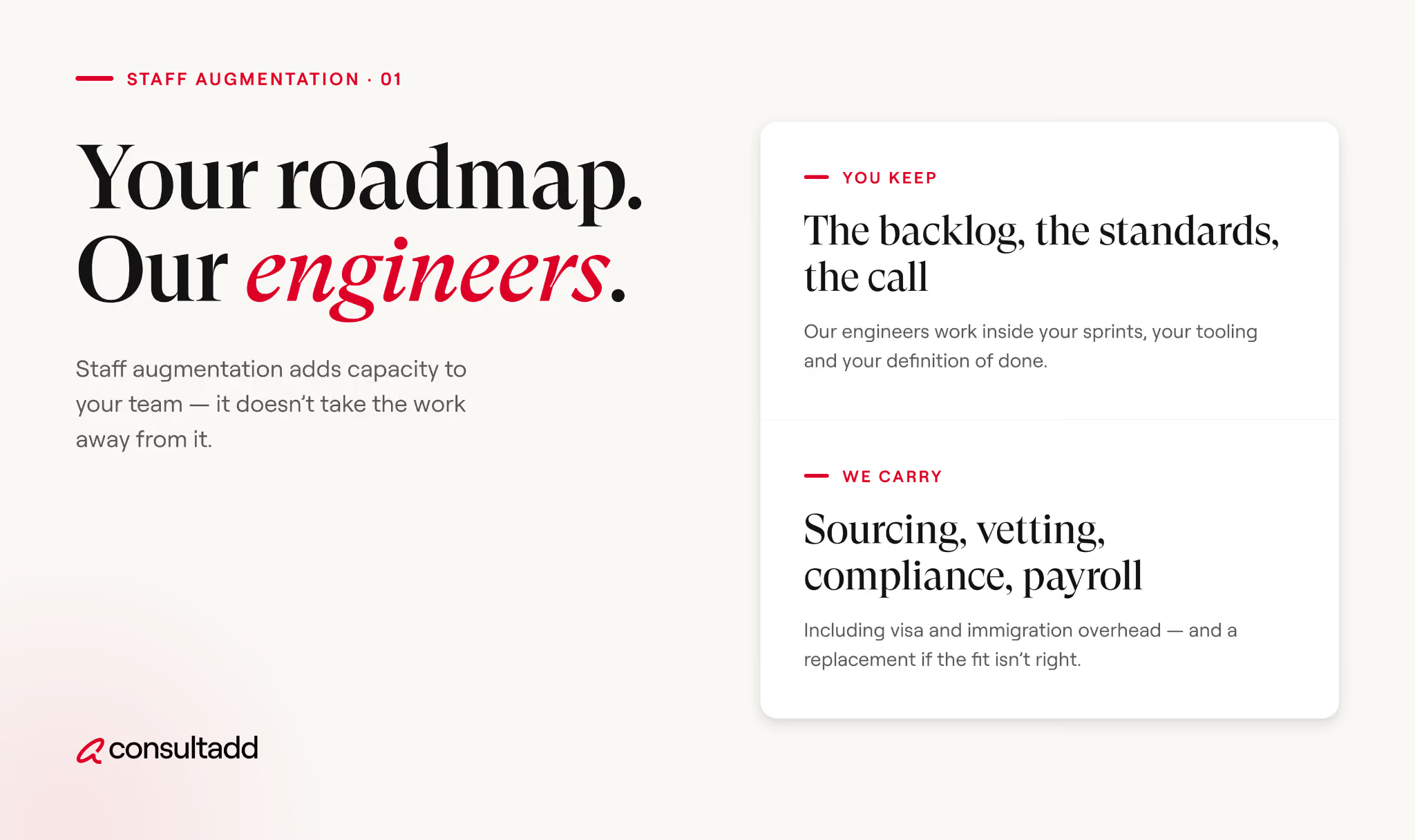
The augmentation firm's actual product is threefold: a sourcing and vetting function you do not have to build, employer-of-record infrastructure, and the ability to scale up and down without a hiring or severance cycle.
How the bill rate is built
You get quoted $128 an hour for a senior Java developer. You know that person could be hired at roughly $115,000 a year. The arithmetic feels wrong.
Here is the actual breakdown:
IT staffing markups generally run about 25% to 75% on contract bill rates, with direct-hire placement fees sitting at 15% to 30% of first-year salary.
A senior software developer paid $80 an hour typically bills somewhere around $112 to $132. A cybersecurity architect paid $100 an hour bills closer to $150 to $175, because scarcity raises both the pay and the recruiting cost.
Markup is not margin
This is the single most misunderstood number in the industry, and the confusion works against you in negotiation.
A 50% markup does not mean the firm keeps 50%. Once payroll taxes, insurance, and benefits come out, a 50% markup often leaves a gross margin in the high teens or low twenties, before the firm has paid a recruiter or a back office.
Two practical consequences. First, a firm quoting a 20% markup on a hard-to-fill role is either losing money, cutting benefits, or has a hidden fee elsewhere. Second, the number to negotiate is rarely the markup percentage. It is the pay rate, the conversion fee, and the volume tier.
Ask for the bill rate and the pay rate separately. A firm that will not show you the split is telling you something.
The market context behind current rates
Rates are not rising the way they were three years ago, and that changes your leverage.
Staffing Industry Analysts forecasts the US staffing market will grow 1% in 2026 to $180.2 billion, with roughly 2% growth in 2027.
That keeps the industry below its pre-pandemic size of $185.5 billion and well under the 2022 peak of $243.9 billion. The IT segment specifically is inching up around 1%.
Demand for labor overall has cooled but not collapsed. The U.S. Bureau of Labor Statistics reported 7.4 million job openings and 5.3 million hires in June 2026.
What that combination means for a buyer: generalist IT contract roles have softened, so you have room to negotiate.
Specialist skills, particularly cloud security, data engineering, and anything AI-adjacent, have not softened at all. Expect firm pricing there and do not waste a negotiation cycle on it.
Contract terms that decide the outcome
The MSA gets signed by procurement and then nobody reads it until something goes wrong. These are the clauses that matter.
The conversion fee is the one that catches most buyers. Staff augmentation frequently turns into contract-to-hire in practice, because a consultant who performs well for six months is exactly who you want to keep.
Negotiate the declining schedule at contract signature, when you have leverage, rather than at the moment you want to make an offer.
On work product, do not rely on a work-for-hire label alone. For software created by contractors, that designation often has no legal effect, and you need an express present assignment instead.
Co-employment and where the risk actually sits
In a proper staff augmentation arrangement, the firm is the employer of record. They run payroll, withhold taxes, carry workers' compensation, and handle unemployment insurance. That is a meaningful part of what your markup buys.
Your exposure is different. It is joint employment, sometimes called co-employment, where your conduct makes you look like an employer of the consultant alongside the firm.
The behaviors that create it are mundane: including contractors in performance review cycles, giving them internal titles and business cards, letting them approve other workers' time, or keeping an engagement running for years with no defined end.
Two practical guardrails:
- Route anything that looks like an employment decision through the firm's account manager, including discipline and termination.
- Keep the engagement's scope and end date documented, even when you expect to extend.
The exposure gets sharper in multi-tier chains, where a prime supplier subcontracts to another vendor who engages a consultant through their own entity.
Classification analysis under the Fair Labor Standards Act turns on economic reality rather than paperwork, and the Department of Labor is explicit that signing an independent contractor agreement does not by itself make someone a contractor. Ask your firm how many tiers sit between them and the person doing the work.
This is general information, not legal advice. Have counsel review your MSA.
The first 30 days determine your ROI
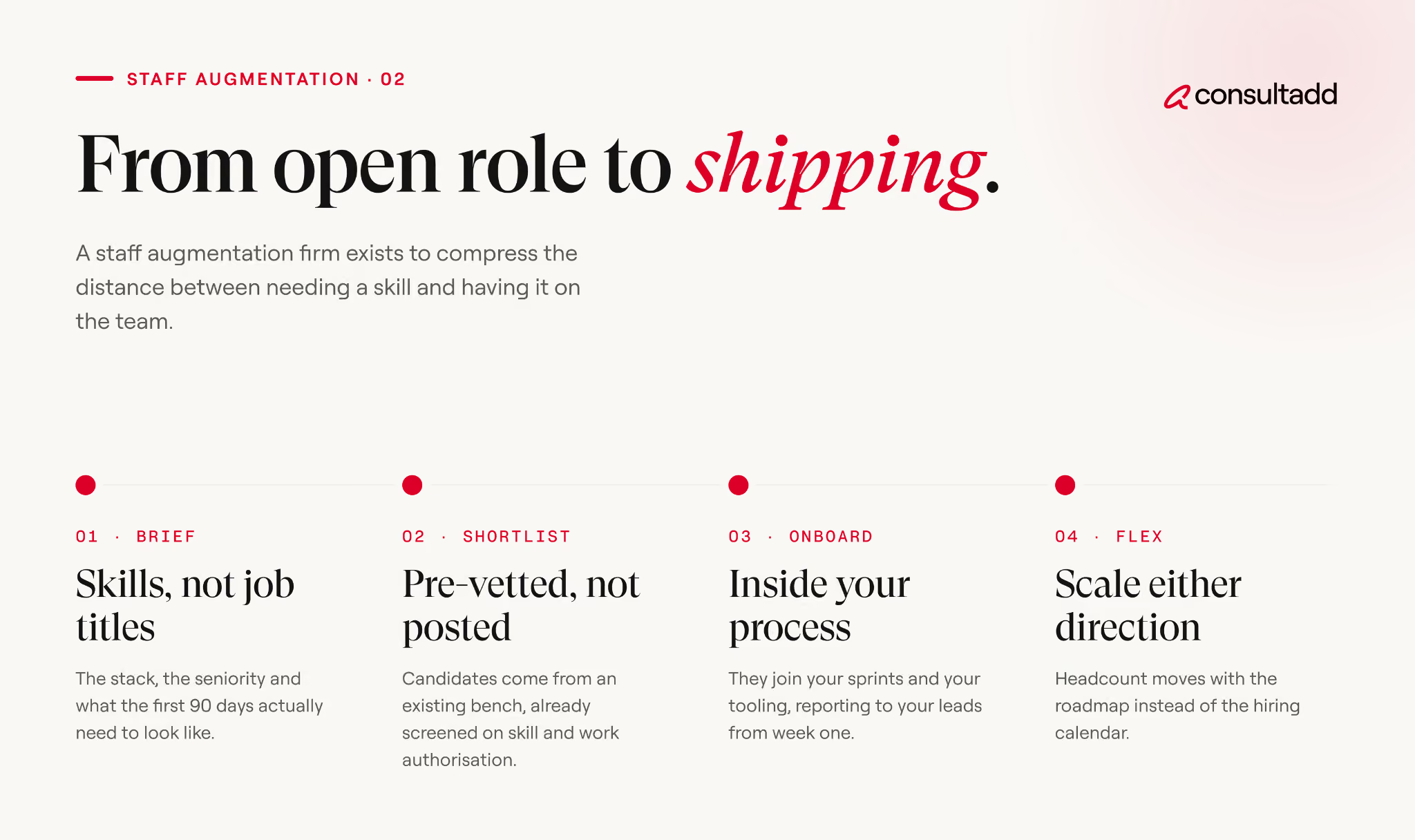
Here is the sequence that quietly wastes the most money in this model.
The firm sources fast. You pick someone. The start date arrives. Then the consultant spends nine business days waiting on a laptop, a VPN certificate, an SSO group, and read access to one database controlled by a single overloaded platform engineer.
You are paying the bill rate that entire time.
Speed is the primary reason to use an IT staff augmentation firm rather than hire. Burning two weeks of it on provisioning gives back the advantage and leaves you with the premium.
If time to hire is the metric you are trying to move, our guide to time to hire benchmarks and what actually fixes them covers the upstream half of the problem.
When an IT staff augmentation firm is the wrong answer
Honest version, since this cuts against the pitch.
Augmentation struggles when the work cannot be defined well enough to hand over. If your own team cannot articulate what done looks like, adding a contractor adds supervision load, not capacity.
It struggles when you have no one to supervise. The model assumes your managers direct the work. Teams already at capacity often discover that onboarding and reviewing an augmented engineer costs more management hours than the engineer saves.
It struggles for genuinely core, long-horizon roles. If you will still need this function in three years, the cumulative bill rate exceeds the cost of hiring, and you have built institutional knowledge that walks out at the end of the engagement.
And it struggles when what you actually want is accountability for a delivered outcome. That is an SOW with a vendor who owns the result, priced and managed differently.
If you are still deciding between partners and models, our buyer's guide to IT staffing firms works through that comparison.
Start Strong With Consultadd
With 15 years in business and 5,000+ successful staffing engagements, we don't just fill roles, we build reliability into your process. We've supported 65 staffing companies in the past year alone and maintain MSAs with industry leaders like Robert Half and TEKsystems.
Here's what working with Consultadd looks like:
- Talent sourced in under 24 hours
- Ready-to-deploy candidates, vetted for experience and compliance
- Lower turnover risk: we match long-term goals, not just short-term needs
- Seamless compliance: visa, documentation, onboarding? Handled.
- Dedicated 1:1 account managers for responsive, personalized support
- Top 100 candidate matches delivered in the past year
- Strong partnerships with universities to tap into fresh, committed talent
- Post-placement support so your investment grows beyond day one
For candidates, your next opportunity is more than just a job title, it's a chance to build skills, gain experience, and move your career forward. At Consultadd, we connect technology professionals with projects and employers that align with their goals, whether they're looking for contract, contract-to-hire, or long-term opportunities.
The tech job market moves fast, but the right guidance can make all the difference. Ready to take the next step in your career journey? Explore Opportunities >>
Key takeaways
- Staff augmentation means you direct the work and own the outcome. If you want the vendor accountable for delivery, you need an SOW instead.
- Markup is not margin. Ask for the bill rate and pay rate separately, and negotiate the pay rate and conversion fee rather than the markup percentage.
- Settle the conversion fee schedule at signature, because augmentation often becomes contract-to-hire in practice.
- Work-for-hire language alone will not transfer ownership of software. Require present assignment language.
- Start provisioning the day you sign. Onboarding delay is the most common way buyers lose the speed they paid for.
FAQs
What does an IT staff augmentation firm actually do?
It sources and vets technical professionals, employs them as the employer of record, and places them into your team to work under your direction. The firm handles payroll, taxes, workers' compensation, and compliance. You manage the day-to-day work and own the deliverables.
How much does IT staff augmentation cost?
Pricing is usually an hourly bill rate carrying a markup of roughly 25% to 75% over the consultant's pay rate, depending on skill scarcity and volume. Most of that markup covers payroll taxes, insurance, benefits, and recruiting rather than profit. Specialist roles like cloud security and data engineering sit at the top of the range.
What is the difference between staff augmentation and outsourcing?
With augmentation, external staff work under your management and you own the outcome. With outsourcing or managed services, the vendor takes responsibility for a defined deliverable or service level and manages its own people. The choice comes down to whether you want control or accountability.
Can I hire an augmented contractor as a full-time employee?
Usually yes, subject to a conversion fee in your agreement. Negotiate a declining fee schedule upfront, ideally reaching zero after six to twelve months of engagement. Without that term, converting a strong performer can cost as much as a direct placement fee.
Who owns the code an augmented developer writes?
Whoever your contract says, assuming the language is drafted correctly. Work-for-hire designation alone generally does not transfer copyright in software, so the agreement needs an express present assignment. Confirm the assignment holds at every tier if subcontractors are involved.
Is staff augmentation risky from a compliance standpoint?
The firm carries employer obligations, which removes most direct exposure. Your residual risk is joint employment, created by treating contractors like staff in reviews, titles, or discipline. Route employment-type decisions through the firm and keep engagement scope and end dates documented.

Nearshore Staff Augmentation: When It Actually Works
Introduction
A hiring manager opens a senior backend req. in February. By May it's still open, two finalists have taken counteroffers, and the roadmap has slipped a quarter. At that point the question stops being "who do we hire" and becomes "where do we look."
Nearshore staff augmentation is one answer. You add contract engineers from countries in or near your own time zone, they work inside your team and your process, and you keep control of the work. For U.S. companies that usually means Mexico, Colombia, Costa Rica, Argentina, Brazil, or Canada.
The pitch is easy to summarize and harder to execute. Most of the value comes from one variable: how many hours a day your team and theirs are both awake and working.
TL;DR
- Nearshore staff augmentation means contracting talent in a nearby country with 0 to 3 hours of time zone difference from your team, while you keep day-to-day direction of the work.
- The real benefit isn't the hourly rate. It's the six or seven overlapping work hours, which cut the review-and-rework cycle that makes far-offshore engagements drag.
- Savings against U.S. onshore contract rates are real but narrower than offshore. If cost is your only driver, nearshore is usually the wrong tool.
- Cross-border contracting brings paperwork most teams underestimate: foreign status documentation, IP assignment under the right jurisdiction, and misclassification risk.
- Nearshore fails most often on work that requires deep institutional context, not on skill.
What nearshore staff augmentation actually means
The staffing model here is nothing new. You bring in external professionals, they follow your workflows, your managers assign their work, and the vendor handles sourcing and contracts.
If you want the mechanics of that model end to end, Consultadd's breakdown of how IT staff augmentation works covers it properly.
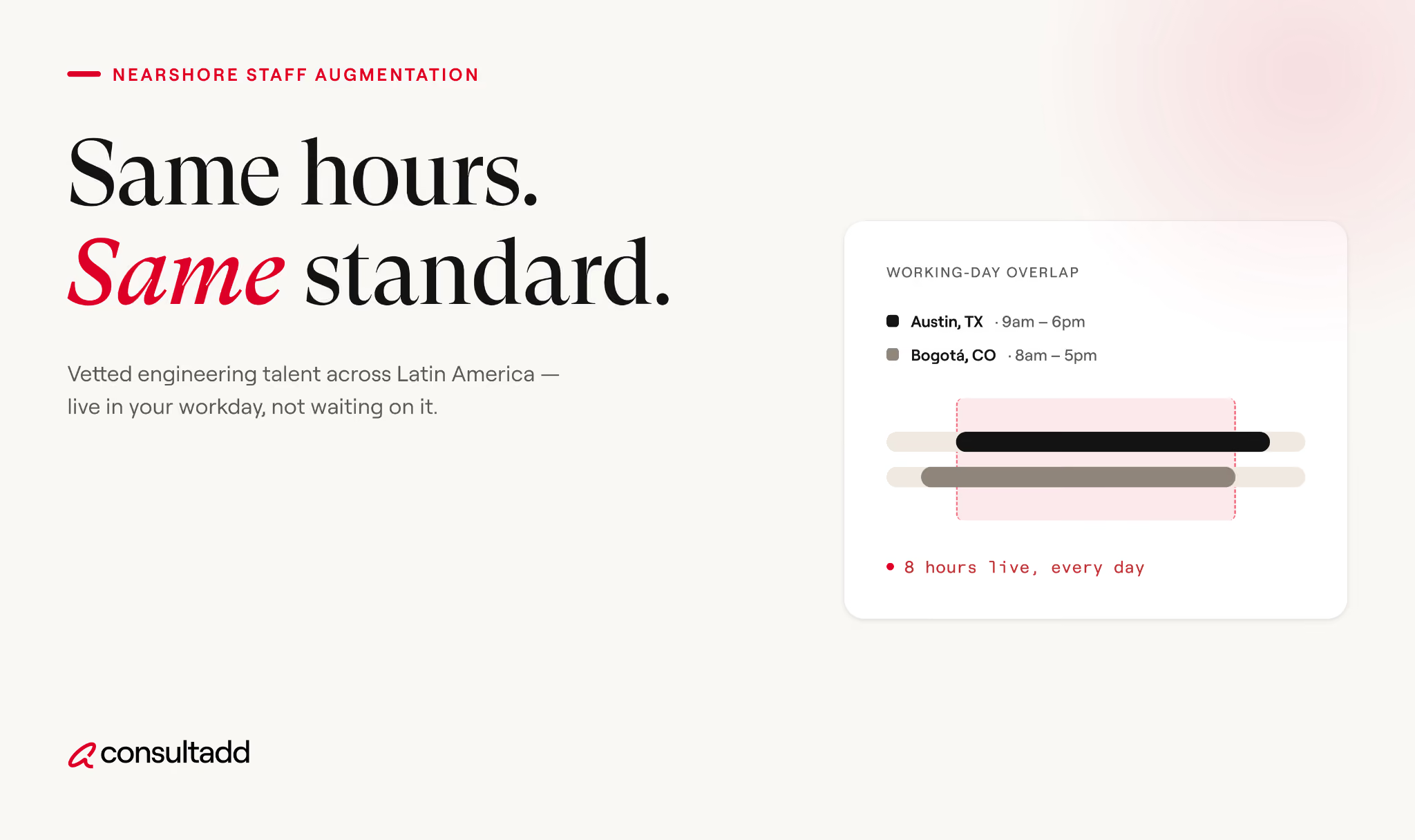
What "nearshore" changes is one input: location.
That sounds minor. It isn't, because location determines overlap, and overlap determines how many times a day a decision can get made. A question that takes four hours to answer costs you one iteration. The same question with a 12-hour gap costs you a day.
Deloitte's 2022 survey of more than 500 business and technology leaders noted companies expanding their external workforce into new regions, with Latin America specifically cited as the route to U.S. nearshore access.
That shift wasn't about finding cheaper engineers. It was about finding engineers who are online at 10 a.m. Eastern.
Nearshore vs offshore vs onshore: the overlap math
Here's what the three options look like side by side for the U.S. Eastern team working 9 to 6.
Why overlap matters more than the rate card
Offshore works well when the scope is written down clearly and doesn't change much. Migration work, test automation, maintenance on a stable system, defined data pipelines. Ambiguity is where it struggles, because every clarification costs a full cycle.
Nearshore is the opposite. Discovery work, product engineering where requirements shift mid-sprint, incident response, anything where someone needs to grab a colleague and screen-share for ten minutes. Those all depend on overlapping hours.
A recruiter we work with puts it more bluntly: “Offshore teams get judged on tickets closed, nearshore teams get judged on whether the product manager stops chasing people.”
Where the savings actually land
Nearshore rates sit between onshore and offshore, which surprises buyers who expected offshore-level pricing. Two things soften that.
The first is rework. Fewer misread requirements means fewer rebuilt features.
The second is management overhead. Someone on your side has to review, unblock, and re-explain. With a three-hour overlap, that person ends up working split days. That cost is real, it just never shows up on an invoice.
Deloitte's 2024 Global Outsourcing Survey found that 80% of executives planned to maintain or increase third-party outsourcing investment, and that skilled talent and agility had joined cost reduction as primary drivers.
When agility is the driver rather than cost, the geography that wins changes.
The markets U.S. teams hire from
"LATAM" gets used as one word. It isn't one market, and rates, English levels, and contracting norms vary considerably between them.
Two practical notes. Colombia doesn't observe daylight saving, so your overlap shifts twice a year without anyone changing schedules.
Argentina and Brazil sit east of U.S. Eastern, which means their afternoon ends before yours does. That's usually fine, but it kills the late-day sync some U.S. teams rely on.
What nearshore engagements really cost
Published hourly rates are the smallest part of this. Build your budget from components instead.
Ask any vendor for the fully loaded number, then ask what happens if you need to end the engagement in month three. Notice periods in cross-border contracts run longer than U.S. staffing norms.
Consultadd's guide to choosing a staff augmentation company has the wider vendor diligence list if you're at that stage.
Compliance across the border
This is where nearshore engagements create work that domestic contract staffing doesn't, and it's the part teams discover in month two.
1. Foreign status documentation.
- If you're paying a non-U.S. individual directly, you generally collect Form W-8BEN before the first payment rather than a W-9.
- It certifies foreign status and supports the correct withholding treatment.
- The IRS instructions for Form W-8BEN spell out when a withholding agent can rely on it and when it doesn't apply, including the case of a nonresident individual performing services inside the United States.
- Where the work is performed matters more than where the person lives.
2. Misclassification.
- Treating a full-time, exclusively assigned contractor as an independent contractor is a risk in most LATAM countries, and several have labor courts that lean toward the worker.
- Going through a staffing partner or employer of record shifts that exposure.
3. IP assignment.
- Your standard contractor agreement was probably written for U.S. law. Confirm that work-for-hire language actually transfers ownership under the contractor's local jurisdiction, because in several countries it doesn't by default without an explicit assignment clause.
4. Payment structure.
- Corp-to-corp arrangements are common in this space and change the paperwork considerably.
The key clauses in a C2C contract are worth reviewing before you sign one.
- None of this is a reason to avoid nearshore. It's a reason to decide early whether you're handling it yourself or paying a partner to handle it.
When nearshore is the wrong call
Balanced advice is more useful than a sales pitch, so here are the cases where we'd tell someone not to bother:
- The work requires a security clearance, or the contract has citizenship or onsite requirements. Federal and defense work usually rules out non-U.S. talent regardless of quality.
- The role depends heavily on institutional knowledge. A staff engineer who needs to know why a decision was made in 2019 can't be dropped in from anywhere, near or far.
- You need one person for six weeks. The setup cost isn't worth it. Local contract staffing will be faster.
- Cost reduction is the only goal and the scope is genuinely well-defined. Offshore will cost less and do the job.
- Your team has never run a distributed engagement.
Nearshore is more forgiving than offshore, but it still requires written decisions, recorded context, and managers who don't rely on hallway conversations.
If you're weighing this against other structures entirely, the full range of IT staffing models is a better starting point than picking a geography first.
Running the first 30 days
Most nearshore engagements that go badly go badly in the first month, and the reasons repeat.
Days 1 to 3. Access sorted before day one, not requested on day one. Repo, cloud console, ticketing, chat, VPN. Waiting on IT is the most common early stall.
Days 1 to 5. Name a single point of contact on your side. Not a committee. Someone who answers questions the same day.
Week 1. Agree core hours in writing. Four to six hours of guaranteed overlap, stated in both time zones, with daylight saving handled.
Week 2. Ship something small to production. A real change, not a sandbox exercise. It tests your pipeline and their access at the same time.
Week 3. First written feedback, both directions. Not a performance review, just a short correction of course.
Week 4. Review the time-to-productivity against what the vendor promised. If it's materially off, raise it now while you still have leverage in the contract.
Calendars also need a look. LATAM countries observe more public holidays than the U.S., and they don't line up. Plan capacity around them at the start of the quarter.
Start Strong With Consultadd
With 15 years in business and 5,000+ successful staffing engagements, we don't just fill roles, we build reliability into your process. We've supported 65 staffing companies in the past year alone and maintain MSAs with industry leaders like Robert Half and TEKsystems.
Here's what working with Consultadd looks like:
- Talent sourced in under 24 hours
- Ready-to-deploy candidates, vetted for experience and compliance
- Lower turnover risk: we match long-term goals, not just short-term needs
- Seamless compliance: visa, documentation, onboarding? Handled.
- Dedicated 1:1 account managers for responsive, personalized support
- Top 100 candidate matches delivered in the past year
- Strong partnerships with universities to tap into fresh, committed talent
- Post-placement support so your investment grows beyond day one
For candidates, your next opportunity is more than just a job title, it's a chance to build skills, gain experience, and move your career forward. At Consultadd, we connect technology professionals with projects and employers that align with their goals, whether they're looking for contract, contract-to-hire, or long-term opportunities.
The tech job market moves fast, but the right guidance can make all the difference. Ready to take the next step in your career journey? Explore Opportunities >>
Key takeaways
- Nearshore staff augmentation buys you overlapping work hours. That's the product, and everything else follows from it.
- Budget from fully loaded cost, including onboarding, provisioning, and the management time your leads will spend.
- Treat LATAM as several distinct markets with different rates, English levels, and contracting rules, not one region.
- Handle foreign status documentation, IP assignment, and classification before the first invoice, not after.
- Skip nearshore for clearance-restricted work, six-week gaps, or roles that live on institutional memory.
FAQs
What is nearshore staff augmentation?
It's a staffing model where you contract professionals in a nearby country, usually within three hours of your time zone, who work inside your team and take direction from your managers. For U.S. companies that generally means Latin America or Canada. You keep control of the work, and the partner handles sourcing, contracts, and compliance.
How is nearshore staff augmentation different from offshore?
The difference is overlap, not skill. Nearshore gives you six to eight shared working hours a day, so questions get answered the same morning. Offshore typically leaves one to three hours of overlap, which pushes most feedback into the next day. That makes offshore stronger on well-specified scopes and weaker on work that changes.
How much can we save with nearshore compared to hiring in the U.S.?
Nearshore rates sit between U.S. onshore and offshore, so the savings are real but smaller than offshore comparisons suggest. The more useful measure is fully loaded cost, which includes onboarding, equipment, compliance work, and the management hours your leads spend supporting the engagement.
Which countries do U.S. companies use most for nearshore staffing?
Mexico, Colombia, Costa Rica, Argentina, and Brazil are the most common, with Canada used when time zone and language alignment matter more than cost. Mexico and Colombia are popular for U.S. Eastern and Central teams because the overlap is nearly complete.
Do we need to issue a 1099 to a nearshore contractor?
Usually not, if the contractor is a non-U.S. person performing all services outside the United States. You generally collect Form W-8BEN instead of a W-9 before the first payment. If any of the work is performed inside the U.S., the reporting and withholding rules change, so confirm the specifics with a tax advisor.
How long does it take to get nearshore staff productive?
Two to four weeks is a realistic ramp for most engineering roles, assuming access is provisioned before day one. Teams that treat onboarding as an afterthought routinely double that. Ask any vendor for their average time-to-productivity by role type rather than a single company-wide number.

Bench Candidate Meaning: What It Means in IT Staffing
Introduction
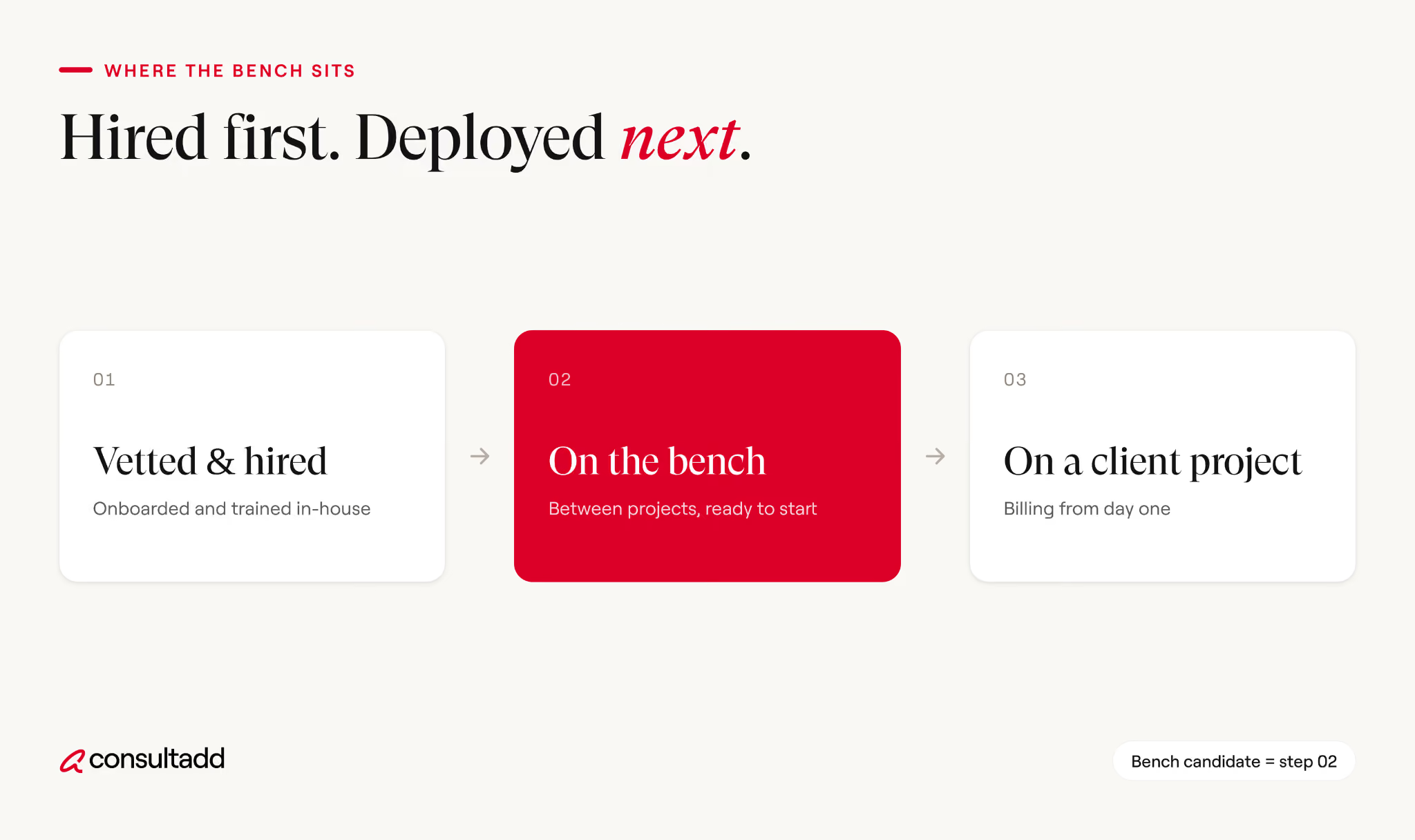
If a recruiter tells you they have three bench candidates ready for your requirement, they're saying something specific. The bench candidate meaning in US IT staffing is simple: a consultant who is already employed by a staffing firm, already vetted, already cleared for work authorization, and currently not billing on a client project.
They're on payroll. They're just not on an assignment.
That gap is the whole point. For a client with an urgent opening, a bench candidate can start in days instead of weeks. For the staffing firm, every day that person sits idle is money going out with nothing coming in. Both things are true at once, which is why bench management gets so much attention in this industry and so little clear explanation.
Here's what the term covers, why consultants end up there, and what actually gets someone off the bench.
TL;DR
- A bench candidate is a consultant on a staffing firm's payroll who isn't currently assigned to a billable client project.
- Bench time usually happens between contracts, after a project ends early, or right after onboarding a new hire.
- Clients like bench candidates because they're pre-vetted and can start almost immediately.
- For H-1B workers, employer-caused bench time is not legally unpaid. The US Department of Labor requires the LCA wage during nonproductive time.
- Short bench periods are normal. Long ones usually point to a resume problem, a rate problem, or a skills problem, and all three are fixable.
What does bench candidate mean?
A bench candidate is a technology professional employed by a staffing or consulting company who is available for assignment but isn't working on one right now.
The word comes from sports. Players on the bench are part of the team, in uniform, ready to go in. They just aren't on the field at this moment.
In staffing, that translates to a few concrete things:
- The person has signed an employment agreement with the staffing firm
- Their background, references, and technical skills have already been checked
- Their work authorization is verified and documented
- Their resume is formatted and ready to submit
- They can usually start within a week, sometimes within 48 hours
Compare that to a candidate the recruiter found on a job board yesterday. That person still needs screening, reference checks, a background check, negotiation, and a notice period at their current job. Two very different timelines.
Bench candidate vs other candidate types
The word "bench" gets used two ways
You'll run into a second usage, especially with larger IT services firms. There, the bench means a deliberately maintained pool of unallocated consultants held in reserve so the company can staff new deals quickly. That's a planned capacity buffer, not an accident.
Both meanings point to the same underlying state: talent on payroll, not on a project. The difference is whether it was intentional.
Why consultants end up on the bench
Being on the bench isn't a performance rating. Most bench time has nothing to do with how good someone is at their job.
The first three are routine. A consultant who finishes a two-year engagement and spends three weeks on the bench before starting the next one is having a completely normal career.
The bottom three are the ones worth paying attention to, because they don't resolve on their own.
The part nobody enjoys
Bench time is uncomfortable for everyone involved:
- The consultant is anxious about income and, for visa holders, about status.
- The recruiter is under pressure to place.
- The firm is paying salary against zero revenue.
That pressure sometimes produces bad behavior across the industry: inflated resumes, consultants pushed into roles they aren't ready for, or firms that stop paying during bench periods. The last one isn't a gray area. It's a violation.
Bench candidates and H-1B rules
This part matters and gets misunderstood constantly.
If an H-1B worker is in nonproductive status because of an employer decision, including simple lack of assigned work, the employer still has to pay. The US Department of Labor's guidance on nonproductive time states that H-1B workers must be paid the required wage rate for all nonproductive time caused by employment-related conditions, such as lack of assigned work.
The obligation is written into 20 CFR 655.731, which requires the employer to pay a salaried H-1B employee the full pro-rata amount due, or an hourly employee for a full-time week, at the wage listed on the Labor Condition Application.
Unpaid time is only permitted in narrow situations that aren't work-related, such as a voluntary personal absence. And even those have conditions attached. The Department of Labor's LCA requirements page lays out the statutory language directly.
Practical version for consultants: if you're on the bench because your employer doesn't have a project for you, you should be getting paid. If you're not, that's worth a conversation, and possibly a call to an immigration attorney.
Practical version for clients: when you engage a staffing partner, their bench payroll discipline tells you something about how they run the rest of their compliance. Firms that cut corners on bench pay tend to cut corners elsewhere too.
If you're evaluating partners on visa-sponsored placements, our guide to corp to corp visa sponsorship for H-1B jobs covers the documentation side in detail.
How bench candidates get placed
The process runs backwards compared to normal recruiting. In standard hiring, you have a job and you look for a person. In bench sales, you have the person and you look for the job.
That reversal shapes everything. A bench sales recruiter spends their day scanning requirements from prime vendors, implementation partners, and direct clients, then matching them against the consultants sitting on their bench.
If you want the full picture of how that function works day to day, our breakdown of bench sales meaning and recruiter roles goes deeper.
The typical sequence:
- Profile prep. The recruiter updates the resume against current market demand, not against what the consultant did three years ago.
- Requirement sourcing. Vendor lists, job portals, and existing client relationships get worked simultaneously.
- Submission. The profile goes out, often with contact details masked so the vendor has to route through the firm.
- Rate confirmation. Both sides agree on a bill rate and pay rate before interviews happen, not after.
- Client interview. Usually one or two rounds, sometimes with a short technical screen.
- Paperwork and start. Contract, onboarding, background check refresh if needed, then start date.
For contracts placed on a corp-to-corp basis, the paperwork layer adds a step or two.
Our complete guide to corp to corp staffing explains how the entity structure changes who signs what.
What actually shortens bench time
From what recruiters see repeatedly, the consultants who get off the bench fastest do a few things differently.
- They keep one resume version per target role instead of one generic resume for everything. They answer their phone.
- They're honest about what they've actually built versus what they've read about.
- They give the recruiter a realistic rate floor on day one rather than renegotiating after a client interview.
- They use bench weeks to close a specific skills gap, not to browse job boards passively.
That last one is underrated. Four weeks is enough time to earn a cloud certification from AWS or Microsoft, which changes what a recruiter can submit you for.
A realistic bench-week plan
If you're weighing whether a contract role is even the right structure for you, W2 vs C2C vs 1099 walks through the tradeoffs before you commit to one.
Why clients ask for bench candidates
From the client side, the appeal is speed with less risk attached.
A bench candidate has already cleared the staffing firm's screening. The firm has a financial incentive to place people who'll succeed, because a failed placement means the consultant comes right back to the bench and the firm eats the cost again. That incentive alignment is quietly one of the better features of the model.
The tradeoff is selection. A bench is finite. If your requirement is unusual, the firm may not have anyone matching it, and they'll need to source externally like anyone else. Bench candidates solve for speed on common stacks, not for rare specializations.
Worth asking any staffing partner: how large is your active bench right now, and how many of those consultants have you placed in the last quarter? The answer tells you whether you're getting a real ready-to-deploy pool or a list of names.
Some clients also use bench placements as a trial period before making a permanent offer.
That structure has its own mechanics, covered in our guide to C2C and contract-to-hire opportunities.
Start Strong With Consultadd
With 15 years in business and 5,000+ successful staffing engagements, we don't just fill roles, we build reliability into your process. We've supported 65 staffing companies in the past year alone and maintain MSAs with industry leaders like Robert Half and TEKsystems.
Here's what working with Consultadd looks like:
- Talent sourced in under 24 hours
- Ready-to-deploy candidates, vetted for experience and compliance
- Lower turnover risk: we match long-term goals, not just short-term needs
- Seamless compliance: visa, documentation, onboarding? Handled.
- Dedicated 1:1 account managers for responsive, personalized support
- Top 100 candidate matches delivered in the past year
- Strong partnerships with universities to tap into fresh, committed talent
- Post-placement support so your investment grows beyond day one
For candidates, your next opportunity is more than just a job title, it's a chance to build skills, gain experience, and move your career forward. At Consultadd, we connect technology professionals with projects and employers that align with their goals, whether they're looking for contract, contract-to-hire, or long-term opportunities.
The tech job market moves fast, but the right guidance can make all the difference. Ready to take the next step in your career journey? Explore Opportunities >>
Key takeaways
- The bench candidate meaning comes down to one thing: a vetted consultant on a staffing firm's payroll without a current billable assignment.
- Most bench time is structural, not a reflection of the consultant's ability.
- Employer-caused bench time for H-1B workers must be paid at the LCA wage rate under federal regulations.
- Clients get speed and pre-verified compliance from bench candidates, but a smaller selection pool.
- Bench periods stretching past six weeks usually signal a fixable issue with positioning, rate, or skills.
FAQs
What does it mean when a candidate is on the bench?
It means the person is employed by a staffing or consulting firm but isn't currently assigned to a client project. They're drawing salary from the firm while waiting for their next placement. The firm markets their profile to clients and vendors during this period.
Is being on the bench a bad thing for a consultant?
Short bench periods between contracts are normal and happen to most contract professionals. It becomes a concern when it stretches past a month or two, which usually points to a resume, rate, or skill-demand mismatch rather than anything personal. The time is also useful for certifications if you use it deliberately.
Do bench candidates get paid?
It depends on the employment arrangement, but for H-1B workers the answer is defined by federal rules. When nonproductive status results from an employer decision such as lack of assigned work, the employer must pay the required wage listed on the Labor Condition Application. Unpaid bench time in that situation is a violation, not standard practice.
What's the difference between a bench candidate and a bench sales recruiter?
The bench candidate is the consultant waiting for an assignment. The bench sales recruiter is the person whose job is to find that assignment, by sourcing requirements from vendors and clients and submitting the consultant's profile. One is the talent, the other is the marketer.
How long do candidates usually stay on the bench?
For in-demand skills, often one to four weeks. For roles where market demand has softened, it can run six weeks or more. The length depends more on skill relevance and rate expectations than on how hard the consultant is searching.
Why do clients hire bench candidates instead of sourcing fresh?
Speed, mostly. A bench candidate has already been screened, background checked, and cleared for work authorization, so they can often start within days instead of the four to eight weeks a fresh hire takes. The tradeoff is that the available pool is limited to whoever the firm currently has on the bench.

Tech Staff Augmentation: When It Works and When It Fails
Introduction
A VP of engineering needs two Kubernetes engineers by the end of the quarter. Recruiting says the search will take ten weeks. The project can't wait ten weeks. So someone suggests tech staff augmentation, and three weeks later there are two contractors in the standup.
Sometimes that story ends well. Sometimes the contractors ship a service nobody on the permanent team understands, then leave in March.
The difference isn't the model. Tech staff augmentation is a reasonable way to add engineering capacity and also a reasonable way to create six months of technical debt.
What separates the two is how the engagement gets scoped, who owns what, and whether anyone planned for the handoff.
TL;DR
- Tech staff augmentation means adding external technology professionals to your existing team, under your management, using your tools and your process.
- The economics favor augmentation when the need is under 12 months, the skill is specialized, or the timeline is shorter than your hiring cycle.
- Control is the dividing line. If you're directing the work day to day, it's augmentation. If a vendor owns the deliverable, it's outsourcing or a managed service.
- The two biggest failure modes are vague scope and no knowledge transfer plan. Both are preventable at the start and expensive to fix later.
- Misclassification and co-employment are real legal exposures. Get the working relationship documented before anyone starts.
What tech staff augmentation actually is
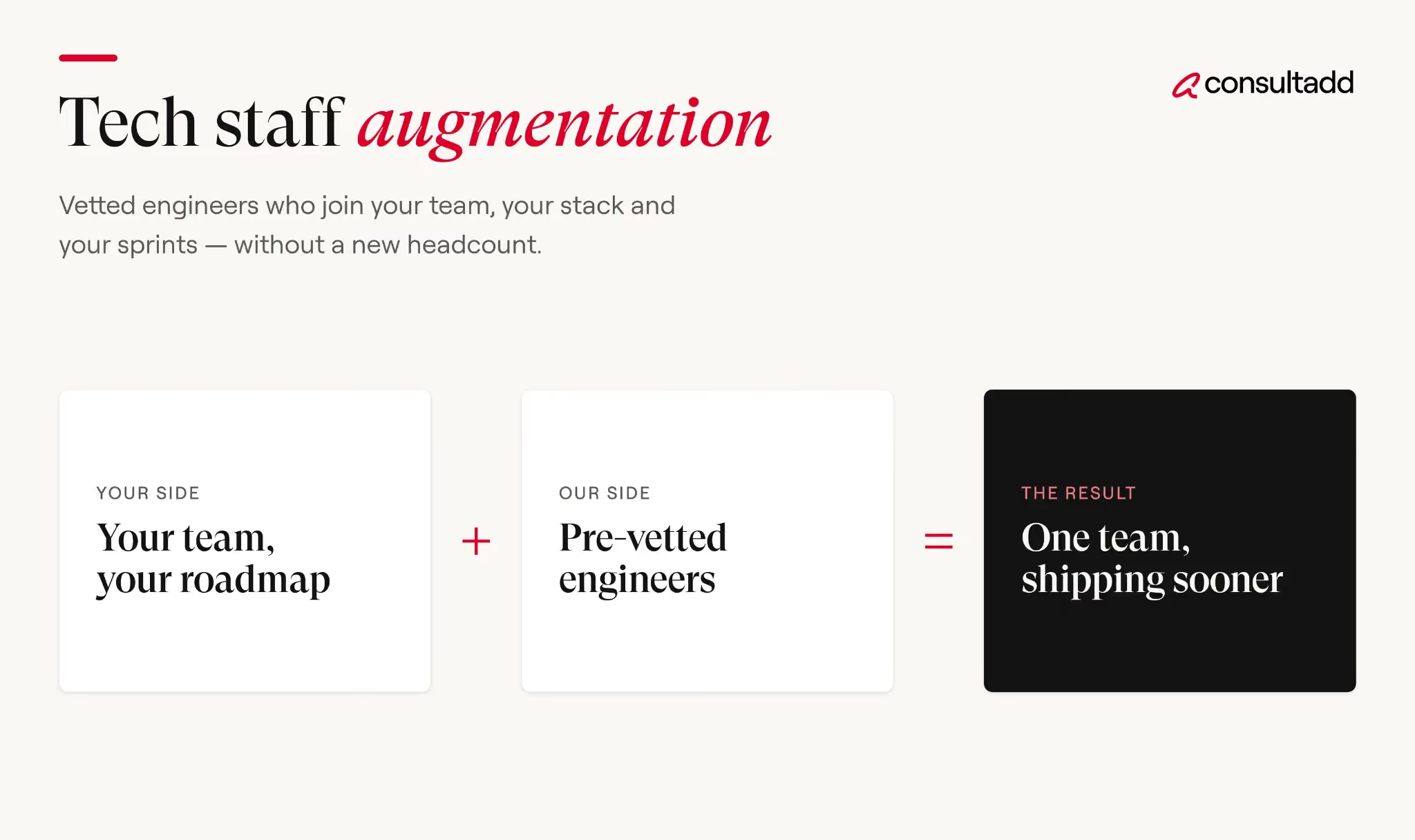
Tech staff augmentation is a staffing model where you bring in external technology professionals to work inside your team for a defined period.
They report to your managers, sit in your standups, work in your repos, and follow your process. You direct the work. A staffing partner handles sourcing, employment, payroll, and compliance.
The people are external. The work is yours.
That's the whole idea, and most confusion about the model comes from blurring it.
The control question
There's one question that sorts almost everything: who decides what gets built this sprint?
If the answer is your engineering manager, it's staff augmentation. If it's the vendor's delivery lead working from a statement of work, it's outsourcing or a managed service.
Both are legitimate. They price differently because the vendor carries different levels of risk.
Companies get into trouble buying one and expecting the other. Paying augmentation rates while expecting a vendor to own delivery outcomes is the common version.
Our breakdown of staff augmentation vs. consulting goes deeper on where that line sits and what each side is actually selling.
How it compares to the alternatives
The full comparison of IT staffing models covers the rest of the category, including RPO and high-volume hiring.
The cost math
The sticker shock is real. An augmented senior engineer might bill at $95 an hour when your equivalent full-time employee costs $160,000 a year. Hourly, that looks like a steep premium. It usually isn't once you finish the arithmetic.
A $160,000 salary carries payroll taxes, benefits, equipment, software licenses, and paid time off. Loaded cost commonly lands 25% to 40% above base. Then there's the cost of making the hire at all.
The SHRM 2025 Benchmarking Report puts average cost per hire at $5,475 for non-executive roles, with median time-to-fill around a month and a half.
And technology roles run slower than the median. The Bureau of Labor Statistics projects employment of software developers, QA analysts, and testers to grow 10 percent from 2025 to 2035, with roughly 106,100 openings a year.
Specialized subsets like ML engineering and cloud security are tighter than the headline suggests.
The last row is the one people forget. Augmentation is cheaper on a 9-month horizon and more expensive on a 3-year one. If you're augmenting the same seat for a third consecutive renewal, you don't have a capacity gap. You have an unfilled role, and you should hire for it.
A rough rule that holds up: under 12 months, augmentation usually wins on total cost. Beyond 18 months, direct hire usually does. The window between them depends on how fast your recruiting actually moves.
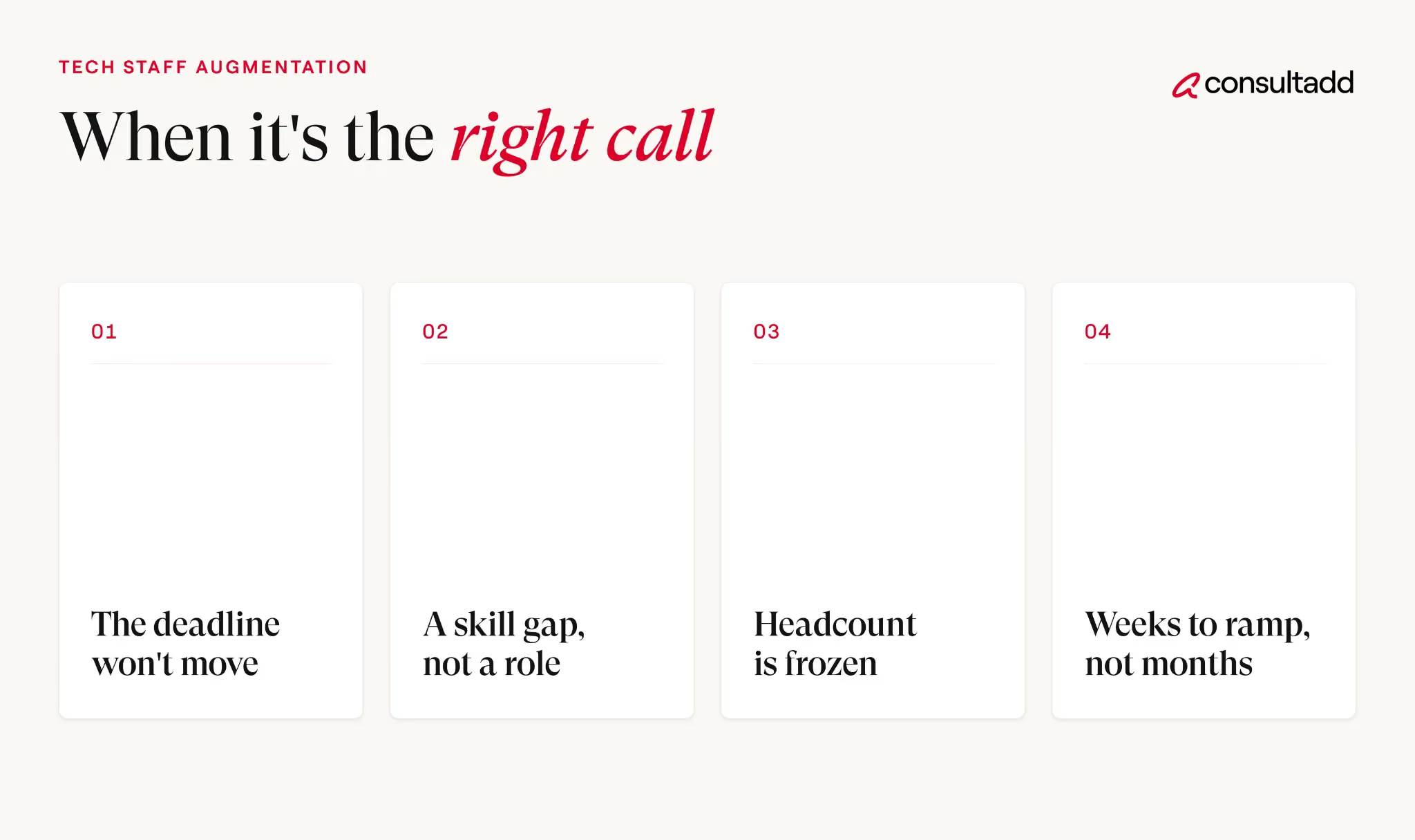
When tech staff augmentation is the right call
You have a dated commitment and a short runway. A migration with a contractual deadline, a compliance remediation, a product launch. The work has an end date, and missing it costs more than the rate premium.
The skill is specialized and temporary. You need someone who has actually run a Databricks migration, once, for four months. Hiring that permanently makes no sense.
Your roadmap is clear and your bottleneck is hands. This is the cleanest case. You know what to build. You have the architecture, the standards, and the review process. You just need more people writing code against it.
You're a staffing firm supplying your own clients. Different situation, same mechanics.
Our guide to IT staff augmentation and fast tech hiring covers this use case specifically.
You want to test a capability before committing headcount. Bring in a security engineer for six months, find out how much security work you actually generate, then decide.
When it's the wrong call
You don't know what you want built. Augmented engineers take direction. If the direction is unclear, you'll pay hourly rates for people waiting on decisions. Ambiguity is a consulting problem, not a capacity problem.
Nobody has time to manage them. This one kills more engagements than skill gaps do. Augmentation transfers sourcing and employment to a partner. It does not transfer management. If your engineering manager is already at capacity, adding three contractors makes things worse before it makes them better.
The role is permanent and you're avoiding a headcount conversation. Using contractors to route around a hiring freeze is common and usually ends badly. The cost shows up in a different budget line and keeps growing.
The work requires deep, undocumented institutional context. If it takes six months to understand your system, a six-month contractor will spend the whole engagement learning.
You need the knowledge to stay. More on this below, because it's fixable.
How to scope the engagement
Define the outcome, not just the seat
"We need a backend engineer" is a requisition. "We need the payments service migrated off the legacy queue by March 31, with runbooks" is a scope.
The second one tells you when you're done, tells the engineer what success looks like, and gives you something to evaluate against in week four instead of week twenty.
You still manage the work day to day. You just know what the work is for.
Plan the ramp
An augmented engineer at a well-run company is productive in one to two weeks. At a company with no documentation and a 90-minute local setup, it's six. That gap is entirely on your side.
Before anyone starts: access provisioned, environment documented, a named buddy on the team, and a first task that's real but small. The first two weeks are billed either way. Decide whether they're spent shipping or hunting for credentials.
Decide who owns what, in writing
Sourcing, employment, payroll, taxes, and work authorization sit with the staffing partner. Task assignment, code review, and technical standards sit with you.
Equipment, security access, and data handling need an explicit answer. Write it down, because ambiguity here is where compliance problems start.
Consultadd's step-by-step IT staffing process covers intake in more detail, which is where most of this gets settled.
Risks worth managing
Two of these deserve a bit more:
Misclassification is a live enforcement area.
Employers also carry documentation duties on every hire: per USCIS guidance, Form I-9 Section 1 is completed no later than the worker's first day, Section 2 within three business days of the hire date, and the form is retained for three years after hire or one year after employment ends, whichever is later.
When a staffing partner is the employer of record, these obligations sit with them, which is much of the point of using one.
Knowledge transfer is the risk people accept and then regret.
The fix is boring and it works: make documentation a contractual deliverable, pair every augmented engineer with a permanent one on anything structural, and schedule the handoff four weeks before the contract ends rather than in the final week.
Choosing a partner
Every vendor will promise fast sourcing and vetted talent. The differences show up in specifics.
That last row predicts more than people expect. A partner who disappears after placement leaves you handling every rate question, timesheet issue, and performance conversation yourself, which is a chunk of the administrative load you were paying to avoid.
Our buyer's guide to IT staff augmentation companies goes through vendor evaluation in more detail.
Start Strong With Consultadd
With 15 years in business and 5,000+ successful staffing engagements, we don't just fill roles, we build reliability into your process. We've supported 65 staffing companies in the past year alone and maintain MSAs with industry leaders like Robert Half and TEKsystems.
Here's what working with Consultadd looks like:
- Talent sourced in under 24 hours
- Ready-to-deploy candidates, vetted for experience and compliance
- Lower turnover risk: we match long-term goals, not just short-term needs
- Seamless compliance: visa, documentation, onboarding? Handled.
- Dedicated 1:1 account managers for responsive, personalized support
- Top 100 candidate matches delivered in the past year
- Strong partnerships with universities to tap into fresh, committed talent
- Post-placement support so your investment grows beyond day one
For candidates, your next opportunity is more than just a job title, it's a chance to build skills, gain experience, and move your career forward. At Consultadd, we connect technology professionals with projects and employers that align with their goals, whether they're looking for contract, contract-to-hire, or long-term opportunities.
The tech job market moves fast, but the right guidance can make all the difference. Ready to take the next step in your career journey? Explore Opportunities >>
Key takeaways
- Tech staff augmentation adds external technology professionals to your team under your direction, while a staffing partner handles employment and compliance.
- Compare loaded costs, not hourly rates. Augmentation usually wins under 12 months and loses beyond 18.
- If you're renewing the same augmented seat a third time, that's a role you should be hiring for.
- Scope to an outcome and plan the ramp. The first two weeks are billed either way.
- Misclassification, co-employment, and lost knowledge are the three failures worth designing against before anyone starts.
FAQs
What is tech staff augmentation?
It's a staffing model where external technology professionals join your existing team on a contract basis. They work under your managers, in your tools, following your process. A staffing partner handles sourcing, employment, payroll, and compliance.
How is staff augmentation different from outsourcing?
Control and ownership. With augmentation, you direct the work and own the outcome. With outsourcing, a vendor manages its own team against a statement of work and delivers a result. Augmentation prices by time; outsourcing usually prices by project or milestone.
How much does tech staff augmentation cost?
Rates depend on skill and seniority, and a contract rate will always look higher than an equivalent salary divided by hours. The useful comparison includes benefits, payroll taxes, equipment, recruiting cost, and the cost of the role sitting open. On engagements under a year, augmentation is often the cheaper total.
How quickly can augmented engineers start?
A partner with an active talent pool can present vetted candidates within 24 to 72 hours, with starts commonly falling in the two-to-five-week range once interviews, notice periods, and onboarding are accounted for. Visa-dependent candidates may need longer.
What roles are most commonly filled through staff augmentation?
Software engineers, DevOps and platform engineers, QA, data engineers, cloud architects, and security analysts. Demand for AI, ML, and cloud skills has grown fastest, and those are also the roles hardest to fill through a standard recruiting cycle.
Is staff augmentation a good fit for long-term needs?
Generally no. It's built for defined periods. Using it to staff a permanent function tends to cost more over time and concentrates knowledge in people who will eventually leave. If the need is ongoing, augmentation can bridge the gap while you hire, but it shouldn't replace hiring.

Remote IT Staffing Services: A Practical 2026 Guide
Introduction
Two credible datasets say opposite things about remote tech work right now:
Robert Half's analysis of job postings found that 87% of roles posted in Q2 2026 were fully on-site, 10% hybrid, and just 3% fully remote, up from 65% fully in-office in Q4 2025.
The FlexJobs Remote Work Index, meanwhile, reported that remote postings rose 22% quarter over quarter in Q2 2026, with computer and IT postings more than doubling compared with Q1.
Both are right. They're measuring different denominators, and understanding why is the first useful thing to know about remote IT staffing services.
If you're evaluating a partner, the market you're buying into is smaller as a share of all hiring and busier in absolute terms than it was six months ago.
This covers what these services actually include, how the engagement models differ, what the compliance load looks like, and the questions worth asking a vendor.
TL;DR
- Remote IT staffing services place technology professionals who work from anywhere, with the agency handling sourcing, payroll, and employer-of-record obligations.
- The single biggest thing you're outsourcing is not recruiting. It's multi-state employment compliance, which triggers the moment one person works in a new state.
- Contract, contract-to-hire, staff augmentation, and direct hire behave very differently on cost, control, and risk. Pick the model before you pick the vendor.
- Remote-only postings are a small share of the market, so treating "fully remote" as a recruiting advantage still works, but only if the rest of your offer is competitive.
- Bill rate is not a markup on salary. It bundles pay, employment taxes, insurance, and margin, and comparing it against a base salary is the most common budgeting error.
What remote IT staffing services actually cover
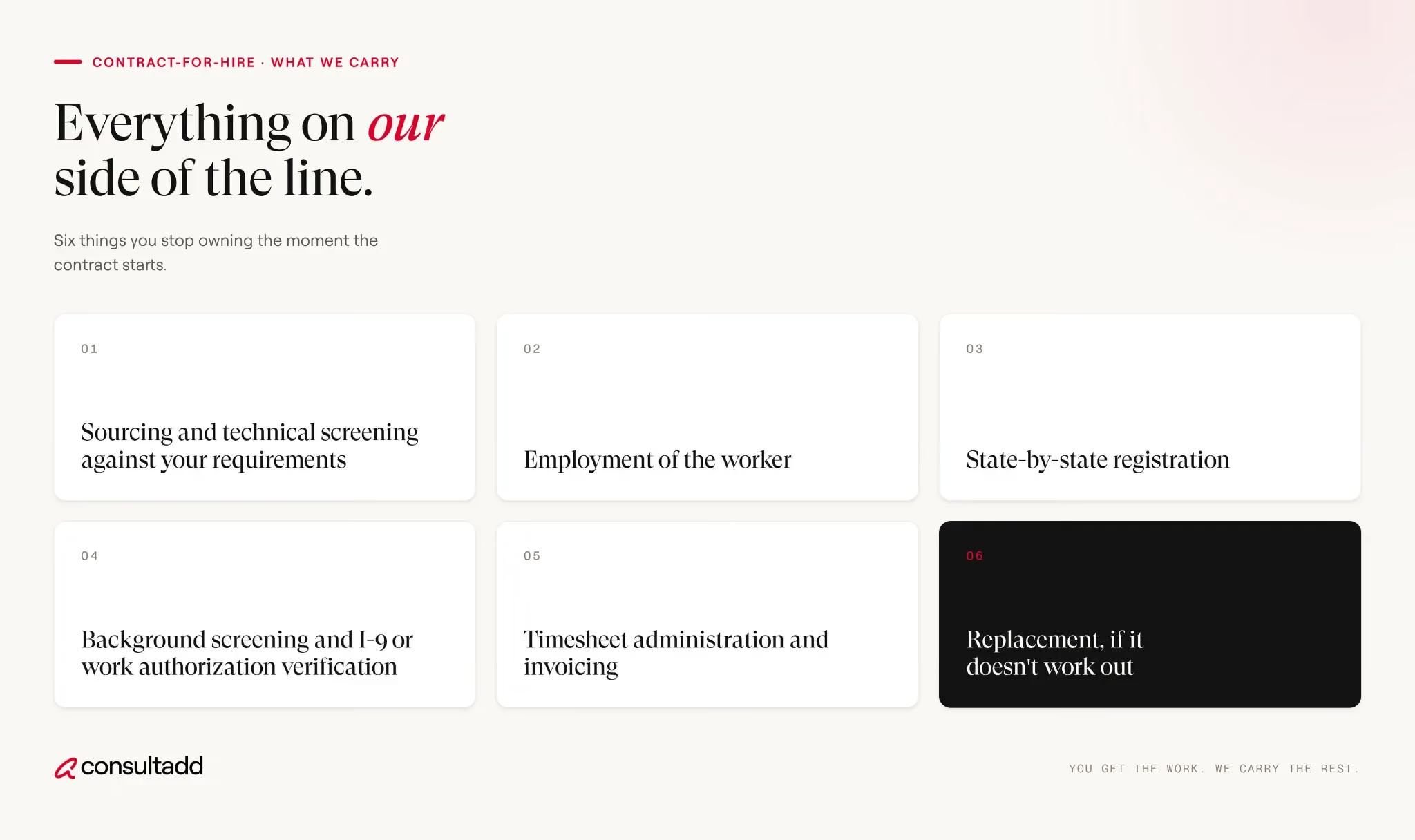
The label gets used loosely, so here's the practical scope. A remote IT staffing engagement usually includes:
- Sourcing and technical screening against your requirements
- Employment of the worker, meaning the agency holds the W-2 and runs payroll
- State-by-state registration, withholding, unemployment insurance, and workers' compensation wherever the person sits
- Background screening and I-9 or work authorization verification
- Timesheet administration and invoicing
- Replacement if a placement doesn't work out, usually within a defined window
What it typically does not include: managing the work. You still own the tickets, the code review, the standups, and the outcome.
If you want a vendor to own delivery rather than headcount, you're looking at managed services, which is a different purchase.
Consultadd's breakdown of IT staffing service models sorts those categories out.
What the conflicting data means for you
Robert Half analyzes the share of postings across its professional categories. FlexJobs indexes volume on a board built for remote and flexible roles.
So one measures remote as a percentage of everything, the other measures remote demand in isolation. A shrinking share and a growing count can coexist.
The detail is more useful than either headline: in technology specifically, Robert Half found 85% of postings fully on-site, 11% hybrid, and 4% fully remote.
Tech is barely more remote-friendly than legal or finance in advertised roles. And 36% of employers said they had increased required on-site days over the past year.
That cuts against the assumption that remote is a free recruiting lever. It also means the lever still has force where it exists, since 46% of professionals were looking or planning to look for a new role in the second half of 2026, and 39% of those cited more remote flexibility as a primary motivation.
Two more patterns worth planning around:
- Flexibility scales with seniority: senior-level postings ran 12% hybrid and 4% remote, mid-level 10% and 3%, entry-level 8% and 2%. Remote entry-level tech hiring is genuinely scarce.
- Demand for the underlying skills isn't in question. BLS projects about 280,000 openings a year on average in computer and information technology occupations, with a median wage of $109,470 in May 2025, and information security analyst employment is projected to grow 21% from 2025 to 2035.
Engagement models compared
Most buyers pick a vendor first and a model second. Do it the other way round.
Contract-to-hire has quietly become the default for a lot of senior remote work, because it lets both sides test a distributed working relationship before committing.
The contract-to-hire model explained covers how conversion fees and timing actually work.
The compliance load you're handing over
This is the part that rarely makes it into a sales deck, and it's the strongest argument for using a staffing partner rather than hiring remotely yourself.
Payroll tax nexus does not work like sales tax nexus. There's no revenue threshold to cross.
The moment someone performs work in a state, employer obligations generally attach in that state, regardless of where your headquarters sits.
Layer on the convenience-of-the-employer rules that a handful of states, including New York, apply. Under those, an employee working from home in another state for their own convenience can still have wages taxed by the employer's state.
Documenting that remote work is a business requirement rather than an accommodation matters if you're in that situation.
State agencies cross-reference new hire reporting data to find employers who should be registered and aren't. This is not a theoretical exposure.
When an agency employs the worker, that entire stack sits with the agency. That is most of what you're paying for.
None of the above is tax or legal advice. Run your specific footprint past a qualified advisor.
What it costs, and the mistake most buyers make

The number a staffing partner quotes is a bill rate, usually hourly. It is not a markup on a salary figure.
A bill rate bundles the worker's pay, employer payroll taxes, unemployment insurance, workers' compensation, any benefits the agency provides, insurance, and the agency's margin.
Comparing a $95 hourly bill rate against a $150,000 base salary is comparing a loaded cost against an unloaded one, and it makes staffing look more expensive than it is.
Better comparisons to run:
- Bill rate against fully loaded internal cost, including benefits, payroll taxes, and your share of recruiting and onboarding time.
- Cost of an unfilled seat against the premium. A senior engineering req open for three months has a real number attached to it.
- Cost of a wrong permanent hire against a contract-to-hire trial.
Ask for the bill rate breakdown. A partner who won't show you what sits inside it is a partner who is hard to hold accountable.
The buyer's guide to IT contract staffing goes deeper on rate structures.
When remote staffing is the wrong answer
Being honest about the limits:
- Work that needs physical access. Data center, lab, hardware, and some regulated environments don't go remote regardless of preference.
- Roles with heavy real-time collaboration across wide time zones. A four-hour overlap window can work. A two-hour one usually doesn't for pairing-intensive work.
- Entry-level hiring you intend to develop. The postings data shows how thin remote junior hiring is, and mentorship is harder to deliver at distance.
- Teams without written process. Distributed work exposes weak documentation immediately. If decisions live in hallway conversations, adding remote contractors will surface that fast.
Any vendor who tells you remote works everywhere is selling, not advising.
How to evaluate a remote IT staffing partner
Questions that separate serious partners from resellers.
If work authorization is part of your picture, note that job title, duties, and worksite have to stay consistent across immigration filings and the actual role.
Consultadd's H1B sponsorship guide explains why consistency matters more than people expect, particularly for remote placements where the worksite question gets complicated.
For a wider view of how the market is moving, the IT staffing trends breakdown covers where demand is concentrating.
Where to start
Remote IT staffing services are worth buying when two things are true:
You need skills that aren't available locally, and you don't want to stand up employer infrastructure in every state your team happens to live in. The second point is the one that gets underestimated.
Decide the engagement model first, then price it against a fully loaded internal cost rather than a base salary, then interrogate the compliance answers.
A partner who can name the states they're registered in and show you inside the bill rate is usually the one who will still be easy to work with in month nine.
Start Strong With Consultadd
With 15 years in business and 5,000+ successful staffing engagements, we don't just fill roles, we build reliability into your process. We've supported 65 staffing companies in the past year alone and maintain MSAs with industry leaders like Robert Half and TEKsystems.
Here's what working with Consultadd looks like:
- Talent sourced in under 24 hours
- Ready-to-deploy candidates, vetted for experience and compliance
- Lower turnover risk: we match long-term goals, not just short-term needs
- Seamless compliance: visa, documentation, onboarding? Handled.
- Dedicated 1:1 account managers for responsive, personalized support
- Top 100 candidate matches delivered in the past year
- Strong partnerships with universities to tap into fresh, committed talent
- Post-placement support so your investment grows beyond day one
For candidates, your next opportunity is more than just a job title, it's a chance to build skills, gain experience, and move your career forward. At Consultadd, we connect technology professionals with projects and employers that align with their goals, whether they're looking for contract, contract-to-hire, or long-term opportunities.
The tech job market moves fast, but the right guidance can make all the difference. Ready to take the next step in your career journey? Explore Opportunities >>
Key takeaways
- Remote postings are a small share of all tech hiring, around 4% fully remote in Robert Half's Q2 2026 technology data, but demand within the remote segment grew sharply in the same period.
- What you're primarily outsourcing is multi-state employment compliance, which attaches with the first hour of work in a new state and has no dollar threshold.
- Contract, contract-to-hire, staff augmentation, and direct hire differ on who employs the worker and where the risk sits. Choose the model before the vendor.
- Compare bill rates to fully loaded internal cost, never to base salary, and ask for the rate breakdown in writing.
- Remote is a poor fit for physical-access work, wide time zone splits, and entry-level development roles. A partner who admits that is more useful than one who doesn't.
FAQs
What are remote IT staffing services?
They are arrangements where a staffing agency sources, employs, and payrolls technology professionals who work remotely for a client company. The agency holds the W-2 and carries state registration, withholding, unemployment insurance, and workers' compensation obligations. The client directs the work.
How is this different from outsourcing?
Staffing gives you people who work inside your team and under your direction, while you keep ownership of the output. Outsourcing or managed services hands a defined scope of work to a vendor who owns delivery. The distinction determines who is accountable when something ships late.
Does hiring one remote employee create tax obligations in their state?
Generally yes. Payroll tax nexus typically attaches as soon as work is performed in a state, with no revenue threshold, and can trigger employer registration, income tax withholding, unemployment insurance, and workers' compensation there. Confirm your specific situation with a tax advisor.
How fast can a remote IT role be filled?
For common skill sets with an active bench, first submittals often come within days. For scarce specialties like ML engineering or cloud security, expect longer, and expect the bill rate to reflect scarcity. Ask any prospective partner for their average time to first qualified submittal by role type.
Is remote staffing cheaper than hiring directly?
Not always, and the comparison is frequently done wrong. Bill rates include employment taxes, insurance, and margin that a base salary figure excludes. Remote staffing usually wins on speed, flexibility, and avoided compliance overhead rather than on raw hourly cost.
Can remote contractors convert to permanent employees?
Yes, that's the contract-to-hire model. The client typically pays a conversion fee, or the fee drops to zero after the worker has billed a set number of hours. Get the fee schedule in writing before the engagement starts rather than negotiating it later.

What Is IT Staffing Services? Models & How It Works
Introduction
Staff augmentation. Managed services. Direct hire. RPO. Contract-to-hire. If you've shopped for IT talent lately, you've heard these terms used almost interchangeably, often by people trying to sell you one of them. They are not the same thing, and the differences decide who manages the work, who owns the result, and where the risk sits.
That's the thing to understand first about IT staffing services: it's not one service. It's a category. IT staffing services are the range of ways a specialized agency helps a company find, hire, and deploy technology talent, from placing a single permanent engineer to running an entire outsourced function.
This guide maps the whole category. It covers what IT staffing actually includes, the main delivery models and how they differ, and a simple way to pick the model that fits your situation instead of the one a vendor happens to sell.
TL;DR
- IT staffing services are the range of ways an agency helps companies find, hire, and deploy technology talent, not a single offering.
- The main models are direct hire, contract, contract-to-hire, staff augmentation, managed services, and RPO.
- The key difference between models is control and ownership: with augmentation you manage the people and own the outcome; with managed services the provider does.
- The right model depends on how long you need the talent, how scarce the skills are, your hiring urgency, and how much control you want.
- Most companies now blend several models, using a permanent core team plus flexible talent for projects and specialized needs.
What is IT staffing services?
IT staffing services are the professional services a staffing agency provides to help a company meet its technology talent needs. That can mean sourcing and screening candidates, placing them, employing them, or in some cases managing an entire team or function on the client's behalf.
The scope has grown well beyond filling vacancies. Modern IT staffing covers capability planning, pipeline design, deployment timing, and aligning talent to program outcomes. Increasingly, companies treat staffing as a delivery mechanism rather than a simple HR activity.
The demand behind it is easy to explain. Technology touches every industry now, and the computer and IT occupations tracked by the Bureau of Labor Statistics continue to grow faster than the available talent pool.
When qualified engineers, cloud architects, and data scientists are hard to find and slow to hire, specialized staffing partners become the practical way to close the gap.
So the honest one-line answer is that: IT staffing services are how companies get the right technology people in place, through whichever model fits the need.
What IT staffing services actually cover
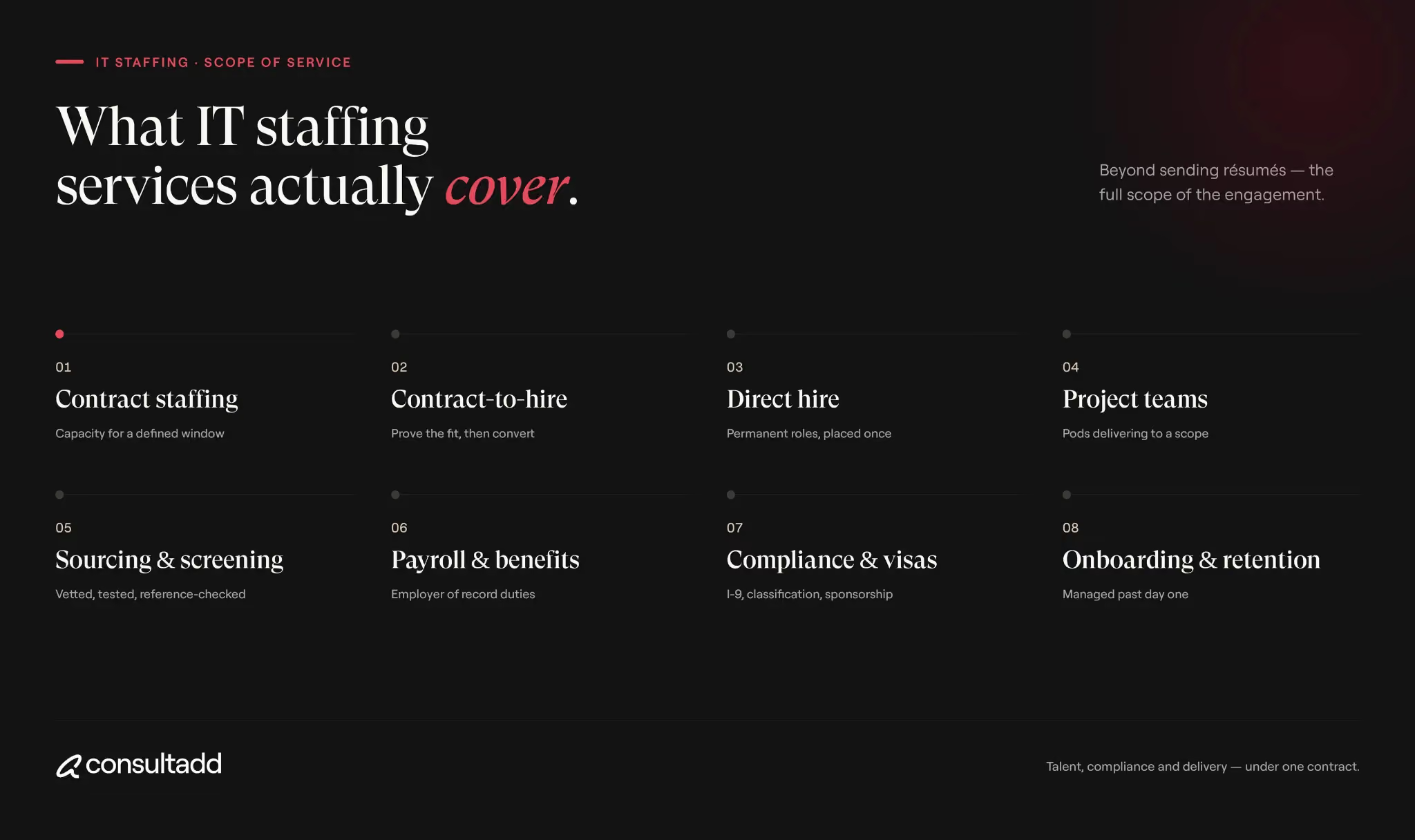
Before the models, it helps to know the ground they cover. IT staffing spans the full range of technology roles and the full lifecycle of getting someone productive.
On roles, staffing agencies place software developers, cloud engineers, cybersecurity specialists, data scientists, DevOps engineers, data analysts, and the AI and machine learning specialists in heavy demand right now.
Some focus on specific platforms, placing proven experts in ecosystems like AWS, ServiceNow, or Atlassian rather than generalists.
On the lifecycle, a good partner handles sourcing, technical screening, and placement, and depending on the model may also carry payroll, compliance, and ongoing management.
That vetting piece matters more than people assume, because a computer science degree doesn't guarantee ability.
Consultadd's guide to the candidate vetting process shows how rigorous screening keeps quality high.
The main types of IT staffing models
This is where the category splits, and where the terms stop being interchangeable. Here are the main IT staffing models and what separates them.
A few of these deserve a closer look.
Direct hire is the classic model:
- The agency finds and screens candidates, and you hire the winner as your own full-time employee, usually paying a placement fee of 15% to 25% of first-year salary.
- It suits the core roles you want to own long term.
Consultadd's technical recruitment guide covers how to get these hires right.
Contract and contract-to-hire:
- They cover temporary and trial-to-permanent needs, where the agency employs the worker and you get the output.
- The trial approach improves selection accuracy, since you evaluate someone on real work before committing.
Consultadd's breakdown of the contract-to-hire model goes deeper on when that pays off.
RPO:
- Recruitment process outsourcing, hands part or all of your recruiting to a specialist partner.
- It's built for structured scale hiring across multiple functions at once, which is where high-volume hiring strategies come into play.
That leaves two models that get confused constantly, which is worth its own section.
Staff augmentation vs managed services
These two get sold interchangeably, but they sit at opposite ends of the control spectrum. Getting the distinction right saves a lot of pain.
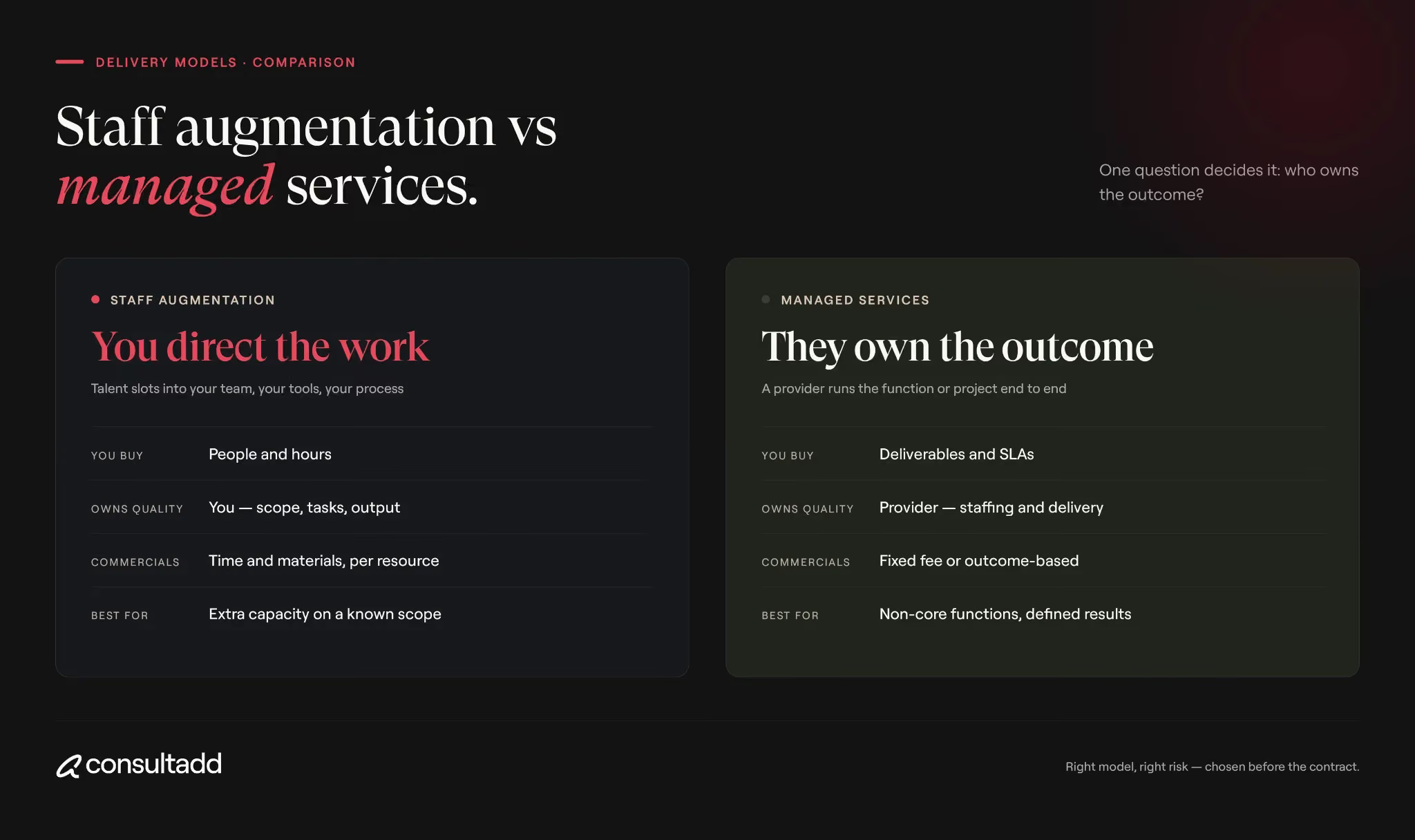
With staff augmentation, you add external professionals to your existing team. They become an extension of your internal staff, following your workflows and processes, and you supervise their day-to-day work.
The key phrase: you manage the people and you own the outcome. It's ideal when a specific skill gap threatens a deadline, or when you want to boost delivery velocity without restructuring.
With managed services, you hand a whole function or project to a provider who takes responsibility for delivering it.
The provider manages the people, owns the outcome, and is held to service level agreements and performance metrics. You trade direct control for risk mitigation.
Neither is better in the abstract. Augmentation fits when maintaining control and internal culture matters, like during a cloud migration or a critical sprint. Managed services fit when you'd rather offload an area entirely and pay for a result.
How to choose the right IT staffing model
With the models clear, the choice comes down to your situation. A few questions point you to the right fit: How long do you need the talent? How scarce are the skills? How urgent is the hire? And how much control do you want to keep?
In practice, most companies don't pick just one. The strongest 2026 approach is a hybrid: a stable core of permanent employees, supplemented by augmentation for projects, contract talent for short-term needs, and managed services where it makes sense to offload. Staffing becomes a portfolio, not a single choice.
Onshore, nearshore, offshore: a sourcing choice
One common source of confusion is worth clearing up. Onshore, nearshore, and offshore are not separate staffing models. They're sourcing strategies that sit inside the models above.
- You can hire a direct-hire engineer onshore, augment your team with nearshore developers, or run a managed service offshore.
- Nearshore tends to work best when daily collaboration and overlapping time zones matter.
- Offshore can widen the talent pool and reduce cost when the work is more independent.
The point is to choose the model first, based on control and ownership, then decide where the talent should sit. Leading with geography alone tends to produce mismatches.
How an IT staffing partner helps
Whichever model you land on, a good IT staffing partner earns its place by compressing the slowest, riskiest parts of getting talent in place.
A specialized partner works from a pre-vetted talent pool, so sourcing and technical screening that would take your team weeks gets handled quickly. You review a short list of qualified people instead of sifting hundreds of resumes.
The partner also absorbs the parts that trip companies up: technical vetting, payroll and compliance where the model calls for it, and knowing which delivery model actually fits your workload.
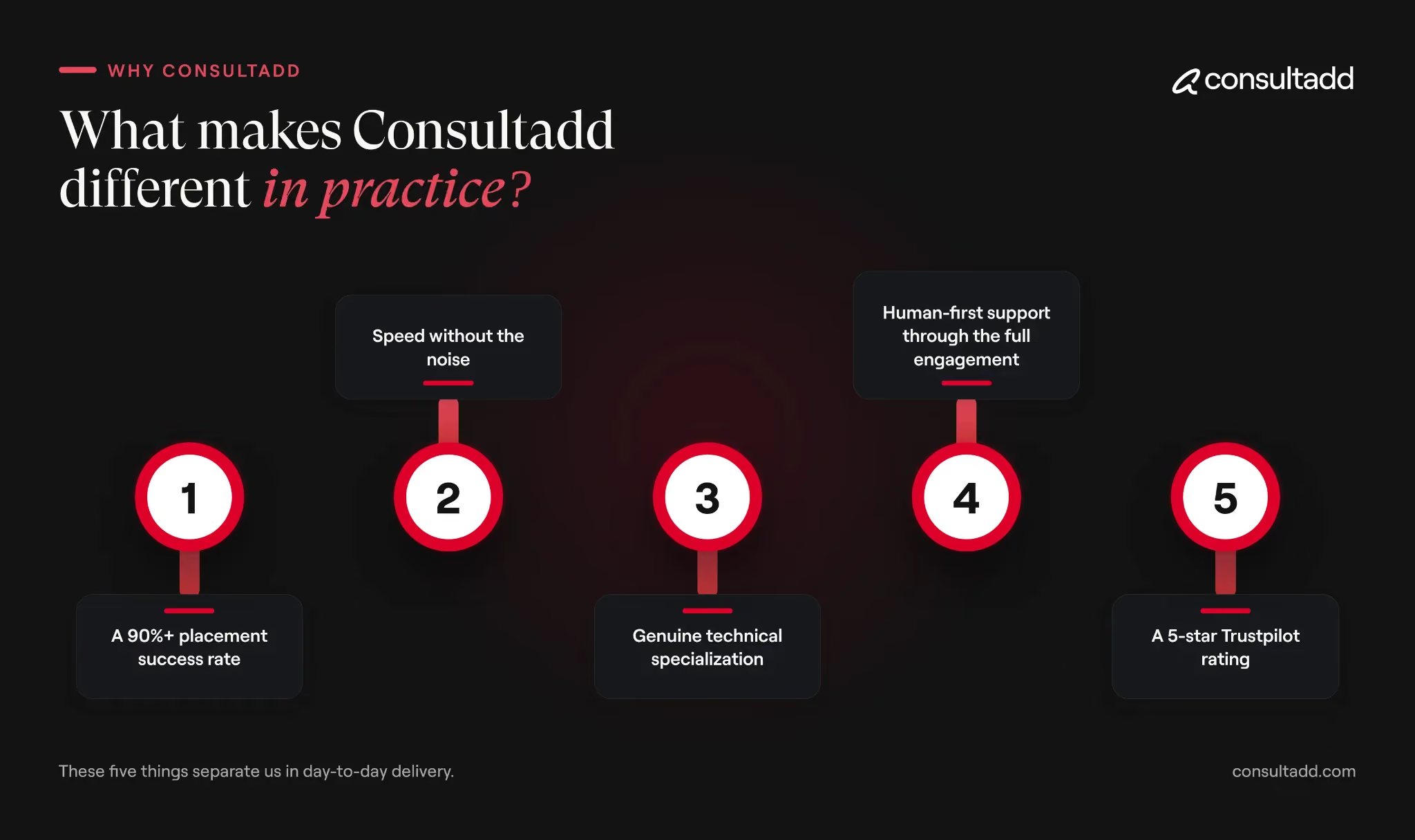
The best partners tie staffing to your workload and outcomes rather than treating it as headcount replacement. They ask what you're trying to deliver, then recommend the model, not the other way around.
That's the real answer to what IT staffing services are. Not a single product to buy, but a set of models to match to your need, with a partner who helps you choose well and move fast.
Start Strong With Consultadd
With 15 years in business and 5,000+ successful staffing engagements, we don't just fill roles, we build reliability into your process. We've supported 65 staffing companies in the past year alone and maintain MSAs with industry leaders like Robert Half and TEKsystems.
Here's what working with Consultadd looks like:
- Talent sourced in under 24 hours
- Ready-to-deploy candidates, vetted for experience and compliance
- Lower turnover risk: we match long-term goals, not just short-term needs
- Seamless compliance: visa, documentation, onboarding? Handled.
- Dedicated 1:1 account managers for responsive, personalized support
- Top 100 candidate matches delivered in the past year
- Strong partnerships with universities to tap into fresh, committed talent
- Post-placement support so your investment grows beyond day one
For candidates, your next opportunity is more than just a job title, it's a chance to build skills, gain experience, and move your career forward. At Consultadd, we connect technology professionals with projects and employers that align with their goals, whether they're looking for contract, contract-to-hire, or long-term opportunities.
The tech job market moves fast, but the right guidance can make all the difference. Ready to take the next step in your career journey? Explore Opportunities >>
Key takeaways
- IT staffing services are a category, not a single offering, spanning several ways to find, hire, and deploy tech talent.
- The main models are direct hire, contract, contract-to-hire, staff augmentation, managed services, and RPO.
- The defining difference is control: with staff augmentation you manage the people and own the outcome, while managed services shift both to the provider.
- The right model depends on duration, skill scarcity, urgency, and how much control you want to keep.
- Most companies blend models into a hybrid workforce, and geography is a sourcing choice made after the model, not instead of it.
FAQs
What is IT staffing services in simple terms?
IT staffing services are the ways a specialized agency helps a company find, hire, and deploy technology talent. That ranges from placing a single permanent engineer to supplying contract teams or managing a whole function. It's a category of services, not one product, so the right fit depends on your specific need.
What is the difference between IT staffing and IT outsourcing?
With most IT staffing, you direct the talent and own the outcome, whether they're permanent hires or augmented team members. With outsourcing, often delivered as managed services, the provider takes over a function, manages the people, and owns the result under agreed service levels. Staffing keeps control with you, while outsourcing shifts it to the provider.
What are the main types of IT staffing?
The common models are direct hire (permanent placement), contract, contract-to-hire, staff augmentation, managed services, and recruitment process outsourcing. Each suits a different combination of timeline, control, and ownership. Many organizations use several at once across their engineering, cloud, data, and security teams.
What is the difference between staff augmentation and managed services?
Staff augmentation adds external experts to your team, and you manage them and own the outcome. Managed services hand a whole function or project to a provider who manages the people and owns the result against service level agreements. Augmentation keeps control with you, while managed services trade control for offloaded responsibility.
What roles do IT staffing services cover?
They cover the full range of technology roles, including software developers, cloud engineers, cybersecurity specialists, data scientists, DevOps engineers, data analysts, and AI and machine learning experts. Some agencies specialize further, placing proven experts in specific platforms and ecosystems rather than generalists.
How do I choose the right IT staffing model?
Start with four questions: how long you need the talent, how scarce the skills are, how urgent the hire is, and how much control you want. Long-term core roles suit direct hire, projects suit contract or augmentation, and offloading a whole function suits managed services. A good staffing partner can recommend the fit based on your goals.